The root
NCERT Class 11 Biology Chapter 5 Section 5.1
Quick answer
Roots absorb water and minerals, anchor the plant, store reserves and make growth regulators; they are usually underground, but position alone does not identify a root. A tap root system has a primary root with laterals, while many similar stem-borne roots form the typical fibrous system; adventitious describes origin from stems or leaves. The root tip has a cap, meristematic region, elongation region and maturation region with root hairs.
With your textbook
NCERT Biology (Class 11), Chapter 5 “Morphology of Flowering Plants”, Section 5.1 “The Root”, pages 57–59.
Open the official NCERT chapter (PDF, 3.4 MB, ncert.nic.in) (opens in a new tab)
Checked against the 2026-27 reprint on .
What is the root?
The root
The main functions of the root system are absorption of water and minerals from the soil, providing a proper anchorage to the plant parts, storing reserve food material and synthesis of plant growth regulators.
NCERT Biology (Class 11), Section 5.1, page 58
- In the typical plant illustrated by NCERT, roots are underground and shoots above ground (page 57). Position alone does not identify an organ: aerial roots and underground stems also occur.
- NCERT describes tap roots, fibrous roots and adventitious roots; these categories describe form and origin and are not mutually exclusive.
- At the root tip, NCERT describes the root cap and, above it, the regions of meristematic activity, elongation and maturation.
In plain words: the root is the part of the plant axis that usually grows down into the soil. It holds the plant in place, takes in water and minerals, can store food, and makes some of the plant’s growth regulators. How the roots are arranged depends on whether the first root, from the radicle of the seed, lasts or is replaced. Roots changed for storage, support or breathing are on the page on modifications of the root.
Tap, fibrous and adventitious roots
- Tap root system: in most dicotyledonous plants the radicle elongates directly into the primary root, which grows into the soil and bears lateral roots of several orders, called secondary, tertiary and so on. The primary root and its branches form the tap root system, as in mustard (pages 57–58).
- Fibrous root system: in monocotyledonous plants the primary root is short-lived and is replaced by a large number of roots that arise from the base of the stem, as in wheat (page 58).
- Adventitious roots: in some plants, such as grass, Monstera and the banyan tree, roots arise from parts of the plant other than the radicle (page 58).
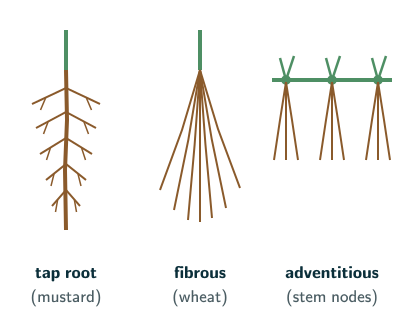
Beyond the NCERT text: tap and fibrous describe the form of a root system; adventitious describes where a root comes from. The primary root develops directly from the radicle; lateral roots branch from existing roots. Stem-borne roots in a fibrous system are adventitious in origin, which is why NCERT can list grass as adventitious and wheat, itself a grass, as fibrous. Many similarly sized roots from the stem base characterise the wheat example; stem origin alone does not mean fibrous, since maize stilt roots also arise from the stem.
Regions of the root
From the tip upwards, NCERT describes the root cap and three regions above it (page 59):
- Root cap: a thimble-like structure covering the apex.
- Region of meristematic activity: NCERT places it a few millimetres above the root cap. Its cells are very small, thin-walled and full of dense protoplasm, and they divide repeatedly. Beyond the NCERT text: the meristem starts right behind the cap, which partly covers it, as NCERT’s own Figure 5.3 draws it.
- Region of elongation: the cells just above the meristematic region elongate and enlarge rapidly; this region is responsible for the growth of the root in length.
- Region of maturation: above the region of elongation, the cells gradually differentiate and mature. Some of its epidermal cells form very fine, delicate, thread-like root hairs.
On the root cap, NCERT says:
It protects the tender apex of the root as it makes its way through the soil.
NCERT Biology (Class 11), Section 5.1.1, page 59
These root hairs absorb water and minerals from the soil.
NCERT Biology (Class 11), Section 5.1.1, page 59
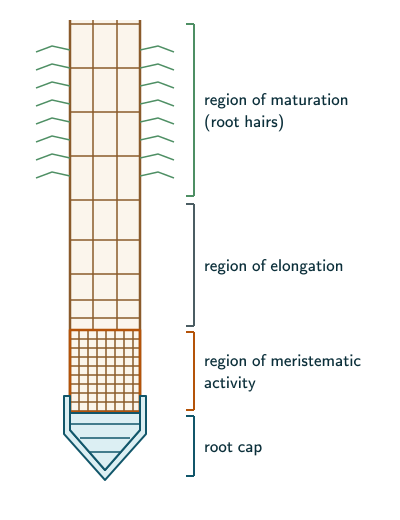
Beyond NCERT Section 5.1: NCERT’s chapter on plant growth (Section 13.1.4, page 170) gives a root elongating at a constant rate as the simplest example of arithmetic growth. After each division only one daughter cell keeps dividing while the other matures, so at equal time steps the length Lt = L0 + rt forms an arithmetic progression. If both daughters kept dividing, the count would double each round, 1, 2, 4, 8, …, a geometric progression with common ratio 2.
Solved examples
Example 1: Which root system?
A wheat plant develops many similarly sized roots from the base of its stem, with no single dominant main root. What is this root system called?
Answer: a fibrous root system, typical of monocotyledonous plants such as wheat (NCERT page 58).
Example 2: Adventitious or not?
The banyan tree has roots growing down from its branches. Why are these called adventitious roots?
Answer: because they arise from a part of the plant other than the radicle (NCERT page 58). Beyond the NCERT text: these prop roots grow from the branches into the soil and hold the branches up.
Example 3: Growth in length
Which region of the root tip is responsible for the growth of the root in length, and what do its cells do?
Answer: the region of elongation; its cells undergo rapid elongation and enlargement (NCERT page 59).
Example 4: Putting the regions in order
Arrange the regions of the root tip from the apex upwards.
Answer: root cap, region of meristematic activity, region of elongation, region of maturation (NCERT page 59).
Example 5: Where root hairs form
In which region do root hairs form, and from which cells?
Answer: in the region of maturation, from some of the epidermal cells (NCERT page 59).
Example 6: Four jobs of the root
List the main functions of the root system.
Answer: absorption of water and minerals from the soil, anchorage of the plant parts, storage of reserve food, and synthesis of plant growth regulators (NCERT page 58).
Common mistakes to avoid
Common mistake
Calling every root that is not a tap root fibrous
Fibrous is a form, adventitious an origin. Banyan and Monstera roots are adventitious without making a fibrous system, and a monocot’s fibrous roots are themselves adventitious in origin.
Common mistake
Putting the meristematic region at the very tip
The very tip is the root cap; the region of meristematic activity lies behind it.
Common mistake
Saying root hairs form in the region of elongation
Root hairs form in the region of maturation, from epidermal cells.
Common mistake
Saying all dicot roots are tap roots
NCERT says the tap root system occurs in the majority of dicotyledonous plants, not in all.
Quick revision summary
- Root functions: absorption of water and minerals, anchorage, storage of reserve food, synthesis of plant growth regulators.
- Tap root: the radicle elongates into a primary root with laterals (most dicots; mustard).
- Fibrous roots: many roots from the stem base replace the short-lived primary root (monocots; wheat).
- Adventitious roots: from parts other than the radicle (grass, Monstera, banyan).
- Root tip, from the apex: root cap, meristematic region (small, dividing cells), elongation region, maturation region with root hairs.
Formula sheet
- tap root: radicle → primary root + laterals (most dicots)
- fibrous: many roots from the stem base (monocots)
- adventitious: roots from parts other than the radicle
- root tip: cap → meristematic → elongation → maturation
- root hairs: from epidermal cells of the maturation region
Questions students ask
What is the difference between a tap root and a fibrous root?
A tap root system has one main root, the primary root, formed by direct elongation of the radicle and bearing lateral roots of several orders, as in mustard, while a fibrous root system has a large number of roots arising from the base of the stem, because the primary root is short-lived, as in wheat (NCERT pages 57–58). Tap roots occur in the majority of dicotyledonous plants and fibrous roots in monocotyledonous plants. In a tap root system one root remains the main axis; in a fibrous system the many roots are much alike and none is the main one.
What is the difference between a tap root and an adventitious root?
The primary tap root develops directly from the radicle, while an adventitious root develops from a stem or leaf, as in NCERT’s stem-node examples (pages 57–58). A lateral root branching from another root belongs to that root system and is not classified as adventitious merely because it did not arise directly from the radicle. So the two differ in where the root comes from, not in its shape or job: the stilt roots that grow from the lower nodes of a maize stem are adventitious, while the swollen food-storing root of a carrot is a tap root.
How many types of roots are there?
NCERT describes three types of roots: tap roots, which develop from the radicle (most dicotyledons), fibrous roots, which arise in large numbers from the base of the stem (monocotyledons), and adventitious roots, which arise from parts of the plant other than the radicle (NCERT Section 5.1). Storage roots, prop and stilt roots and pneumatophores are not further types but roots modified for storage of food, mechanical support or respiration (NCERT Summary, page 69).
Is Morphology of Flowering Plants in the NEET 2026 syllabus?
Yes, Morphology of Flowering Plants is covered by Unit 2 of the NEET (UG) 2026 Biology syllabus, Structural Organisation in Animals and Plants, which lists ‘Morphology and modifications’, the ‘Anatomy and functions of different parts of flowering plants: Root, stem, leaf, inflorescence - cymose and recemose, flower, fruit and seed’ and ‘Family (malvaceae, Cruciferae, leguminoceae, compositae, graminae)’. The root, stem, leaf, inflorescence, flower, fruit and seed are in Chapter 5 of the 2026–27 NCERT Class 11 book, but the modifications of root, stem and leaf and those five families are not described in the current NCERT text.
Practice questions
Try each question first, then open the answer to check your working.
-
Q1. What is the function of the root cap?
Show answerHide answer
It protects the tender apex of the root as it makes its way through the soil (NCERT page 59).
-
Q2. Describe the cells of the region of meristematic activity.
Show answerHide answer
They are very small, thin-walled and with dense protoplasm, and they divide repeatedly (NCERT page 59).
-
Q3. Name the plant NCERT gives as an example of a tap root system and of a fibrous root system.
Show answerHide answer
Mustard (tap root) and wheat (fibrous root) (NCERT page 58).
-
Q4. What are secondary and tertiary roots?
Show answerHide answer
Secondary roots branch from the primary root, and tertiary roots from the secondary roots (NCERT page 57).