Modifications of stem
Beyond NCERT In the NEET syllabus; the Class 11 book has no section for it.
Quick answer
Stems are modified for storage, support, protection and vegetative propagation. Underground stems such as the potato tuber, ginger rhizome and zaminkand corm store food; stem tendrils of gourds and protective thorns grow from axillary buds, and the flattened green stems of desert plants photosynthesise. Runners, stolons, offsets and suckers are spreading lateral stems that give rise to new plants.
How stems are modified
Modifications of stem
Some stems perform the function of storage of food, support, protection and of vegetative propagation.
NCERT Biology (Class 11), Section 5.2, page 59
Standard examples (beyond the 2026–27 NCERT text):
- Storage: underground stems such as the potato tuber, the rhizomes of ginger and turmeric, and the corms of zaminkand and Colocasia.
- Support and protection: stem tendrils (cucumber, grapevine) and thorns (Citrus, Bougainvillea).
- Food-making in dry places: flattened or fleshy green stems (Opuntia, Euphorbia).
- Vegetative propagation: runners, stolons, offsets and suckers.
The 2026–27 NCERT chapter lists these stem functions but no longer describes the modified stems, while the NEET (UG) 2026 syllabus lists “Morphology and modifications” in Unit 2. Apart from the cited NCERT lines, everything on this page is beyond the 2026–27 NCERT text.
In plain words: a modified stem can look nothing like a stem, but it still gives itself away, either by a stem’s marks, nodes and internodes (NCERT Summary, page 69) with buds (page 59), or by its position. A potato’s “eyes” are nodes with buds; the position and development of a tendril or thorn help establish its shoot origin; not every stem tendril lies in a leaf axil.
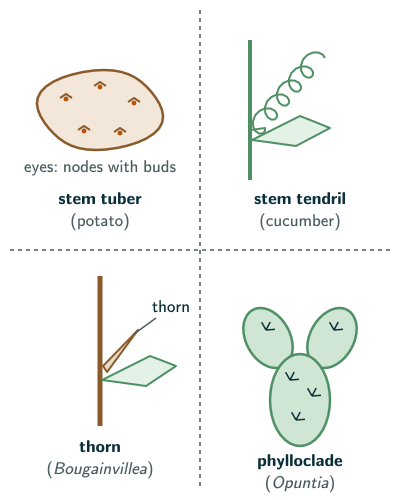
Underground stems for storage
NCERT itself describes the potato as an “underground stem” (page 68). Underground stems such as the potato, ginger, turmeric, zaminkand and Colocasia store food. They also act as organs of perennation, carrying the plant through conditions unfavourable for growth (beyond the 2026–27 NCERT text).
- Tuber: the swollen tip of an underground stem, as in the potato; its eyes are nodes bearing buds.
- Rhizome: a horizontal underground stem with nodes, scale leaves and buds, as in ginger and turmeric.
- Corm: a short, swollen, upright underground stem, as in zaminkand and Colocasia.
Stem tendrils and thorns
Older NCERT describes stem tendrils and thorns as axillary-bud modifications. This fits its gourd/thorn examples, but should not be imposed on every climbing plant: grapevine tendrils occur opposite leaves, as documented by the University of Texas botanical teaching collection. Their position differs even though they are shoot-derived (beyond the 2026–27 NCERT text).
- Stem tendrils: slender, spirally coiled structures that help plants climb, as in gourds (cucumber, pumpkin, watermelon) and grapevines.
- Thorns: woody, straight and pointed, as in Citrus and Bougainvillea; they protect the plant from browsing animals.
Beyond the NCERT Biology text: once its tip has caught a support, a tendril coils up and works like a spring. When wind tugs the stem, the coil stretches and pulls back instead of snapping or tearing loose. An ordinary spring obeys Hooke’s law for small stretches; a tendril coil is only roughly like this, and it grows stiffer as it is pulled further.
Phylloclades
Some plants of arid regions modify their stems into flattened green structures, as in Opuntia, or fleshy cylindrical ones, as in Euphorbia. These stems contain chlorophyll and carry out photosynthesis, taking over the leaves’ job; in Opuntia the leaves are reduced to spines. A modified green shoot specialised for photosynthesis, whether flattened and leaf-like (Opuntia) or fleshy and cylindrical in the textbook Euphorbia example, is called a phylloclade (beyond the 2026–27 NCERT text).
Runners, stolons, offsets and suckers
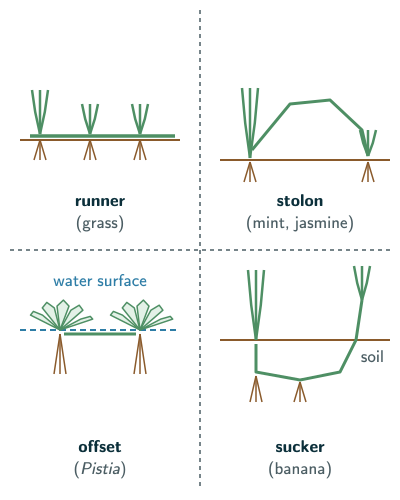
These lateral stems spread the plant and give rise to new plants, a form of vegetative propagation (beyond the 2026–27 NCERT text):
- Runner: a stem that creeps along the ground and roots at its nodes, as in grass and strawberry; when older parts die, the rooted parts live on as new plants.
- Stolon: a slender lateral branch from the base of the main axis that grows in the air for a while and then arches down to touch the ground, as in mint and jasmine.
- Offset: a lateral branch with short internodes, each node bearing a rosette of leaves and a tuft of roots, in aquatic plants such as Pistia and Eichhornia.
- Sucker: a lateral branch that arises from the basal, underground part of the main stem, grows horizontally under the soil and then comes up obliquely as a leafy shoot, as in banana, pineapple and Chrysanthemum.
Solved examples
Example 1: Why is a potato a stem?
The potato grows underground. Why is it a stem and not a root?
Answer: NCERT calls it an underground stem (page 68). Its eyes are nodes bearing buds, and nodes with buds mark a stem (NCERT pages 59 and 69; the eyes are beyond the 2026–27 NCERT text).
Example 2: Tendril or thorn?
A cucumber has slender coiled structures; a Bougainvillea has woody pointed ones. Both arise in leaf axils. Name them and their functions.
Answer: stem tendrils in the cucumber, which help it climb; thorns in Bougainvillea, which protect it from browsing animals. Both develop from axillary buds (beyond the 2026–27 NCERT text).
Example 3: A stem that does a leaf’s job
How does Opuntia make food when its leaves are reduced to spines?
Answer: its flattened green stem, the phylloclade, contains chlorophyll and carries out photosynthesis (beyond the 2026–27 NCERT text).
Example 4: Name the propagating stem
Name the modification: (a) mint; (b) Pistia; (c) banana; (d) grass.
Answer: (a) stolon; (b) offset; (c) sucker; (d) runner (beyond the 2026–27 NCERT text).
Example 5: Ginger and turmeric
To which kind of modified stem do ginger and turmeric belong, and how can you tell it is a stem?
Answer: rhizomes. They bear nodes with scale leaves and buds at the nodes; roots have no nodes or leaves (beyond the 2026–27 NCERT text).
Example 6: Linking to NCERT’s list
NCERT lists four extra functions of some stems. Match each with a modification on this page.
Answer: storage of food, underground stems such as the potato; support, stem tendrils; protection, thorns; vegetative propagation, runners, stolons, offsets and suckers (NCERT page 59 for the functions; the matches are beyond the 2026–27 NCERT text).
Common mistakes to avoid
Common mistake
Calling the potato a root
The potato is an underground stem (NCERT page 68); the sweet potato is a root.
Common mistake
Calling *Opuntia* spines modified stems
In Opuntia the flattened green part is the stem; the spines are modified leaves.
Common mistake
Mixing up stolons and suckers
A stolon grows in the air and then arches down to the ground (mint, jasmine); a sucker grows under the soil and then comes up (banana, pineapple).
Common mistake
Calling every sharp point a thorn
A thorn (Bougainvillea, Citrus) is a stem from an axillary bud; a spine (Opuntia) is a leaf; the prickles of a rose are outgrowths of the surface, neither stem nor leaf (beyond the 2026–27 NCERT text). NCERT Class 12 Biology notes that the thorn and tendrils of Bougainvillea and Cucurbita represent homology (Section 6.3, page 115).
Common mistake
Forgetting where tendrils and thorns come from
Identify the organ of origin, not just the function. NCERT’s gourd tendrils and thorns are described as axillary-bud modifications; grapevine tendrils are leaf-opposed, so an axillary position is not a universal test.
Quick revision summary
- NCERT: some stems store food, give support or protection, or help in vegetative propagation (page 59); the potato is an underground stem (page 68).
- Storage and perennation: tuber (potato), rhizome (ginger, turmeric), corm (zaminkand, Colocasia).
- Stem tendrils support climbing (gourds, grapevine); thorns protect (Citrus, Bougainvillea). NCERT describes axillary origin, but grapevine tendrils are opposite leaves.
- Arid regions: phylloclades, flattened (Opuntia) or fleshy and cylindrical (Euphorbia), photosynthesise.
- Propagation: runner (grass, strawberry), stolon (mint, jasmine), offset (Pistia, Eichhornia), sucker (banana, pineapple, Chrysanthemum).
Formula sheet
- underground storage stems: tuber, rhizome, corm (also perennation)
- gourd tendrils and thorns: NCERT axillary-bud examples; grapevine tendrils opposite leaves
- phylloclade: green stem, flattened or cylindrical, that photosynthesises
- runner: creeps on the ground, roots at nodes
- stolon: arches down to the ground; offset: rosette and roots (aquatic)
- sucker: grows under the soil, then obliquely up
Questions students ask
Is modification of stem deleted for NEET 2026?
No, modification of stem is not deleted for NEET (UG) 2026: Unit 2 of its Biology syllabus lists ‘Morphology and modifications’, so underground stems, stem tendrils and thorns, phylloclades and the propagating stems can still be asked. The 2026–27 NCERT Class 11 book no longer describes modified stems, but it still says that ‘Some stems perform the function of storage of food, support, protection and of vegetative propagation’ (NCERT page 59) and calls the potato an underground stem (page 68).
What is the difference between a phylloclade and a cladode?
Phylloclades and cladodes are both green stems that take over photosynthesis from the leaves, and books define the two terms differently. By one common definition, a phylloclade is a flattened or fleshy green stem of several nodes and internodes, as in Opuntia and Euphorbia, while a cladode is a green branch of limited growth, only one or two internodes long, as in Asparagus and Ruscus. Some botanists use the two words interchangeably, so follow your textbook’s usage in an exam (beyond the 2026–27 NCERT text).
What is the difference between a runner and a stolon?
A runner is a stem that creeps along the ground and roots at its nodes, as in grass and strawberry, while a stolon, in the sense used here, is a slender lateral branch from the base of the main axis that grows in the air for a while and then arches down to touch the ground, as in mint and jasmine. Both are lateral stems that give rise to new plants by vegetative propagation. In general botany, stolon and runner are often used as two names for the same creeping stem, so a question that keeps them apart expects the distinction above (beyond the 2026–27 NCERT text).
Practice questions
Try each question first, then open the answer to check your working.
-
Q1. Which four extra functions do some stems perform, according to NCERT?
Show answerHide answer
Storage of food, support, protection and vegetative propagation (NCERT page 59).
-
Q2. Name two plants with stem tendrils.
Show answerHide answer
Any two of cucumber, pumpkin, watermelon and grapevine (beyond the 2026–27 NCERT text).
-
Q3. What is an offset, and in which plants is it found?
Show answerHide answer
A lateral branch with short internodes, each node bearing a rosette of leaves and a tuft of roots, found in aquatic plants such as Pistia and Eichhornia (beyond the 2026–27 NCERT text).
-
Q4. What does perennation mean for an underground stem?
Show answerHide answer
Surviving conditions unfavourable for growth, so that the plant grows again when conditions improve (beyond the 2026–27 NCERT text).