Site of photosynthesis
NCERT Class 11 Biology Chapter 11 Section 11.3
Quick answer
Photosynthesis takes place in the chloroplasts of green leaves and other green parts; mesophyll cells have many chloroplasts, aligned along their walls for the best light. In the chloroplast, the membrane system (grana and stroma lamellae) traps light and makes ATP and NADPH in the light reactions, while enzymes in the stroma use them to make sugar in the dark, or carbon, reactions, which are not directly driven by light but still depend on it.
With your textbook
NCERT Biology (Class 11), Chapter 11 “Photosynthesis in Higher Plants”, Section 11.3 “Where does Photosynthesis take place?”, page 136.
Open the official NCERT chapter (PDF, 2.7 MB, ncert.nic.in) (opens in a new tab)
Checked against the 2026-27 reprint on .
Where photosynthesis takes place
Site of photosynthesis
Photosynthesis takes place in the green leaves of plants, and also in their other green parts. Inside the cells it happens in the chloroplasts, which are plentiful in the mesophyll cells of leaves (NCERT page 136).
There is a clear division of labour within the chloroplast.
NCERT Biology (Class 11), Section 11.3, page 136
In plain words: think of the chloroplast as a factory with two departments. In the membranes (the grana and stroma lamellae), light is caught and its energy is packed into two carriers, ATP and NADPH. In the stroma, enzymes spend those carriers to build sugar from carbon dioxide. Only the membranes use light directly, but the stroma cannot work for long without the ATP and NADPH they make.
Green leaves and other green parts
Leaves are the most important vegetative organs for photosynthesis (NCERT Chapter 5, page 59), but photosynthesis also happens in the other green parts of a plant (page 136). NCERT asks you to name some; Example 1 does.
Mesophyll cells and chloroplasts
- The mesophyll cells of the leaf have a large number of chloroplasts (page 136). In a dicot leaf the mesophyll is made of palisade and spongy parenchyma (see the dorsiventral leaf).
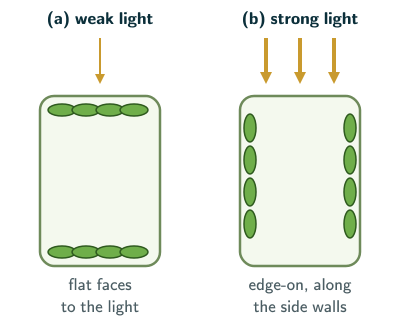
- Usually the chloroplasts align themselves along the walls of the mesophyll cells, so that they get the optimum quantity of incident light (page 136).
- In C plants such as maize and sorghum, the bundle sheath cells around the veins also have a large number of chloroplasts (NCERT Section 11.8, page 145).
NCERT then asks when the chloroplasts lie with their flat surfaces parallel to the walls, and when they are perpendicular to the incident light (page 136). Beyond the NCERT text, chloroplasts move with the light. In weak light they gather along the walls that face the light, the top and bottom walls, with their flat surfaces perpendicular to it, catching as much light as they can. In strong light they move to the side walls, which run parallel to the light, and lie flat against them, edge-on to the light (Hangarter and Gest, Photosynthesis Research, 2004). This cuts the light they absorb and protects them from damage (Kasahara and others, Nature, 2002). So: flat surfaces parallel to the side walls in strong light; perpendicular to the incident light in weak light.
Inside the chloroplast
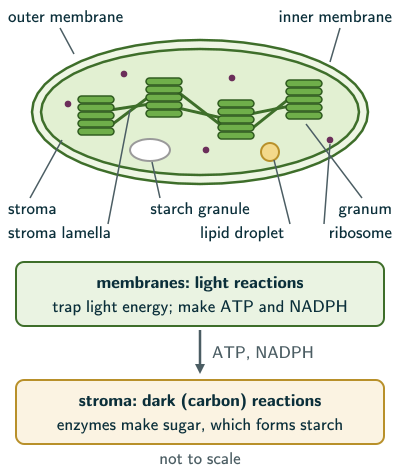
Within the chloroplast there is a membranous system made of the grana and the stroma lamellae, and a matrix, the stroma (NCERT page 136). You met this structure in Chapter 8 (see plastids). The two parts do different jobs (page 136):
- The membrane system traps light energy and synthesises ATP and NADPH.
- In the stroma, enzymatic reactions synthesise sugar, which in turn forms starch.
Light reactions and dark reactions
- The reactions of the membrane system are directly driven by light, so they are called light reactions (photochemical reactions) (page 136). They include light absorption, water splitting, oxygen release and the formation of ATP and NADPH (NCERT Section 11.5, page 138).
- The reactions of the stroma are not directly driven by light, but they depend on the products of the light reactions, ATP and NADPH. By convention they are called dark reactions (carbon reactions) (page 136).
NCERT warns that the name “should not be construed to mean that they occur in darkness or that they are not light-dependent” (page 136). In a plant they run in the light, alongside the light reactions. NCERT Section 11.7 calls them the biosynthetic phase and adds that when light becomes unavailable they continue for some time and then stop; when light returns, they start again (page 142). They stop because their supply of ATP and NADPH runs out and, beyond the NCERT text, because several of their enzymes are activated by light and have low activity in the dark (Michelet and others, Frontiers in Plant Science, 2013).
| Feature | Light reactions | Dark (carbon) reactions |
|---|---|---|
| Where | membranes: grana, stroma lamellae | stroma |
| Driven by | light, directly | ATP and NADPH |
| Products | ATP, NADPH, O | sugar, then starch |
(NCERT pages 136 and 138.)
A point to get exactly right: NCERT says the grana membranes have both PS I and PS II, but the stroma lamellae lack PS II and the enzyme NADP reductase, so they can make ATP, by cyclic photophosphorylation, but not NADPH; water splitting, and so O release, needs PS II, which is in the grana (NCERT Section 11.6, pages 139–140). Beyond the NCERT text, PS I is in fact largely excluded from the stacked grana and sits mainly in the unstacked stroma lamellae (Caffarri and others, Current Protein and Peptide Science, 2014); answer an explicitly NCERT-based question using its stated model. Modern measurements locate ferredoxin–NADP reductase (FNR) at stromal-exposed membranes, including the combined lamellae/margin region, so a universal claim that these regions contain no FNR is inaccurate (Kramer and others, eLife, 2021).
Solved examples
Example 1: Other green parts (NCERT page 136)
Name some parts of a plant, other than leaves, where photosynthesis may occur.
Answer: any green part with chloroplasts. Examples: young stems, which are generally green (NCERT Chapter 5, page 59); the green sepals of most flowers (sepals are generally green and leaf-like, NCERT Chapter 5, page 63); and, beyond the 2026–27 NCERT text, the flattened green stems of Opuntia and the fleshy green stems of Euphorbia (phylloclades).
Example 2: Chloroplasts and light (NCERT page 136)
When will chloroplasts lie with their flat surfaces parallel to the walls, and when perpendicular to the incident light?
Answer: perpendicular to the incident light in weak light: they line the top and bottom walls with their flat faces to the light, to catch as much of it as possible. Flat surfaces parallel to the side walls, which run along the light, in strong light: lying edge-on to the light cuts the light they absorb and protects them from damage (beyond the NCERT text; Hangarter and Gest, 2004; Kasahara and others, 2002).
Example 3: Why “dark” reactions?
If the dark reactions do not need darkness, why are they given that name?
Answer: only by convention, to set them apart from the light reactions. They are not driven by light directly, but they use the ATP and NADPH made in the light reactions, so they are light-dependent and normally run in the light (NCERT page 136).
Example 4: Made where, used where?
Where in the chloroplast are ATP and NADPH made, and where are they used?
Answer: made in the membrane system (grana and stroma lamellae) by the light reactions; used in the stroma, where enzymes make sugar (NCERT page 136).
Common mistakes to avoid
Common mistake
Saying dark reactions happen at night
They are not light-driven, but they depend on ATP and NADPH from the light reactions; NCERT warns that the name does not mean they occur in darkness (page 136).
Common mistake
Putting the light reactions in the stroma
Light is trapped, and ATP and NADPH are made, in the membrane system (grana and stroma lamellae); sugar is made in the stroma (page 136).
Common mistake
Thinking only leaves photosynthesise
Any green part of a plant can photosynthesise (page 136).
Quick revision summary
- Photosynthesis takes place in green leaves and other green parts, in the chloroplasts; mesophyll cells have many chloroplasts, aligned along their walls for the optimum light.
- The chloroplast has a membrane system (grana, stroma lamellae) and a matrix (stroma), with a clear division of labour.
- Membranes: light reactions (photochemical), which trap light and make ATP and NADPH.
- Stroma: dark reactions (carbon reactions), which use ATP and NADPH to make sugar, then starch; they are not driven directly by light, but they are light-dependent.
Formula sheet
- thylakoid membrane system as a whole: light reactions → ATP, NADPH
- stroma: dark (carbon) reactions → sugar → starch
- dark reactions need ATP and NADPH, not darkness
Questions students ask
What is the difference between grana and stroma?
Grana are stacks of thylakoids, the flattened membranous sacs that hold the chlorophyll, while the stroma is the matrix that fills the chloroplast around them (NCERT Chapter 8, page 98). The membrane system, the grana with the stroma lamellae, traps light and makes ATP and NADPH in the light reactions; in the stroma, enzymes use that ATP and NADPH to make sugar, which in turn forms starch, in the dark (carbon) reactions (NCERT page 136). The stroma also holds the chloroplast’s own small, circular DNA and its 70S ribosomes (NCERT Chapter 8, page 98).
What is the difference between grana lamellae and stroma lamellae?
Grana lamellae are the thylakoid membranes stacked in the grana, while stroma lamellae are flat membranous tubules that connect the thylakoids of different grana (NCERT Chapter 8, page 98). NCERT adds that the grana lamellae have both PS I and PS II while the stroma lamellae lack PS II and NADP reductase, making them a possible site of cyclic photophosphorylation, which makes ATP but no NADPH (NCERT page 140). Beyond the NCERT text, PS II is concentrated in the stacked grana and PS I is largely excluded from them (Caffarri and others, 2014); this is a spatial distribution, not two fully independent membrane systems. FNR is also detected at stromal-exposed lamellae/margins (Kramer and others, eLife, 2021). Use the stated NCERT model when a question explicitly asks for it.
How are the light and dark reactions of photosynthesis interdependent?
The light and dark reactions of photosynthesis depend on each other: the dark reactions in the stroma run on the ATP and NADPH made by the light reactions, and the light reactions need the ADP, phosphate and NADP that the dark reactions give back (NCERT page 136; NCERT Figure 11.8, page 144). NADP is the final acceptor of the electrons that leave PS I (NCERT page 139), so the non-cyclic electron flow needs a steady return of NADP from the Calvin cycle. The dependence shows when light is cut off: the dark reactions continue for some time and then stop, and they start again when light returns (NCERT page 142).
What is the difference between chloroplast and chlorophyll?
A chloroplast is an organelle, while chlorophyll is a pigment inside it: chloroplasts are double membrane-bound plastids, found mostly in the mesophyll cells of leaves, and chlorophyll is the green pigment held in their thylakoids (NCERT Chapter 8, page 98). Chlorophyll absorbs the light, while the chloroplast as a whole carries out photosynthesis, its membranes making ATP and NADPH and its stroma making sugar (NCERT page 136). Chlorophyll a is the chief pigment, helped by the accessory pigments chlorophyll b, xanthophylls and carotenoids (photosynthetic pigments).
Why is the chloroplast called the kitchen of the cell?
The chloroplast is called the kitchen of the cell because it is where a green plant cell makes its food: inside it, light energy is used to make sugar from CO and water, and the sugar in turn forms starch (NCERT pages 136 and 142). Its membranes trap light and make ATP and NADPH, and enzymes in its stroma use them to build the sugar, so both the trapping of light and the making of sugar happen within this one organelle. The nickname is not NCERT’s; NCERT simply places photosynthesis in the chloroplasts and notes “a clear division of labour within the chloroplast” (page 136).
Practice questions
Try each question first, then open the answer to check your working.
-
Q1. Which cells of a leaf have a large number of chloroplasts?
Show answerHide answer
The mesophyll cells (NCERT page 136).
-
Q2. Name the two parts of the membrane system of a chloroplast.
Show answerHide answer
The grana and the stroma lamellae (NCERT page 136).
-
Q3. What is the other name for the dark reactions?
Show answerHide answer
Carbon reactions (NCERT page 136).