Requirements for photosynthesis
NCERT Class 11 Biology Chapter 11 Section 11.1
Quick answer
Green plants use light energy, captured by chlorophyll, to build organic compounds from CO and water, releasing O. Starch tests on initially destarched leaves support the need for light, chlorophyll and CO; KOH removes CO from the test enclosure. Photosynthesis supports most food webs, with chemosynthetic ecosystems as an exception.
With your textbook
NCERT Biology (Class 11), Chapter 11 “Photosynthesis in Higher Plants”, Section 11.1 “What do we Know?”, pages 133–134.
Open the official NCERT chapter (PDF, 2.7 MB, ncert.nic.in) (opens in a new tab)
Checked against the 2026-27 reprint on .
Photosynthesis and what it needs
Photosynthesis
Green plants carry out photosynthesis, a physico-chemical process by which they use light energy to drive the synthesis of organic compounds; because they make their own food this way, they are called autotrophs (NCERT page 133).
The use of energy from sunlight by plants doing photosynthesis is the basis of life on earth.
NCERT Biology (Class 11), Chapter 11, Introduction, page 133
In plain words: a leaf is a factory that runs on sunlight. It takes in carbon dioxide and water and, using the energy of light caught by its green pigment, builds sugar, giving out oxygen on the side. Photosynthetic production supports most food webs, and its oxygen supports aerobic life. Some organisms live without oxygen, and chemosynthetic microbes support food webs using chemical energy instead of light.
Why photosynthesis matters
Photosynthesis is important for two reasons (page 133):
- It supplies the organic matter supporting most food webs. NCERT calls it the “primary source of all food” (page 133), but its own chemosynthetic bacteria (Chapter 2, page 13) are an exception. Heterotrophs obtain organic food from other organisms or their remains; this is not limited to food made by green plants.
- It is responsible for the release of oxygen into the atmosphere by green plants.
NCERT says that “the autotrophic nutrition is found only in plants” (page 133). Its own Chapter 2 says otherwise: some bacteria are photosynthetic or chemosynthetic autotrophs, cyanobacteria among them (Section 2.1, page 13; see Kingdom Monera), and its Table 2.1 (page 11) lists protists as photosynthetic autotrophs too, such as diatoms and Euglena (pages 14–15). This chapter is about the autotrophs we see most: green plants.
Chlorophyll, light and carbon dioxide
Simple experiments show that chlorophyll (the green pigment of the leaf), light and CO are required for photosynthesis (page 133):
- Light and chlorophyll: a variegated leaf, or a leaf partly covered with black paper, is exposed to light and then tested for starch. Starch is found only in the green parts of the leaf that were in light (page 133).
- CO: part of a leaf is enclosed in a test tube with cotton soaked in KOH, which absorbs CO, while the other half is exposed to air. After some time in light, the exposed part tests positive for starch and the enclosed part negative, showing that CO is required (page 134).
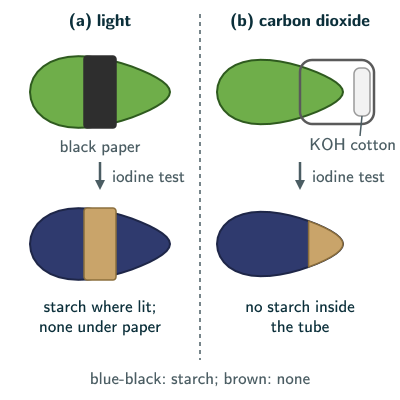
Beyond the NCERT text: the potted plant is usually kept in the dark for a day or two before such an experiment (destarching), to use up the starch its leaves already hold; otherwise pre-existing starch could give a positive result even where no new starch was made. Before the iodine test the leaf is boiled in water and then warmed in alcohol in a water bath, away from a naked flame, to remove its chlorophyll, so the blue-black colour can be seen. The KOH set-up is often called Moll’s half-leaf experiment in question banks.
Solved examples
Example 1: Reading the KOH experiment (NCERT page 134)
The part of a leaf inside a tube with KOH-soaked cotton tests negative for starch; the exposed part tests positive. Explain how this shows that CO is needed.
Answer: KOH absorbs CO, so the enclosed part had light, water and chlorophyll but no CO; it made no starch, while the exposed part, which had CO, did. The intended variable is CO availability, so this supports its requirement (NCERT page 134). For a stronger controlled test, compare with a similarly enclosed leaf portion without KOH and keep light, water and temperature comparable.
Example 2: The variegated leaf
A destarched variegated leaf with green and white patches is kept in light and tested for starch. Where is starch found, and what does that show?
Answer: only in the green patches, showing that chlorophyll is needed for photosynthesis (NCERT page 133).
Example 3: Two reasons
Give the two reasons NCERT gives for the importance of photosynthesis.
Answer: NCERT says it is the primary source of all food and releases oxygen into the atmosphere (page 133). Scientifically, “most food webs” allows for chemosynthetic ecosystems, as explained above.
Common mistakes to avoid
Common mistake
Thinking only plants are autotrophs
Cyanobacteria and some other bacteria are autotrophs too (NCERT Chapter 2, page 13), and so are many protists, such as diatoms (NCERT Chapter 2, pages 11 and 14).
Common mistake
Forgetting what KOH does
In the half-leaf experiment, KOH removes CO from the air in the tube; that is why the enclosed part makes no starch (NCERT page 134).
Quick revision summary
- Photosynthesis uses light energy to synthesise organic compounds; green plants are autotrophs, and heterotrophs depend on them for food.
- It supports most food webs and releases oxygen; chemosynthetic ecosystems are an exception to dependence on photosynthesis.
- Chlorophyll, light and CO are needed: starch forms only in green, lit parts of a leaf, and not where KOH has removed CO.
Formula sheet
- requirements: chlorophyll, light, CO (and water)
- black-paper test: no starch without light
- KOH test: no starch without CO
Questions students ask
What is the difference between autotrophic and heterotrophic nutrition?
Autotrophic nutrition is making one’s own food, as green plants do by photosynthesis, while heterotrophic nutrition is depending on food made by other organisms. NCERT says green plants synthesise the food they need through photosynthesis and so are called autotrophs, while organisms that depend on green plants for food are heterotrophs (page 133). Animals are heterotrophic, getting food from plants directly (herbivores) or indirectly (carnivores), and saprophytes such as fungi depend on dead and decaying matter (NCERT Chapter 12, pages 153–154). Most food webs depend on photosynthesis, but chemosynthetic autotrophs also make organic food using chemical energy (NCERT Chapter 2, page 13).
Why is photosynthesis called a physico-chemical process?
Photosynthesis is called a physico-chemical process because a physical event, the absorption of light by pigments such as chlorophyll, drives chemical reactions that build organic compounds: NCERT says green plants “use light energy to drive the synthesis of organic compounds” (page 133). The absorbed light excites electrons of chlorophyll a, and their energy is stored first in ATP and NADPH and then in sugar, which is why NCERT speaks of reactions “that transform light energy into chemical energy” (page 133). NCERT uses the term without explaining it; this reading is the usual one.
What are the raw materials and products of photosynthesis?
The raw materials of photosynthesis are carbon dioxide and water, and its products are carbohydrates, principally glucose and starch, and oxygen; light, absorbed by chlorophyll, supplies the energy. NCERT notes that plants use light energy to make carbohydrates from CO and water (page 135), and that leaves take in CO from the atmosphere through their stomata (Summary, page 151). NCERT’s overall equation, 6CO + 12HO → CHO + 6HO + 6O, also shows some water formed anew, and all the oxygen released comes from the water taken in (why twelve waters).
What is the difference between photosynthesis and respiration?
Photosynthesis makes food and respiration breaks it down: by photosynthesis green plants trap light energy and store it as chemical energy in carbohydrates such as glucose, sucrose and starch, while respiration breaks the C–C bonds of such compounds by oxidation to release energy, which is trapped as ATP. In higher plants, photosynthesis occurs in chloroplast-containing cells; photosynthetic bacteria have no chloroplasts. Living plant cells, green or not, also obtain energy by respiration. Oxygenic photosynthesis takes in CO and releases O, whereas aerobic respiration of carbohydrate consumes O and releases CO; plants can also use fermentation when oxygen is scarce (NCERT Chapter 12, pages 153–157).
Is photosynthesis in the NEET (UG) 2026 syllabus?
Photosynthesis is in the NEET (UG) 2026 syllabus, in Biology Unit 4, Plant Physiology, which lists “Photosynthesis as a means of Autotrophic nutrition; Site of photosynthesis take place; pigments involved in Photosynthesis (Elementary idea); Photochemical and biosynthetic phases of photosynthesis; Cyclic and non cyclic and photophosphorylation; Chemiosmotic hypothesis; Photorespiration C3 and C4 pathways; Factors affecting photosynthesis.” This page covers its first point, photosynthesis as autotrophic nutrition and what it needs, from NCERT Class 11 Section 11.1. The early experiments of NCERT Section 11.2 are not named in that list.
Practice questions
Try each question first, then open the answer to check your working.
-
Q1. Why are green plants called autotrophs?
Show answerHide answer
Because they synthesise the food they need through photosynthesis (NCERT page 133).
-
Q2. What does KOH do in the half-leaf experiment?
Show answerHide answer
It absorbs CO (NCERT page 134).