Kingdom Monera
NCERT Class 11 Biology Chapter 2 Section 2.1
Quick answer
NCERT’s Kingdom Monera contains prokaryotes, including archaebacteria and eubacteria, with wide metabolic diversity. Bacteria multiply mainly by fission; common endospores aid survival, while DNA transfer creates genetic variation without itself increasing cell number. Typical eubacterial walls contain peptidoglycan, archaebacterial walls differ, and mycoplasmas lack a wall.
With your textbook
NCERT Biology (Class 11), Chapter 2 “Biological Classification”, Section 2.1 “Kingdom Monera”, pages 12–14.
Open the official NCERT chapter (PDF, 3.3 MB, ncert.nic.in) (opens in a new tab)
Checked against the 2026-27 reprint on .
What is Kingdom Monera?
Kingdom Monera
Bacteria are the sole members of the Kingdom Monera. They are the most abundant micro-organisms.
NCERT Biology (Class 11), Section 2.1, page 12
- Monerans are prokaryotes: their cells have no nuclear membrane (NCERT Table 2.1, page 11).
- The typical eubacterial wall contains peptidoglycan (sugar chains linked by peptides); archaebacterial walls differ, and Mycoplasma has no wall at all.
In plain words: Monera is the kingdom of bacteria, the simplest cells, without a true nucleus. They live almost everywhere: hundreds are present in a handful of soil, and they survive in hot springs, deserts, snow and deep oceans, where few other organisms can (page 12). Many live in or on other organisms as parasites.
Shapes of bacteria
NCERT groups bacteria into four categories by shape (page 12): the spherical coccus (plural cocci), the rod-shaped bacillus (bacilli), the comma-shaped vibrio and the spiral spirillum (spirilla).
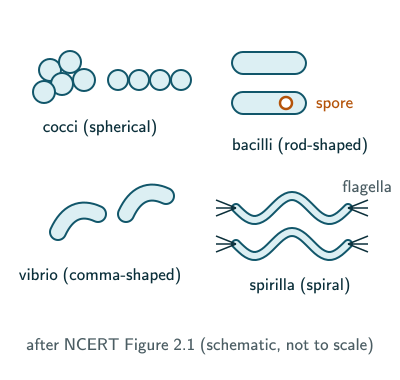
NCERT writes the comma-shaped form as “Vibrium (pl.: vibrio)” on page 12. Standard usage differs: the singular is vibrio, as in Vibrio cholerae, the cholera bacterium, and the plural is vibrios (beyond the NCERT text).
Nutrition: the widest range of metabolism
Compared to many other organisms, bacteria as a group show the most extensive metabolic diversity.
NCERT Biology (Class 11), Section 2.1, page 13
- Autotrophic bacteria make their own food from inorganic substrates. They are either photosynthetic (using light) or chemosynthetic (using energy from chemical reactions).
- Heterotrophic bacteria, the vast majority, depend on other organisms or on dead organic matter for food.
Archaebacteria
Archaebacteria live in some of the harshest habitats (page 13):
- extreme salty areas: halophiles;
- hot springs: thermoacidophiles;
- marshy areas: methanogens.
Archaebacteria differ from other bacteria in having a different cell wall structure and this feature is responsible for their survival in extreme conditions.
NCERT Biology (Class 11), Section 2.1.1, page 13
Methanogens also live in the gut of ruminant animals such as cows and buffaloes, and produce methane (biogas) from their dung (page 13).
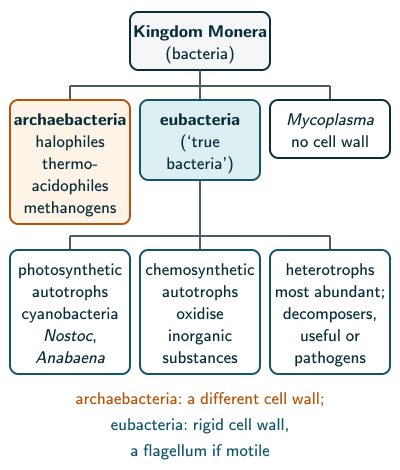
Eubacteria
They are characterised by the presence of a rigid cell wall, and if motile, a flagellum.
NCERT Biology (Class 11), Section 2.1.2, page 13
There are thousands of different eubacteria, the ‘true bacteria’. NCERT describes three nutritional groups (pages 13–14).
Cyanobacteria (blue-green algae). NCERT Chapter 3 no longer counts them as algae (page 23). They have chlorophyll a, like green plants, and are photosynthetic autotrophs. They are unicellular, colonial or filamentous, and live in fresh water, the sea or on land; colonies are usually surrounded by a gelatinous sheath, and they often form blooms in polluted water.
Some of these organisms can fix atmospheric nitrogen in specialised cells called heterocysts, e.g., Nostoc and Anabaena.
NCERT Biology (Class 11), Section 2.1.2, page 13
Chemosynthetic autotrophs. They oxidise inorganic substances and use the energy released to make ATP, and they recycle nutrients such as nitrogen, phosphorus, iron and sulphur (page 13). NCERT gives “nitrates, nitrites and ammonia” as examples of the substances oxidised. Strictly, nitrate cannot be oxidised: its nitrogen already has its highest oxidation number, +5, and it is the end product. The nitrifying bacteria oxidise ammonia to nitrite and nitrite to nitrate (beyond the NCERT text). Distinguish a question asking for NCERT’s listed wording from one asking for the chemical mechanism: in nitrification, ammonia and nitrite are oxidised, while nitrate is the product.
Heterotrophic bacteria.
Heterotrophic bacteria are most abundant in nature. The majority are important decomposers.
NCERT Biology (Class 11), Section 2.1.2, page 13
They help in making curd from milk, producing antibiotics and fixing nitrogen in legume roots. Some are pathogens of human beings, crops, farm animals and pets: cholera, typhoid, tetanus and citrus canker are bacterial diseases (pages 13–14).
Reproduction
Bacteria reproduce mainly by fission, one cell dividing into two. NCERT also mentions spores under unfavourable conditions and DNA transfer (page 14). Beyond NCERT’s wording: these processes have different roles. In the familiar endospore cycle, one cell forms one resistant resting stage that later returns to one growing cell; this is survival, not an increase in bacterial number. Cornell University’s Angert Laboratory describes endospores as a survival strategy.
They also reproduce by a sort of sexual reproduction by adopting a primitive type of DNA transfer from one bacterium to the other.
NCERT Biology (Class 11), Section 2.1.2, page 14
Beyond NCERT’s wording: DNA transfer can produce genetic variation without producing a new individual. NCBI’s MeSH definition describes bacterial conjugation as one-way transfer of genetic material. Thus fission, endospore formation and gene transfer should not be listed as three equivalent ways of multiplying.
Mycoplasma
The Mycoplasma are organisms that completely lack a cell wall. They are the smallest living cells known and can survive without oxygen.
NCERT Biology (Class 11), Section 2.1.2, page 14
Many mycoplasmas cause disease in animals and plants (page 14).
Solved examples
Example 1: Shapes
Name the four shape groups of bacteria and describe the shape of each.
Answer: coccus (spherical), bacillus (rod-shaped), vibrio (comma-shaped) and spirillum (spiral).
Example 2: Matching archaebacteria to habitats
Which archaebacteria live in salt pans, hot springs and the gut of a cow?
Answer: halophiles (salt), thermoacidophiles (hot springs), methanogens (ruminant gut, and marshes).
Example 3: Why archaebacteria survive extremes
What feature lets archaebacteria survive extreme conditions?
Answer: their different cell wall structure (NCERT page 13).
Example 4: Heterocysts
What are heterocysts, and in which bacteria are they found?
Answer: specialised cells in which some cyanobacteria fix atmospheric nitrogen, for example Nostoc and Anabaena.
Example 5: Economic uses (adapted from NCERT Exercise Q2)
State two economically important uses of heterotrophic bacteria and one use of archaebacteria named in this NCERT section.
Answer: (a) making curd from milk, and producing antibiotics (also nitrogen fixation in legume roots). (b) NCERT names one: methanogens produce methane (biogas) from the dung of ruminants such as cows and buffaloes (NCERT pages 13–14).
Example 6: The smallest cells
Which organisms does NCERT describe as the smallest living cells known, and what is unusual about them?
Answer: mycoplasmas; they completely lack a cell wall and can survive without oxygen.
Common mistakes to avoid
Common mistake
Saying all cyanobacteria fix nitrogen
NCERT says “Some of these organisms” and gives heterocyst-bearing Nostoc and Anabaena as examples; do not extend the property to all cyanobacteria.
Common mistake
Saying all bacteria have a cell wall
Mycoplasma completely lacks a cell wall; NCERT Chapter 8 names it as the one exception among prokaryotes.
Common mistake
Thinking most bacteria are autotrophs
The vast majority of bacteria are heterotrophs; heterotrophic bacteria are the most abundant in nature.
Common mistake
Being confused by NCERT’s “Vibrium”
NCERT writes “Vibrium (pl.: vibrio)”; standard usage is vibrio for one cell and vibrios for many. Both name the comma-shaped bacteria.
Quick revision summary
- Monera contains only bacteria, the most abundant micro-organisms; they are prokaryotes found almost everywhere.
- Shapes: coccus, bacillus, vibrio, spirillum.
- Bacteria show the most extensive metabolic diversity: photosynthetic or chemosynthetic autotrophs, and heterotrophs (the vast majority).
- Archaebacteria (halophiles, thermoacidophiles, methanogens) survive extremes thanks to a different cell wall; methanogens make biogas.
- Eubacteria have a rigid cell wall and, if motile, a flagellum; some cyanobacteria (Nostoc, Anabaena) fix nitrogen in heterocysts.
- Multiplication: mainly fission. Common endospores aid survival; DNA transfer provides genetic variation without itself increasing cell number. NCERT describes mycoplasmas as its smallest living cells, lacking walls and able to live without oxygen.
Formula sheet
- Monera: prokaryotic, only bacteria
- shapes: coccus, bacillus, vibrio, spirillum
- archaebacteria: halophiles, thermoacidophiles, methanogens
- cyanobacteria: chlorophyll a; some fix N in heterocysts
- fission: multiplication; endospores: survival; DNA transfer: variation
- mycoplasmas: no cell wall; NCERT’s smallest-cell example
Questions students ask
What is the difference between archaebacteria and eubacteria?
Archaebacteria differ from eubacteria in their cell wall: NCERT says archaebacteria have a different cell wall structure, which is responsible for their survival in extreme conditions, while eubacteria, the ‘true bacteria’, have a rigid cell wall and, if motile, a flagellum. Archaebacteria live in harsh habitats, as halophiles (salty areas), thermoacidophiles (hot springs) and methanogens (marshes, the gut of ruminants), while eubacteria include the photosynthetic cyanobacteria such as Nostoc, chemosynthetic bacteria and heterotrophic bacteria, mostly decomposers. Beyond the NCERT text, archaebacterial walls lack the peptidoglycan of eubacterial walls; most have a protein layer instead.
Why are cyanobacteria called blue-green algae if they are bacteria?
Cyanobacteria are called blue-green algae because of their colour and because they look and live like algae: they have chlorophyll a similar to green plants, are photosynthetic, and grow as unicellular, colonial or filamentous forms in fresh water, the sea or on land, so earlier classifications placed them with the algae under ‘Plants’. They are prokaryotes, however, with no nuclear membrane, so the five kingdom system puts them in Monera, among the eubacteria, and NCERT Chapter 3 states that they are not ‘algae’ any more (page 23). The two names refer to the same organisms, such as Nostoc and Anabaena.
Is Kingdom Monera unicellular or multicellular?
Kingdom Monera is unicellular: bacteria are its sole members, and NCERT Table 2.1 gives its body organisation simply as ‘cellular’, where Plantae and Animalia have tissues and organs. Some cyanobacteria are colonial or filamentous, such as Nostoc, and their colonies are generally surrounded by a gelatinous sheath, but these are groups of cells, not tissues. All monerans are also prokaryotic, with no nuclear membrane, which separates them from the single-celled eukaryotes of Protista.
Practice questions
Try each question first, then open the answer to check your working.
-
Q1. Where do methanogens live, and what do they produce?
Show answerHide answer
In marshy areas and in the gut of ruminants such as cows and buffaloes; they produce methane (biogas) from the dung of these animals (NCERT page 13).
-
Q2. Name four bacterial diseases given by NCERT.
Show answerHide answer
Cholera, typhoid, tetanus and citrus canker (NCERT page 14).
-
Q3. How do chemosynthetic autotrophic bacteria get their energy, and what is their role in nature?
Show answerHide answer
By oxidising inorganic substances and using the released energy to make ATP; they recycle nutrients such as nitrogen, phosphorus, iron and sulphur (NCERT page 13).
-
Q4. Distinguish fission, common endospore formation and DNA transfer in bacteria.
Show answerHide answer
Fission increases the number of cells. In the common endospore cycle, a cell forms a resistant survival stage rather than extra individuals. DNA transfer changes genetic information without itself multiplying cells. NCERT page 14 mentions all three, but their biological roles differ.