Five kingdom classification
Beyond NCERT In the NEET syllabus; the Class 11 book has no section for it.
Quick answer
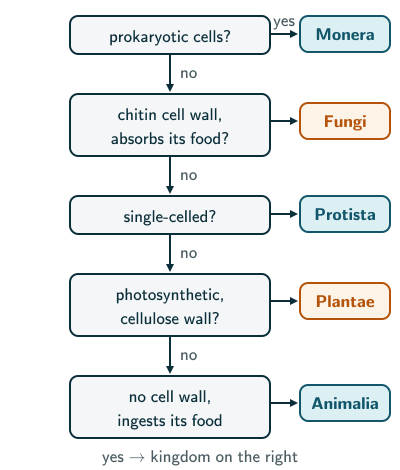
Whittaker’s five kingdom classification (1969) recognises Monera, Protista, Fungi, Plantae and Animalia using cell structure, body organisation, nutrition, reproduction and phylogenetic relationships. It separates prokaryotes from eukaryotes and fungi from green plants, with exceptions such as unicellular yeasts still placed in Fungi. NCERT illustrates the three-domain system by splitting Monera into two groups while keeping eukaryotes in a third domain, yielding its six-kingdom mapping.
What is the five kingdom classification?
Five kingdom classification
R.H. Whittaker (1969) proposed a Five Kingdom Classification.
NCERT Biology (Class 11), Chapter 2, Introduction, page 11
- The five kingdoms are Monera, Protista, Fungi, Plantae and Animalia.
- The main criteria are cell structure, body organisation, mode of nutrition, reproduction and phylogenetic (evolutionary) relationships.
The main criteria for classification used by him include cell structure, body organisation, mode of nutrition, reproduction and phylogenetic relationships.
NCERT Biology (Class 11), Chapter 2, Introduction, page 11
In plain words: instead of putting every living thing into “plants” or “animals”, Whittaker asked whether its cells have a nucleus, whether it is one cell or many, how it gets its food, how it reproduces and how it is related to other groups. Answering these places it in one of five kingdoms. NCERT covers this system in the opening pages of Chapter 2, not in a numbered section, and NEET (UG) 2026 lists the five kingdom classification in Unit 1.
From Aristotle to two kingdoms
The earliest classifications grouped organisms by their use, for food, shelter and clothing (page 10).
Aristotle was the earliest to attempt a more scientific basis for classification.
NCERT Biology (Class 11), Chapter 2, Introduction, page 10
He classified plants into trees, shrubs and herbs by simple morphological characters, and divided animals into those with red blood and those without (page 10). In Linnaeus’ time a two kingdom system, Plantae and Animalia, was developed, which took in all plants and all animals. It was easy to use, but:
This system did not distinguish between the eukaryotes and prokaryotes, unicellular and multicellular organisms and photosynthetic (green algae) and non-photosynthetic (fungi) organisms.
NCERT Biology (Class 11), Chapter 2, Introduction, page 10
Many organisms did not fit either kingdom, so the two kingdom classification was found inadequate, and characters such as cell structure, nature of the wall, mode of nutrition, habitat, methods of reproduction and evolutionary relationships had to be added (page 10).
Where the groups moved
Earlier systems put bacteria, blue-green algae, fungi, mosses, ferns, gymnosperms and angiosperms together under ‘Plants’, simply because they all have a cell wall (page 11). The five kingdom system separated them:
| Organisms | Earlier | Now |
|---|---|---|
| bacteria, blue-green algae | plants | Monera |
| Chlamydomonas, Chlorella | plants | Protista |
| Spirogyra | plants | Plantae |
| Amoeba, Paramoecium | animals | Protista |
| fungi | plants | Fungi |
| mosses, ferns, gymnosperms, angiosperms | plants | Plantae |
All prokaryotes went to Monera; the listed unicellular algae and protozoans, whether they had walls or not, to Protista; and the fungi, with chitin in their walls and heterotrophic nutrition, to a kingdom of their own (pages 11–12).
This happened because the criteria for classification changed.
NCERT Biology (Class 11), Chapter 2, Introduction, page 12
Chemistry’s periodic classification of the elements went through the same kind of revision as new properties were understood.
The five kingdoms compared (NCERT Table 2.1)
NCERT Table 2.1 (page 11) compares the kingdoms on five characters. These are broad summaries: yeasts are unicellular fungi, mycoplasmas lack walls, archaebacterial walls differ from the typical eubacterial wall, and sponges have cellular organisation. Read the group-specific exceptions alongside the table:
- Monera: prokaryotic; cell wall non-cellulosic (polysaccharide + amino acid); no nuclear membrane; cellular; autotrophic (chemosynthetic and photosynthetic) and heterotrophic (saprophytic or parasitic).
- Protista: eukaryotic; cell wall present in some; nuclear membrane present; cellular; autotrophic (photosynthetic) and heterotrophic.
- Fungi: eukaryotic; cell wall present, with chitin; nuclear membrane present; multicellular or loose tissue; heterotrophic (saprophytic or parasitic).
- Plantae: eukaryotic; cell wall present (cellulose); nuclear membrane present; tissue and organ; autotrophic (photosynthetic).
- Animalia: eukaryotic; no cell wall; nuclear membrane present; tissue, organ and organ system; heterotrophic (holozoic, saprophytic etc.).
The three-domain system
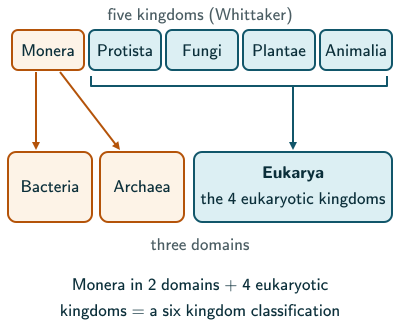
The three-domain system has also been proposed that divides the Kingdom Monera into two domains, leaving the remaining eukaryotic kingdoms in the third domain and thereby a six kingdom classification.
NCERT Biology (Class 11), Chapter 2, Introduction, page 11
NCERT leaves the details for higher classes. Beyond the NCERT text: the three domains, proposed by Carl Woese, are Bacteria and Archaea (the two prokaryotic domains carved out of Monera) and Eukarya (all eukaryotes). NCERT’s own Section 2.1 already separates archaebacteria from eubacteria by their different cell wall structure (page 13).
Solved examples
Example 1: Why two kingdoms failed
Give three distinctions that the two kingdom system could not make.
NCERT page 10 lists them.
Answer: it did not separate eukaryotes from prokaryotes, unicellular from multicellular organisms, or photosynthetic (green algae) from non-photosynthetic (fungi) organisms.
Example 2: Placing Chlamydomonas
In which kingdom was Chlamydomonas placed earlier, and where is it now? Why the change?
It has a cell wall, so it was put with algae in plants. It is a single-celled eukaryote.
Answer: earlier in Plantae (algae); now in Protista in this NCERT account. A single eukaryotic cell alone is not a sufficient test: unicellular yeasts belong to Fungi.
Example 3: Fungi out of plants
What two differences justify a separate kingdom for fungi?
Answer: fungi are heterotrophic while green plants are autotrophic, and fungal walls contain chitin while plant walls are cellulosic (NCERT pages 11–12).
Example 4: Reading NCERT Table 2.1
Which kingdom has no nuclear membrane, and which has no cell wall?
Answer: Monera has no nuclear membrane; Animalia has no cell wall.
Example 5: Counting kingdoms
How does NCERT map the five kingdoms to its illustrated six-kingdom account?
Monera is split into two domains; the four eukaryotic kingdoms stay together in the third domain.
Answer: 2 prokaryotic groups + 4 eukaryotic kingdoms = 6 kingdoms.
Example 6: Whittaker’s criteria
Name Whittaker’s main criteria.
Answer: cell structure, body organisation, mode of nutrition, reproduction and phylogenetic relationships (NCERT page 11).
Common mistakes to avoid
Common mistake
Putting blue-green algae in Plantae
Blue-green algae (cyanobacteria) are prokaryotes, so they belong to Monera, not to the algae of Plantae.
Common mistake
Thinking Protista means organisms without walls
Protista includes walled forms such as Chlamydomonas and Chlorella as well as Amoeba and Paramoecium. Use cell type together with nutrition and the stated group: unicellular yeasts belong to Fungi.
Common mistake
Assuming all fungi are multicellular
Yeasts are unicellular fungi; NCERT Table 2.1’s “multicellular/loose tissue” describes most fungi, not all.
Common mistake
Confusing the number of domains and kingdoms
Domain and kingdom are different ranks. NCERT illustrates three domains with a six-kingdom mapping; three domains do not logically require exactly six kingdoms in every classification.
Common mistake
Mixing Chapter 2 and Chapter 3 placements
NCERT Chapter 2 (page 12) puts Chlamydomonas and Chlorella in Protista, but NCERT Chapter 3 still lists Chlamydomonas among the green algae and calls Chlorella “a unicellular alga” (page 26). For Whittaker’s five kingdoms, answer Protista.
Common mistake
Adding habitat to Whittaker’s criteria
Habitat and nature of wall appear in NCERT’s page 10 list of characters, but Whittaker’s main criteria (page 11) are cell structure, body organisation, mode of nutrition, reproduction and phylogenetic relationships only.
Quick revision summary
- Early classifications were based on uses; Aristotle used simple morphology; in Linnaeus’ time a two kingdom system (Plantae, Animalia) was used.
- The two kingdom system lumped prokaryotes with eukaryotes, unicellular with multicellular, and fungi with green plants, so it was found inadequate.
- Whittaker (1969): five kingdoms, Monera, Protista, Fungi, Plantae and Animalia, on cell structure, body organisation, mode of nutrition, reproduction and phylogenetic relationships.
- Prokaryotes went to Monera, unicellular eukaryotes to Protista, and fungi (chitin walls, heterotrophic) to Fungi.
- NCERT’s three-domain account splits Monera into two domains and keeps the eukaryotes in a third, illustrating a six-kingdom mapping.
Formula sheet
- five kingdoms: Monera, Protista, Fungi, Plantae, Animalia (Whittaker, 1969)
- criteria: cell structure, body organisation, nutrition, reproduction, phylogeny
- prokaryotic: Monera only
- cell wall: chitin in Fungi, cellulose in Plantae, none in Animalia
- NCERT mapping: Monera split in two + 4 eukaryotic kingdoms = six kingdoms
Questions students ask
What is the difference between the two kingdom and five kingdom classification?
The two kingdom classification, developed in Linnaeus’ time, puts every organism in Plantae or Animalia, while Whittaker’s five kingdom classification (1969) uses cell structure, body organisation, mode of nutrition, reproduction and phylogenetic relationships to recognise five kingdoms. As a result, prokaryotes such as bacteria and blue-green algae go to Monera, single-celled eukaryotes, with walls (Chlamydomonas) or without (Amoeba), go to Protista, and the heterotrophic, chitin-walled fungi get a kingdom of their own instead of sitting among green plants. NCERT notes that plant and animal kingdoms have been a constant under all systems; what changed is which organisms they include.
What are the merits and demerits of the five kingdom classification?
The main merit of the five kingdom classification is that it uses several characters, not one: it separates prokaryotes from eukaryotes, gathers many single-celled eukaryotes in Protista (with yeasts retained in Fungi), keeps the heterotrophic fungi apart from green plants, and tries to reflect evolutionary relationships. Its demerits show in NCERT itself: the boundaries of Kingdom Protista are not well defined, so ‘a photosynthetic protistan’ to one biologist may be ‘a plant’ to another, and the system makes no mention of lichens or of acellular viruses, viroids and prions. It also keeps archaebacteria and eubacteria together in Monera, which the three-domain system splits.
Who gave the two kingdom classification?
The two kingdom classification, with the kingdoms Plantae and Animalia, is credited to Carolus Linnaeus: NCERT says it was developed in Linnaeus’ time, and its chapter summary says that Linnaeus classified all living organisms into these two kingdoms. Aristotle, much earlier, had classified plants into trees, shrubs and herbs and animals by whether they had red blood, but NCERT does not credit him with the two kingdom system. Linnaeus also gave the binomial nomenclature still used to name organisms.
Who proposed the three-domain system, and what is it based on?
The three-domain system was proposed by Carl Woese with Otto Kandler and Mark Wheelis in 1990, based mainly on comparisons of ribosomal RNA (rRNA) sequences, which had shown that prokaryotes form two very different groups. It adds a rank, the domain, above the kingdom: Bacteria and Archaea divide NCERT’s Kingdom Monera between them, and Eukarya holds the eukaryotic kingdoms. NCERT names neither Woese nor the basis of the system, and leaves its details for higher classes.
Which parts of Biological Classification are in the NEET 2026 syllabus?
The NEET (UG) 2026 syllabus lists “Five kingdom classification; salient features and classification of Monera; Protista and Fungi into major groups; Lichens; Viruses and Viroids” in Biology Unit 1, Diversity in Living World, so most of NCERT Chapter 2 is in it. Prions, which NCERT Section 2.6 also describes, are not named. Plants and animals are listed separately, as the salient features and classification of plants into algae, bryophytes, pteridophytes and gymnosperms, and of animals, non-chordates up to phyla and chordates up to classes, which NCERT Chapters 3 and 4 cover.
Practice questions
Try each question first, then open the answer to check your working.
-
Q1. How did Aristotle classify plants and animals?
Show answerHide answer
Plants into trees, shrubs and herbs, by simple morphological characters; animals into those that had red blood and those that did not (NCERT page 10).
-
Q2. Which character did earlier systems use to unite bacteria, fungi, mosses, ferns and seed plants under ‘Plants’?
Show answerHide answer
The presence of a cell wall in their cells (NCERT page 11).
-
Q3. Compare Fungi and Plantae on cell wall, body organisation and mode of nutrition (NCERT Table 2.1).
Show answerHide answer
Fungi: wall with chitin, multicellular or loose tissue, heterotrophic (saprophytic or parasitic). Plantae: wall of cellulose, tissue and organ, autotrophic (photosynthetic).
-
Q4. Discuss how classification systems have changed over time (NCERT Exercise Q1).
Show answerHide answer
From uses (food, shelter, clothing), to Aristotle’s simple morphology, to the two kingdom system of Linnaeus’ time, found inadequate, to Whittaker’s five kingdoms (1969), and now a proposed three-domain system. The criteria change as our understanding of characteristics and evolutionary relationships improves (NCERT pages 10–12).