Taxonomic categories
NCERT Class 11 Biology Chapter 1 Section 1.2
Quick answer
Classification is a hierarchy of steps, each a rank or taxonomic category: species, genus, family, order, class, phylum (division for plants) and kingdom, from lowest to highest. A genus groups closely related species, a family related genera, and so on up to the kingdoms Animalia and Plantae. Going up the hierarchy, the members of a category share fewer common characteristics.
With your textbook
NCERT Biology (Class 11), Chapter 1 “The Living World”, Section 1.2 “Taxonomic Categories”, pages 6–8.
Open the official NCERT chapter (PDF, 2.3 MB, ncert.nic.in) (opens in a new tab)
Checked against the 2026-27 reprint on .
What are taxonomic categories?
Taxonomic category and hierarchy
Classification is not a single step process but involves hierarchy of steps in which each step represents a rank or category.
NCERT Biology (Class 11), Section 1.2, page 6
Since the category is a part of overall taxonomic arrangement, it is called the taxonomic category and all categories together constitute the taxonomic hierarchy.
NCERT Biology (Class 11), Section 1.2, page 6
In plain words: classification is done in steps. An organism is placed in a species, the species in a genus, the genus in a family, and so on up to a kingdom. Each step is a rank, or category, and the whole ladder of ranks is the taxonomic hierarchy. NCERT calls each category a unit of classification, or taxon (plural taxa). Strictly, the rank (family) is the category, and the group placed at that rank (Felidae) is a taxon. Each taxon sits inside the taxon one rank above it, as a subset sits inside a larger set.
NCERT’s example is the insects: a group of organisms sharing common features like three pairs of jointed legs, recognisable and concrete enough to be given a rank (page 6). Such groups are real biological units:
These taxonomic groups/ categories are distinct biological entities and not merely morphological aggregates.
NCERT Biology (Class 11), Section 1.2, page 6
The seven categories
The common categories are kingdom, phylum (called division for plants), class, order, family, genus and species, and species is the lowest of these seven principal categories (page 6). Beyond this simplified hierarchy, ranks such as subspecies can occur below species and domain above kingdom. Placing an organism in them needs knowledge of its characters, to find similarities and differences with other organisms.
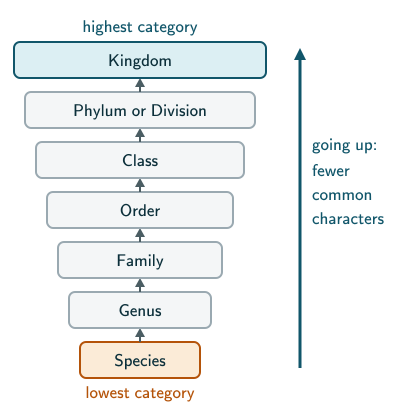
Say, for example, as we go higher from species to kingdom, the number of common characteristics goes on decreasing.
NCERT Biology (Class 11), Section 1.2.7, page 8
So the members of a species share the most characters, and the members of a kingdom the fewest. NCERT adds that the higher the category, the harder it is to work out its relationship to other taxa at the same level, so classification becomes more complex higher up (page 8). Taxonomists also use sub-categories within this hierarchy for finer placement.
Species and genus
Taxonomic studies consider a group of individual organisms with fundamental similarities as a species.
NCERT Biology (Class 11), Section 1.2.1, page 6
One species should be distinguishable from closely related species by distinct morphological differences. In Mangifera indica (mango), Solanum tuberosum (potato) and Panthera leo (lion), the words indica, tuberosum and leo are specific epithets, and Mangifera, Solanum and Panthera are genera, the next higher level. Human beings are Homo sapiens: specific epithet sapiens in the genus Homo.
NCERT’s definition rests on morphological similarities. The box on Ernst Mayr at the start of the unit (page 2) says that he “pioneered the currently accepted definition of a biological species”. Beyond NCERT: in Mayr’s biological species concept, a species is a group of actually or potentially interbreeding natural populations that is reproductively isolated from other such groups. It cannot be used for organisms that reproduce only asexually, such as bacteria (NCERT Exercise Q8).
We can say that genera are aggregates of closely related species.
NCERT Biology (Class 11), Section 1.2.2, page 7
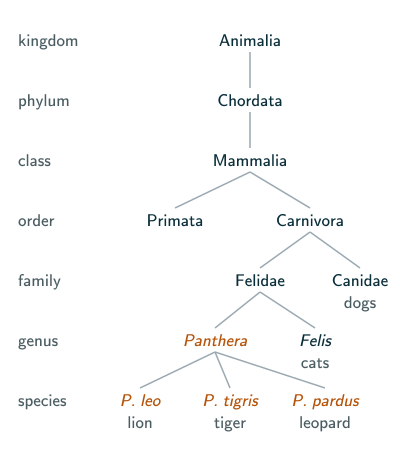
Potato (S. tuberosum) and brinjal (S. melongena) are different species of the genus Solanum, which also includes S. nigrum. Lion (Panthera leo), leopard (P. pardus) and tiger (P. tigris) are species of Panthera, a genus different from Felis, which includes cats.
Family and order
A family is a group of related genera, with still fewer similarities than a genus or a species. Plant families are characterised on both vegetative and reproductive features (page 7). Examples from NCERT:
- the plant genera Solanum, Petunia and Datura are in the family Solanaceae;
- the animal genera Panthera and Felis are in the family Felidae;
- cats and dogs, though similar in some ways, are in different families, Felidae and Canidae.
An order is an assemblage of families that show a few similar characters; order and the higher categories are identified on aggregates of characters (page 7). The plant families Convolvulaceae and Solanaceae are placed in one order mainly on floral characters, and the animal order Carnivora includes Felidae and Canidae. NCERT spells this order “Polymoniales” (page 7). Beyond NCERT: the standard spelling is Polemoniales, after the genus Polemonium, and most modern systems place these two families in the order Solanales. Recognise both spellings in questions.
Class, phylum and kingdom
- Class: related orders. The order Primata (monkey, gorilla, gibbon) and the order Carnivora (tiger, cat, dog) are both in the class Mammalia, which has other orders too. (Beyond NCERT: the name in standard use is Primates.)
- Phylum: classes comprising animals such as fishes, amphibians, reptiles, birds and mammals, which have a notochord and a dorsal hollow neural system at least during development, form the phylum Chordata. For plants, classes with a few similar characters form a division.
- Kingdom: the highest of the seven principal categories listed here. All animal phyla make up the kingdom Animalia, and all plant divisions the kingdom Plantae.
Four organisms classified (NCERT Table 1.1)
NCERT Table 1.1 (page 8) places four common organisms in the categories from genus up to phylum or division:
- Man, Homo sapiens: genus Homo, family Hominidae, order Primata, class Mammalia, phylum Chordata.
- Housefly, Musca domestica: genus Musca, family Muscidae, order Diptera, class Insecta, phylum Arthropoda.
- Mango, Mangifera indica: genus Mangifera, family Anacardiaceae, order Sapindales, class Dicotyledonae, division Angiospermae.
- Wheat, Triticum aestivum: genus Triticum, family Poaceae, order Poales, class Monocotyledonae, division Angiospermae.
Mango and wheat share a division but differ from the class down; man and the housefly share only the kingdom Animalia.
Solved examples
Example 1: The correct sequence (NCERT Exercise Q7)
Which is the correct sequence of taxonomic categories: (a) Species, Order, Phylum, Kingdom; (b) Genus, Species, Order, Kingdom; (c) Species, Genus, Order, Phylum?
Ascending order is species, genus, family, order, class, phylum, kingdom; a correct sequence may skip ranks but must keep this order. (b) puts genus below species.
Answer: both (a) and (c) keep the correct ascending order, each skipping some ranks; only (b) is wrong.
Example 2: Where does the lion belong?
Give the genus, family, order, class and phylum of the lion.
From NCERT Section 1.2: Panthera leo is in the genus Panthera, the family Felidae, the order Carnivora, the class Mammalia and the phylum Chordata.
Answer: Panthera, Felidae, Carnivora, Mammalia, Chordata.
Example 3: Who shares more characters?
Do the members of a genus or the members of an order share more characters?
Going up the hierarchy, the number of common characteristics decreases.
Answer: the members of a genus.
Example 4: Division or phylum?
What is the plant equivalent of a phylum, and which division do mango and wheat belong to?
Answer: a division; both are in the division Angiospermae (NCERT Table 1.1).
Example 5: Same genus, different species
Name two NCERT examples of different species in one genus.
Answer: potato (Solanum tuberosum) and brinjal (S. melongena) in Solanum; lion (Panthera leo) and tiger (P. tigris) in Panthera.
Example 6: Cat and dog
Cats and dogs are both carnivores. At which level are they first separated?
Both are in the order Carnivora, but cats are in Felidae and dogs in Canidae.
Answer: at the family level.
Common mistakes to avoid
Common mistake
Putting genus above family
The order upwards is species, genus, family, order, class, phylum, kingdom. A family contains genera, not the other way round.
Common mistake
Calling the plant category a phylum
For plants, NCERT uses division in place of phylum.
Common mistake
Thinking higher taxa share more characters
It is the opposite: the higher the category, the fewer the characteristics its members have in common.
Common mistake
Italicising family and higher names
Only genus and species names are italic. Hominidae, Primata and Mammalia are written in ordinary type, as in NCERT Table 1.1.
Quick revision summary
- Classification is a hierarchy of steps; each step is a rank or taxonomic category, and all of them form the taxonomic hierarchy.
- Ascending order: species, genus, family, order, class, phylum (division for plants), kingdom. Species is the lowest of these seven principal categories.
- Going up, the number of common characteristics decreases, and relationships become harder to determine.
- A species is a group of individuals with fundamental similarities; a genus is an aggregate of closely related species; a family a group of related genera; an order an assemblage of families; a class related orders; a phylum related classes; a kingdom the highest of these seven categories (Animalia, Plantae).
- NCERT examples: Panthera (lion, tiger, leopard) and Felis (cats) in Felidae; Felidae and Canidae in Carnivora; Carnivora and Primata in Mammalia; Mammalia in Chordata.
Formula sheet
- species → genus → family → order → class → phylum (division) → kingdom
- in NCERT’s seven-rank hierarchy: lowest species; highest kingdom
- going up: fewer common characters
- plants: division in place of phylum
- only genus and species names in italics
Questions students ask
How do you remember the order of the taxonomic hierarchy?
The order of the taxonomic hierarchy is easy to remember with the mnemonic ‘King Philip Came Over For Good Soup’, whose initials give kingdom, phylum, class, order, family, genus and species, from the top down; for plants, read phylum as division. NCERT’s Figure 1.1 shows the categories the other way, in ascending order from species to kingdom, so for that order read the mnemonic from its last word back to its first.
What is the difference between a taxon and a taxonomic category?
A taxonomic category is a rank in the hierarchy, such as class or genus, while a taxon is an actual group of organisms placed at a rank, such as Mammalia at the rank of class or Solanum at the rank of genus. So one category holds many taxa: the rank of family holds Felidae, Canidae, Hominidae and Solanaceae, among others. NCERT does not keep the two strictly apart, since it says that each category represents a rank and ‘is commonly termed as taxon’ (page 6), so in a question ‘taxon’ may mean either a group or a rank.
What is the basic unit of classification?
Species is the basic unit of classification: NCERT calls every taxonomic category a unit of classification, but species is the lowest of the seven principal categories listed here, and every higher category is built by grouping species, first into genera and then upwards. NCERT describes a species as a group of individual organisms with fundamental similarities, which can be told apart from closely related species by distinct morphological differences.
Which taxonomic category contains the largest number of organisms?
Within one nested lineage in NCERT’s seven-rank hierarchy, kingdom includes all its constituent phyla or divisions, whereas a species is a much narrower group. This is a comparison of nested taxa, not a rule that any kingdom must contain more individuals than any taxon in another branch. So, going up the hierarchy from species to kingdom, each higher taxon generally includes more organisms, though, as NCERT notes on page 8, they have fewer characteristics in common.
What are the 8 taxonomic categories, and where does domain fit?
The 8 taxonomic categories often listed are domain, kingdom, phylum, class, order, family, genus and species: NCERT’s seven categories with domain added above kingdom. Domain is the top rank of the three-domain system, which NCERT mentions in Chapter 2 as dividing Kingdom Monera into two domains and leaving the eukaryotic kingdoms in a third. NCERT’s hierarchy in Chapter 1 stops at kingdom, so for NEET learn the seven ranks from species to kingdom.
Practice questions
Try each question first, then open the answer to check your working.
-
Q1. Define a taxon and give examples of taxa at different levels (NCERT Exercise Q6).
Show answerHide answer
A taxon is a unit of classification: a group of organisms at any rank (plural taxa). For example, Homo sapiens (species), Panthera (genus), Felidae (family), Carnivora (order), Mammalia (class) and Chordata (phylum).
-
Q2. Place the housefly in the categories from genus to phylum (NCERT Table 1.1).
Show answerHide answer
Musca domestica: genus Musca, family Muscidae, order Diptera, class Insecta, phylum Arthropoda.
-
Q3. Which plant families does NCERT place in the same order on the basis of floral characters?
Show answerHide answer
Convolvulaceae and Solanaceae, in the order NCERT spells Polymoniales (correctly Polemoniales).
-
Q4. Arrange in ascending order: class, family, kingdom, species, order, genus, phylum.
Show answerHide answer
Species, genus, family, order, class, phylum, kingdom.