Family Solanaceae
NCERT Class 11 Biology Chapter 5 Section 5.9
Quick answer
Solanaceae, the potato family, has mostly herbs and shrubs with alternate, simple, exstipulate leaves. Its flowers are bisexual and actinomorphic, with five united sepals and five united petals, five epipetalous stamens and a superior, bilocular ovary of two fused, obliquely placed carpels with swollen axile placentae. Its floral formula is ⊕ ⚥ K(5) C(5) A5 G(2), and it gives tomato, brinjal, potato, chilli, tobacco and petunia.
With your textbook
NCERT Biology (Class 11), Chapter 5 “Morphology of Flowering Plants”, Section 5.9 “Solanaceae”, pages 68–69.
Open the official NCERT chapter (PDF, 3.4 MB, ncert.nic.in) (opens in a new tab)
Checked against the 2026-27 reprint on .
Solanaceae, the potato family
Solanaceae
It is a large family, commonly called as the ‘potato family’.
NCERT Biology (Class 11), Section 5.9, page 68
- Solanaceae is widely distributed in the tropics, subtropics and even temperate zones (page 68).
- NCERT illustrates it with Solanum nigrum (makoi), and also names potato, tomato, brinjal, chilli, belladonna, ashwagandha, tobacco and petunia (pages 68–69).
In plain words: NCERT’s Section 5.9 is its worked example of a semi-technical description. It describes the family in the standard order: vegetative characters, then floral characters, then the floral formula and floral diagram. NCERT’s Chapter 1 uses the same family to explain the rank of family: Solanum, Petunia and Datura are placed in Solanaceae.
Vegetative characters
- Habit: mostly herbs and shrubs, rarely small trees.
- Stem: herbaceous, rarely woody; aerial; erect, cylindrical, branched, solid or hollow, hairy or glabrous. In potato (Solanum tuberosum) there is an underground stem.
- Leaves: alternate, simple, rarely pinnately compound; exstipulate (without stipules); venation reticulate (page 68).
Floral characters
NCERT lists them as follows (page 69):
- Inflorescence: solitary, axillary or cymose as in Solanum.
- Flower: bisexual, actinomorphic.
- Calyx: sepals five, united, persistent, valvate aestivation.
- Corolla: petals five, united; valvate aestivation.
- Androecium: stamens five, epipetalous.
- Gynoecium: bicarpellary, obliquely placed, syncarpous; ovary superior, bilocular; placenta swollen, with many ovules; axile placentation.
- Fruits: berry or capsule.
- Seeds: many, endospermous.
NCERT prints the gynoecium as “bicarpellary obligately placed” (page 69). The intended word is obliquely: the two carpels sit at a slant to the front-to-back plane of the flower.
Beyond the NCERT text: a persistent calyx stays on after the flower has become a fruit, as the green cap on a brinjal or a tomato shows.
Floral formula and floral diagram
Fusion is indicated by enclosing the figure within bracket and adhesion by a line drawn above the symbols of the floral parts.
NCERT Biology (Class 11), Section 5.8, page 68
NCERT’s floral formula for Solanaceae (page 69) is ⊕ ⚥ K(5) C(5) A5 G(2), with a line drawn over C and A, and the G underlined.
- ⊕ ⚥: actinomorphic and bisexual.
- K(5) and C(5): five united sepals and five united petals; the brackets show fusion.
- The line over C and A: the stamens are attached to the petals (epipetalous); a line above the symbols shows adhesion.
- A5: five stamens, free from one another (no bracket) but joined to the petals.
- G(2), underlined: two fused carpels in a superior ovary.
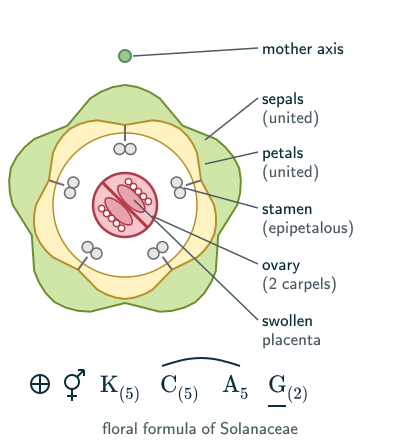
To draw it (NCERT page 68): a dot on top for the mother axis, then whorls from outside in. Calyx: five sepals in one ring. Corolla: five united petals alternating with the sepals. Stamens: five, alternating with the petals, each joined to the corolla. Ovary: two chambers, the septum drawn at a slant, a swollen placenta on it in each chamber bearing many ovules.
Economic importance
Many plants of this family are useful (page 69):
| Use | Plants |
|---|---|
| Food | tomato, brinjal, potato |
| Spice | chilli |
| Medicine | belladonna, ashwagandha |
| Fumigatory | tobacco |
| Ornamental | petunia |
Solved examples
Example 1: A semi-technical description (NCERT Exercise Q6)
Take one flower of the family Solanaceae and write its semi-technical description. Also draw their floral diagram.
Answer: for Solanum nigrum (makoi), using NCERT’s family description (pages 68–69):
- Habit: herb.
- Root: branched tap root (beyond the NCERT text; NCERT notes that dicotyledons generally have tap roots, page 69).
- Stem: herbaceous, aerial, erect, cylindrical, branched.
- Leaves: alternate, simple, exstipulate; venation reticulate.
- Inflorescence: cymose.
- Flower: bisexual, actinomorphic.
- Calyx: sepals five, united, persistent; valvate.
- Corolla: petals five, united; valvate.
- Androecium: stamens five, epipetalous.
- Gynoecium: bicarpellary, obliquely placed, syncarpous; ovary superior, bilocular, with swollen placentae bearing many ovules; axile placentation.
- Fruit: berry. Seeds: many, endospermous.
- Floral formula: ⊕ ⚥ K(5) C(5) A5 G(2), a line over C and A, the G underlined. The floral diagram is the figure above.
Beyond the NCERT text: makoi is a small branched herb and its fruit is a berry; NCERT’s Figure 5.17 (a) shows its flowering twig with clusters of round fruits.
Example 2: Reading the formula
What do the brackets and the line over C and A tell you in the Solanaceae formula?
Answer: the brackets round 5 for K and C show that the sepals and the petals are united; the line drawn over C and A shows adhesion, the stamens attached to the petals (epipetalous) (NCERT pages 68–69).
Example 3: The ovary
Describe the gynoecium of Solanaceae.
Answer: bicarpellary and syncarpous, the carpels obliquely placed; the ovary is superior and bilocular, and its swollen placentae bear many ovules in axile placentation (NCERT page 69, which misprints obliquely as ‘obligately’).
Example 4: Uses
Give one plant of Solanaceae used as food, one as a medicine and one as an ornamental.
Answer: food: tomato, brinjal or potato; medicine: belladonna or ashwagandha; ornamental: petunia (NCERT page 69).
Example 5: The potato
Which part of the potato plant does NCERT mention under the stem of Solanaceae?
Answer: its underground stem (Solanum tuberosum) (NCERT page 68).
Common mistakes to avoid
Common mistake
Calling the stamens of Solanaceae free of the corolla
They are epipetalous: attached to the petals, shown by a line over C and A in the formula.
Common mistake
Writing an inferior ovary for Solanaceae
The ovary is superior, so the G is underlined, not overlined.
Common mistake
Drawing the septum straight across the ovary
The carpels are obliquely placed, so the septum is drawn at a slant (NCERT Figure 5.17 (f), page 68).
Common mistake
Giving the leaves stipules
Solanaceae leaves are exstipulate.
Quick revision summary
- Solanaceae, the potato family: large, in tropics, subtropics and temperate zones; Solanum nigrum (makoi) is NCERT’s example.
- Vegetative: mostly herbs and shrubs; stem herbaceous, rarely woody, underground in potato; leaves alternate, simple, exstipulate, reticulate.
- Floral: solitary, axillary or cymose; bisexual, actinomorphic; calyx 5 united, persistent, valvate; corolla 5 united, valvate; stamens 5 epipetalous; gynoecium bicarpellary, obliquely placed, syncarpous, superior, bilocular, axile with swollen placentae.
- Fruit: berry or capsule; seeds many, endospermous.
- Formula: ⊕ ⚥ K(5) C(5) A5 G(2), a line over C and A, the G underlined.
- Uses: food (tomato, brinjal, potato), spice (chilli), medicine (belladonna, ashwagandha), fumigatory (tobacco), ornamental (petunia).
Formula sheet
- Solanaceae: potato family
- leaves: alternate, simple, exstipulate, reticulate venation
- calyx: 5 united, persistent; corolla: 5 united; both valvate
- stamens 5, epipetalous; ovary bicarpellary, superior, axile
- formula: ⊕ ⚥ K(5) C(5) A5 G(2), line over C and A, G underlined
- fruit: berry or capsule; seeds many, endospermous
Questions students ask
Is the Solanaceae family in the NEET syllabus?
The family Solanaceae is not named in the NEET (UG) 2026 syllabus, whose Unit 2 lists only ‘Family (malvaceae, Cruciferae, leguminoceae, compositae, graminae)’. It is, however, the one family that the 2026–27 NCERT Class 11 book describes, in Section 5.9, and NCERT’s Exercise Q6 asks for a semi-technical description and floral diagram of a Solanaceae flower, so it belongs to the Class 11 course. Its description is also NCERT’s model of how a family is described, from the habit to the floral formula, and the five NEET families are described in the same order.
Why is Solanaceae called the potato family?
Solanaceae is called the potato family, the common name NCERT gives it, because its best-known member is the potato, Solanum tuberosum, and the family takes its name from the genus Solanum, to which the potato and makoi (Solanum nigrum) belong. It is also called the nightshade family, after plants such as makoi, the black nightshade, and belladonna (Atropa belladonna), the deadly nightshade.
Is Solanaceae a dicot or a monocot family?
Solanaceae is a family of dicotyledons: its leaves have reticulate venation, which NCERT gives as the general rule for dicots, and its sepals, petals and stamens are in fives, K(5) C(5) A5. Most monocots have parallel venation and floral parts in threes, as in lily; the two classes are compared on the angiosperms page.
Which vegetables belong to the Solanaceae family?
Vegetables of the Solanaceae family include tomato, brinjal and potato, which NCERT lists as foods, and chilli, which it lists as a spice; capsicum (bell pepper) is a mild chilli of the same genus, Capsicum. In tomato, brinjal and chilli the part eaten is the fruit, a berry, while in potato it is the underground stem.
Practice questions
Try each question first, then open the answer to check your working.
-
Q1. What is the aestivation of the calyx and the corolla in Solanaceae?
Show answerHide answer
Valvate in both (NCERT page 69).
-
Q2. What kinds of fruit does NCERT give for Solanaceae?
Show answerHide answer
Berry or capsule (NCERT page 69).
-
Q3. Which plant of Solanaceae does NCERT list as fumigatory?
Show answerHide answer
Tobacco (NCERT page 69).
-
Q4. What does ‘persistent’ mean for the calyx of Solanaceae?
Show answerHide answer
The calyx stays on after the flower has become a fruit (NCERT page 69 lists it as persistent; the explanation is beyond the NCERT text).