Family Leguminosae (Fabaceae)
Beyond NCERT In the NEET syllabus; the Class 11 book has no section for it.
Quick answer
Leguminosae (Fabaceae) includes many plants with nitrogen-fixing root nodules and compound, stipulate leaves. The traditional scheme has three subfamilies, while LPWG’s 2017 classification has six; pea-type flowers have a papilionaceous corolla, usually (9) + 1 stamens and a single superior carpel with marginal placentation. Pea’s formula is % ⚥ K(5) C1+2+(2) A(9)+1 G1, with G underlined; soil nitrogen benefit depends partly on residue return.
The family Leguminosae
Leguminosae (Fabaceae)
Leguminosae, also called Fabaceae, is the pea or legume family of dicotyledons. It is named after its fruit, the legume (pod).
- The roots of many members bear root nodules, in which bacteria fix nitrogen.
- Traditionally the family is split into three subfamilies: Papilionoideae, Caesalpinioideae and Mimosoideae.
- Papilionoideae, the pea subfamily, typically has a papilionaceous corolla, diadelphous stamens, a single carpel with marginal placentation, and a legume.
The 2026–27 NCERT book describes only the family Solanaceae, while the NEET (UG) 2026 syllabus lists Leguminosae in Unit 2. NCERT uses pea, bean, gram, Cassia and gulmohur as examples in Chapter 5, and those lines are cited below. Everything else is beyond the 2026–27 NCERT text.
Vegetative characters and root nodules
- Habit: herbs, shrubs, trees and climbers; pea climbs by tendrils formed from its upper leaflets.
- Root: a tap root, usually with root nodules. NCERT names fixing nitrogen in legume roots among the jobs of heterotrophic bacteria (Chapter 2, pages 13–14); in the nodules this is done by the bacterium Rhizobium (NCERT Class 12 Biology, Section 8.6, page 158).
- Leaves: alternate, usually pinnately compound, stipulate. In some leguminous plants the leaf base is swollen into a pulvinus (NCERT page 60).
The three traditional subfamilies
- Papilionoideae (pea, bean, gram, groundnut, soybean): zygomorphic flowers; papilionaceous corolla in vexillary (descending imbricate) aestivation, the posterior standard outermost; ten stamens, usually diadelphous, (9) + 1 (monadelphous in groundnut).
- Caesalpinioideae (Cassia, gulmohur, tamarind): zygomorphic flowers; ascending imbricate aestivation, the posterior petal innermost; ten stamens or fewer, usually free.
- Mimosoideae (Mimosa, Acacia): small actinomorphic flowers in heads or spikes; valvate aestivation; stamens four to many (four in Mimosa pudica, many in Acacia), long and showy.
NCERT supports the first two at the level of examples: pea, bean, gulmohur and Cassia are zygomorphic (page 62); pea and bean are vexillary, while Cassia and gulmohur are imbricate (page 64). Modern classifications have redrawn these subfamilies; the traditional three are given here.
Papilionoideae: papilionaceous corolla and diadelphous stamens
The following is the pea-type pattern; the subfamily varies, including the monadelphous groundnut already listed above.
- Inflorescence: a raceme.
- Flower: bisexual and zygomorphic.
- Calyx: five sepals, united (gamosepalous).
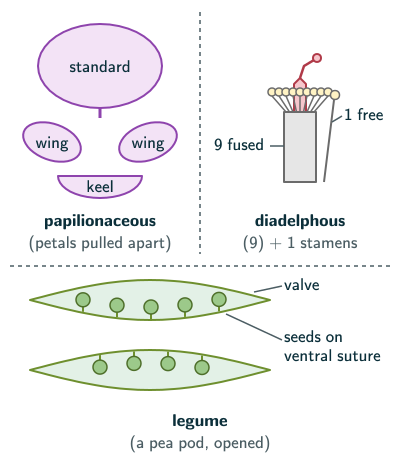
- Corolla: five petals, polypetalous and papilionaceous (butterfly-like): one large posterior standard, two lateral wings and two anterior petals, joined along their lower edges, forming the keel, which encloses the stamens and the pistil. The aestivation is vexillary, which NCERT also calls papilionaceous: the standard overlaps the wings, which overlap the keel (NCERT page 64).
- Androecium: ten stamens, diadelphous: nine with their filaments fused into a sheath, and one free, written (9) + 1; the anthers are two-lobed (dithecous). NCERT gives pea as its example of stamens in two bundles (page 64).
Marginal placentation and the legume
- Gynoecium: a single carpel (monocarpellary); the ovary is superior and one-chambered, with many ovules.
In marginal placentation the placenta forms a ridge along the ventral suture of the ovary and the ovules are borne on this ridge forming two rows, as in pea.
NCERT Biology (Class 11), Section 5.5.1, page 65
- Fruit: a legume (pod), which splits along both sutures, the ventral and the dorsal, into two valves; the groundnut pod, which ripens underground, does not split.
- Seeds: one to many, non-endospermic (a few legumes, such as fenugreek and guar, keep an endosperm). NCERT gives bean, gram and pea as seeds whose endosperm is not present when mature (page 66).
Floral formula of Papilionoideae
Beyond the NCERT text: % ⚥ K(5) C1+2+(2) A(9)+1 G1, with the G underlined.
- % ⚥: zygomorphic and bisexual.
- K(5): five united sepals.
- C1+2+(2): one standard, two wings and two keel petals, the keel petals fused.
- A(9)+1: diadelphous stamens, nine fused and one free.
- G1, underlined: one carpel in a superior ovary.
Economic importance
| Use | Plants |
|---|---|
| Pulses | gram, arhar (pigeon pea), moong, sem, pea, soybean |
| Edible oil | soybean, groundnut |
| Fibre | sunhemp (Crotalaria juncea) |
| Fodder | berseem (Trifolium), Sesbania |
| Medicine | muliathi (liquorice, Glycyrrhiza glabra) |
| Others | indigo (Indigofera, dye), sheesham (timber), sweet pea and lupin (ornamental) |
Root nodules can make legumes valuable in crop rotation. Fixed nitrogen first nourishes the legume; roots and residues return nitrogen as they decompose, while harvesting grain removes some. New Mexico State University’s Nitrogen Fixation by Legumes explains why soil benefit depends on residue return and crop management.
Solved examples
Example 1: Spot the subfamily
A flower has a large standard, two wings and a keel, and ten stamens of which nine are fused. Name the subfamily and its family.
Answer: Papilionoideae, of the family Leguminosae (Fabaceae); pea is an example.
Example 2: Reading the formula
In % ⚥ K(5) C1+2+(2) A(9)+1 G1, what do C1+2+(2) and A(9)+1 stand for?
Answer: C1+2+(2): a papilionaceous corolla of one standard, two wings and a keel of two fused petals. A(9)+1: ten diadelphous stamens, nine fused and one free (symbols as on NCERT pages 67–68).
Example 3: Pea or gulmohur?
Both pea and gulmohur flowers are zygomorphic. How does their aestivation differ?
Answer: pea is vexillary: the standard overlaps the wings and the wings the keel. Gulmohur is imbricate (NCERT pages 62 and 64). Beyond NCERT, gulmohur’s pattern is called ascending imbricate: the posterior petal is innermost, the reverse of vexillary (descending imbricate), where the posterior standard is outermost.
Example 4: Why grow legumes?
Why are legumes good for the soil?
Answer: their root nodules hold bacteria that fix atmospheric nitrogen (NCERT Chapter 2, pages 13–14, names nitrogen fixation in legume roots), and nitrogen can return to the soil through roots and decomposing residues. Harvesting nitrogen-rich grain removes some, so enrichment is not automatic.
Example 5: The seeds of the family
Are pea and gram seeds endospermic?
Answer: no: in bean, gram and pea the endosperm is not present in mature seeds (NCERT page 66).
Common mistakes to avoid
Common mistake
Calling pea monadelphous
Pea is diadelphous, (9) + 1 (NCERT page 64); china rose is monadelphous.
Common mistake
Giving every legume a papilionaceous corolla
Only Papilionoideae has one; Cassia and gulmohur (Caesalpinioideae) are imbricate, and Mimosa (Mimosoideae) is actinomorphic and valvate.
Common mistake
Calling the papilionaceous corolla gamopetalous
Only the two keel petals are joined (written C1+2+(2)); the corolla as a whole is still polypetalous.
Common mistake
Reading “Fabaceae” in a question as all three subfamilies
Some books use Fabaceae for the pea subfamily alone (Papilionoideae), with Caesalpiniaceae and Mimosaceae as separate families. In such questions answer with pea-type characters: zygomorphic, vexillary, diadelphous (9) + 1. Botanists today use Fabaceae and Leguminosae for the whole family.
Quick revision summary
- Leguminosae (Fabaceae), the pea family: herbs to trees and climbers; tap roots with nitrogen-fixing root nodules; leaves alternate, pinnately compound, stipulate, with a pulvinus in some.
- Traditional subfamilies: Papilionoideae (vexillary, diadelphous), Caesalpinioideae (ascending imbricate, stamens free), Mimosoideae (actinomorphic, valvate, stamens 4 to many).
- Papilionoideae: raceme; zygomorphic, bisexual; calyx 5 united; corolla papilionaceous (standard, 2 wings, keel); stamens (9) + 1.
- Pea: one carpel, superior ovary, marginal placentation; fruit a legume; seed non-endospermic. Some legumes retain endosperm or have indehiscent pods.
- Formula: % ⚥ K(5) C1+2+(2) A(9)+1 G1, G underlined.
- Uses: pulses, edible oils (soybean, groundnut), fodder, dye, timber.
Formula sheet
- Leguminosae: pea family (Fabaceae); root nodules fix nitrogen
- traditional subfamilies: Papilionoideae, Caesalpinioideae, Mimosoideae; LPWG 2017 recognises six
- papilionaceous corolla: standard, 2 wings, keel (vexillary)
- diadelphous stamens: (9) + 1
- one carpel, marginal placentation; fruit legume
- formula: % ⚥ K(5) C1+2+(2) A(9)+1 G1, G underlined
Questions students ask
Are Fabaceae and Leguminosae the same family?
Fabaceae and Leguminosae are two names for the same family, the pea or legume family, when it is taken as a whole, as most botanists now take it. Leguminosae, named after its fruit, the legume, is the old name that the botanical code still allows because of its long use, and Fabaceae is the regular name, formed from Faba, the old genus name of the broad bean (now Vicia faba). The code also allows Fabaceae for the pea subfamily alone when that is treated as a separate family, Papilionaceae, and NCERT editions before the rationalisation used the name in this narrow sense.
What is the difference between Fabaceae and Solanaceae?
Fabaceae, taken as its pea subfamily, differs from Solanaceae in symmetry, corolla, stamens and ovary: a pea flower is zygomorphic, with a polypetalous, papilionaceous corolla in vexillary aestivation, ten diadelphous stamens, (9) + 1, and one carpel with marginal placentation that becomes a legume. A Solanaceae flower is actinomorphic, with five united petals in valvate aestivation, five epipetalous stamens and two fused carpels with axile placentation that become a berry or capsule. The leaves differ too: usually pinnately compound and stipulate in legumes, simple and exstipulate in Solanaceae.
What is the difference between Malvaceae and Fabaceae?
Malvaceae and Fabaceae differ in symmetry, corolla, stamens and ovary: a Malvaceae flower such as china rose is actinomorphic, with an epicalyx and twisted petals, while a pea flower is zygomorphic, with no epicalyx and a papilionaceous corolla in vexillary aestivation. The many stamens of china rose form one bundle, while the ten of pea form two, (9) + 1. The china rose ovary has five fused carpels with axile placentation and forms a capsule, while the pea ovary has one carpel with marginal placentation and forms a legume.
Is the Fabaceae family in the NEET syllabus?
Fabaceae is in the NEET (UG) 2026 syllabus under its other name: Unit 2 lists ‘Family (malvaceae, Cruciferae, leguminoceae, compositae, graminae)’, and ‘leguminoceae’ is the syllabus’s spelling of Leguminosae. The 2026–27 NCERT Class 11 book does not describe the family; NCERT editions before the rationalisation described its pea subfamily under the name Fabaceae, so its characters now come from those older editions and standard botany texts.
How many subfamilies does Fabaceae have?
Fabaceae has three subfamilies in the traditional scheme followed on this page, Papilionoideae, Caesalpinioideae and Mimosoideae, but six in the classification of the Legume Phylogeny Working Group (2017): Cercidoideae, Detarioideae, Duparquetioideae, Dialioideae, Caesalpinioideae and Papilionoideae. In the new scheme the mimosoids, such as Mimosa, form a group inside Caesalpinioideae, and some old Caesalpinioideae, such as tamarind, have moved to the new subfamilies.
Practice questions
Try each question first, then open the answer to check your working.
-
Q1. Which part of the papilionaceous corolla encloses the stamens and the pistil?
Show answerHide answer
The keel, formed by the two anterior petals.
-
Q2. What is a pulvinus?
Show answerHide answer
A swollen leaf base, found in some leguminous plants (NCERT page 60).
-
Q3. Name two legumes that give edible oil.
Show answerHide answer
Soybean and groundnut.
-
Q4. To which family do sunhemp and muliathi belong, and what is each used for?
Show answerHide answer
Leguminosae: sunhemp gives fibre; muliathi (liquorice) is a medicine.