The fruit
NCERT Class 11 Biology Chapter 5 Section 5.6
Quick answer
A fruit develops from a mature ovary, sometimes with additional floral parts; development without fertilisation is parthenocarpy. Its wall is the pericarp, differentiated into epicarp, mesocarp and endocarp in the examples here, and fruits may be seeded or seedless. Mango and coconut are one-seeded drupes with a stony endocarp: mango has an edible fleshy mesocarp, while coconut has a fibrous mesocarp and edible endosperm.
With your textbook
NCERT Biology (Class 11), Chapter 5 “Morphology of Flowering Plants”, Section 5.6 “The Fruit”, pages 65–66.
Open the official NCERT chapter (PDF, 3.4 MB, ncert.nic.in) (opens in a new tab)
Checked against the 2026-27 reprint on .
What is a fruit?
The fruit
The fruit is a characteristic feature of the flowering plants.
NCERT Biology (Class 11), Section 5.6, page 65
- A fruit is a mature or ripened ovary, developed after fertilisation (page 65).
- A fruit formed without fertilisation of the ovary is a parthenocarpic fruit (page 65).
- Generally, a fruit consists of a wall, the pericarp, and seeds (page 65).
In plain words: after fertilisation, the ovary of a flower grows into the fruit and the ovules inside it grow into seeds. Only flowering plants have an ovary round their ovules, so only they make fruits. NCERT puts it this way in Chapter 3: unlike the gymnosperms, whose ovules are naked, in the angiosperms the seeds are enclosed in fruits (Section 3.5, page 34).
The pericarp
The pericarp may be dry or fleshy (page 65).
When pericarp is thick and fleshy, it is differentiated into the outer epicarp, the middle mesocarp and the inner endocarp.
NCERT Biology (Class 11), Section 5.6, page 65
- Epicarp: the outer layer, usually a skin.
- Mesocarp: the middle layer.
- Endocarp: the inner layer, next to the seed.
NCERT Class 12 Biology adds that the wall of the ovary develops into the pericarp, and gives fleshy fruits (guava, orange, mango) and dry fruits (groundnut, mustard) as examples (Section 1.4.3, page 20).
Drupes: mango and coconut
NCERT calls the fruit of mango and coconut a drupe, and says they develop from monocarpellary superior ovaries and are one-seeded (page 65). Beyond the NCERT text, a drupe is recognised by its stony endocarp, the ‘stone’ round the single seed, which is why drupes are also called stone fruits.
- Mango: the pericarp is well differentiated into an outer thin epicarp, a middle fleshy edible mesocarp and an inner stony hard endocarp (pages 65–66).
- Coconut: also a drupe, but with a different mesocarp, as NCERT notes:
In coconut which is also a drupe, the mesocarp is fibrous.
NCERT Biology (Class 11), Section 5.6, page 66
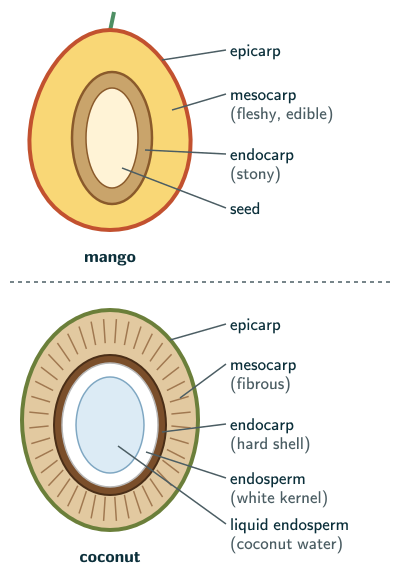
NCERT says that mango and coconut both develop from monocarpellary superior ovaries (page 65). That holds for mango but not for coconut. The coconut palm bears separate male and female flowers, and the female flower has “an ovary consisting of 3 connate carpels”, that is, three fused carpels; yet the fruit holds a single seed, whose root breaks out through one of the three germinating pores in the shell (National Tropical Botanical Garden plant database, Cocos nucifera). In an NCERT-based exam, quote NCERT’s line.
What you eat in a drupe
- Mango: the fleshy, edible mesocarp (NCERT page 66).
- Coconut: not the fibrous mesocarp, which forms most of the husk, but the endosperm inside the hard endocarp. NCERT Class 12 Biology says the coconut water of a tender coconut is free-nuclear endosperm, made up of thousands of nuclei, and the surrounding white kernel is cellular endosperm (Section 1.4.1, page 19).
True and false fruits, and parthenocarpy
NCERT Class 12 Biology takes the fruit further (Section 1.4.3, pages 20–21):
- In most plants the other floral parts degenerate and fall off as the fruit develops. In a few species, such as apple, strawberry and cashew, the thalamus also contributes to the fruit; these are false fruits.
- Most fruits develop only from the ovary and are true fruits.
- Parthenocarpic fruits develop without fertilisation; banana is one example. Parthenocarpy can be induced with growth hormones, and such fruits are seedless.
Beyond the NCERT text, useful edible-part examples:
- Apple: the fleshy thalamus.
- Strawberry: the fleshy thalamus; the tiny ‘seeds’ on it are the true fruits.
- Cashew: the ‘cashew apple’ is the swollen stalk and thalamus; the true fruit is the nut.
- Banana: the mesocarp and endocarp.
- Orange: juicy hairs that grow from the endocarp.
Solved examples
Example 1: Parthenocarpic fruit
What is a parthenocarpic fruit? Give the example NCERT uses.
Answer: a fruit formed without fertilisation of the ovary (NCERT Class 11, page 65), such as banana (NCERT Class 12 Biology, page 21).
Example 2: The layers of a mango
Name the three layers of the mango pericarp and describe each.
Answer: an outer thin epicarp, a middle fleshy edible mesocarp, and an inner stony hard endocarp (NCERT page 66).
Example 3: What makes a drupe
How do drupes develop, according to NCERT, and how many seeds do they have? Give NCERT’s two examples.
Answer: they develop from monocarpellary superior ovaries and are one-seeded, as in mango and coconut (NCERT page 65). Beyond the NCERT text: the coconut’s ovary has three fused carpels, though its fruit holds a single seed (see the note under the figure).
Example 4: The edible part
Which part is eaten in a mango, and which in a coconut?
Answer: in mango, the fleshy mesocarp (NCERT Class 11, page 66); in coconut, the endosperm: the white kernel (cellular) and the coconut water (free-nuclear) (NCERT Class 12 Biology, page 19).
Example 5: Why is apple a false fruit?
Why is apple called a false fruit, and which parts of the flower form it?
Answer: because the thalamus also contributes to the fruit, along with the ovary; a true fruit develops only from the ovary (NCERT Class 12 Biology, page 20).
Example 6: Fleshy or dry
Sort these fruits as fleshy or dry: guava, groundnut, orange, mustard.
Answer: fleshy: guava and orange; dry: groundnut and mustard (NCERT Class 12 Biology, page 20).
Common mistakes to avoid
Common mistake
Calling the coconut kernel the mesocarp
The coconut’s mesocarp is the fibrous part of the husk; the white kernel and the coconut water are endosperm.
Common mistake
Calling the mango stone the seed
The stone is the stony endocarp; the seed is inside it.
Common mistake
Calling the whole coconut you buy the seed
The brown coconut sold in shops has lost its husk (epicarp and fibrous mesocarp); what is left is the hard endocarp with the one seed inside it.
Common mistake
Calling every fruit a ripened ovary alone
In false fruits such as apple, strawberry and cashew, the thalamus also forms part of the fruit.
Quick revision summary
- The fruit is a characteristic feature of flowering plants: a ripened ovary, developed after fertilisation; without fertilisation it is parthenocarpic.
- A fruit generally has a wall, the pericarp, and seeds; seedless fruits also occur; the pericarp is dry or fleshy, and a thick fleshy pericarp has epicarp, mesocarp and endocarp.
- Drupe (mango, coconut): from a superior ovary, one-seeded. NCERT calls both ovaries monocarpellary, but the coconut’s has three fused carpels.
- Mango: thin epicarp, fleshy edible mesocarp, stony endocarp. Coconut: fibrous mesocarp; endosperm as kernel and water.
- False fruits (apple, strawberry, cashew) include the thalamus; parthenocarpic fruits (banana) form without fertilisation.
Formula sheet
- fruit: mature ovary, usually after fertilisation; accessory parts may contribute
- parthenocarpic fruit: formed without fertilisation
- pericarp: epicarp, mesocarp, endocarp
- drupe: superior ovary, one-seeded, stony endocarp (mango, coconut)
- mango: fleshy edible mesocarp; coconut: fibrous mesocarp
- false fruit: thalamus also contributes (apple, strawberry, cashew)
Questions students ask
Is a parthenocarpic fruit a false fruit?
A parthenocarpic fruit is not necessarily a false fruit, because the two terms answer different questions. A false fruit is one to which the thalamus also contributes, as in apple, strawberry and cashew, while a parthenocarpic fruit is one that develops without fertilisation, as in banana (NCERT Class 12 Biology, pages 20–21). So ‘false’ is about which parts of the flower form the fruit, and ‘parthenocarpic’ about whether fertilisation took place, and one does not imply the other.
What is the difference between parthenocarpy and apomixis?
Parthenocarpy is the formation of a fruit without fertilisation, as in banana, while apomixis is the production of seeds without fertilisation, as in some species of Asteraceae and grasses (NCERT Class 12 Biology, pages 21–22). Parthenocarpy gives a fruit, usually seedless, while apomixis gives seeds, whose embryos arise without fertilisation; that is why NCERT calls apomixis a form of asexual reproduction that mimics sexual reproduction.
What is the difference between a drupe and a berry?
A drupe has a hard, stony endocarp, the ‘stone’, round its single seed, as in mango and coconut, while a berry has a fleshy pericarp with no stony layer and usually many seeds embedded in its pulp, as in tomato. In a drupe the mesocarp is fleshy (mango) or fibrous (coconut) and the endocarp hard, but in a berry no layer of the fruit wall hardens into a stone (beyond the NCERT text, which names the berry only as a fruit of Solanaceae, page 69).
What is the difference between an aggregate fruit and a multiple fruit?
An aggregate fruit develops from the several free carpels of a single flower, each carpel forming a small fruitlet, as in raspberry and strawberry, while a multiple fruit develops from a whole cluster of flowers, an inflorescence, as in pineapple, mulberry and jackfruit (beyond the NCERT text). Jackfruit is therefore a multiple fruit, not an aggregate one, because it forms from the many flowers of one inflorescence.
Practice questions
Try each question first, then open the answer to check your working.
-
Q1. Which part of the flower becomes the fruit, and which becomes the seed?
Show answerHide answer
The ovary becomes the fruit and the ovules become the seeds (NCERT pages 65–66).
-
Q2. When is a pericarp differentiated into epicarp, mesocarp and endocarp?
Show answerHide answer
When it is thick and fleshy (NCERT page 65).
-
Q3. Coir, the coconut fibre, comes from which layer of the fruit?
Show answerHide answer
The fibrous mesocarp (NCERT page 66); the name coir is beyond the NCERT text.
-
Q4. Is a mango a true fruit or a false fruit?
Show answerHide answer
A true fruit: it develops only from the ovary, with no part of the thalamus (NCERT Class 12 Biology, page 20, defines true fruits).