Plant growth regulators: auxin to ABA
NCERT Class 11 Biology Chapter 13 Section 13.4
Quick answer
Plant growth regulators are small, simple molecules of diverse chemistry that control growth and development. Auxins, gibberellins and cytokinins are growth promoters, while abscisic acid is an inhibitor and ethylene is largely an inhibitor. Auxins cause rooting and apical dominance, gibberellins lengthen stems and cause bolting, cytokinins promote cell division, ethylene ripens fruit, and ABA closes stomata and induces dormancy.
With your textbook
NCERT Biology (Class 11), Chapter 13 “Plant Growth and Development”, Section 13.4 “Plant Growth Regulators”, pages 174–178.
Open the official NCERT chapter (PDF, 1.9 MB, ncert.nic.in) (opens in a new tab)
Checked against the 2026-27 reprint on .
Plant growth regulators
Plant growth regulators (PGRs)
The plant growth regulators (PGRs) are small, simple molecules of diverse chemical composition.
NCERT Biology (Class 11), Section 13.4.1, page 174
They are also called plant growth substances, plant hormones or phytohormones (page 174).
In plain words: PGRs are the plant’s chemical messengers. A small amount made in a shoot tip, ripening fruit or stressed leaf can act locally or after transport, helping regulate cell division, stretching, flowering, ripening, abscission or dormancy. NCERT studies five main groups (page 179).
Characteristics
NCERT’s five groups illustrate very different chemical types (NCERT page 174):
| Chemical nature | Example |
|---|---|
| indole compounds | indole-3-acetic acid (IAA), an auxin |
| adenine derivatives | N-furfurylamino purine (kinetin), a cytokinin |
| derivatives of carotenoids | abscisic acid (ABA) |
| terpenes | gibberellic acid (GA) |
| gases | ethylene (CH) |
Growth promoters and inhibitors
NCERT divides PGRs into two groups by their functions in the plant (page 174):
- Plant growth promoters take part in growth-promoting activities such as cell division, cell enlargement, pattern formation, tropic growth, flowering, fruiting and seed formation: auxins, gibberellins and cytokinins.
- The other group plays an important role in plant responses to wounds and stresses of biotic and abiotic origin, and in growth-inhibiting activities such as dormancy and abscission: abscisic acid.
- Ethylene, a gas, could fit either group, but it is largely an inhibitor of growth activities.
These are broad functional groups, not fixed effects in every organ or at every concentration. The same hormone can promote one process and inhibit another; tissue, dose, developmental stage and other hormones matter.
The discovery of plant growth regulators
NCERT notes that the discovery of each of the five major groups was accidental (page 174):
| PGR | Discovery |
|---|---|
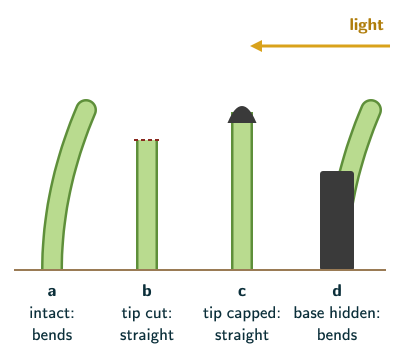
| Auxin | Charles and Francis Darwin: canary grass coleoptiles bend towards light (phototropism); F.W. Went isolated auxin from oat coleoptile tips |
| Gibberellin | E. Kurosawa (1926): sterile filtrates of the fungus Gibberella fujikuroi produced bakanae-like elongation symptoms in rice seedlings |
| Cytokinin | F. Skoog and co-workers: tobacco callus grew only with auxin plus extracts of vascular tissue, yeast extract, coconut milk or DNA; Miller et al. (1955) named the substance kinetin |
| Abscisic acid | mid-1960s: inhibitor-B, abscisin II and dormin, found to be one chemical |
| Ethylene | H.H. Cousins (1910): a volatile substance from ripened oranges hastened the ripening of stored unripe bananas |
(NCERT pages 174–175.)
-
NCERT prints the second inhibitor as “abscission II” (page 175); its name in the research literature is abscisin II (Addicott and co-workers, “Abscisic acid: a new name for abscisin II (dormin)”, Science, 1968).
-
The Darwins concluded that the tip of the coleoptile was the site of a transmittable influence that caused the whole coleoptile to bend (page 174, NCERT Figure 13.10).
-
A callus is a mass of undifferentiated cells (page 175); the cytokinesis-promoting substance from Skoog’s work was crystallised as kinetin (page 175).
Physiological effects of plant growth regulators
Each PGR has many effects, and different PGRs can have similar ones (NCERT page 179, Summary). The five groups are covered below; NCERT Section 13.4.3 gives their effects on pages 175–178.
Auxins
- Auxins (from the Greek ‘auxein’, to grow) were first isolated from human urine (NCERT page 175).
- NCERT also says F.W. Went isolated auxin from the tips of oat coleoptiles (page 174). Keep both answers as NCERT gives them: auxin was first isolated from human urine (page 175), and Went isolated it from the tips of oat coleoptiles (page 174).
- The term covers indole-3-acetic acid (IAA) and other natural and synthetic compounds with certain growth-regulating properties. IAA and indole butyric acid (IBA) have been isolated from plants; NAA (naphthalene acetic acid) and 2,4-D are synthetic auxins (page 175).
- They are generally produced by the growing apices of stems and roots, and migrate to the regions where they act (page 175).
Effects and uses (NCERT pages 175–176):
- initiate rooting in stem cuttings, widely used for plant propagation;
- promote flowering, for example in pineapples;
- prevent fruit and leaf drop at early stages, but promote abscission of older, mature leaves and fruits;
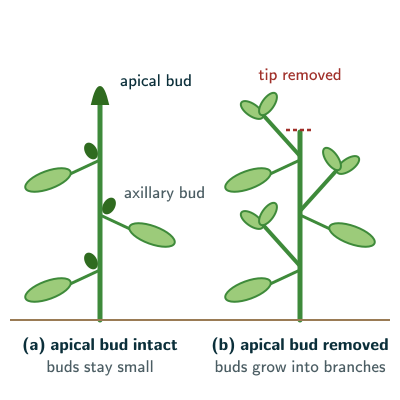
- cause apical dominance: “In most higher plants, the growing apical bud inhibits the growth of the lateral (axillary) buds, a phenomenon called apical dominance” (page 175). Removing the shoot tip (decapitation) usually makes the lateral buds grow, which is used in tea plantations and hedge-making;
- induce parthenocarpy, for example in tomatoes;
- serve as herbicides: NCERT presents 2,4-D as selective for dicotyledonous weeds over mature monocots, explaining its use in lawns. This is relative selectivity, not universal immunity: 2,4-D can also damage susceptible grasses (Washington State University Hortsense, “Lawn and Turf: 2,4-D damage”);
- control xylem differentiation and help in cell division.
NCERT writes the synthetic auxin’s name as “2, 4-dichlorophenoxyacetic” (page 175); the full name is 2,4-dichlorophenoxyacetic acid.
Gibberellins
- Gibberellins are another kind of promotory PGR. More than 100 gibberellins are known, from widely different organisms such as fungi and higher plants, named GA, GA, GA and so on; GA (gibberellic acid) was one of the first discovered and is the most intensively studied. All GAs are acidic (NCERT page 176).
Effects and uses (page 176):
- increase the length of the axis, used to lengthen grape stalks;
- make fruits like apple elongate and improve their shape;
- delay senescence, so fruits can be left on the tree longer to extend the market period;
- GA speeds up the malting process in the brewing industry;
- spraying sugarcane with gibberellins lengthens the stem, raising the yield by as much as 20 tonnes per acre;
- spraying juvenile conifers hastens maturity, giving early seed production;
- promote bolting (internode elongation just before flowering) in beet, cabbages and many plants with a rosette habit.
Cytokinins
- Cytokinins have specific effects on cytokinesis. They were discovered as kinetin, a modified form of adenine (a purine), from autoclaved herring sperm DNA; NCERT states that kinetin does not occur naturally in plants (page 176). Beyond NCERT, Barciszewski and colleagues reported its detection in plant cell extracts (FEBS Letters, 1996). Keep the textbook contrast with zeatin identifiable, but do not present absolute absence from plants as an uncontested modern fact.
- The search for natural substances with cytokinin-like activity led to zeatin, isolated from corn kernels and coconut milk (page 176).
- Natural cytokinins are made where rapid cell division occurs: root apices, developing shoot buds, young fruits and so on (page 177).
Effects (page 177):
- help produce new leaves, chloroplasts in leaves, lateral shoot growth and adventitious shoot formation;
- help overcome apical dominance;
- promote nutrient mobilisation, which helps delay leaf senescence.
Ethylene
- Ethylene is a simple gaseous PGR, made in large amounts by tissues undergoing senescence and by ripening fruits (NCERT page 177).
Effects and uses (page 177):
- horizontal growth of seedlings, swelling of the axis and apical hook formation in dicot seedlings; beyond the NCERT text, such effects on dark-grown seedlings are called the triple response of ethylene (Schaller and Kieber, “Ethylene”, The Arabidopsis Book, 2002);
- promotes senescence and abscission, especially of leaves and flowers;
- is highly effective in fruit ripening, and raises the rate of respiration during ripening;
- breaks seed and bud dormancy, initiates germination in peanut seeds and sprouting of potato tubers;
- promotes rapid internode and petiole elongation in deep water rice, keeping leaves and upper parts of the shoot above water;
- NCERT lists promotion of root growth and root hair formation, increasing absorption surface. This is context-dependent: ethylene can inhibit primary-root cell elongation while promoting root-hair elongation, as experiments in Arabidopsis show (Strader and colleagues, Plant Journal, 2010);
- initiates flowering and synchronises fruit-set in pineapples, and induces flowering in mango.
The most widely used source of ethylene is ethephon: absorbed and transported in aqueous solution, it releases ethylene slowly. It hastens fruit ripening in tomatoes and apples, accelerates abscission in flowers and fruits (thinning of cotton, cherry and walnut) and promotes female flowers in cucumbers, increasing the yield (page 177).
NCERT calls the rise in the rate of respiration during ripening the “respiratory climactic” (page 177). The correct term is the respiratory climacteric.
Abscisic acid
- ABA was discovered for its role in regulating abscission and dormancy, but it has wide-ranging effects. It acts as a general plant growth inhibitor and an inhibitor of plant metabolism (NCERT page 177).
- ABA inhibits seed germination, stimulates the closure of stomata and increases the plant’s tolerance to stresses of various kinds: “Therefore, it is also called the stress hormone” (page 177).
- It plays an important role in seed development, maturation and dormancy. By inducing dormancy, it helps seeds withstand desiccation and other unfavourable factors (page 178).
- In most situations, ABA acts as an antagonist to GAs (page 178).
PGRs act together
- Every phase of growth, differentiation and development involves one PGR or another. Their roles can be complementary or antagonistic, individualistic or synergistic (NCERT page 178).
- Several events involve more than one PGR: dormancy in seeds and buds, abscission, senescence and apical dominance (page 178).
- PGRs are only one kind of intrinsic control; with genomic control and extrinsic factors, they control growth and development. Many extrinsic factors, such as temperature and light, act through PGRs, in events such as vernalisation, flowering, dormancy, seed germination and plant movements (page 178).
Two slips in this part of the book:
- NCERT writes “complimentary or antagonistic” (page 178), meaning complementary.
- NCERT says it will “discuss briefly the role of light and temperature … on initiation of flowering” (page 178), but the 2026–27 book has no such section: the Summary follows straight after. Exercises 7 and 9, on short-day and long-day plants and on photoperiodic cycles (page 179), refer to the same missing material.
Solved examples
Example 1: Which PGR would you use? (NCERT Exercise 8)
Which plant growth regulator would you use to (a) induce rooting in a twig, (b) quickly ripen a fruit, (c) delay leaf senescence, (d) induce growth in axillary buds, (e) ‘bolt’ a rosette plant, (f) induce immediate stomatal closure in leaves?
Answer: (a) an auxin, such as IBA or NAA (rooting in stem cuttings); (b) ethylene, for example from ethephon; (c) a cytokinin (nutrient mobilisation delays leaf senescence); (d) a cytokinin (it helps overcome apical dominance), or remove the apical bud; (e) a gibberellin (bolting); (f) abscisic acid (stomatal closure) (NCERT pages 175–177).
Example 2: What would happen? (NCERT Exercise 10a, c, d)
What would be expected if (a) GA is applied to rice seedlings, (c) a rotten fruit gets mixed with unripe fruits, (d) you forget to add cytokinin to the culture medium?
Answer: (a) the seedlings would elongate abnormally, like the ‘foolish seedling’ (bakanae) symptoms that the gibberellin-producing fungus causes in rice (NCERT pages 175–176). (c) Ethylene from the rotting, senescing fruit would hasten the ripening of the unripe fruits, as Cousins saw with oranges and bananas (pages 175 and 177). (d) In Skoog’s tobacco-callus system, proliferation would be impaired because a cytokinin source was required in addition to auxin (page 175), and shoot induction would be impaired (page 177). This is not a rule that every explant always dies or forms no shoots without added cytokinin: the tissue and its endogenous hormone supply also matter.
Example 3: The stress hormone (NCERT Exercise 5)
Why is abscisic acid also known as the stress hormone?
Answer: ABA stimulates the closure of stomata and increases the tolerance of plants to various kinds of stresses; by inducing dormancy, it also helps seeds withstand desiccation and other unfavourable conditions (NCERT pages 177–178).
Example 4: Hedges and tea bushes
Why are tea bushes and hedges regularly cut at the top?
Answer: removing the shoot tips (decapitation) ends apical dominance, so the lateral buds grow into branches and the plant becomes bushy (NCERT page 175).
Example 5: Five groups of PGRs (NCERT Exercise 4)
List the five main groups of natural plant growth regulators, and write a note on one of them.
Answer: auxins, gibberellins, cytokinins, abscisic acid and ethylene (NCERT page 179). Note on ethylene: discovered when H.H. Cousins (1910) found that a volatile substance from ripened oranges hastened the ripening of stored bananas (page 175). Physiologically, it promotes senescence and abscission, fruit ripening, the breaking of seed and bud dormancy, and elongation in deep water rice (page 177). In agriculture, ethylene is used to initiate flowering and synchronise fruit-set in pineapples and to induce flowering in mango; its source ethephon hastens ripening in tomatoes and apples, thins cotton, cherry and walnut, and promotes female flowers in cucumbers (page 177).
Common mistakes to avoid
Common mistake
Giving only one PGR for flowering in pineapple
NCERT names two: auxins promote flowering in pineapples (page 175), and ethylene initiates flowering and synchronises fruit-set in pineapples (page 177). Ethylene also induces flowering in mango (page 177).
Common mistake
Calling ethylene a growth promoter
NCERT says ethylene could fit either group but is largely an inhibitor of growth activities (page 174).
Common mistake
Saying 2,4-D kills all plants
NCERT describes selective action against dicot weeds in lawns (page 176). “Selective” does not mean harmless to every monocot at every dose; susceptible turfgrasses can also be injured (Washington State University Hortsense).
Common mistake
Taking kinetin for a natural plant cytokinin
NCERT contrasts kinetin from autoclaved herring sperm DNA with naturally isolated zeatin (page 176). Preserve that textbook account while recognising the later report of kinetin in plant extracts discussed above.
Common mistake
Mixing up who overcomes apical dominance
Auxin from the apical bud causes apical dominance; cytokinins help overcome it (NCERT pages 175 and 177).
Quick revision summary
- PGRs are small, simple molecules of diverse chemistry: indole compounds (IAA), adenine derivatives (kinetin), carotenoid derivatives (ABA), terpenes (GA) and gases (ethylene).
- Promoters: auxins, gibberellins, cytokinins. Inhibitor: abscisic acid. Ethylene fits either, but is largely an inhibitor.
- Auxins: rooting, flowering in pineapple, apical dominance, parthenocarpy, herbicide 2,4-D, xylem differentiation. Gibberellins: lengthening (grape stalks, sugarcane), bolting, malting, delayed senescence.
- Cytokinins: cell division, new leaves and chloroplasts, overcoming apical dominance, delaying leaf senescence. Ethylene: ripening, senescence and abscission, breaking dormancy, deep water rice, female flowers in cucumber (ethephon).
- ABA: inhibits germination, closes stomata, induces dormancy; the stress hormone; antagonist to GAs.
Formula sheet
- promoters: auxins, gibberellins, cytokinins; inhibitor: abscisic acid; ethylene: largely an inhibitor
- auxin: rooting, apical dominance, parthenocarpy, 2,4-D herbicide
- gibberellin: stem and stalk lengthening, bolting, malting
- cytokinin: cell division, overcomes apical dominance, delays leaf senescence
- ethylene: fruit ripening, abscission, breaks dormancy; source: ethephon
- abscisic acid: stomatal closure, dormancy; the stress hormone
Questions students ask
What is the difference between auxin and gibberellin?
Auxins and gibberellins are both growth promoters, but they differ in chemistry and in their main effects. Natural auxins such as IAA and IBA are indole compounds, generally produced by the growing apices of stems and roots, while gibberellins are terpenes, all of them acidic, with more than 100 known from fungi and higher plants (NCERT pages 174–176). Auxins initiate rooting in stem cuttings, cause apical dominance, induce parthenocarpy in tomatoes and, as 2,4-D, selectively control many dicot weeds; gibberellins lengthen the axis, as in grape stalks and sugarcane, cause bolting and, as GA, speed up malting (pages 175–176).
What is bolting in plants, and how can it be induced artificially?
Bolting is internode elongation just before flowering, seen in beet, cabbages and many plants with a rosette habit, and since gibberellins promote it, spraying a rosette plant with a gibberellin makes it bolt (NCERT page 176). Beyond the NCERT text, Anton Lang showed in the 1950s that gibberellin applied to rosette plants such as henbane, Hyoscyamus niger, made them first elongate their stems and then flower (Lang, Proceedings of the National Academy of Sciences, 1957).
Why does apical dominance occur?
Apical dominance occurs because auxin made at the growing shoot apex keeps the axillary buds below it from growing: NCERT lists it among the effects of auxins, which are made at the growing apices of stems and migrate to where they act (NCERT page 175). Beyond the NCERT text, Thimann and Skoog showed in 1933 that auxin applied to the cut stem of a decapitated broad bean, Vicia faba, kept its lateral buds inhibited (Cline, Annals of Botany, 1996). Also beyond NCERT, auxin is thought to act on the buds indirectly, lowering cytokinins, which NCERT says help overcome apical dominance (page 177), and raising strigolactones (Beveridge and others, Journal of Experimental Botany, 2023).
Are plant growth regulators and plant hormones the same?
In NCERT, plant growth regulators and plant hormones are the same: it says PGRs are variously described as plant growth substances, plant hormones or phytohormones (NCERT page 174). Many other sources draw a line: a plant hormone is a substance the plant makes itself, while ‘plant growth regulator’ also covers synthetic compounds (beyond the NCERT text: TNAU Agritech Portal, ‘Plant growth regulators’; Centre for Food Safety, Hong Kong, Food Safety Focus, 2011). In that usage, IAA and zeatin are plant hormones, while the synthetic auxins NAA and 2,4-D are growth regulators but not hormones (NCERT pages 175–176).
What is the difference between gibberellin and gibberellic acid?
Gibberellin is the name of a whole group of plant growth regulators, while gibberellic acid is one of them, GA. More than 100 gibberellins are known, named GA, GA, GA and so on, and all of them are acidic, but the name gibberellic acid belongs to GA alone, one of the first discovered and still the most intensively studied (NCERT page 176). NCERT names GA as the terpene among the PGRs and as the form used to speed up malting, and the active substances of the bakanae fungus were identified as gibberellic acid (pages 174–176).
What is the difference between ethylene and ethephon?
Ethylene is the plant growth regulator itself, a simple gas made in large amounts by senescing tissues and ripening fruits, while ethephon is a compound sprayed on crops that releases ethylene inside the plant (NCERT page 177). A gas is hard to apply to a crop in the open, but ethephon in an aqueous solution is readily absorbed and transported within the plant and releases ethylene slowly (page 177). Beyond the NCERT text, ethephon is 2-chloroethylphosphonic acid, which breaks down in plant tissue to ethylene, phosphate and chloride (US Environmental Protection Agency, ethephon registration review).
Practice questions
Try each question first, then open the answer to check your working.
-
Q1. Who collected auxin from coleoptile tips, and from which plant?
Show answerHide answer
F.W. Went, from the tips of coleoptiles of oat seedlings (NCERT page 174). Auxin was first isolated from human urine (page 175).
-
Q2. Which PGR is a terpene, and which is a gas?
Show answerHide answer
Gibberellic acid (GA) is a terpene; ethylene (CH) is a gas (NCERT page 174).
-
Q3. Name the most widely used source of ethylene in agriculture.
Show answerHide answer
Ethephon (NCERT page 177).