Plant tissues
Beyond NCERT In the NEET syllabus; the Class 11 book has no section for it.
Quick answer
Plant tissues are meristematic or permanent. Apical and intercalary meristems add length and lateral meristems (vascular and cork cambium) add girth; the simple permanent tissues are parenchyma, collenchyma and sclerenchyma. The complex tissues are xylem (tracheids, vessels, fibres and living parenchyma) and phloem (sieve tubes without nuclei, companion cells, parenchyma and fibres).
What is a plant tissue?
Plant tissues
A tissue is a group of cells having a common origin and usually performing a common function. NCERT’s Chapter 6 opens with the same ladder: plants have cells as the basic unit, cells are organised into tissues, and tissues into organs (page 71).
The plant tissues are broadly classified into meristematic (apical, lateral and intercalary) and permanent (simple and complex).
NCERT Biology (Class 11), Chapter 6, Summary, page 77
The 2026–27 NCERT chapter has no section on these tissues. Its Summary still lists them, and Section 6.1 still opens with “We were discussing types of tissues based on the types of cells present” (page 71), but the chapter no longer contains that discussion. The book mentions meristems only briefly, in NCERT Chapter 13 (pages 167–168), and nowhere describes simple and complex permanent tissues. The NEET (UG) 2026 syllabus lists tissues in Unit 2, so this page gives the standard account. Apart from the NCERT lines cited, it is beyond the 2026–27 NCERT text.
Meristematic tissues
A meristem is a tissue whose cells keep dividing by mitosis. NCERT’s chapter on plant growth explains that plants grow throughout life because of meristems at certain locations in their body (Chapter 13, Section 13.1.1, page 167).
- Apical meristems, at the tips of roots and shoots, cause primary growth: the root and shoot apical meristems mainly lengthen the plant along its axis (NCERT pages 167–168). Beyond the NCERT text: some cells left behind by the shoot apical meristem form the axillary buds.
- Intercalary meristems lie between mature tissues, for example at the base of leaves and internodes in grasses. They let a grass regrow after grazing animals have cut it. Like apical meristems, they add to primary growth.
- Lateral meristems, the vascular cambium and the cork cambium, appear later in the life of dicotyledons and gymnosperms, in the mature parts of roots and stems, and increase the girth: this is secondary growth (NCERT page 168).
Primary/secondary origin and apical/intercalary/lateral position are different classifications. A lateral cambium produces secondary growth, but not all its cells originate by dedifferentiation: fascicular cambium retains procambial cells within a primary vascular bundle (the botanical review Stem cell function during plant vascular development). By contrast, NCERT notes that the interfascicular cambium and cork cambium form from fully differentiated parenchyma cells by dedifferentiation (Chapter 13, Section 13.2, page 172).
Simple permanent tissues
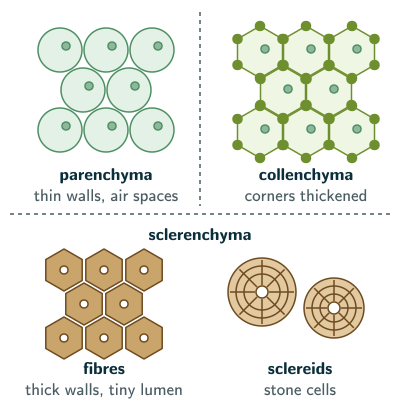
Cells produced by a meristem can differentiate into specialised permanent tissues, normally no longer actively dividing. “Permanent” does not mean every living cell has irreversibly lost division capacity: some can dedifferentiate, as NCERT’s cambium examples show. A simple tissue is made of one type of cell. NCERT names the three simple tissues, which make up the ground tissue system:
It consists of simple tissues such as parenchyma, collenchyma and sclerenchyma.
NCERT Biology (Class 11), Section 6.1.2, page 72
- Parenchyma: living cells, commonly with thin cellulose walls and roughly equal dimensions (round, oval or polygonal), though their shapes and intercellular spaces vary. Palisade mesophyll, for example, contains elongated parenchyma cells (NCERT page 76). They photosynthesise, store food and secrete. NCERT places parenchyma in the cortex, pericycle, pith and medullary rays of primary stems and roots (page 72).
- Collenchyma: living cells with uneven primary-wall thickening containing cellulose, hemicellulose and pectin; the familiar angular type is thickened at the corners, in layers below the epidermis of dicotyledonous stems and leaf stalks; they often contain chloroplasts. Collenchyma gives mechanical support to growing parts: NCERT describes the hypodermis of a young dicot stem as a few layers of collenchyma that provide mechanical strength (page 75). Monocot stems have a sclerenchymatous hypodermis instead (page 76).
- Sclerenchyma: cells with thick, lignified walls, usually dead and without protoplasm, giving mechanical support. Its fibres are long and pointed; its sclereids are short, very thick-walled cells with narrow cavities, as in the shells of nuts, the pulp of guava, pear and sapota, the seed coats of legumes and the leaves of tea.
Complex permanent tissues
A complex tissue is made of more than one type of cell working as a unit. NCERT’s vascular tissue system consists of two of them:
The vascular system consists of complex tissues, the phloem and the xylem.
NCERT Biology (Class 11), Section 6.1.3, page 73
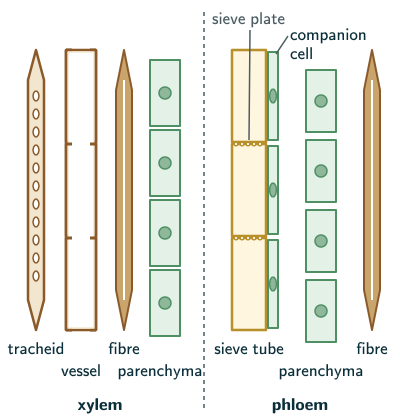
Xylem conducts water and minerals from the roots, and also gives mechanical support. It has four kinds of element:
- Tracheids: elongated, tube-like cells with thick lignified walls and tapering ends; dead.
- Vessels: long tubes made of many cells, the vessel members, joined end to end through openings in their end walls; dead, with lignified walls. Vessels are characteristic of angiosperms. Gymnosperms lack them, except the Gnetales (Gnetum, Ephedra, Welwitschia); some angiosperms, such as Drimys, have none; vessel absence does not make a living species an evolutionary ancestor.
- Xylem fibres: thick-walled, with a small cavity; they give support.
- Xylem parenchyma: living cells that store food and help lateral transport. The school account contrasts them with dead tracheids, vessel elements and fibres; beyond that simplification, some wood fibres retain living contents, as documented in Parenchyma is not the sole site of storage: storage in living fibres (IAWA Journal, 2023).
The first-formed primary xylem is the protoxylem, the later-formed primary xylem the metaxylem. In stems the protoxylem lies towards the centre (endarch; NCERT, dicot stem, page 76); in roots, towards the periphery (exarch).
Phloem carries food. In angiosperms, phloem has four kinds of element:
- Sieve tube elements: long cells joined end to end; their end walls are perforated as sieve plates. A mature sieve tube element has cytoplasm but no nucleus. NCERT’s Chapter 8 gives sieve tube cells as mature cells that lack a nucleus (Section 8.5.10, page 100).
- Companion cells: living cells with a nucleus, beside the sieve tube elements, which they keep working.
- Phloem parenchyma: living cells that store food; absent in most monocotyledons. NCERT states that the phloem parenchyma is absent in the monocot stem (page 76).
- Phloem fibres (bast fibres): sclerenchyma, dead at maturity; generally absent in primary phloem, present in secondary phloem. Jute, flax and hemp fibres are of this kind.
Gymnosperms have sieve cells and albuminous cells in place of sieve tubes and companion cells.
Solved examples
Example 1: Regrowth after grazing
Why can a lawn grass grow again after it is mowed?
Answer: because of its intercalary meristems, at the base of its leaves and internodes, which keep adding new cells even after the tips are cut off.
Example 2: Living and dead
Which elements of xylem are living, and which of phloem lack a nucleus when mature?
Answer: xylem parenchyma is the living element in the usual school comparison; some wood fibres also remain living, so “only” is not universal. In phloem, mature sieve tube elements lack a nucleus but are living (NCERT Chapter 8, page 100); phloem fibres are dead at maturity. Companion cells and phloem parenchyma are living, with nuclei.
Example 3: Collenchyma or sclerenchyma?
Give two differences between collenchyma and sclerenchyma.
Answer: collenchyma cells are living, with uneven cellulose/pectin-rich wall thickening (at corners in angular collenchyma); sclerenchyma cells are usually dead and thickened all over, with lignin.
Example 4: Primary or secondary growth?
Which meristems cause growth in length, and which growth in girth?
Answer: apical (and intercalary) meristems cause growth in length, primary growth; lateral meristems, the vascular cambium and cork cambium, cause growth in girth, secondary growth (NCERT Chapter 13, pages 167–168; the intercalary meristem is in its Summary, page 178).
Example 5: Gymnosperm vascular tissue
Which xylem and phloem elements do gymnosperms lack?
Answer: vessels in the xylem (except the Gnetales), and sieve tubes and companion cells in the phloem; they have tracheids, and sieve cells with albuminous cells, instead.
Common mistakes to avoid
Common mistake
Saying no gymnosperm has vessels
Most gymnosperms lack vessels, but the Gnetales (Gnetum, Ephedra, Welwitschia) have them.
Common mistake
Calling root xylem endarch
In roots the protoxylem lies towards the periphery (exarch); endarch, with protoxylem towards the centre, is the stem arrangement.
Common mistake
Calling the sieve tube dead
A mature sieve tube element has no nucleus, but it is living; the dead element of phloem is the phloem fibre.
Quick revision summary
- Tissues are meristematic (apical, lateral, intercalary) or permanent (simple, complex) (NCERT Summary, page 77).
- Apical and intercalary meristems cause primary growth (length); lateral meristems, vascular and cork cambium, cause secondary growth (girth).
- Simple tissues: parenchyma (living, thin walls), collenchyma (living, corners thickened), sclerenchyma (dead, lignified: fibres and sclereids).
- Xylem: tracheids and vessel elements dead at functional maturity; fibres usually dead; parenchyma living. Some wood fibres remain living. Gymnosperms generally lack vessels, except Gnetales.
- Phloem: sieve tube elements (no nucleus when mature), companion cells, phloem parenchyma, phloem fibres; gymnosperms have sieve cells and albuminous cells instead.
Formula sheet
- meristems: apical, intercalary (length); lateral (girth)
- simple tissues: parenchyma, collenchyma, sclerenchyma
- sclerenchyma: fibres and sclereids (usually dead at maturity, thick walls)
- xylem: tracheids, vessels, fibres, living parenchyma; some fibres also living
- phloem: sieve tubes, companion cells, parenchyma, fibres
- gymnosperms: no vessels (except Gnetales); sieve cells, albuminous cells
Questions students ask
What is the difference between xylem and phloem?
Xylem conducts water and minerals from the roots to the rest of the plant and also gives mechanical support, while phloem carries assimilates from sources to sinks. Leaves are common sources, but a germinating seed or mobilised storage organ can also supply growing sinks. Water in the xylem moves mainly upwards, while food in the phloem can move up or down. Most xylem elements are dead at maturity, with thick lignified walls, while most phloem elements are living; xylem conducts through tracheids and vessels, phloem through sieve tubes kept working by companion cells.
What is the difference between meristematic and permanent tissue?
Meristematic tissue is made of cells that keep dividing, while permanent tissue is made of differentiated cells normally specialised for a particular job rather than actively dividing; some living cells can resume division by dedifferentiation. Meristematic cells are small and compactly packed, with thin cellulose walls, dense cytoplasm, prominent nuclei and at most small vacuoles; permanent cells are usually larger, often with a large vacuole, and may be living, like parenchyma, or dead at maturity, like most sclerenchyma. Meristems are found only in certain regions, the root and shoot tips, the intercalary meristems of grasses and the cambia, while permanent tissues make up the rest of the plant body.
Why are sclerenchyma cells dead?
Sclerenchyma cells are usually dead at maturity because, once their thick, evenly lignified walls are complete, the protoplast breaks down, leaving only a narrow empty cavity, the lumen. Their thick walls provide support after cell contents are lost. Do not explain death simply as lignin cutting off water: some lignified fibres remain living, and lignification alone does not prove that a cell is dead.
Are plant tissues in the NEET syllabus?
Plant tissues are in the NEET (UG) 2026 syllabus: Unit 2 lists ‘Morphology and modifications; Tissues; Anatomy and functions of different parts of flowering plants’. The 2026–27 NCERT Class 11 book, however, no longer has a section on meristematic, simple and complex tissues, as NCERT editions before the rationalisation did: Chapter 6 only names them, and Chapter 13 mentions meristems briefly. The tissue systems and the anatomy of dicot and monocot organs are still described in the current book.
Practice questions
Try each question first, then open the answer to check your working.
-
Q1. Name the two lateral meristems.
Show answerHide answer
The vascular cambium and the cork cambium (NCERT page 168).
-
Q2. Where in a primary stem does NCERT place parenchyma?
Show answerHide answer
Usually in the cortex, pericycle, pith and medullary rays (NCERT page 72); in a dicot stem, though, NCERT describes the pericycle as patches of sclerenchyma (page 76).
-
Q3. What are sieve plates?
Show answerHide answer
The perforated end walls between sieve tube elements.
-
Q4. Name a source of commercial bast (phloem) fibre.
Show answerHide answer
Jute (also flax and hemp).