Significance of mitosis
NCERT Class 11 Biology Chapter 10 Section 10.3
Quick answer
Mitosis normally preserves the chromosome complement while increasing cell number for growth, tissue repair and replacement. Dividing stem or progenitor cells replace lost specialised cells, and plant meristems sustain growth. It can occur in haploid as well as diploid cells; NCERT also illustrates restoration of the nucleus-to-cytoplasm ratio after growth.
With your textbook
NCERT Biology (Class 11), Chapter 10 “Cell Cycle and Cell Division”, Section 10.3 “Significance of Mitosis”, page 125.
Open the official NCERT chapter (PDF, 2.5 MB, ncert.nic.in) (opens in a new tab)
Checked against the 2026-27 reprint on .
Significance of mitosis
Why mitosis matters
Mitosis usually results in the production of diploid daughter cells with identical genetic complement.
NCERT Biology (Class 11), Section 10.3, page 125
- Mitosis, the equational division, is usually restricted to diploid cells; but in some lower plants and in some social insects, haploid cells also divide by mitosis (page 125).
In plain words: mitosis makes copies. In normal division, daughter cells receive the same chromosome complement as the parent, so a body can grow, repair itself and replace worn-out cells while normally preserving its chromosome complement.
Growth and the nucleo-cytoplasmic ratio
- Mitosis increases cell number and contributes to the growth of multicellular organisms (page 125).
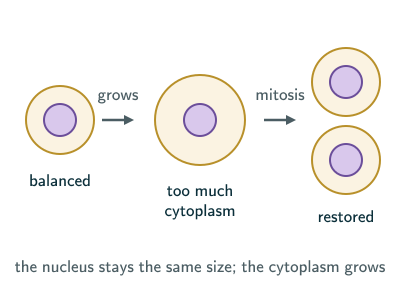
- NCERT uses restoration of the nucleo-cytoplasmic ratio after growth as a reason for division (page 125). This is a simplified model: it does not mean the nucleus must remain fixed in size or that all growing cells must immediately divide. Cell-cycle controls coordinate growth, DNA replication and division.
Cell repair
A very significant contribution of mitosis is tissue repair and cell replacement. The cells of the upper layer of the epidermis, the cells lining the gut and blood cells are constantly being replaced (page 125); Replacement comes from dividing stem/progenitor cells; mature shed epidermal cells and mature red blood cells do not themselves divide. The epidermis and the gut lining are both epithelia.
Growth from meristems in plants
Mitotic divisions in the meristematic tissues give plants continuous growth throughout their life (page 125).
NCERT’s phrase for these tissues is “the apical and the lateral cambium” (page 125); read it as the apical meristems and the lateral meristems. Only the lateral meristems, the vascular cambium and the cork cambium, are cambia; the apical meristems at the tips of roots and shoots are not called cambium (NCERT Chapter 13, pages 167–168).
Solved examples
Example 1: Three roles of mitosis
Give three roles of mitosis in a multicellular organism.
Answer: growth of the organism, restoring the nucleo-cytoplasmic ratio after cell growth, and cell repair, such as the replacement of epidermal, gut-lining and blood cells (NCERT page 125).
Example 2: Identical daughters
Why does normal mitosis usually give daughter cells with the same genetic complement?
Answer: in S phase every chromosome is copied into two identical sister chromatids; mitosis sends one chromatid of each chromosome to each daughter, so both daughters normally get the same chromosome set as the parent. Replication errors or chromosome-segregation errors can create differences (NCERT pages 121, 123 and 125).
Example 3: The ratio after growth
A cell doubles its cytoplasm while its nucleus stays the same size. What happens to the ratio of nucleus to cytoplasm, and how is it restored?
Answer: the ratio halves (1 ÷ 2), since the same nucleus now serves twice the cytoplasm; under the simplified model, two daughter nuclei each of the original volume, with half the enlarged cytoplasm apiece, restore the original ratio (idea from NCERT page 125).
Example 4: Haploid cells that do and do not divide (NCERT Exercise 13)
Name (i) haploid insects and lower plants in which cells divide, and (ii) some haploid cells in higher plants that do not divide.
Answer: (i) male honey bees are haploid, and their cells divide by mitosis (NCERT page 122); in bryophytes the main plant body, the gametophyte, is haploid and grows by mitosis (NCERT Chapter 3, page 29). (ii) In gymnosperms, meiosis gives four haploid megaspores, but only one develops into the female gametophyte (NCERT Chapter 3, page 33); beyond the NCERT text, the other three degenerate without dividing.
Common mistakes to avoid
Common mistake
Saying mitosis never occurs in haploid cells
In some lower plants and some social insects, haploid cells divide by mitosis (NCERT page 125).
Common mistake
Calling the apical meristem a cambium
The cambia are lateral meristems (vascular and cork cambium); apical meristems are not cambia (NCERT Chapter 13, pages 167–168).
Quick revision summary
- Mitosis gives diploid daughter cells with an identical genetic complement; it is usually in diploid cells, but haploid cells of some lower plants and social insects also divide by mitosis.
- It causes growth, restores the nucleo-cytoplasmic ratio, and repairs tissues (epidermis, gut lining, blood cells).
- Mitosis in meristems gives plants lifelong growth.
Formula sheet
- normal mitosis: daughter nuclei retain the parent chromosome complement
- roles: growth, nucleo-cytoplasmic ratio, cell repair
- plants: continuous growth from meristems
Questions students ask
Does mitosis produce haploid or diploid cells?
Mitosis produces daughter cells with the same chromosome number as the parent cell, so a diploid cell gives diploid cells and a haploid cell gives haploid cells; it never halves the number, which is the work of meiosis (NCERT pages 122 and 125). Most mitosis takes place in diploid cells, so it usually gives diploid daughter cells. Male honey bees show the haploid case: they are haploid, with 16 chromosomes against 32 in the diploid females, and produce their sperms by mitosis (NCERT Class 12 Biology, Section 4.6.2, page 71).
How is the significance of mitosis different from that of meiosis?
Mitosis keeps the chromosome number and the genetic complement of the parent cell, so its significance lies in growth, cell repair and restoring the nucleo-cytoplasmic ratio, while meiosis halves the chromosome number, and its significance lies in keeping each species’ chromosome number constant across generations and in increasing genetic variability (NCERT pages 125 and 128). Mitosis normally preserves the nuclear genetic complement during growth and replacement; meiosis, with fertilisation, links one generation to the next and gives each offspring a new mix of genes. See the significance of meiosis for both roles of meiosis.
What is the importance of mitosis in asexual reproduction?
Mitosis is the cell division behind asexual reproduction in eukaryotes: because it gives daughter cells with an identical genetic complement (NCERT page 125), offspring formed from one parent by mitotic divisions share its genetic make-up, as with the gemmae of liverworts, green, multicellular, asexual buds (NCERT Chapter 3, page 29). Beyond the NCERT text, such offspring are clones, and in unicellular eukaryotes such as yeast and Amoeba one mitotic division is itself reproduction. Bacteria, being prokaryotes, do not divide by mitosis: they reproduce mainly by fission (NCERT Chapter 2, page 14).
Practice questions
Try each question first, then open the answer to check your working.
-
Q1. Name three kinds of cells that NCERT says are constantly replaced.
Show answerHide answer
Cells of the upper layer of the epidermis, cells lining the gut, and blood cells (NCERT page 125).
-
Q2. Why must a growing cell divide, according to NCERT?
Show answerHide answer
Growth disturbs the ratio between the nucleus and the cytoplasm, and division restores the nucleo-cytoplasmic ratio (NCERT page 125).