Sex determination
NCERT Class 12 Biology Chapter 4 Section 4.6
Quick answer
XO and XY systems illustrate male heterogamety, while birds have ZW females and ZZ males. The typical human chromosome model predicts roughly equal XX and XY outcomes; neither parent chooses the fertilising sperm. Honey bees usually have diploid females and haploid drones, but complementary sex determination can also produce diploid males.
With your textbook
NCERT Biology (Class 12), Chapter 4 “Principles of Inheritance and Variation”, Section 4.6 “Sex Determination”, pages 69–71.
Open the official NCERT chapter (PDF, 19.2 MB, ncert.nic.in) (opens in a new tab)
Checked against the 2026-27 reprint on .
How is sex determined?
Sex chromosomes and autosomes
Due to the involvement of the X-chromosome in the determination of sex, it was designated to be the sex chromosome, and the rest of the chromosomes were named as autosomes.
NCERT Biology (Class 12), Section 4.6, page 70
- The clues to a chromosomal basis of sex came from cytological observations in insects (page 69).
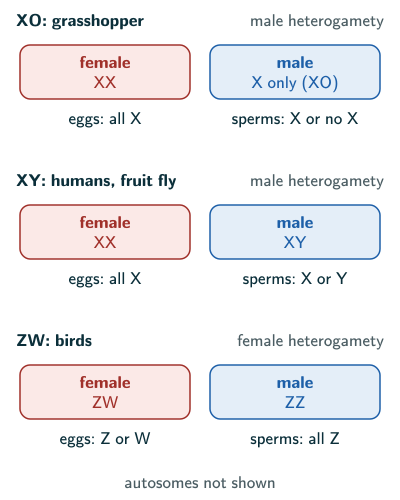
- The main types are XO and XY, where the male makes two kinds of gametes (male heterogamety), and ZW, in birds, where the female does (female heterogamety) (pages 70–71).
In plain words: in many animals one pair of chromosomes differs between the sexes. In these simplified chromosome models, the heterogametic parent supplies either of two sex-chromosome types. Typical human sperm carry X or Y; bird eggs carry Z or W. Neither parent consciously chooses which gamete takes part.
Henking’s X body
- Henking (1891) traced a particular nuclear structure all through spermatogenesis in a few insects (page 69).
- He saw that 50 per cent of the sperms received this structure and the other 50 per cent did not. He named it the X body, but could not explain its significance (page 69).
- Later work showed that Henking’s X body was in fact a chromosome, hence the name X-chromosome (pages 69–70).
XO type in grasshoppers
- In a large number of insects sex determination is of the XO type: all eggs carry an additional X-chromosome besides the autosomes, while some sperms carry the X-chromosome and some do not (page 70).
- An egg fertilised by a sperm with an X becomes a female; an egg fertilised by a sperm without an X becomes a male (page 70).
- The grasshopper is an example: the males have only one X-chromosome besides the autosomes, and the females a pair of X-chromosomes (page 70).
- NCERT asks whether males and females have the same number of chromosomes (page 70). In the XO type they do not: the male has one chromosome fewer, because he has one X where the female has two.
Here O means absence of a second sex chromosome, not a chromosome named O.
XY type in humans and the fruit fly
- In a number of other insects and in mammals, including humans, sex determination is of the XY type, and both sexes have the same number of chromosomes (page 70).
- In humans the male typically has an X-chromosome and a smaller Y-chromosome; the female has a pair of X-chromosomes. Both sexes have the same number of autosomes: males are autosomes + XY, females autosomes + XX (page 70).
- In humans and in Drosophila the males have one X and one Y, and the females a pair of X-chromosomes besides the autosomes (NCERT Figure 4.12 a, b, page 70).
Same chromosome notation, different mechanism: human testis development usually involves the Y-linked SRY gene and downstream pathways. In Drosophila, X-chromosome dosage relative to the autosomal background controls the sex pathway; the Y is important for male fertility, not the primary male-determining switch (NCBI Developmental Biology).
Male and female heterogamety
- In both the XO and the XY type, the males produce two different types of gametes: with or without an X, or with an X or a Y. This is male heterogamety (page 70).
- In birds the total number of chromosomes is the same in both sexes, but it is the females that produce two types of gametes with respect to the sex chromosomes: female heterogamety (pages 70–71).
- To keep it distinct, the two different sex chromosomes of a female bird are called Z and W: females are ZW and males ZZ, besides the autosomes (page 71).
- NCERT asks whether the sperm or the egg is responsible for the sex of the chicks (page 71). The egg is: every sperm carries a Z, while an egg carries either Z or W, so a Z egg gives a male (ZZ) and a W egg a female (ZW).
Sex determination in humans
- The typical human model has 23 chromosome pairs: 22 autosomal pairs and XX in females or XY in males (page 71). “Same autosomes” means the same chromosome types, not identical DNA sequences in different people.
- During spermatogenesis two types of sperms are produced: 50 per cent carry X and 50 per cent carry Y, besides the autosomes. Females produce only one type of ovum, with an X (page 71).
- Fertilisation by an X-carrying or a Y-carrying sperm is equally likely. An X sperm gives a female (XX) and a Y sperm a male (XY) (page 71).
Thus, it is evident that it is the genetic makeup of the sperm that determines the sex of the child.
NCERT Biology (Class 12), Section 4.6.1, page 71
- The Mendelian model predicts approximately ½ XX and ½ XY independently for each fertilisation. This is a teaching probability, not an exact observed birth ratio or a complete account of sex development.
- NCERT adds that it is unfortunate that women are blamed for giving birth to female children, and have been ostracised and ill-treated because of this false notion (page 71). The typical chromosome model disproves that blame; it does not transfer blame to the father. Neither parent chooses the fertilising sperm. Variations in chromosomes, genes and hormonal development mean that XX/XY alone does not describe every individual (NHS differences in sex development).
Sex determination in honey bee
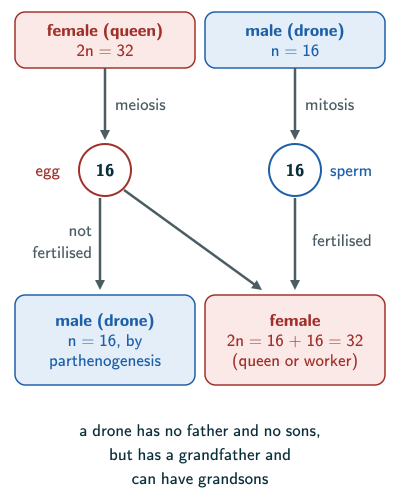
- NCERT presents the honey bee’s usual haplodiploid pattern using chromosome sets (page 71). The following rules describe ordinary haploid drones and diploid females.
- An offspring formed from the union of a sperm and an egg develops as a female (queen or worker). An unfertilised egg develops as a male (drone), by parthenogenesis (page 71).
- So the females are diploid, with 32 chromosomes, and the males haploid, with 16: the haplodiploid sex-determination system (page 71).
- Special features: the males produce sperms by mitosis, because they are already haploid. A male has no father, because he comes from an unfertilised egg, and cannot have sons, because sons also come only from unfertilised eggs; but he has a grandfather and can have grandsons (page 71). NCERT links the two with “thus”; both follow from males coming from unfertilised eggs.
Biological qualification: chromosome count alone is not the complete mechanism. At the honey bee’s complementary sex-determination locus, diploid heterozygotes develop as females, while diploid homozygotes can develop as males (Beye and colleagues, 2003). The “no father/no sons” rule below applies to NCERT’s ordinary haploid-drone model, not these exceptional diploid males.
NCERT slip (page 71): in NCERT Figure 4.13 (page 71) the arrow to the female offspring (32) starts from the male’s gamete alone, and the arrow to the male offspring (16) from the female’s gametes. The text is the guide: a female comes from an egg (16) fertilised by a sperm (16), 16 + 16 = 32, and a male from an unfertilised egg (page 71). Also, NCERT numbers two different figures 4.13: this one and the pedigree symbols on page 72. In a diagram you draw, join the egg and the sperm to give the female.
Solved examples
Example 1: Sex determination in humans (NCERT Exercise 11)
How is sex determined in human beings?
Answer (typical NCERT chromosome model): humans have the XY type. A woman has 22 pairs of autosomes and XX; a man has 22 pairs of autosomes and XY. All ova carry an X; half the sperms carry an X and half a Y. If an X-carrying sperm fertilises the ovum, the zygote is XX and develops into a girl; if a Y-carrying sperm does, it is XY and develops into a boy. The fertilising sperm supplies X or Y, with a ½ probability for each in this simplified model (NCERT page 71).
Example 2: Counting chromosomes in an XO insect
In an insect with the XO type, a female has 22 autosomes and two X-chromosomes. How many chromosomes does the male have, and what kinds of sperm does he make?
Answer: the male has the same 22 autosomes but only one X: 22 + 1 = 23, one fewer than the female’s 22 + 2 = 24. Each sperm gets half the autosomes, 11, and either the X or no X: sperms with 12 chromosomes (11 + X) and with 11 (no X), in equal numbers. A 12-chromosome sperm gives a female (24), an 11-chromosome sperm a male (23) (NCERT page 70).
Example 3: Who decides a chick’s sex?
In birds, is the sperm or the egg responsible for the sex of the chicks? What fraction of chicks would you expect to be female?
Answer: the egg. Males are ZZ, so every sperm carries Z; females are ZW, so half the eggs carry Z and half W. Z egg + Z sperm = ZZ, male; W egg + Z sperm = ZW, female. So ½ of the chicks are expected to be female (NCERT page 71).
Example 4: A drone’s family
In NCERT’s ordinary haploid-drone model, explain why a drone has no father but has a grandfather.
Answer: a drone develops from an unfertilised egg of the queen, so he has a mother but no father. The queen herself came from a fertilised egg, so she had a father, a drone; that drone is the drone’s grandfather. In the same way, a drone’s sperms fertilise eggs that become females (his daughters), never sons, but his daughters’ unfertilised eggs become his grandsons (NCERT page 71).
Common mistakes to avoid
Common mistake
Blaming the mother for the sex of the child
In the typical model the egg contributes X and the sperm contributes X or Y. Neither parent chooses the outcome; blaming either parent is unjustified.
Common mistake
Calling male birds heterogametic
In birds the females are ZW and make two kinds of eggs (female heterogamety); males are ZZ (NCERT page 71).
Common mistake
Writing that drones make sperms by meiosis
Drones are haploid (16 chromosomes) and produce sperms by mitosis (NCERT page 71).
Common mistake
Giving XO males and females the same chromosome number
In the XO type the male has one X fewer than the female; it is in the XY type that both sexes have the same number (NCERT page 70).
Quick revision summary
- Henking (1891) found the X body in insect spermatogenesis, in 50 per cent of sperms; it is the X-chromosome.
- The chromosome involved in sex determination is the sex chromosome; the rest are autosomes.
- XO type (grasshopper): female XX, male X only; XY type (humans, fruit fly): female XX, male XY. Both are male heterogamety.
- ZW type (birds): female ZW, male ZZ: female heterogamety; the egg decides the sex.
- Typical human chromosome model: 22 autosomal pairs plus XX or XY; expected X:Y sperm ratio 1:1. Chromosomes are one part of sex development.
- Honey bee, ordinary NCERT model (diploid-male exceptions exist): fertilised egg → female, 32 chromosomes; unfertilised egg → male (drone), 16, by parthenogenesis; drones make sperms by mitosis.
Formula sheet
- XO: female XX, male XO; XY: female XX, male XY → male heterogamety
- ZW: female ZW, male ZZ → female heterogamety
- humans: 22 pairs of autosomes + XX (female) or XY (male)
- typical human chromosome model: X:Y sperm = 1:1; XX:XY offspring ≈ 1:1
- honey bee: female 2n = 32 (fertilised); male n = 16 (unfertilised)
Questions students ask
What is the difference between sex chromosomes and autosomes?
Sex chromosomes are the chromosomes involved in determining sex, which differ between males and females, while autosomes are all the others, carried alike by both sexes: the X-chromosome was designated a sex chromosome because of its role in sex determination, and the rest were named autosomes (NCERT pages 70 and 77). In humans 22 pairs are autosomes, and the pair of sex chromosomes is XX in a female and XY in a male (page 71). Sex chromosomes also carry genes for other traits, such as the X-linked genes behind red–green colour blindness and haemophilia (pages 73–74).
Is sex always determined by sex chromosomes?
No, sex is not always determined by sex chromosomes: in the honey bee NCERT bases it on the number of sets of chromosomes an individual receives (page 71). Beyond the NCERT text, a sea turtle’s sex “is determined by the temperature in the nest” (NOAA Fisheries, 2022), eggs incubated warm hatching mostly as females and cool ones mostly as males. So the sex-chromosome mechanisms of NCERT pages 70–71 explain sex in many animals, but not in every animal.
What decides whether a female honey bee becomes a queen or a worker?
Beyond the NCERT text, larval feeding, not a difference in chromosomes, decides whether a female honey bee becomes a queen or a worker (US Agricultural Research Service, 2020); NCERT says only that both castes develop from fertilised eggs (page 71). Also beyond the NCERT text, larvae destined to be queens receive royal jelly and, through their whole larval life, larger rations than future workers, and the service’s trials at Fargo showed that the quantity of jelly matters, not only its kind.
Practice questions
Try each question first, then open the answer to check your working.
-
Q1. Who first described the X body, and in which year?
Show answerHide answer
Henking, in 1891, in the spermatogenesis of a few insects (NCERT page 69).
-
Q2. Which type of sex determination is found in birds, and which sex is heterogametic?
Show answerHide answer
The ZW type; the female (ZW) is heterogametic and the male is ZZ (NCERT pages 70–71).
-
Q3. In NCERT’s ordinary haploid-drone model, why can a drone not have a son?
Show answerHide answer
Sons develop from unfertilised eggs, so the drone’s sperms play no part in them; any egg his sperm fertilises becomes a female (NCERT page 71).