Inheritance of two genes: the dihybrid cross
NCERT Class 12 Biology Chapter 4 Section 4.3
Quick answer
A dihybrid cross predicts 9:3:3:1 when loci assort independently, each shows complete dominance, and other model assumptions hold. Linked loci can deviate from independent assortment; parental gametes exceed recombinants when recombination is below 50%. Chromosome behaviour explains segregation, while recombination frequencies help build genetic maps.
With your textbook
NCERT Biology (Class 12), Chapter 4 “Principles of Inheritance and Variation”, Section 4.3 “Inheritance of Two Genes”, pages 62–68.
Open the official NCERT chapter (PDF, 19.2 MB, ncert.nic.in) (opens in a new tab)
Checked against the 2026-27 reprint on .
What happens when two genes are inherited together?
Law of independent assortment
The law states that ‘when two pairs of traits are combined in a hybrid, segregation of one pair of characters is independent of the other pair of characters’.
NCERT Biology (Class 12), Section 4.3.1, page 64
- A dihybrid cross follows inheritance at two loci, illustrated here by plants differing in two traits (page 64).
- Genes on the same chromosome need not assort independently: they are linked, and new combinations of them arise by recombination (page 67).
In plain words: when two characters, such as seed colour and seed shape, are controlled by genes on different chromosomes, the way one pair of alleles goes into the gametes has no effect on the other pair. Morgan later found that genes sitting on the same chromosome tend to stay together.
The dihybrid cross
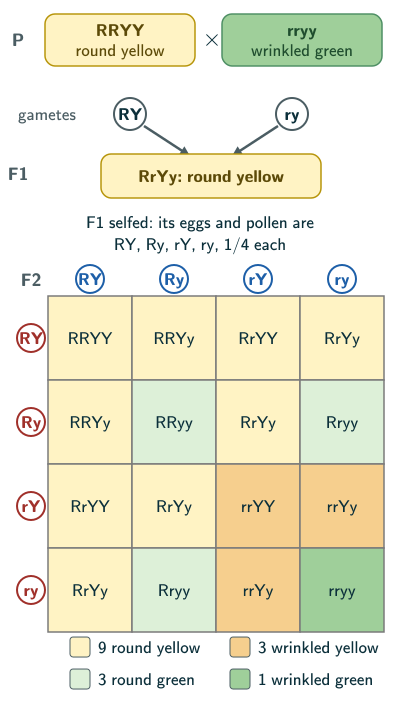
- Mendel crossed a pea plant with yellow, round seeds and one with green, wrinkled seeds (page 62).
- The F seeds were all yellow and round: yellow is dominant over green and round over wrinkled, just as in separate monohybrid crosses (page 62).
- Symbols: Y yellow, y green, R round, r wrinkled. The parents are RRYY and rryy; their gametes RY and ry unite to give the F hybrid RrYy (page 62).
- When the F plants were self-hybridised, ¾ of the F plants had yellow seeds and ¼ green, a 3 : 1 ratio; round and wrinkled also segregated 3 : 1, just as in a monohybrid cross (page 62).
- Taken together, the four F phenotypes, round yellow, wrinkled yellow, round green and wrinkled green, appeared in the ratio 9 : 3 : 3 : 1, and Mendel found such a ratio for several pairs of characters (page 64).
The law of independent assortment
- Assuming independent assortment, complete dominance at each locus, no epistasis and equal survival, the expected 9:3:3:1 ratio is two 3:1 ratios combined (page 64): (3 round : 1 wrinkled) × (3 yellow : 1 green) = 9 round yellow : 3 wrinkled yellow : 3 round green : 1 wrinkled green.
- From such dihybrid crosses Mendel proposed his Law of Independent Assortment, quoted at the top of this page (page 64).
- In the F (RrYy), 50 per cent of the gametes carry R and 50 per cent r. Independently, 50 per cent carry Y and 50 per cent y. So half the R gametes have Y and half y, and the same for the r gametes (page 64).
- That gives four kinds of gametes, RY, Ry, rY and ry, each 25 per cent (¼), as pollen and as eggs. Written along the two sides of a Punnett square, they give the 16 squares of the F (page 64).
NCERT asks how many genotypes and phenotypes the 16 squares hold, and whether the genotypic ratio is also 9 : 3 : 3 : 1 (page 64). Counting the squares:
| Genotype | Squares (of 16) | Phenotype |
|---|---|---|
| RRYY | 1 | round yellow |
| RRYy | 2 | round yellow |
| RrYY | 2 | round yellow |
| RrYy | 4 | round yellow |
| rrYY | 1 | wrinkled yellow |
| rrYy | 2 | wrinkled yellow |
| RRyy | 1 | round green |
| Rryy | 2 | round green |
| rryy | 1 | wrinkled green |
So there are 9 genotypes and 4 phenotypes. The genotypic ratio is 1 : 2 : 2 : 4 : 1 : 2 : 1 : 2 : 1, not 9 : 3 : 3 : 1; it is the 1 : 2 : 1 of seed shape combined with the 1 : 2 : 1 of seed colour (our count from the square in NCERT Figure 4.7, page 63).
Chromosomal theory of inheritance
Why Mendel’s work waited till 1900
Mendel presented his findings in 1865 and published them in 1866; NCERT page 64 gives 1865 as publication. The work gained wide recognition around 1900, for four reasons (page 65):
- Communication was not easy in those days, and his work could not be widely publicised.
- His idea of genes (factors) as stable, discrete units, with alleles that do not blend, was not accepted by his contemporaries as an explanation for the apparently continuous variation seen in nature.
- His use of mathematics to explain biology was totally new and unacceptable to many biologists of his time.
- He could not provide any physical proof that factors existed or say what they were made of.
In 1900, three scientists, de Vries, Correns and von Tschermak, independently rediscovered Mendel’s results (page 65).
Chromosomes and genes
- Advances in microscopy let scientists observe cell division carefully. They found structures in the nucleus that appeared to double and divide just before each cell division: the chromosomes, “colored bodies”, as they were seen by staining (page 65).
- By 1902 the movement of chromosomes during meiosis had been worked out. Walter Sutton and Theodore Boveri noted that the behaviour of chromosomes was parallel to the behaviour of genes, and used chromosome movement to explain Mendel’s laws (page 65).
- In the diploid autosomal model, chromosomes and gene copies occur in pairs, and the two alleles of a gene pair sit on homologous sites on homologous chromosomes (page 65).
- NCERT Table 4.3 (page 66) sets the two side by side, as columns A and B, and asks which column is which. Both columns say the same three things in slightly different words: they occur in pairs; they segregate at gamete formation so that only one of each pair goes into a gamete; and one pair segregates independently of another pair. The wording alone cannot uniquely assign A and B; either column describes both, and the parallel itself is the point Sutton and Boveri made.
- In meiosis I, the two chromosome pairs line up at the metaphase plate independently of each other, so either both chromosomes from one parent go to the same pole, or they are split (NCERT Figure 4.9, page 66). This is independent assortment, seen in the chromosomes.
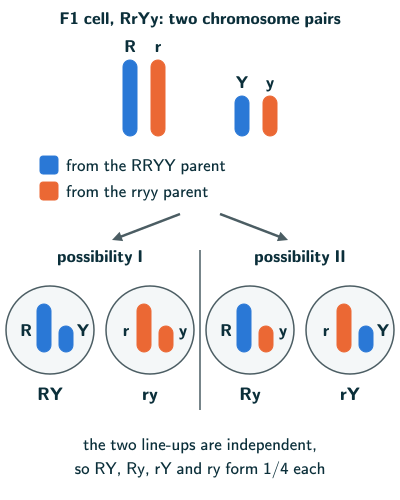
NCERT slip (page 66): NCERT writes “During Anaphase of meiosis I, the two chromosome pairs can align at the metaphase plate independently of each other” (page 66), and the top panels of NCERT Figure 4.9 are labelled as anaphase of meiosis I, though they show the pairs at the plate. The pairs line up at the metaphase plate in metaphase I and separate in anaphase I (NCERT Class 11, Section 10.4.1, pages 126–127). In an exam, write that the pairs align independently at metaphase I.
Sutton united the knowledge of chromosomal segregation with Mendelian principles and called it the chromosomal theory of inheritance.
NCERT Biology (Class 12), Section 4.3.2, page 67
Morgan and the fruit fly
- The chromosomal theory was verified by experiment by Thomas Hunt Morgan and his colleagues, which led to the discovery of the basis for the variation that sexual reproduction produced (page 67).
- Morgan worked with the tiny fruit fly Drosophila melanogaster, very suitable for such studies (page 67):
- it grows on a simple synthetic medium in the laboratory;
- it completes its life cycle in about two weeks;
- a single mating can produce a large number of progeny flies;
- the male and female flies are easily told apart;
- it has many types of hereditary variations that can be seen with low power microscopes.
Linkage and recombination
- Morgan carried out several dihybrid crosses in Drosophila to study sex-linked genes. For example, he crossed yellow-bodied, white-eyed females with brown-bodied, red-eyed males and intercrossed their F progeny (page 67).
- The linked genes produced excess parental combinations. NCERT compares this with 9:3:3:1 (page 67), but that ratio belongs to an autosomal double-heterozygote cross under complete dominance. For the stated X-linked cross, the F female is heterozygous and the F male carries the recessive X; independent loci would give four phenotype combinations at ¼ each, not 9:3:3:1. Match the expected ratio to the actual sexes and genotypes.
- Both genes were on the X chromosome, and when the two genes of a dihybrid cross were on the same chromosome, the parental gene combinations were much more common than the non-parental ones (page 67).
Morgan attributed this due to the physical association or linkage of the two genes and coined the term linkage to describe this physical association of genes on a chromosome and the term recombination to describe the generation of non-parental gene combinations
NCERT Biology (Class 12), Section 4.3.3, page 67
- Genes on the same chromosome can be tightly linked (very low recombination) or loosely linked (higher recombination). The genes white and yellow showed only 1.3 per cent recombination; white and miniature wing showed 37.2 per cent (page 67; NCERT Figure 4.11, page 68).
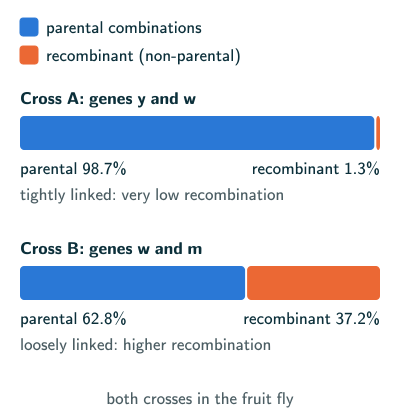
- Morgan’s student Alfred Sturtevant used the frequency of recombination between gene pairs on the same chromosome as a measure of the distance between them, and so “mapped” their positions on the chromosome. Genetic maps are now a starting point for sequencing whole genomes, as in the Human Genome Sequencing Project (pages 67–68). NCERT’s Summary adds: “Closely located genes assorted together, and distantly located genes, due to recombination, assorted independently” (page 77). Beyond the NCERT text: the recombination frequency of widely separated loci on one chromosome reaches 50 per cent; so recombination frequency is not a direct physical ruler over long distances (Wikipedia, “Genetic linkage”, facts in our words).
- For linked loci, recombinant chromatids arise through crossing over, exchange between non-sister chromatids of homologous chromosomes in pachytene of prophase I, which NCERT describes with meiosis in Class 11 (NCERT Class 11, Section 10.4.1, page 126).
NCERT slip (page 67): NCERT says Morgan’s group knew the genes were on the X chromosome “(Section 4.4)”, but the X chromosome is explained in Section 4.6, Sex Determination (pages 69–70); Section 4.4 is Polygenic Inheritance. The reference follows the contents list on page 53, which numbers Sex Determination 4.4. In an answer, refer to sex determination by name.
Solved examples
Example 1: Two genes, two kinds of parent (NCERT Exercise 7)
A tall plant with yellow seeds (TtYy) is crossed with a tall plant with green seeds (Ttyy). What proportion of the offspring would be (a) tall and green, (b) dwarf and green?
Answer: take each gene on its own, then multiply (the genes assort independently).
- Height: Tt × Tt gives ¾ tall and ¼ dwarf.
- Seed colour: Yy × yy gives ½ yellow (Yy) and ½ green (yy).
- (a) tall and green: ¾ × ½ = ⅜;
- (b) dwarf and green: ¼ × ½ = ⅛.
Example 2: Gametes from four heterozygous loci (NCERT Exercise 3)
A diploid organism is heterozygous for 4 loci. How many types of gametes can it produce?
Answer: each heterozygous locus gives 2 kinds of gamete, and with independent assortment the choices multiply: 2 × 2 × 2 × 2 = 2 = 16 types. (For two loci, RrYy, this gives the 2 = 4 types RY, Ry, rY and ry of NCERT page 64.) If some loci are linked, the 16 types no longer form in equal numbers (with complete linkage the recombinant types do not form at all); 16 is the count for loci that assort independently.
Example 3: Two linked loci (NCERT Exercise 8)
Two heterozygous parents are crossed. If the two loci are linked, what would be the distribution of phenotypic features in the offspring (F) of this dihybrid cross?
Answer (our working, from NCERT pages 64 and 67): let both parents be AaBb, with A and B on one chromosome and a and b on its homologue.
- If the linkage were complete and each parent carried A with B (AB on one chromosome, ab on the other), each would make only AB and ab gametes, ½ each: ¼ AABB, ½ AaBb, ¼ aabb, 3 with both dominant traits : 1 with both recessive traits.
- If instead each parent carried A with b (Ab and aB), complete linkage gives ¼ AAbb, ½ AaBb, ¼ aaBB: 1 : 2 : 1 (A only : both : B only).
- With recombination, recombinant gametes (Ab and aB, or AB and ab) also form. There are very few when the genes are tightly linked (white and yellow, 1.3 per cent) and more when they are loosely linked (white and miniature wing, 37.2 per cent). The phenotype frequencies depend on linkage phase, recombination fraction and the cross; parental gamete combinations exceed recombinant gametes when recombination is below 50%. One cannot assign a universal linked F ratio without these details.
NCERT prints “dibybrid” in this Exercise; it means dihybrid.
Example 4: Morgan’s contribution (NCERT Exercise 9)
Briefly mention the contribution of T.H. Morgan in genetics.
Answer: Morgan verified the chromosomal theory of inheritance by experiment, working with the fruit fly. From dihybrid crosses of sex-linked genes he found that closely linked genes depart from independent assortment, and coined the terms linkage and recombination. He showed that some genes are tightly linked (white and yellow, 1.3 per cent recombination) and others loosely (white and miniature wing, 37.2 per cent). His student Sturtevant used these frequencies to map genes on a chromosome (NCERT page 67).
Common mistakes to avoid
Common mistake
Expecting a 9 : 3 : 3 : 1 genotypic ratio
9 : 3 : 3 : 1 is the phenotypic ratio of the F. The 16 squares hold 9 genotypes in the ratio 1 : 2 : 2 : 4 : 1 : 2 : 1 : 2 : 1 (NCERT Figure 4.7, page 63).
Common mistake
Applying independent assortment to linked genes
Genes close together on one chromosome stay together far more often than chance predicts, so their F departs from 9 : 3 : 3 : 1 (NCERT page 67). The farther apart they lie, the more they recombine (white and miniature wing, 37.2 per cent). Distantly located genes, due to recombination, assort independently (NCERT Summary, page 77). Beyond the NCERT text: the recombination frequency of widely separated loci on one chromosome reaches 50 per cent (Wikipedia, “Genetic linkage”, facts in our words).
Common mistake
Reading low recombination as weak linkage
A low recombination frequency means tight linkage: white and yellow, at 1.3 per cent, are more tightly linked than white and miniature wing, at 37.2 per cent (NCERT pages 67–68).
Quick revision summary
- A dihybrid cross, RRYY × rryy, gives an all round yellow F, RrYy.
- The F shows 9 round yellow : 3 wrinkled yellow : 3 round green : 1 wrinkled green, two 3 : 1 ratios combined.
- Law of independent assortment: one pair of characters segregates independently of the other; the F makes RY, Ry, rY and ry, ¼ each.
- Mendel’s 1865 presentation/1866 publication gained renewed recognition in 1900 by de Vries, Correns and von Tschermak.
- Sutton and Boveri matched chromosome behaviour to gene behaviour: the chromosomal theory of inheritance.
- Morgan, working with the fruit fly: linkage keeps genes on one chromosome together; recombination makes non-parental combinations.
- Recombination frequency: 1.3 per cent (tight) for white and yellow, 37.2 per cent (loose) for white and miniature wing; Sturtevant used it to map genes.
Formula sheet
- dihybrid cross: RRYY × rryy → F RrYy (round yellow)
- F gametes: RY, Ry, rY, ry, ¼ each
- F phenotypes: (3 : 1)(3 : 1), that is 9 : 3 : 3 : 1
- F: 16 squares, 9 genotypes, 4 phenotypes
- gamete types from n heterozygous unlinked loci = 2n
- linked loci with r<50%: parental gametes exceed recombinant gametes
- white–yellow 1.3%: tight; white–miniature wing 37.2%: loose
Questions students ask
What is the difference between linkage and recombination?
Linkage is the “physical association of genes on a chromosome”, which keeps their parental combinations together, while recombination is “the generation of non-parental gene combinations”: Morgan coined both terms from his crosses in Drosophila (NCERT page 67). Recombination is not limited to linked genes: in the RrYy hybrid of RRYY × rryy, the non-parental gametes Ry and rY make up half of all gametes, as the two genes assort independently (our working from NCERT page 64). For linked genes, recombinants arise only when crossing over occurs between them, so in Morgan’s crosses they made up less than half (NCERT page 67).
What is the difference between the law of segregation and the law of independent assortment?
The law of segregation concerns the two alleles of one gene, which separate so that “a gamete receives only one of the two factors” (NCERT page 59), while the law of independent assortment concerns different genes, whose allele pairs segregate independently (page 64). So segregation holds even for linked genes, as a linked Aa still gives ½ A and ½ a gametes, but independent assortment fails for them: Morgan found that two genes on the X chromosome “did not segregate independently of each other” (NCERT page 67).
How is recombination frequency used to map genes?
Recombination frequency, the percentage of offspring with non-parental gene combinations, is used as a measure of the distance between two genes on one chromosome: Morgan’s student Alfred Sturtevant used it to ‘map’ their positions (NCERT page 67). For example, if genes A and B recombine in 8 per cent of offspring, B and C in 5 per cent, and A and C in 13 per cent, then B lies between A and C, since 8 + 5 = 13. Beyond the NCERT text, the unit of such maps is the centimorgan, a 1 per cent chance of recombination between two markers in meiosis, named after Morgan (NHGRI).
Practice questions
Try each question first, then open the answer to check your working.
-
Q1. Differentiate between a monohybrid and a dihybrid cross. (NCERT Exercise 2 c)
Show answerHide answer
A monohybrid cross follows one character: true-breeding parents that differ in it are crossed (TT × tt), and their F, Tt, heterozygous for the genes of that one character, is a monohybrid (NCERT page 57). A dihybrid cross follows two characters at once, between plants differing in two traits (RRYY × rryy), giving the F hybrid RrYy (NCERT pages 62 and 64).
-
Q2. Out of 1600 F plants from RrYy × RrYy, how many would you expect to have round green seeds?
Show answerHide answer
Round green is 3 of the 16 squares: 3/16 × 1600 = 300.
-
Q3. Who proposed the chromosomal theory of inheritance? (NCERT Exercise 15)
Show answerHide answer
Sutton and Boveri: they noted that chromosomes behave like genes and used chromosome movement to explain Mendel’s laws, and Sutton united chromosomal segregation with Mendelian principles and called it the chromosomal theory of inheritance (NCERT pages 65 and 67).