Mendel’s experiments on inheritance
NCERT Class 12 Biology Chapter 4 Section 4.1
Quick answer
Mendel used controlled crosses of garden pea to study inheritance and variation. His quantitative experiments used true-breeding lines and seven pairs of contrasting traits, tracing results through generations. True-breeding refers to the trait tested, not identity at every gene.
With your textbook
NCERT Biology (Class 12), Chapter 4 “Principles of Inheritance and Variation”, Section 4.1 “Mendel’s Laws of Inheritance”, pages 54–55.
Open the official NCERT chapter (PDF, 19.2 MB, ncert.nic.in) (opens in a new tab)
Checked against the 2026-27 reprint on .
What did Mendel’s experiments set out to explain?
Inheritance and variation
Inheritance is the process by which characters are passed on from parent to progeny; it is the basis of heredity.
NCERT Biology (Class 12), Chapter 4, Introduction, page 53
- Variation is the degree by which progeny differ from their parents (page 53).
- Genetics is the branch of biology that deals with the inheritance, as well as the variation, of characters from parents to offspring (page 53).
In plain words: children resemble their parents, yet siblings can differ in inherited traits and environmental influences. Gregor Mendel established foundational rules for particular inheritance patterns, by crossing pea plants that differed in one clear character and counting the offspring of each kind over several generations.
Before Mendel: selective breeding
- Humans knew from as early as 8000–1000 B.C. that one of the causes of variation was hidden in sexual reproduction (page 53).
- They used the variation present in wild plants and animals to selectively breed organisms with desirable characters. Through artificial selection and domestication from ancestral wild cows, for example, India has well-known breeds such as Sahiwal cows in Punjab (pages 53–54).
- But our ancestors had very little idea of the scientific basis of inheritance and variation (page 54).
Mendel’s hybridisation experiments on the garden pea
- Gregor Mendel carried out hybridisation experiments on garden peas for seven years (1856–1863) and proposed the laws of inheritance in living organisms (page 54).
- During Mendel’s investigations it was, NCERT says, for the first time that statistical analysis and mathematical logic were applied to problems in biology (page 54); give this in an NCERT-based answer. The safe takeaway is his pioneering quantitative study of inheritance; whether it was literally the first use in all biology is a historical judgement (our reasoning).
- His experiments had a large sampling size, which gave greater credibility to his data, and he confirmed his inferences on successive generations of his plants, showing that his results pointed to general rules of inheritance (page 54).
- He studied characters that showed two opposing traits, such as tall or dwarf plants and yellow or green seeds (page 54).
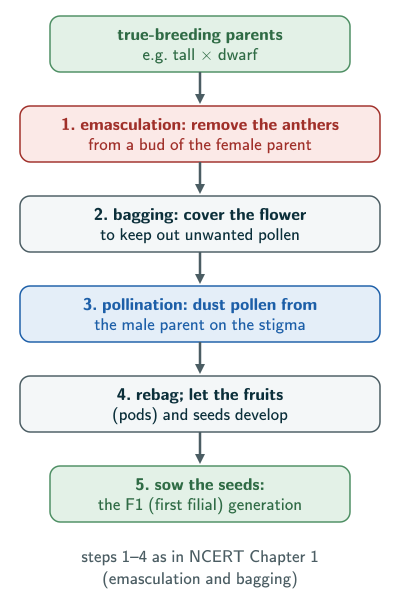
He made the crosses by artificial pollination, in the way described in NCERT Chapter 1: emasculation and bagging of the female parent, then dusting its stigma with pollen from the male parent.
True-breeding lines
A true-breeding line is one that, after continuous self-pollination, shows stable inheritance and expression of a trait for several generations (page 54). True-breeding describes the trait being tested, not necessarily homozygosity at every locus or genetic identity of the entire line. Mendel used several such lines:
Mendel selected 14 true-breeding pea plant varieties, as pairs which were similar except for one character with contrasting traits.
NCERT Biology (Class 12), Section 4.1, page 54
Seven pairs of contrasting traits
NCERT Table 4.1 (page 55) lists the contrasting traits Mendel studied, and NCERT Figure 4.1 (page 54) labels which trait of each pair is dominant, the one seen in the F (page 55):
| Character | Dominant | Recessive |
|---|---|---|
| Stem height | tall | dwarf |
| Flower colour | violet | white |
| Flower position | axial | terminal |
| Pod shape | inflated (full) | constricted |
| Pod colour | green | yellow |
| Seed shape | round | wrinkled |
| Seed colour | yellow | green |
The 14 varieties form these 7 pairs: 7 × 2 = 14 (page 54).
NCERT slip (page 53): the chapter’s opening list of contents numbers Sex Determination, Mutation and Genetic Disorders as 4.4, 4.5 and 4.6, but the NCERT text numbers them Sections 4.6, 4.7 and 4.8, after 4.4 Polygenic Inheritance and 4.5 Pleiotropy. This site follows the text. In an answer, name a section by its title.
Solved examples
Example 1: Why the pea? (NCERT Exercise 1)
Mention the advantages of selecting the pea plant for Mendel’s experiments.
Answer: from NCERT’s account: pea plants can undergo continuous self-pollination, so true-breeding lines, stable over several generations, were available; the characters came as clear, contrasting pairs of traits (tall or dwarf, yellow or green seeds), so offspring could be sorted and counted without doubt; and crosses gave large numbers of offspring, so the counts could be analysed statistically (NCERT page 54). The pea could also be crossed artificially by emasculation and bagging (NCERT Section 1.2.3, page 17).
Example 2: Counting the varieties
Mendel used 14 true-breeding varieties for 7 characters. How many varieties did each character need, and why?
Answer: 14 ÷ 7 = 2 per character: one true-breeding line for each of the two contrasting traits, such as a tall line and a dwarf line, similar for the comparison being studied, not necessarily identical at all other genes (NCERT page 54).
Example 3: Which trait is dominant?
In Mendel’s table, is green pod colour dominant or recessive, and is green seed colour dominant or recessive?
Answer: green pod colour is dominant over yellow pods, but green seed colour is recessive to yellow seeds (NCERT Table 4.1, page 55, and Figure 4.1, page 54). The same colour word can be dominant in one character and recessive in another.
Common mistakes to avoid
Common mistake
Mixing up pod colour and seed colour
In pea, green pods are dominant over yellow pods, while yellow seeds are dominant over green seeds (NCERT Table 4.1, page 55).
Common mistake
Mixing up a character and a trait
The character is the feature, such as seed colour; the traits are its two contrasting forms, yellow and green. Mendel studied 7 characters, using 14 varieties (NCERT page 54; Table 4.1, page 55).
Quick revision summary
- Inheritance passes characters from parent to progeny; variation is how much progeny differ; genetics studies both.
- Selective breeding is ancient (8000–1000 B.C.; Sahiwal cows), but its scientific basis came with Mendel.
- Mendel crossed garden peas for seven years (1856–1863), using statistics, large samples and successive generations.
- A true-breeding line keeps a stable trait over generations of self-pollination; Mendel used 14 such varieties as 7 contrasting pairs.
- The seven characters: stem height, flower colour, flower position, pod shape, pod colour, seed shape, seed colour.
Formula sheet
- Mendel: garden pea, 1856–1863
- true-breeding line: stable trait over several generations of selfing
- 14 varieties = 7 pairs of contrasting traits
- dominant: tall, violet, axial, inflated, green pod, round, yellow seed
Questions students ask
What are Mendel’s three laws of inheritance?
Mendel’s three laws of inheritance are the Law of Dominance, the Law of Segregation and the Law of Independent Assortment. NCERT calls the first two, drawn from his monohybrid crosses, the First Law and the Second Law (page 59); the third came from his dihybrid crosses of plants differing in two traits (page 64). In short: in a dissimilar pair of factors one dominates the other, each gamete receives only one factor of a pair, and the pairs for two characters segregate independently. Beyond the NCERT text, some research papers call segregation Mendel’s First Law (Veller, 2022).
Which of Mendel’s laws is universal?
The law of segregation is the Mendelian law that holds most widely: beyond the NCERT text, fair segregation “holds across most genomic loci in most of the sexual species” in which it has been studied (Veller, 2022). NCERT limits the other two laws, since “Not all characters show true dominance” and independent assortment “does not hold true for the genes that were located on the same chromosomes” (NCERT Summary, page 77). Segregation can still fail: NCERT traces aneuploidy to a “failure of segregation of chromatids” (page 75), and ‘meiotic driver’ genes can distort it (Veller, 2022).
Who is called the father of genetics?
Gregor Mendel is called the father of genetics, a title from beyond the NCERT text: a 2016 review of his life (De Castro, Molecular Genetics & Genomic Medicine) says he was “posthumously recognized as the father of modern genetics”, after his death in 1884. NCERT does not use the title, but credits him with the hybridisation experiments on garden peas in which he proposed the laws of inheritance in living organisms (page 54). His work of 1865 remained unrecognised till 1900 (NCERT pages 64–65; why it waited).
Why did Mendel use true-breeding lines as parents?
Mendel used true-breeding lines because each was homozygous for the trait he was studying, with an identical pair of alleles such as TT or tt (NCERT page 56), so every gamete of a parent carried the same allele. A cross between two such lines therefore gave a uniform F, and when the hidden trait came back in the F it could only have come from the hybrids. Had the tall parent secretly been Tt, its cross with a dwarf plant could have given dwarf plants already in the F, blurring the 3 : 1 pattern of the F.
Is principles of inheritance and variation in the NEET (UG) 2026 syllabus?
Yes, principles of inheritance and variation is in the NEET (UG) 2026 syllabus: Unit 7, Genetics and Evolution, opens with “Heredity and variation: Mendelian Inheritance; Deviations from Mendelism”, and the same entry runs on through “Linkage and crossing over” to “Down’s syndrome, Turner’s and Klinefelter’s syndromes” (National Medical Commission, Syllabus for NEET (UG) 2026). That is NCERT Class 12 Biology Chapter 4 (pages 53–78), whose eight sections are this chapter’s eight pages. Crossing over itself is described in NCERT Class 11, with meiosis I (page 126).
Practice questions
Try each question first, then open the answer to check your working.
-
Q1. For how many years, and in which years, did Mendel carry out his experiments on peas?
Show answerHide answer
Seven years, 1856–1863 (NCERT page 54).
-
Q2. Which flower position did Mendel find dominant in pea?
Show answerHide answer
Axial (NCERT Table 4.1, page 55; Figure 4.1, page 54).
-
Q3. Define a true-breeding line.
Show answerHide answer
A line that, having undergone continuous self-pollination, shows stable trait inheritance and expression for several generations (NCERT page 54).