Infertility and assisted reproductive technologies
NCERT Class 12 Biology Chapter 3 Section 3.5
Quick answer
NCERT defines infertility as the inability to conceive or produce children even after 2 years of unprotected sexual cohabitation (WHO now uses one year); causes may involve either partner, both or be unexplained, and NCERT notes that more often than not the problem lies in the male partner. IVF fertilises eggs outside the body, GIFT transfers gametes into a tube, ICSI injects sperm into an oocyte, and IUI places semen in the uterus (clinically, washed sperm). NCERT’s eight-cell transfer cutoff is a textbook comparison, not a universal clinical rule.
With your textbook
NCERT Biology (Class 12), Chapter 3 “Reproductive Health”, Section 3.5 “Infertility”, pages 47–48.
Open the official NCERT chapter (PDF, 1.3 MB, ncert.nic.in) (opens in a new tab)
Checked against the 2026-27 reprint on .
What is infertility?
Infertility
- NCERT calls couples infertile when they are unable to produce children in spite of unprotected sexual co-habitation (pages 47–48). Its Summary adds a time: “Inability to conceive or produce children even after 2 years of unprotected sexual cohabitation is called infertility” (page 49).
- Beyond the NCERT text: WHO uses a shorter interval, a year or more of regular sex without contraception with no pregnancy (WHO, Infertility fact sheet).
The reasons for this could be many–physical, congenital, diseases, drugs, immunological or even psychological.
NCERT Biology (Class 12), Section 3.5, page 48
In plain words: some couples cannot have a child even though they are trying. The cause may lie with either partner; some causes can be treated, and when they cannot, special techniques can help fertilisation happen or help an embryo start its development in the woman’s body.
How long a couple must try: the main text gives no time; the Summary’s definition above gives 2 years (page 49). Beyond the NCERT text, MedlinePlus (US National Library of Medicine, public domain) defines it as not becoming pregnant after frequent, unprotected sex for one year or longer, or six months for women aged 35 or older (MedlinePlus, “Infertility”). In an NCERT-based question, use the Summary’s 2 years; in real life, earlier assessment may be appropriate for age or known risk factors, rather than waiting for a textbook interval.
Causes of infertility
- The causes may be physical, congenital, diseases, drugs, immunological or even psychological (page 48). Untreated sexually transmitted infections are one cause NCERT names elsewhere (NCERT Section 3.4, page 47).
- NCERT: “In India, often the female is blamed for the couple being childless, but more often than not, the problem lies in the male partner” (page 48). In an NCERT-based question, give NCERT’s point: infertility is not only the female’s problem; more often than not, the problem lies in the male partner.
- Beyond the NCERT text: infertility may involve male factors, female factors, both, or remain unexplained. MedlinePlus (US National Library of Medicine, public domain) notes that infertility “can affect both men and women” and that “Sometimes both partners contribute to the cause.” In some cases no clear cause is found. Neither partner should be blamed.
- Specialised health care units (infertility clinics, etc.) can help diagnose and correct some of these disorders; where correction is not possible, couples can be helped by assisted reproductive technologies (ART) (page 48).
IVF and embryo transfer: ZIFT and IUT
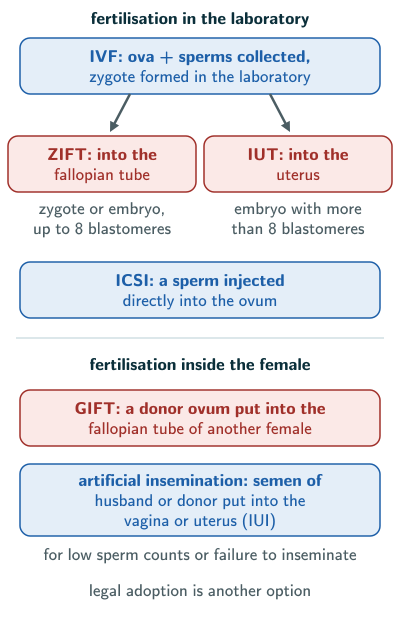
In vitro fertilisation (IVF–fertilisation outside the body in almost similar conditions as that in the body) followed by embryo transfer (ET) is one of such methods.
NCERT Biology (Class 12), Section 3.5, page 48
- In this method, popularly known as the test tube baby programme, ova from the wife or a donor and sperms from the husband or a donor are collected and made to form a zygote under simulated conditions in the laboratory (page 48).
- ZIFT (zygote intra fallopian transfer), as described by NCERT: the zygote or early embryos with up to 8 blastomeres are transferred into the fallopian tube (page 48).
- IUT (intra uterine transfer), in NCERT’s comparison: embryos with more than 8 blastomeres are transferred into the uterus (page 48).
- Embryos formed by in vivo fertilisation (fusion of gametes within the female) can also be used for such transfers, to help females who cannot conceive (page 48).
The eight-cell threshold is a textbook comparison, not a universal clinical rule. Modern IVF can transfer cleavage-stage embryos on day 2/3 or blastocysts into the uterus; embryos with eight or fewer cells are not biologically barred from uterine transfer (HFEA, Decisions to make about your embryos).
GIFT
GIFT (gamete intra fallopian transfer) places eggs and sperm into a fallopian tube, so fertilisation occurs in the body. NCERT illustrates a donor-ovum case (page 48); donor eggs are an example, not the definition of every GIFT procedure.
ICSI
Intra cytoplasmic sperm injection (ICSI) is a specialised procedure to form an embryo in the laboratory, in which a sperm is directly injected into the ovum (page 48).
Artificial insemination and IUI
- Artificial insemination may help when intercourse or insemination is difficult or donor sperm is used. NCERT also mentions very low sperm counts (page 48), but IUI is not a guaranteed correction for severe male-factor infertility; suitability depends on assessment.
- NCERT describes artificial introduction of semen into the vagina or uterus (page 48). Beyond the NCERT text: clinically, IUI (intra-uterine insemination) places washed, prepared sperm into the uterus, not unprocessed ejaculate (HFEA).
Limits of ART, and legal adoption
- All these techniques need extremely high precision handling by specialised professionals and expensive instruments, so access can be limited by cost, location and service availability; NCERT’s “few centres” is not a current count (page 48).
- Emotional, religious and social factors also deter people from adopting these methods (page 48).
- Legal adoption is another path to parenthood, distinct from infertility treatment. It follows applicable eligibility and child-welfare procedures and is a personal choice; it should not be ranked as universally best or presented as a medical cure.
Solved examples
Example 1: Helping infertile couples (NCERT Exercise 9)
Suggest some methods to assist infertile couples to have children.
Answer: treatment of correctable disorders in infertility clinics; and assisted reproductive technologies: IVF with embryo transfer by ZIFT (up to 8 blastomeres, into the fallopian tube) or IUT (more than 8 blastomeres, into the uterus); GIFT; ICSI; and artificial insemination, including IUI. Legal adoption is another possible route to parenthood (NCERT page 48).
Example 2: True or false (NCERT Exercise 11 b)
Infertility is defined as the inability to produce a viable offspring and is always due to abnormalities or defects in the female partner. True or false?
Answer: false. NCERT defines infertility as the inability to conceive or produce children even after 2 years of unprotected sexual cohabitation (page 49). The causes may be physical, congenital, diseases, drugs, immunological or even psychological, and NCERT adds that in India the female is often blamed, but “more often than not, the problem lies in the male partner” (NCERT page 48). Beyond the NCERT text: the cause can lie with either partner or both, or remain unexplained (MedlinePlus, “Infertility”), so the woman alone should never be blamed.
Example 3: Correct the statement (NCERT Exercise 12 d)
Correct the statement: in E.T. techniques, embryos are always transferred into the uterus.
Answer: in embryo transfer, a zygote or early embryo with up to 8 blastomeres is transferred into the fallopian tube (ZIFT); NCERT assigns embryos with more than 8 blastomeres to the uterus (IUT, page 48). This corrects the textbook statement, but modern clinical uterine transfer is not restricted by an absolute eight-cell cutoff.
Common mistakes to avoid
Common mistake
Swapping ZIFT and IUT
In NCERT’s comparison, ZIFT uses the tube and IUT the uterus (page 48). Treat the cell counts as that comparison, not a universal modern treatment rule.
Common mistake
Calling GIFT a transfer of an embryo
GIFT transfers gametes into a fallopian tube; fertilisation then happens inside the body (NCERT page 48).
Common mistake
Thinking IUI is in vitro fertilisation
In IUI, the semen is introduced into the uterus and fertilisation happens in the body; IVF fertilises the ovum outside the body (NCERT page 48). Beyond the NCERT text: clinically, washed, prepared sperm are used for IUI (see above).
Quick revision summary
- Infertility: inability to conceive or produce children even after 2 years of unprotected sexual cohabitation (NCERT’s Summary); WHO now uses one year. NCERT: the female is often blamed, but more often than not, the problem lies in the male partner (page 48). Beyond NCERT: causes may involve either partner, both or be unexplained.
- IVF fertilises eggs in the laboratory; embryo transfer places the embryo in the reproductive tract. NCERT’s ZIFT/IUT cell-count distinction is not an absolute clinical rule.
- GIFT: eggs and sperm into a tube; ICSI: a sperm injected into an oocyte; IUI: semen into the uterus (clinically, washed sperm).
- ART needs specialists and costly equipment; legal adoption is a separate possible route to parenthood.
Formula sheet
- IVF + ET = test tube baby
- NCERT ZIFT: zygote/up to 8 blastomeres → fallopian tube
- NCERT IUT comparison: more than 8 blastomeres → uterus; not an absolute clinical cutoff
- GIFT: gametes (eggs and sperm) → fallopian tube
- ICSI: sperm injected into oocyte; IUI: semen (clinically, washed sperm) into uterus
Questions students ask
Is infertility the same as sterility or impotence?
Beyond the NCERT text, infertility, sterility and impotence overlap but are not the same. MeSH defines infertility as “a reduced or absent capacity to reproduce” and lists sterility as another name for it, while its entry on sterilisation calls a sterile person incapable of reproduction, so, by our reasoning, sterility is the complete form of infertility; NCERT’s sterilisation by vasectomy or tubectomy is a “terminal method to prevent any more pregnancies” (pages 45–46). Impotence is different again: MeSH files it under erectile dysfunction, in which the penis fails to become erect, a problem of the sexual act that may make conception harder, not another name for infertility.
What is the difference between IVF and ICSI?
IVF and ICSI both fertilise the ovum in the laboratory, but they differ in how the sperm gets in: in IVF the collected ova and sperms are “induced to form zygote under simulated conditions in the laboratory”, while ICSI is a specialised procedure in which “a sperm is directly injected into the ovum” (NCERT page 48). By our reasoning, only in ICSI is the sperm’s own entry into the ovum bypassed. Beyond the NCERT text, MeSH says ICSI is used mainly for male infertility, for example when sperms cannot penetrate the egg, are too few or move weakly.
Is there a law on assisted reproductive technology in India?
Yes, beyond the NCERT text, India regulates assisted reproductive technology under the Assisted Reproductive Technology (Regulation) Act, 2021 (Act No. 42 of 2021), which received the President’s assent on 18 December 2021 and sets up the oversight of ART clinics and ART banks (Gazette of India). By our reasoning from its definition of ART, which turns on gametes being handled outside the body, the Act covers NCERT’s IVF, ZIFT, IUT, GIFT and ICSI, and AI with IUI as well. It bars clinics from offering a child of a chosen sex, and it takes one year of unprotected coitus without conception as the mark of infertility, against the 2 years of NCERT’s Summary (page 49).
How common is infertility?
Infertility is common worldwide: beyond the NCERT text, the World Health Organization’s 2023 estimate, pooled from studies dating from 1990 to 2021, is that about one adult in six, 17.5 per cent, has infertility at some time in life (WHO, 2023). Income makes little difference to it, with a lifetime figure of 16.5 per cent in low- and middle-income countries and 17.8 per cent in high-income ones. NCERT gives no figure but makes the same point: “A large number of couples all over the world including India are infertile” (page 47).
Practice questions
Try each question first, then open the answer to check your working.
-
Q1. What does IVF stand for, and what is the method popularly called?
Show answerHide answer
In vitro fertilisation, fertilisation outside the body in almost similar conditions; with embryo transfer it is the test tube baby programme (NCERT page 48).
-
Q2. For which kind of infertility is artificial insemination used?
Show answerHide answer
It may help when insemination/intercourse is difficult or donor sperm is used. NCERT mentions low counts, but severe male-factor infertility often requires other approaches after assessment.
-
Q3. Into which organ does IUI introduce the semen?
Show answerHide answer
The uterus: in IUI, the semen collected from the husband or a healthy donor is introduced into the uterus (NCERT page 48).