Population stabilisation and birth control
NCERT Class 12 Biology Chapter 3 Section 3.2
Quick answer
Contraception supports voluntary decisions about whether and when to have children. Methods include barriers, IUDs, hormonal methods, fertility-awareness methods and sterilisation, with different mechanisms, effectiveness and reversibility. NCERT’s fixed fertile days, pill schedules and 72-hour emergency interval need qualification: schedules vary, LAM has three required conditions, and some emergency options extend to 120 hours.
With your textbook
NCERT Biology (Class 12), Chapter 3 “Reproductive Health”, Section 3.2 “Population Stabilisation and Birth Control”, pages 43–46.
Open the official NCERT chapter (PDF, 1.3 MB, ncert.nic.in) (opens in a new tab)
Checked against the 2026-27 reprint on .
Why population stabilisation and birth control?
Population stabilisation and birth control
- Better health facilities and living conditions in the last century had an explosive impact on population growth; to check it, the government promotes smaller families through contraceptive methods (page 43).
An ideal contraceptive should be user-friendly, easily available, effective and reversible with no or least side-effects.
NCERT Biology (Class 12), Section 3.2, page 43
- It also should in no way interfere with the sexual drive, desire or the sexual act of the user (page 43).
In plain words: when death rates fall while births remain high, populations may grow rapidly. Contraception lets couples choose whether and when to have children, which slows that growth. Methods differ in how they work, how reliable and reversible they are, and their side effects, and the choice should be made with a qualified medical professional.
Population growth in India and the world
NCERT’s figures (page 43):
| Where and when | Population |
|---|---|
| World, 1900 | about 2 billion (2000 million) |
| World, 2000 | about 6 billion |
| World, 2011 | 7.2 billion |
| India, at independence | about 350 million |
| India, 2000 | close to 1 billion |
| India, May 2011 | crossed 1.2 billion |
- Probable reasons (page 43): a rapid decline in the death rate, the maternal mortality rate (MMR) and the infant mortality rate (IMR), and an increase in the number of people of reproducible age.
- The RCH programme brought the population growth rate down only marginally. According to the 2011 census, the growth rate was less than 2 per cent, meaning less than 20/1000/year, a rate at which the population could still increase rapidly (page 43).
- Such growth could lead to an absolute scarcity of even the basic requirements, food, shelter and clothing (page 43).
Historical-data qualification: these are NCERT’s dated figures, not present population estimates. UN demographic accounts put world population near 1.6 billion in 1900, rather than NCERT’s rounded 2 billion.
Reading note: the chapter’s opening list of contents names this section “Population Explosion and Birth Control” (page 41), but its heading reads “Population Stabilisation and Birth Control” (page 43), the title used here.
Measures to check population growth
The most important step to overcome this problem is to motivate smaller families by using various contraceptive methods.
NCERT Biology (Class 12), Section 3.2, page 43
- Media campaigns show a happy couple with two children and the slogan Hum Do Hamare Do (we two, our two); many young, urban, working couples have adopted a one child norm (page 43).
- NCERT names the statutory raising of the marriageable age of the female to 18 years and that of males to 21 years as another measure (page 43). Beyond the NCERT text: these are the ages in the Prohibition of Child Marriage Act, 2006, which defines a child as a female under 18 or a male under 21 (India Code).
- Incentives are given to couples with small families (page 43).
Types of contraceptive methods
NCERT groups the methods into Natural/Traditional, Barrier, IUDs, Oral contraceptives, Injectables, Implants and Surgical methods (page 43).
The sections below separate each method’s mechanism from textbook schedules and current clinical qualifications.
Natural methods
Natural methods work on the principle of avoiding the chances of the ovum and sperms meeting (page 44).
- Periodic abstinence: NCERT uses days 10–17 as a teaching example (page 44). Ovulation and the fertile window vary; these fixed calendar days are not a universally reliable safe/unsafe-day rule.
- Withdrawal (coitus interruptus): the male partner withdraws his penis from the vagina just before ejaculation, to avoid insemination (page 44).
- Lactational amenorrhea method (LAM): breastfeeding may suppress ovulation, but not invariably. WHO requires all three conditions: no return of menstrual bleeding, fully or nearly fully breastfeeding day and night, and an infant under six months. Breastfeeding alone does not guarantee contraception; ovulation can precede the first period.
- These methods avoid drug/device effects, but effectiveness depends on the method and correct use. Withdrawal and simple calendar rules are less reliable; LAM must not be grouped as uniformly high-failure when all criteria are met.
Barrier methods
In barrier methods, the ovum and sperms are prevented from physically meeting (page 44).
- Condoms are barriers of thin rubber or latex that cover the penis in the male, or the vagina and cervix in the female, just before coitus, so that the ejaculated semen does not enter the female reproductive tract. Nirodh is a popular brand of condom for the male (page 44).
- Use of condoms has increased because they also reduce the risk of STIs, including HIV infection that can cause AIDS. Male and female condoms are disposable, can be self-inserted and so give the user privacy (page 44).
- Diaphragms, cervical caps and vaults are rubber barriers inserted into the female reproductive tract to cover the cervix during coitus; they block the entry of sperms through the cervix and are reusable (page 44).
- Spermicidal creams, jellies and foams are usually used with these barriers to increase their contraceptive efficiency (page 44).
Intra-uterine devices (IUDs)
IUDs are placed in the uterus through the cervix by trained professionals. NCERT gives three historical categories; listed devices are examples, not a current product-availability list:
- non-medicated IUDs, such as the Lippes loop;
- copper-releasing IUDs, such as CuT, Cu7 and Multiload 375;
- hormone-releasing IUDs, such as Progestasert and LNG-20.
IUDs increase phagocytosis of sperms within the uterus and the Cu ions released suppress sperm motility and the fertilising capacity of sperms.
NCERT Biology (Class 12), Section 3.2, page 44
Hormonal IUDs principally thicken cervical mucus and inhibit sperm, while also thinning the endometrium (WHO, Intrauterine devices). NCERT emphasises cervical hostility and reduced endometrial receptivity (page 45); do not present prevention of implantation as the sole or main mechanism. Suitability is individual; IUDs can provide reversible pregnancy spacing but do not protect against STIs.
Oral pills and Saheli
- Small doses of progestogens or progestogen–estrogen combinations taken by mouth as tablets are popularly called the pills (page 45).
- NCERT describes a 21 active-day plus 7 hormone-free-day schedule (page 45), one combined-pill regimen. It is not the schedule for every pill: progestogen-only and other formulations differ. Bleeding in a hormone-free interval is withdrawal bleeding, not evidence of a normal ovulatory cycle.
- Hormonal pills prevent pregnancy chiefly through ovulation suppression and/or cervical-mucus changes, depending on formulation; endometrial changes also occur. NCERT lists inhibition of ovulation/implantation and altered mucus (page 45). Effectiveness and side effects depend on formulation and use.
- Saheli, the new oral contraceptive for females, contains a non-steroidal preparation. It is a “once a week” pill with very few side effects and high contraceptive value (page 45). Beyond the NCERT text: its drug is centchroman, also called ormeloxifene (CSIR, “World’s first non-steroidal birth control pill”). How to start and take any contraceptive is for a qualified doctor to advise (NCERT page 46 asks for such consultation).
Injectables, implants and emergency contraception
- Progestogens alone, or with estrogen, can also be given as injections or as implants under the skin. They act like the pills, but their effective periods are much longer (page 45).
- Emergency contraception: NCERT mentions 72 hours (page 45). WHO describes effective options up to 120 hours (five days) after unprotected intercourse, with earlier use preferable and the method determining suitability. Copper IUDs and emergency pills are distinct options; they prevent pregnancy and do not interrupt an established pregnancy. A 72-hour textbook statement must not imply that every option stops working then.
Surgical methods: vasectomy and tubectomy
Surgical methods, also called sterilisation, are generally advised as a terminal method, to prevent any more pregnancies. They block gamete transport (pages 45–46).
- Vasectomy (male): a small part of the vas deferens is removed or tied up through a small incision on the scrotum (page 46).
- Tubectomy (female): a small part of the fallopian tube is removed or tied up through a small incision in the abdomen or through the vagina (page 46).
- These methods are intended to be permanent; reversal is not assured (page 46). Vasectomy is not immediately effective: remaining sperm must clear and effectiveness is confirmed by semen testing.
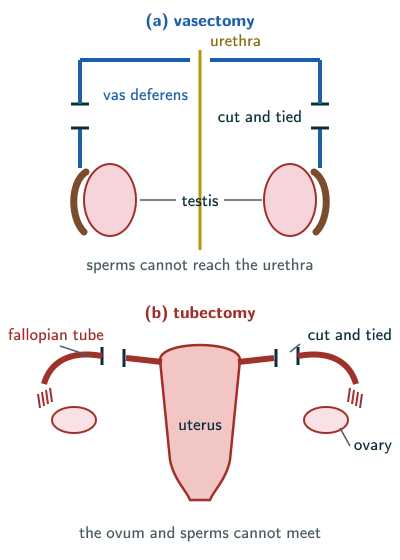
The ducts cut here are the vas deferens and the fallopian tubes of Chapter 2.
Possible ill-effects of contraceptives
- The choice of a contraceptive method and its use should always be made in consultation with qualified medical professionals (page 46).
- Contraception supports voluntary decisions about preventing, delaying or spacing pregnancy. Some methods also treat non-contraceptive conditions; access and informed choice are parts of reproductive health.
- Side effects are method-specific; bleeding changes, nausea or other effects cannot be assigned to every contraceptive. NCI reports a small increase in breast-cancer risk with current/recent oral-contraceptive use and reductions in ovarian/endometrial cancer risk. NCERT’s broad cancer list is not a statement that all contraceptives cause cancer, nor that every risk is insignificant.
Solved examples
Example 1: Reasons for population explosion (NCERT Exercise 5)
What are the suggested reasons for population explosion?
Answer: NCERT gives a rapid decline in the death rate, the maternal mortality rate and the infant mortality rate, together with an increase in the number of people of reproducible age; behind these lie better health facilities and living conditions (NCERT page 43).
Example 2: Removal of gonads (NCERT Exercise 7)
Removal of gonads cannot be considered a contraceptive option. Why?
Answer: our reasoning from NCERT. An ideal contraceptive should be reversible, with no or least side effects, and should not interfere with sexual drive (NCERT page 43). The gonads make not only the gametes but also hormones: the testes secrete androgens and the ovaries steroid hormones (NCERT Chapter 2, pages 27–28). Removing them would prevent pregnancy, but it is irreversible and would also remove these hormones, so it fails the tests of reversibility, least side effects and no interference with sexual drive. Sterilisation instead cuts only the ducts, which blocks gamete transport (page 46).
Example 3: Doubling time at 2 per cent
If a hypothetical population grows at exactly 20/1000/year, roughly how many years would it take to double?
Answer: beyond the NCERT text (our arithmetic). Each year the population is multiplied by 1.02. Doubling needs 1.02 = 2, so n = log 2 ÷ log 1.02 ≈ 35 years. That is why NCERT calls 2 per cent a rate at which the population “could increase rapidly” (page 43).
Example 4: The pill schedule
In NCERT’s illustrative 21-active-day/7-day-gap arithmetic model, a course starts on day 3. On which days does she take the pills, and when does she start the next course?
Answer: days 3 to 23 (21 days); then a 7-day gap, days 24 to 30, in which withdrawal bleeding may occur; the next course starts on day 31, that is 21 + 7 = 28 days after the first (NCERT page 45). This checks counting only, not a universal medication schedule.
Common mistakes to avoid
Common mistake
Saying surgical methods stop gamete formation
Vasectomy and tubectomy block gamete transport; the testes and ovaries still make gametes (NCERT page 46).
Common mistake
Calling Saheli a steroid pill
Saheli contains a non-steroidal preparation; NCERT describes it as a once-a-week pill (NCERT page 45).
Common mistake
Treating days 10–17 as a universal fertile window
Those are NCERT’s example days. Real ovulation timing varies, and calendar days alone do not guarantee protection.
Quick revision summary
- NCERT’s historical world-population figures: about 2 billion in 1900 (UN gives 1.6 billion), 6 billion in 2000, 7.2 billion in 2011; India: about 350 million at independence, over 1.2 billion in 2011, growing at under 2 per cent a year.
- Causes: falling death rate, MMR and IMR; more people of reproducible age. Measures: smaller families (Hum Do Hamare Do), marriageable age 18 for females and 21 for males, incentives.
- Ideal contraceptive: user-friendly, available, effective, reversible, least side effects, no interference with sexual drive or act.
- Natural methods: calendar-based abstinence, withdrawal, LAM only when all three criteria hold; barriers (condoms, diaphragms, caps, vaults); IUDs (Lippes loop, CuT, Cu7, Multiload 375, Progestasert, LNG-20).
- Pill schedules differ; Saheli is a non-steroidal, once-a-week pill (NCERT); injectables and implants last longer; emergency options can extend to 120 hours; vasectomy and tubectomy block gamete transport, poorly reversible.
Formula sheet
- under 2 per cent annually = under 20/1000/year
- marriageable age: female 18, male 21
- NCERT calendar example: days 10–17; actual fertile windows vary
- LAM: amenorrhea + full/nearly full breastfeeding + infant under 6 months
- pill schedules vary; Saheli: non-steroidal, once a week (NCERT)
- emergency contraception: NCERT 72 hours; WHO options up to 120 hours
- vasectomy: vas deferens; tubectomy: fallopian tube
Questions students ask
Are birth control and contraception the same thing?
Yes, birth control and contraception are two names for the same thing: NCERT heads its section “Population Stabilisation and Birth Control” and calls the methods in it contraceptive methods (page 43), and beyond the NCERT text, MedlinePlus defines birth control, “also known as contraception”, as “the use of medicines, devices, or surgery to prevent pregnancy”. One difference in grouping: MedlinePlus lists fertility awareness, the lactational amenorrhea method and withdrawal apart, as ways of avoiding pregnancy without medicines, devices or surgery, whereas NCERT counts such natural methods among its contraceptive methods (page 43).
What is the difference between vasectomy and tubectomy?
Vasectomy sterilises the male and tubectomy the female: vasectomy removes or ties up a small part of the vas deferens through a small incision on the scrotum, while tubectomy does the same to a small part of the fallopian tube through a small incision in the abdomen or through the vagina (NCERT page 46). By our reasoning from NCERT Chapter 2, the cut vas deferens keeps sperms out of the semen, while the cut fallopian tube keeps the ovum and sperms apart. Both are highly effective but poorly reversible, and NCERT calls them a terminal method (pages 45–46).
How do birth control pills prevent pregnancy?
Birth control pills, small doses of progestogens or progestogen–estrogen combinations, prevent pregnancy in the three ways NCERT names: they inhibit ovulation, they inhibit implantation, and they alter the quality of cervical mucus to prevent or retard the entry of sperms (page 45). By our reasoning from NCERT Chapter 2, each blocks a different step: no ovum is released, an embryo cannot embed in the endometrium (implantation), and sperms are held back at the cervix.
Is Saheli the same pill as Chhaya?
Yes, beyond the NCERT text, Saheli and Chhaya are two names for one drug, centchroman: a National Health Mission booklet for ASHA workers (MoHFW, 2017) gives Chhaya as its name in India’s public health system, where it costs nothing, and Saheli as a name it carries in some shops. NCERT names Saheli as a new oral contraceptive for females developed by scientists at the Central Drug Research Institute (CDRI), Lucknow (pages 42–43).
What is population explosion?
Population explosion is a very rapid rise in the number of people, the kind of growth NCERT describes for the last century (page 43). NCERT’s figures show its scale: the world’s population went from about 2 billion in 1900 to about 6 billion by 2000, three times as many in a hundred years, while India’s grew from about 350 million at independence in 1947 to more than 1.2 billion by May 2011, over three times as many in about 64 years (page 43).
What does population stabilisation mean, and has India reached it?
Population stabilisation means bringing a population to a steady size, and India had not reached it by NCERT’s latest figure, a growth rate of less than 2 per cent a year in the 2011 census (page 43). By our reasoning from NCERT Chapter 11, numbers stop rising only when births plus immigration no longer exceed deaths plus emigration (population growth). Beyond the NCERT text, the National Population Policy 2000 set replacement-level fertility, 2.1 children per woman, as the step before a stable population, planned for 2045 (MoHFW, 2008), and NFHS-5 (2019–21) put India’s rate at 2.0, just below that level (MoHFW and IIPS).
Practice questions
Try each question first, then open the answer to check your working.
-
Q1. How do copper-releasing IUDs prevent conception?
Show answerHide answer
IUDs increase the phagocytosis of sperms within the uterus, and the copper ions released suppress sperm motility and the fertilising capacity of sperms (NCERT page 44).
-
Q2. Name two barrier methods used by females that cover the cervix, and say whether they are reusable.
Show answerHide answer
Any two of diaphragms, cervical caps and vaults; they are reusable (NCERT page 44).
-
Q3. What emergency-contraception interval does NCERT name, and how does current WHO guidance qualify it?
Show answerHide answer
NCERT names 72 hours (page 45); WHO describes emergency pills and copper IUD options up to 120 hours, with earlier use preferable. The interval and suitability depend on the method.