Populations: attributes, growth and interactions
NCERT Class 12 Biology Chapter 11 Section 11.1
Quick answer
A population comprises members of one species in a defined area, with attributes such as birth and death rates, age structure and density. Exponential and logistic equations model growth under different assumptions. Interactions between species include competition, predation, parasitism, mutualism, commensalism and amensalism.
With your textbook
NCERT Biology (Class 12), Chapter 11 “Organisms and Populations”, Section 11.1 “Populations”, pages 191–202.
Open the official NCERT chapter (PDF, 1.6 MB, ncert.nic.in) (opens in a new tab)
Checked against the 2026-27 reprint on .
What is a population?
Population
In nature, we rarely find isolated, single individuals of any species; majority of them live in groups in a well defined geographical area, share or compete for similar resources, potentially interbreed and thus constitute a population.
NCERT Biology (Class 12), Section 11.1, page 191
In plain words: a population is all the members of one species living together in one place, such as all the lotus plants in a pond. A population has features that no single member has: a birth rate, a death rate, a sex ratio, an age structure and a size that rises or falls.
- Ecology studies the interactions among organisms and between the organism and its physical (abiotic) environment. It is concerned with four levels of biological organisation: organisms, populations, communities and biomes; this chapter explores the population level (page 191).
- At any level we can ask two types of question, NCERT notes with a bulbul singing in the garden: the ‘how-type’ questions seek the mechanism behind a process (the voice box and vibrating bone), and the ‘why-type’ questions seek its significance (the bird’s need to communicate with its mate in the breeding season) (NCERT Chapter 11, Introduction, page 190).
- Although interbreeding implies sexual reproduction, a group of individuals resulting from asexual reproduction is also generally considered a population for ecological studies (page 191).
- Examples: all the cormorants in a wetland, rats in an abandoned dwelling, teakwood trees in a forest tract, bacteria in a culture plate and lotus plants in a pond (page 191).
- An individual copes with a changed environment, but it is at the population level that natural selection operates to evolve the desired traits. Population ecology therefore links ecology to population genetics and evolution (page 191).
Population attributes
- A population has attributes that an individual does not. An individual may have births and deaths, but a population has birth rates and death rates, expressed per capita: the change in numbers with respect to the members of the population (page 191).
- NCERT’s examples (page 191): a pond had 20 lotus plants last year and 8 new plants were added by reproduction, so the birth rate is 8/20 = 0.4 offspring per lotus per year. If 4 of 40 fruitflies in a laboratory population died in a week, the death rate is 4/40 = 0.1 individuals per fruitfly per week.
- A population also has a sex ratio; for example, 60 per cent of the population are females and 40 per cent males (page 191).
Age pyramids
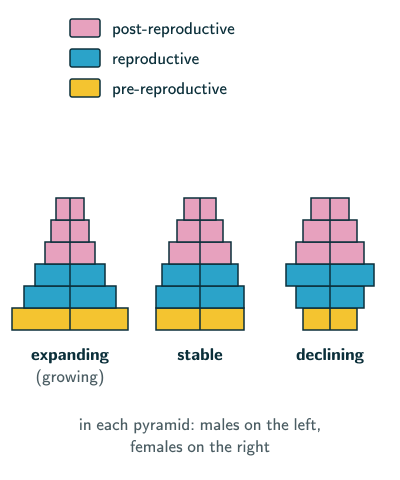
- A population is made of individuals of different ages. If the age distribution (per cent individuals of a given age or age group) is plotted, the structure is an age pyramid; for humans, the pyramid usually shows males and females (page 191).
- Its shape reflects the growth status of the population: (a) growing, (b) stable or (c) declining (page 191).
Population density
- The size of a population tells us a lot about its status in the habitat; ecological processes (competition with another species, the impact of a predator, the effect of a pesticide) are always evaluated through changes in population size (page 192).
- The size in nature could be as low as under 10 (Siberian cranes at Bharatpur wetlands in any year) or run into millions (Chlamydomonas in a pond) (page 192).
- Population size, technically called population density (N), need not be measured in numbers only. If an area has 200 carrot grass (Parthenium hysterophorus) plants but a single huge banyan tree with a large canopy, calling the banyan’s density low underestimates its enormous role; per cent cover or biomass is the more meaningful measure (page 192).
- Counting is also impractical when a population is huge. For some studies relative densities serve equally well: the number of fish caught per trap is a good enough measure of fish density in a lake. Sizes are mostly estimated indirectly: the tiger census in national parks and tiger reserves is often based on pug marks and fecal pellets (page 192).
NCERT asks how to report the density of a dense laboratory culture of bacteria in a petri dish (page 192). Counting the cells is impossible, so a measure such as the biomass or the per cent cover of the plate is more practical (reasoned from NCERT page 192).
Population growth
- Population size keeps changing with time, depending on factors such as food availability, predation pressure and adverse weather (page 192).
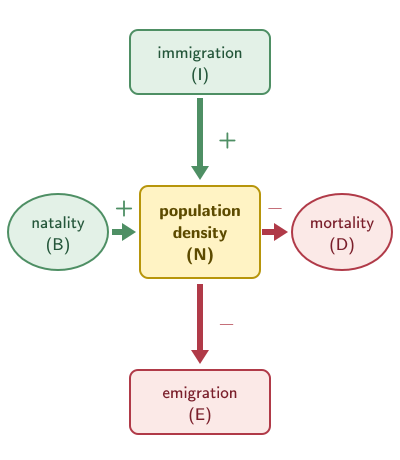
- The density changes through four basic processes: two increase it, natality and immigration, and two decrease it, mortality and emigration (pages 192–193):
- natality: the number of births in a given period added to the initial density;
- mortality: the number of deaths in the population during a given period;
- immigration: the number of individuals of the same species that have come into the habitat from elsewhere in the period;
- emigration: the number of individuals of the population who left the habitat and went elsewhere in the period.
Density at time t + 1 (NCERT page 193)
- So the density increases if births plus immigrants (B + I) exceed deaths plus emigrants (D + E). Under normal conditions births and deaths matter most; immigration and emigration matter only in special conditions, for example when a new habitat is being colonised, where immigration may add more than births (page 193).
Exponential growth
- When resources (food and space) are unlimited, each species can realise fully its innate potential to grow in number, as Darwin observed; the population then grows in an exponential or geometric fashion (page 194).
- If b is the per capita birth rate and d the per capita death rate, the change in N per unit time is (page 194):
Exponential growth (NCERT page 194)
- Here r = b − d is the intrinsic rate of natural increase, a very important parameter for assessing the impact of any biotic or abiotic factor on population growth. NCERT gives r = 0.015 for the Norway rat, 0.12 for the flour beetle, and 0.0205 for the human population of India in 1981 (page 194).
- Plotting N against time gives a J-shaped curve. The integral form is (page 194):
Integral form (NCERT page 194)
- Here Nt is the density after time t, N0 the density at time zero, r the intrinsic rate of natural increase and e the base of natural logarithms (2.71828) (page 194).
- Any species growing exponentially reaches enormous densities quickly. Darwin showed that even a slow-growing elephant could reach enormous numbers without checks. NCERT’s chess-board story makes the point: one wheat grain on square 1, doubling on each square; by half the board the king saw that all the wheat in his kingdom could not fill the 64 squares. A Paramecium doubling every day from one individual would reach a mind-boggling number in 64 days, if food and space stayed unlimited (pages 194–195).
NCERT asks for India’s current r (page 194), from birth and death rates. Beyond the NCERT text: World Bank data (CC BY 4.0) give India’s crude birth rate in 2024 as 15.981 and its crude death rate as 6.587 per 1000 people, so r ≈ (15.981 − 6.587) ÷ 1000 ≈ 0.0094 per year (our arithmetic), less than half the 1981 value.
Logistic growth and carrying capacity
- No population in nature has unlimited resources. This leads to competition between individuals, and eventually the ‘fittest’ individual survives and reproduces (page 195).
- A habitat has enough resources to support a maximum possible number, beyond which no further growth is possible: the carrying capacity (K) for that species in that habitat (page 195).
- A population growing with limited resources shows a lag phase, then phases of acceleration and deceleration, and finally an asymptote when the density reaches the carrying capacity. Plotting N against time gives a sigmoid curve: Verhulst–Pearl logistic growth (page 195).
Logistic growth (NCERT page 195)
- Here N is the density at time t, r the intrinsic rate of natural increase and K the carrying capacity. Since resources for most animal populations are finite and become limiting sooner or later, the logistic model is considered more realistic (page 196).
- Reading the equation: while N is small compared with K, (K − N)/K is close to 1 and growth is almost exponential; at N = K the factor is 0, so dN/dt = 0 and growth stops at the asymptote. In between, the population adds numbers fastest at N = K/2, the steepest point of the S (reasoned from NCERT’s equation, page 195).
NCERT asks you to plot India’s census population for the last 100 years and see which growth pattern it shows (page 196). Make the plot from the Census of India totals. To read it: exponential growth keeps r constant, so the curve gets ever steeper, while in logistic growth the per capita rate falls as N rises. India’s r fell from 0.0205 in 1981 to about 0.0094 in 2024 (World Bank figures above) but is still positive: the population is still rising, though no longer at a constant rate, which is consistent with the logistic model; it has not levelled off (reasoned from NCERT pages 194–196).
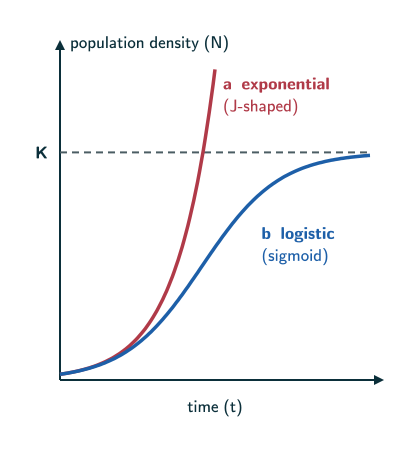
NCERT slip (page 194): the caption of NCERT Figure 11.3 reads “when responses are not limiting the growth, plot is exponential” and “when responses are limiting the growth, plot is logistic”. The word should be resources, as NCERT’s own text says: exponential growth needs unlimited resources, and logistic growth follows when resources are limited (pages 194–195). In an exam, write “resources”.
Life history variation
- Populations evolve to maximise their reproductive fitness, also called Darwinian fitness (high r value), in their habitat; under a particular set of selection pressures, organisms evolve towards the most efficient reproductive strategy (page 196).
- Some organisms breed only once in their lifetime (Pacific salmon fish, bamboo); others breed many times (most birds and mammals) (page 196).
- Some produce a large number of small-sized offspring (oysters, pelagic fishes); others a small number of large-sized offspring (birds, mammals) (page 196).
- Ecologists suggest that life history traits have evolved in relation to the constraints imposed by the abiotic and biotic components of the habitat; their evolution is an important area of current research (page 196).
Population interactions
- No natural habitat on earth is inhabited by just a single species. A species needs at least one more species to feed on; even a plant needs soil microbes to return inorganic nutrients from organic matter, and an animal agent for pollination. Animals, plants and microbes interact to form a biological community (page 196).
- Interspecific interactions arise between populations of two different species, and can be beneficial (+), detrimental (−) or neutral (0) to one or both (page 196). NCERT Table 11.1 (page 197) lists them; for species A and B:
- mutualism: + and +, both benefit;
- competition: − and −, both lose;
- predation: + and −, the predator benefits, the prey is harmed;
- parasitism: + and −, the parasite benefits, the host is harmed;
- commensalism: + and 0, one benefits, the other is neither benefited nor harmed;
- amensalism: − and 0, one is harmed, the other is unaffected.
- Predation, parasitism and commensalism share one feature: the interacting species live closely together (page 197).
Predation
- Predation is nature’s way of transferring the energy fixed by plants to higher trophic levels. A tiger eating a deer is predation, but so is a sparrow eating any seed; herbivores are, in a broad ecological context, not very different from predators (page 197).
- Predators keep prey populations under control; without them, prey could reach very high densities and cause ecosystem instability (page 197).
- An exotic species introduced into a new area can become invasive, because the invaded land lacks its natural predators. NCERT’s example: the prickly pear cactus introduced into Australia spread rapidly over millions of hectares of rangeland, and was brought under control only after a cactus-feeding moth from its natural habitat was introduced (page 197). Biological control methods in agriculture rest on this ability of predators to regulate prey (pages 197–198).
- Predators also maintain species diversity by reducing competition among prey species. When all the starfish Pisaster, an important predator of the rocky intertidal communities of the American Pacific Coast, were removed from an enclosed area, more than 10 species of invertebrates became extinct within a year in that enclosed area (a local extinction, our reading), through interspecific competition (page 198).
- A predator that overexploits its prey could drive the prey, and then itself, to extinction; so predators in nature are ‘prudent’ (page 198).
- Prey defences: some insects and frogs are cryptically coloured (camouflaged); some are poisonous. The Monarch butterfly is highly distasteful to birds because of a chemical it acquires as a caterpillar by feeding on a poisonous weed (page 198).
- Plant defences: nearly 25 per cent of all insects are phytophagous, and plants cannot run away. Plants defend themselves with thorns, as in Acacia and cactus, the commonest morphological defence, and with chemicals that make the herbivore sick, inhibit feeding or digestion, disrupt reproduction or kill it. The weed Calotropis produces highly poisonous cardiac glycosides, so cattle and goats never browse it. Nicotine, caffeine, quinine, strychnine and opium are made by plants as defences against grazers and browsers (page 198).
Reading note (page 197): NCERT says the prickly pear cactus was introduced into Australia “in the early 1920’s”. Beyond the NCERT text, prickly pears had been brought to Australia long before, with the First Fleet of European settlers, as host plants for the cochineal insects used for dye, and had spread over a vast area of farmland; the moth that brought them under control, Cactoblastis cactorum, came from Argentina (Wikipedia, “Prickly pears in Australia” and “Cactoblastis cactorum”, facts in our words). In an exam, follow NCERT: an introduced cactus became invasive and was controlled by a moth from its natural habitat.
Competition
- Darwin was convinced that interspecific competition is a potent force in organic evolution (page 198).
- Competition is not limited to closely related species competing for limiting resources (pages 198–199):
- totally unrelated species can compete for the same resource: in some shallow South American lakes, visiting flamingoes and resident fishes compete for their common food, the zooplankton;
- resources need not be limiting: in interference competition, the feeding efficiency of one species may be reduced by the interfering and inhibitory presence of another, even if food and space are abundant.
- So competition is best defined as a process in which the fitness of one species (measured by its r, the intrinsic rate of increase) is significantly lower in the presence of another species (page 199).
- Gause and other experimental ecologists showed in the laboratory that, when resources are limited, the competitively superior species eventually eliminates the other; evidence for such competitive exclusion in nature is not always conclusive (page 199).
- Strong and persuasive circumstantial evidence does exist in some cases: the Abingdon tortoise in the Galapagos Islands became extinct within a decade after goats were introduced on the island, apparently due to the greater browsing efficiency of the goats (page 199); give this in an NCERT-based answer. Beyond the NCERT text: goats were brought to Pinta (Abingdon) Island in the late 1950s and ate much of its vegetation; hunting by buccaneers and whalers had already wiped out most of its tortoises by the end of the 19th century; a single male, Lonesome George, was found on the island in 1971 and died in captivity in 2012, the last known individual (Wikipedia, “Pinta Island tortoise”, facts in our words).
- Competitive release: a species restricted to a small area by a competitively superior species expands its range dramatically when the competitor is removed. Connell’s field experiments on the rocky sea coasts of Scotland showed that the larger, competitively superior barnacle Balanus dominates the intertidal area and excludes the smaller barnacle Chthamalus from that zone (page 199).
- In general, herbivores and plants appear to be more adversely affected by competition than carnivores (page 199).
- Gause’s Competitive Exclusion Principle states that “two closely related species competing for the same resources cannot co-exist indefinitely and the competitively inferior one will be eliminated eventually” (page 199). NCERT adds that this may be true if resources are limiting, but not otherwise; more recent studies do not support such gross generalisations, and species facing competition might evolve mechanisms that promote co-existence rather than exclusion (page 199).
- One such mechanism is resource partitioning: two species reduce competitive overlap through, for example, different feeding times or foraging patterns. MacArthur showed that five closely related species of warblers living on the same tree were able to avoid competition and co-exist due to behavioural differences in their foraging activities (page 199).
NCERT slip (page 199): NCERT prints the smaller barnacle as “Chathamalus”. The genus is Chthamalus: the NCBI Taxonomy database (US National Library of Medicine, public domain) lists Chthamalus and finds no “Chathamalus”. In an exam, write Chthamalus; an option spelt as NCERT prints it means the same barnacle.
Parasitism
- The parasitic mode of life ensures free lodging and meals, so parasitism has evolved in many taxonomic groups, from plants to higher vertebrates (pages 199–200).
- Many parasites have evolved to be host-specific (they can parasitise only a single species of host), in such a way that host and parasite tend to co-evolve: if the host evolves ways of rejecting or resisting the parasite, the parasite must evolve ways to counteract them (page 200).
- Parasites have evolved special adaptations: loss of unnecessary sense organs, adhesive organs or suckers to cling to the host, loss of the digestive system and high reproductive capacity (page 200).
- Their life cycles are often complex, with one or two intermediate hosts or vectors: the human liver fluke (a trematode) depends on two intermediate hosts, a snail and a fish, and the malarial parasite needs a vector, the mosquito, to spread to other hosts (page 200). Beyond the NCERT text: this is the cycle of the Chinese liver fluke, Clonorchis sinensis, whose first intermediate host is a freshwater snail and second a freshwater fish (Wikipedia, “Clonorchis sinensis”, facts in our words).
- Most parasites harm the host: they may reduce its survival, growth and reproduction and its population density, and make it more vulnerable to predation (page 200).
- Ectoparasites feed on the external surface of the host: lice on humans, ticks on dogs, and copepods on many marine fish. Cuscuta, a parasitic plant commonly found growing on hedge plants, has lost its chlorophyll and leaves in the course of evolution and derives its nutrition from the host plant (page 200); give this in an NCERT-based answer. Beyond the NCERT text: Cuscuta keeps very little chlorophyll, and its leaves are reduced to tiny scales (Wikipedia, “Cuscuta”, facts in our words).
- Endoparasites live inside the host body at different sites (liver, kidney, lungs, red blood cells and so on). Their life cycles are more complex because of their extreme specialisation, and their morphological and anatomical features are greatly simplified while their reproductive potential is emphasised (page 200).
- Brood parasitism in birds: the parasitic bird lays its eggs in the nest of its host and lets the host incubate them. During the course of evolution, the eggs of the parasitic bird have evolved to resemble the host’s egg in size and colour, to reduce the chances of the host detecting the foreign eggs and ejecting them. The cuckoo (koel) is the brood parasite and the crow its host: the koel lays its eggs in the crow’s nest in the breeding season (spring to summer) (pages 200–201).
NCERT asks why natural selection has not produced totally harmless parasites (page 200). A parasite gains by taking more of the host’s resources for its own growth and reproduction, so selection favours parasites that exploit the host, and that harms it; the host in turn evolves resistance, and the two keep co-evolving (our reasoning from NCERT page 200).
NCERT also asks why the female mosquito is not considered a parasite, although it needs our blood for reproduction (page 200). NCERT’s parasite gets free lodging and meals from its host (pages 199–200); the female mosquito only visits a host briefly for a blood meal, feeds on many hosts and lives on or in none of them, so it is not counted as a parasite (reasoned from NCERT pages 199–200).
Commensalism
- Commensalism: one species benefits and the other is neither harmed nor benefited (page 201).
- Examples (page 201):
- an orchid growing as an epiphyte on a mango branch, and barnacles growing on the back of a whale: the orchid and barnacles benefit, the mango tree and the whale get no apparent benefit;
- the cattle egret and grazing cattle: as the cattle move, they flush out insects from the vegetation, which the egrets catch;
- the sea anemone, with stinging tentacles, and the clown fish that lives among them: the fish is protected from predators, and the anemone does not appear to benefit.
Mutualism and co-evolution
- Mutualism benefits both species (page 201).
- Lichens are an intimate mutualistic relationship between a fungus and photosynthesising algae or cyanobacteria. Mycorrhizae are associations between fungi and the roots of higher plants: the fungi help the plant absorb essential nutrients from the soil, and the plant gives the fungi energy-yielding carbohydrates (page 201).
- The most spectacular examples are plant-animal relationships. Plants need animals for pollination and seed dispersal, and pay ‘fees’: pollen and nectar for pollinators, juicy, nutritious fruits for seed dispersers. The system must also be guarded against ‘cheaters’ that steal nectar without pollinating. So plant-animal interactions often involve co-evolution: the evolution of the flower and of its pollinator are tightly linked (page 202).
- Fig and wasp: many fig species have a tight one-to-one relationship with a pollinator species of wasp; a fig species can be pollinated only by its ‘partner’ wasp. The female wasp uses the fruit as an egg-laying site and the developing seeds to feed its larvae; it pollinates the fig inflorescence while searching for egg-laying sites, and in return the fig gives some of its developing seeds (page 202).
- Orchids show a bewildering diversity of floral patterns that attract the right pollinator, such as bees and bumblebees. Not all orchids reward the pollinator: the Mediterranean orchid Ophrys uses ‘sexual deceit’. One petal resembles the female bee in size, colour and markings; the male bee ‘pseudocopulates’ with the flower, is dusted with pollen, and carries it to the next flower. If the female bee’s colour pattern changes even slightly during evolution, pollination success falls unless the orchid co-evolves to keep the resemblance (page 202).
Solved examples
Example 1: Doubling time and r
If a population growing exponentially doubles in size in 3 years, what is the intrinsic rate of increase (r) of the population? (NCERT Exercise 2, page 204.)
Answer: Nt = N0 ert, and doubling means Nt = 2N0 at t = 3 years. So e3r = 2, 3r = ln 2 = 0.693, and r ≈ 0.231 per year (our arithmetic from NCERT’s equation, page 194).
Example 2: Counting births and deaths
A pond held 50 frogs at the start of a year. During the year 15 frogs were born, 5 arrived from a nearby pond, 8 died and 2 left. What is the population at the end of the year, and what were the per capita birth and death rates?
Answer: Nt+1 = 50 + [(15 + 5) − (8 + 2)] = 50 + 10 = 60 frogs. Birth rate = 15/50 = 0.3 per frog per year; death rate = 8/50 = 0.16 per frog per year (NCERT’s equation and per capita rates, pages 191 and 193).
Example 3: Logistic growth slows near K
A population has r = 0.2 per year and carrying capacity K = 1000. How fast does it grow when N = 250, and how fast would it grow at the same size without limits?
Answer: logistic: dN/dt = 0.2 × 250 × (1000 − 250)/1000 = 50 × 0.75 = 37.5 individuals per year. Exponential: dN/dt = 0.2 × 250 = 50 individuals per year. The factor (K − N)/K slows growth more and more as N approaches K (NCERT’s equations, pages 194–195).
Common mistakes to avoid
Common mistake
Always counting individuals to measure density
Where one huge banyan shares an area with 200 carrot grass plants, numbers mislead; per cent cover or biomass is the more meaningful measure (NCERT page 192).
Common mistake
Swapping the J and S curves
Exponential growth with unlimited resources gives a J-shaped curve; logistic growth with limited resources gives a sigmoid (S-shaped) curve that levels off at K (NCERT pages 194–195).
Common mistake
Calling the orchid on a mango branch a parasite
The epiphytic orchid benefits while the mango tree is neither harmed nor benefited: this is commensalism (NCERT page 201).
Common mistake
Thinking competition needs related species and scarce resources
Unrelated species compete too, like flamingoes and fishes for zooplankton, and interference competition happens even when food and space are abundant (NCERT pages 198–199).
Quick revision summary
- Population: individuals of a species in a defined area that share or compete for resources and potentially interbreed. Attributes: birth and death rates (per capita), sex ratio, age distribution (age pyramids: growing, stable, declining), density.
- Density (N): numbers, per cent cover, biomass or relative density (fish per trap); often estimated indirectly (pug marks, fecal pellets).
- Growth: natality and immigration add; mortality and emigration remove. Exponential growth with unlimited resources (J-shaped); logistic growth with limited resources up to the carrying capacity K (sigmoid; lag, acceleration, deceleration, asymptote), the more realistic model.
- Life history: breeding once or many times; many small or few large offspring; traits shaped by the habitat’s constraints.
- Interactions: mutualism (+ +), competition (− −), predation and parasitism (+ −), commensalism (+ 0), amensalism (− 0).
- Predators transfer energy, control prey, keep diversity; prey and plants have defences. Competition: fitness lowered in another species’ presence; competitive exclusion; resource partitioning. Parasites: host-specific, co-evolving; ecto-, endo- and brood parasites. Mutualism: lichens, mycorrhizae, fig and wasp, orchid and bee.
Formula sheet
- change in N = (B + I) − (D + E)
- dN/dt = rN, where r = b − d
- Nt = N0 ert
- dN/dt = rN (K − N)/K
- doubling time T: r = ln 2 / T
Questions students ask
What is amensalism, and what is an example of it?
Amensalism is the population interaction in which one species is harmed whereas the other is unaffected, the − 0 pair in NCERT Table 11.1 (page 197); unlike commensalism (+ 0) or parasitism (+ −), no species gains from it. NCERT’s 2026–27 Class 12 book defines amensalism but names no example of it. Beyond the NCERT text, an ecology paper by Akihiko Mougi (Scientific Reports, 2016, CC BY) offers two: grass and small invertebrates crushed underfoot by large land vertebrates, and some bacteria killed by the penicillin that the mould Penicillium produces.
How do you find the carrying capacity of a population?
In the logistic model, a population’s carrying capacity K is the density at which its net growth stops, NCERT’s “maximum possible number” the habitat can support (page 195), so it is the level a plot of N against time flattens towards, in the same units as N (a number, per cent cover or biomass, page 192). If r is known, one measured rate of growth also gives K, from dN/dt = rN(K − N)/K: by our example, a population of 300 with r = 0.5 per year that is growing at 60 individuals a year has (K − 300)/K = 60/(0.5 × 300) = 0.4, so 300/K = 0.6 and K = 500.
What does an age pyramid with a broad base indicate?
An age pyramid with a broad base indicates an expanding, or growing, population: in NCERT Figure 11.1 (page 192) the expanding pyramid’s pre-reproductive band is its widest, so, by our reading, many individuals are still to reach the reproductive age group. In the same figure the stable pyramid has a pre-reproductive base about as wide as its reproductive layers, and the declining pyramid a base narrower than them. Even so, the growth status that NCERT reads from a pyramid’s shape (page 191) is, by our reading, a growth potential rather than a certainty, since actual growth also depends on births, deaths and migration (pages 192–193).
What is the difference between competitive exclusion and competitive release?
Competitive exclusion is the eventual elimination of a competitively inferior species by a superior one, shown in the laboratory by Gause and other experimental ecologists when resources are limited; competitive release is the dramatic expansion of a species’ distributional range when a competitively superior species restricting it is experimentally removed (NCERT page 199). NCERT adds that evidence for exclusion in nature is “not always conclusive”, though strong circumstantial evidence exists in some cases, and offers release as further evidence of competition in nature (page 199). By our reading, release shows the competitor, not the habitat, kept the species out of part of its range.
Is Organisms and Populations in the NEET (UG) 2026 syllabus?
Yes, Organisms and Populations is in the NEET (UG) 2026 syllabus: Unit 10, Ecology and Environment, opens with “Organisms and environment” and then lists “Population interactions-mutualism, competition, predation, parasitism; Population attributes-growth, birth rate and death rate, age distribution” (National Medical Commission, Syllabus for NEET (UG) 2026). NCERT’s 2026–27 reprint of the chapter has a single section, 11.1 Populations (pages 191–202), and no section on the organism and its environment; its front matter says the book’s contents have been rationalised (page v). By our reading, everything the bullet lists after “Organisms and environment” is on this page.
Practice questions
Try each question first, then open the answer to check your working.
-
Q1. List the attributes that populations possess but not individuals. (NCERT Exercise 1, page 204.)
Show answerHide answer
Birth rate and death rate (per capita), sex ratio, age distribution (shown as an age pyramid) and population density (NCERT pages 191–192).
-
Q2. An orchid plant is growing on the branch of a mango tree. How do you describe this interaction between the orchid and the mango tree? (NCERT Exercise 4, page 204.)
Show answerHide answer
Commensalism: the orchid, an epiphyte, benefits, while the mango tree is neither harmed nor benefited (NCERT page 201).
-
Q3. Select the statement which best explains parasitism: (a) one organism is benefited; (b) both the organisms are benefited; (c) one organism is benefited, the other is not affected; (d) one organism is benefited, the other is affected. (NCERT Exercise 9, page 204.)
Show answerHide answer
(d): the parasite benefits and the host is harmed (NCERT page 197).