Microbes as biofertilisers
NCERT Class 12 Biology Chapter 8 Section 8.6
Quick answer
Biofertilisers use living microbes to improve nutrient availability. Nitrogen-fixing bacteria add biologically usable nitrogen, while mycorrhizal fungi improve access to existing soil phosphorus. Their benefits depend on the crop, strain and conditions, and they can complement other nutrient inputs.
With your textbook
NCERT Biology (Class 12), Chapter 8 “Microbes in Human Welfare”, Section 8.6 “Microbes as Biofertilisers”, pages 157–158.
Open the official NCERT chapter (PDF, 12.9 MB, ncert.nic.in) (opens in a new tab)
Checked against the 2026-27 reprint on .
What are biofertilisers?
Biofertilisers
Biofertilisers are organisms that enrich the nutrient quality of the soil.
NCERT Biology (Class 12), Section 8.6, page 158
- The main sources of biofertilisers are bacteria, fungi and cyanobacteria (page 158).
In plain words: instead of pouring factory-made nitrogen and phosphorus onto a field, a farmer can use living microbes that pull nitrogen out of the air or fetch phosphorus from the soil for the crop.
Environmental pollution is a major concern today, and the use of chemical fertilisers to meet the ever-increasing demand for agricultural produce has contributed significantly to it. Because of the problems of overusing chemical fertilisers, there is large pressure to switch to organic farming, the use of biofertilisers (pages 157–158).
Nitrogen-fixing bacteria
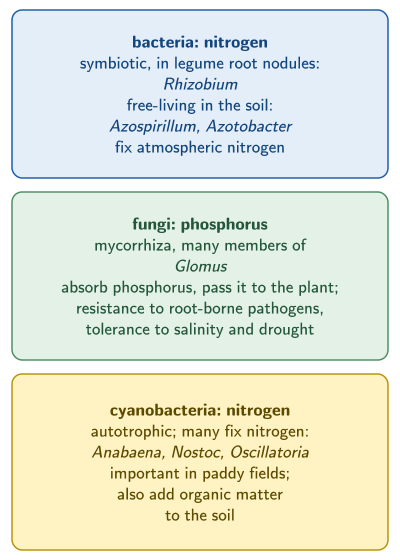
- The nodules on the roots of leguminous plants are formed by the symbiotic association of Rhizobium. These bacteria fix atmospheric nitrogen into organic forms, which the plant uses as nutrient (page 158). See the root nodules of legumes in Class 11.
- Other bacteria fix atmospheric nitrogen while free-living in the soil, for example Azospirillum and Azotobacter, and so enrich the nitrogen content of the soil (page 158).
Mycorrhiza: fungi as biofertilisers
- Fungi also form symbiotic associations with plants, called mycorrhiza. Many members of the genus Glomus form mycorrhiza (page 158).
- The fungal symbiont absorbs phosphorus from the soil and passes it to the plant (page 158).
- Plants with such associations show other benefits too: resistance to root-borne pathogens, tolerance to salinity and drought, and an overall increase in plant growth and development (page 158).
NCERT asks what advantage the fungus gets from this association (page 158). NCERT answers it in its chapter on organisms and populations: in mycorrhizae the fungi help the plant absorb essential nutrients from the soil, and the plant in turn provides the fungi with energy-yielding carbohydrates (NCERT Class 12 Biology, Chapter 11, Section 11.1.4, page 201). Both partners gain: it is a mutualism.
Cyanobacteria in paddy fields
- Cyanobacteria are autotrophic microbes widely distributed in aquatic and terrestrial environments; many of them can fix atmospheric nitrogen, for example Anabaena, Nostoc and Oscillatoria (page 158). Class 11 notes that some, such as Nostoc and Anabaena, fix nitrogen in specialised cells called heterocysts (NCERT Class 11 Biology, Chapter 2, page 13).
- In paddy fields, cyanobacteria serve as an important biofertiliser (page 158).
- Blue-green algae, another name for cyanobacteria (NCERT Class 11 Biology, Chapter 2, page 13), also add organic matter to the soil and increase its fertility (page 158).
- A number of biofertilisers are now available commercially in India, and farmers use them regularly to replenish soil nutrients and reduce dependence on chemical fertilisers (page 158).
Solved examples
Example 1: How biofertilisers enrich the soil
How do biofertilisers enrich the fertility of the soil? (NCERT Exercise 15, page 160.)
Answer: Rhizobium, in the root nodules of legumes, fixes atmospheric nitrogen into organic forms used by the plant; Azospirillum and Azotobacter fix nitrogen while free-living and enrich the soil’s nitrogen; mycorrhizal fungi such as Glomus absorb phosphorus from the soil and pass it to plants; cyanobacteria such as Anabaena, Nostoc and Oscillatoria fix nitrogen in paddy fields and add organic matter to the soil (NCERT page 158).
Example 2: Fewer chemical fertilisers
Microbes can be used to decrease the use of chemical fertilisers. Explain how. (NCERT Exercise 10, page 159, the fertilisers part.)
Answer: biofertilisers supply the nutrients that chemical fertilisers would: nitrogen from nitrogen-fixing bacteria (symbiotic Rhizobium; free-living Azospirillum and Azotobacter) and cyanobacteria, and phosphorus through mycorrhizal fungi. Farmers use commercial biofertilisers to replenish soil nutrients and reduce dependence on chemical fertilisers (NCERT page 158). The pesticides part is answered on the biocontrol page.
Example 3: Which nutrient?
Which nutrient does each supply to the plant: (a) Rhizobium; (b) Glomus; (c) Anabaena?
Answer: (a) nitrogen, fixed in root nodules; (b) phosphorus, absorbed from the soil by the mycorrhizal fungus; (c) nitrogen, fixed by the cyanobacterium (NCERT page 158).
Common mistakes to avoid
Common mistake
Saying mycorrhizal fungi fix nitrogen
NCERT’s mycorrhizal fungus absorbs phosphorus from the soil and passes it to the plant; nitrogen is fixed by bacteria and cyanobacteria (NCERT page 158).
Common mistake
Calling *Azotobacter* symbiotic
Azospirillum and Azotobacter fix nitrogen while free-living in the soil; Rhizobium is the symbiont of legume root nodules (NCERT page 158).
Common mistake
Thinking cyanobacteria only fix nitrogen
Besides fixing nitrogen, blue-green algae also add organic matter to the soil and increase its fertility (NCERT page 158).
Quick revision summary
- Biofertilisers: organisms that enrich the nutrient quality of the soil; main sources bacteria, fungi and cyanobacteria; an answer to the pollution caused by overusing chemical fertilisers.
- Bacteria: Rhizobium in legume root nodules (symbiotic) fixes nitrogen into organic forms; Azospirillum and Azotobacter fix nitrogen free-living.
- Mycorrhiza: fungi such as Glomus absorb phosphorus and pass it to plants; plants also gain resistance to root-borne pathogens, tolerance to salinity and drought, and better growth.
- Cyanobacteria: autotrophic; many fix nitrogen (Anabaena, Nostoc, Oscillatoria); important in paddy fields; add organic matter.
Formula sheet
- biofertilisers: bacteria, fungi, cyanobacteria
- legume root nodules: symbiotic N fixation
- free-living N fixers in the soil
- mycorrhiza: phosphorus to the plant
- cyanobacteria: N fixation in paddy fields
Questions students ask
What is the difference between biofertilisers and biopesticides?
Biofertilisers feed a crop and, beyond the NCERT text, biopesticides protect it: NCERT defines biofertilisers as organisms that enrich the nutrient quality of the soil (page 158), while biopesticides are pesticides “derived from such natural materials as animals, plants, bacteria, and certain minerals”, the most widely used microbial ones being strains of Bacillus thuringiensis (US EPA, public domain). NCERT’s microbial biocontrol agents are therefore biopesticides (our reading). Root-zone fungi fall on either side: mycorrhizal fungi are biofertilisers (page 158), while Trichoderma is a biocontrol agent (page 157).
What are the two types of mycorrhiza, and which one is VAM?
Beyond the NCERT text, which names no types, mycorrhizae are of two main kinds, ectomycorrhizae and endomycorrhizae (MeSH, public domain), and VAM, vesicular-arbuscular mycorrhiza, is an endomycorrhiza. In an ectomycorrhiza, common on trees such as pines, the hyphae often sheathe the root and grow between its cortical cells; in an arbuscular mycorrhiza they enter those cells and branch into tree-like arbuscules, and ‘AM’ is now preferred to ‘VAM’ as some of these fungi form no vesicles (D.M. Sylvia, Pennsylvania State University, facts in our words). NCERT’s mycorrhizal genus belongs to the Glomeromycota (NCBI Taxonomy), fungi that “form arbuscular mycorrhizae with plant roots” (MeSH).
What is the difference between a biofertiliser and an organic manure such as vermicompost?
A biofertiliser is made of living organisms, while an organic manure, beyond the NCERT text, is plant or animal matter, often already broken down by microbes: NCERT defines biofertilisers as organisms that enrich the nutrient quality of the soil (page 158), and India’s Fertiliser (Control) Order, 1985, defines a biofertiliser by its living microbes and the farm work they do, whether fixing nitrogen, making phosphorus soluble or mobilising nutrients, while it lists composts such as vermicompost in a different class, organic fertilisers (facts in our words). By our reading, a manure mainly brings its nutrients with it, while a biofertiliser brings organisms that keep working in the soil.
Practice questions
Try each question first, then open the answer to check your working.
-
Q1. Name two free-living nitrogen-fixing bacteria.
Show answerHide answer
Azospirillum and Azotobacter (NCERT page 158).
-
Q2. Besides phosphorus, what benefits do plants with mycorrhiza show?
Show answerHide answer
Resistance to root-borne pathogens, tolerance to salinity and drought, and an overall increase in plant growth and development (NCERT page 158).
-
Q3. Name three nitrogen-fixing cyanobacteria.
Show answerHide answer
Anabaena, Nostoc and Oscillatoria (NCERT page 158).