Microbes in biogas production
NCERT Class 12 Biology Chapter 8 Section 8.4
Quick answer
Biogas is a mixture of gases, predominantly methane, produced by microbial activity and used as fuel. The methanogens that produce it grow anaerobically and live in the anaerobic sludge of sewage plants and in the rumen of cattle, so cattle dung, gobar, is rich in them. In a biogas plant, dung slurry is fed into a concrete tank, a floating cover rises as the gas forms, and the gas is piped to houses for cooking and lighting.
With your textbook
NCERT Biology (Class 12), Chapter 8 “Microbes in Human Welfare”, Section 8.4 “Microbes in Production of Biogas”, pages 155–156.
Open the official NCERT chapter (PDF, 12.9 MB, ncert.nic.in) (opens in a new tab)
Checked against the 2026-27 reprint on .
What is biogas?
Biogas
Biogas is a mixture of gases (containing predominantly methane) produced by the microbial activity and which may be used as fuel.
NCERT Biology (Class 12), Section 8.4, page 155
- Microbes produce different gaseous end-products during growth and metabolism; the gas depends on the microbe and the organic substrate it uses (page 155).
In plain words: some microbes, living without air, turn plant material into methane, a gas that burns. Cattle dung is full of these microbes, so a closed tank of dung slurry becomes a small gas works.
Methanogens
- In the fermentation of dough, in cheese making and in the production of beverages, the main gas produced is CO2 (page 155).
- Certain bacteria, which grow anaerobically on cellulosic material, produce large amounts of methane along with CO2 and H2. These are collectively called methanogens; one common example is Methanobacterium (page 155).
- Methanogens are commonly found in the anaerobic sludge of sewage treatment, and in the rumen (a part of the stomach) of cattle (page 155).
- The food of cattle contains a lot of cellulosic material, which is also present in the rumen. There, NCERT says, these bacteria help in the breakdown of cellulose and play an important role in the nutrition of cattle (page 155).
- NCERT Class 11 Biology places the methanogens among the archaebacteria, noting that they live in the gut of ruminants such as cows and buffaloes and produce methane (biogas) from their dung (NCERT Class 11 Biology, Section 2.1.1, page 13).
Reading note (page 155): NCERT calls the methanogens bacteria that grow anaerobically on cellulosic material and produce large amounts of methane along with CO2 and H2, and says that in the rumen they help in the breakdown of cellulose. Beyond the NCERT text, this credits the methanogens with the work of the whole anaerobic community. The methanogens are archaea and do not break cellulose down themselves: other microbes first break the complex polymers down and ferment them to acetate, carbon dioxide and hydrogen, and the methanogens make methane from these small products; those that use carbon dioxide and hydrogen use H2 up rather than release it. NCERT’s “help” is fair in one sense: by keeping hydrogen low, the methanogens let the earlier steps go on (Enzmann and colleagues, a review of methanogens in AMB Express, 2018; CC BY 4.0). In an exam, give NCERT’s version: methanogens grow anaerobically on cellulosic material and produce methane with CO2 and H2; in the rumen they help in the breakdown of cellulose and in the nutrition of cattle, and cattle dung is rich in them.
NCERT asks whether we can digest the cellulose in our food (page 155; NCERT prints “celluose”, a misprint). No: beyond the NCERT text, the US National Library of Medicine’s MeSH thesaurus (public domain) defines dietary fibre as “The remnants of plant cell walls that are resistant to digestion by the alimentary enzymes of man”, and NCERT Class 11 Biology notes that plant cell walls are made of cellulose (Chapter 9, page 111). Unlike cattle, we have no rumen full of cellulose-digesting microbes (our reasoning).
Cattle dung (gobar) as raw material
- Because of these microbes in the rumen, the excreta (dung) of cattle, commonly called gobar, is rich in methanogens (page 155).
- Dung can therefore be used to generate biogas, commonly called gobar gas (page 155).
- Cattle dung is available in large quantities in rural areas, where cattle are used for a variety of purposes, so biogas plants are more often built in rural areas (page 156).
A biogas plant
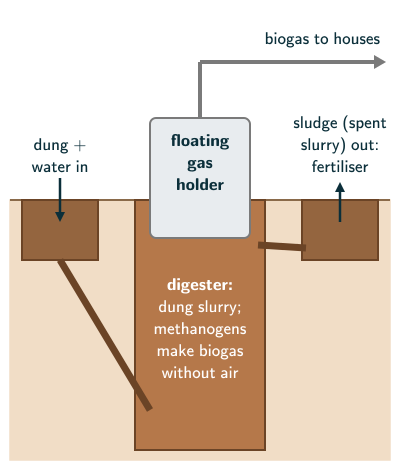
- A biogas plant consists of a concrete tank (10–15 feet deep) in which bio-wastes are collected and a slurry of dung is fed (page 155).
- A floating cover is placed over the slurry. It keeps rising as gas is produced in the tank by microbial activity (pages 155–156).
- An outlet is connected to a pipe that supplies biogas to nearby houses. The spent slurry is removed through another outlet and may be used as fertiliser (page 156).
- The biogas is used for cooking and lighting (page 156).
- The technology of biogas production was developed in India mainly through the efforts of the Indian Agricultural Research Institute (IARI) and the Khadi and Village Industries Commission (KVIC) (page 156).
Biogas also forms in sewage treatment: the anaerobic sludge digesters of a treatment plant produce methane, hydrogen sulphide and carbon dioxide, which form biogas (NCERT Section 8.3, page 154).
Solved examples
Example 1: Microbes as a source of energy
Do you think microbes can also be used as a source of energy? If yes, how? (NCERT Exercise 9, page 159.)
Answer: yes. Methanogens such as Methanobacterium, growing anaerobically on cellulosic material, produce large amounts of methane with CO2 and H2. In a biogas plant, cattle dung slurry, rich in these microbes, is fed into a tank; the biogas collects under a floating cover and is piped to houses for cooking and lighting (NCERT pages 155–156). Anaerobic sludge digesters at sewage plants also yield biogas, an inflammable fuel (NCERT page 154).
Example 2: Why gobar?
Why is cattle dung used to make biogas?
Answer: methanogens live in the rumen of cattle, where the cellulosic material of their food is broken down, so the dung (gobar) is rich in these bacteria. Dung is also available in large quantities in rural areas (NCERT pages 155–156).
Example 3: The floating cover
In a biogas plant, why does the cover over the slurry keep rising?
Answer: the cover floats on the slurry. As the microbes produce gas in the tank, the gas collects under the cover and pushes it up (reasoned from NCERT page 156, where the cover “keeps on rising as the gas is produced”).
Common mistakes to avoid
Common mistake
Calling carbon dioxide the main gas of biogas
Biogas is predominantly methane; CO2 is the main gas in dough, cheese and beverage fermentations (NCERT page 155).
Common mistake
Thinking methanogens need oxygen
Methanogens grow anaerobically: the biogas tank and the sludge digesters work without air (reasoned from NCERT pages 154–155).
Common mistake
Throwing away the spent slurry
The spent slurry removed from the biogas plant may be used as fertiliser (NCERT page 156).
Quick revision summary
- Biogas: a mixture of gases, predominantly methane, produced by microbial activity and used as fuel.
- Methanogens (e.g. Methanobacterium) grow anaerobically on cellulosic material and produce methane with CO2 and H2; found in anaerobic sludge and in the rumen of cattle; Class 11 places them among the archaebacteria.
- Cattle dung (gobar) is rich in methanogens: gobar gas. Plants are more often built in rural areas.
- Biogas plant: a concrete tank 10–15 feet deep with dung slurry; a floating cover rises as gas forms; an outlet pipe supplies houses (cooking, lighting); spent slurry used as fertiliser. Developed in India by IARI and KVIC.
Formula sheet
- biogas: mostly methane, from microbes
- methanogens: anaerobic; methane + CO + H
- methanogens: rumen, dung, anaerobic sludge
- gobar gas: biogas from cattle dung
- floating cover rises as gas forms
- spent slurry: fertiliser
Questions students ask
What is the composition of biogas?
Biogas is predominantly methane, as NCERT puts it (page 155), and, beyond the NCERT text, the US Energy Information Administration (EIA, public domain) gives its methane content as 45–65 per cent, depending on the material digested, and describes biogas as made up mostly of methane and carbon dioxide. So carbon dioxide forms most of the remaining 35–55 per cent (our arithmetic). The EIA adds that biogas also carries small amounts of hydrogen sulphide, “a noxious and potentially toxic compound when in high concentrations”.
What is the difference between methanogens and methanotrophs?
Methanogens produce methane and, beyond the NCERT text, methanotrophs consume it: NCERT’s methanogens grow anaerobically (page 155), while methanotrophs are microbes that oxidise methane for energy, the aerobic ones being bacteria and the anaerobic ones including bacteria and archaea (Guerrero-Cruz and colleagues, Frontiers in Microbiology, 2021, CC BY). The same review states that making methane to conserve energy is known only in the archaea, and calls methanotrophs the sole biological methane sink: where conditions suit, they remove methane before it can reach the air. So the two are producer and consumer of one gas, not partners (our reading).
How is biogas different from LPG and CNG?
Biogas is made by microbes from wastes such as cattle dung (NCERT pages 155–156), while LPG and CNG, beyond the NCERT text, are fossil fuels: the US Energy Information Administration (EIA, public domain) defines LPG as hydrocarbon gases, “primarily propane, normal butane, and isobutane, derived from crude oil refining or natural gas processing”, and CNG as natural gas, whose largest component is methane, compressed into high-pressure containers. Raw biogas shares the methane but, says the EIA, needs its moisture removed and its carbon dioxide and hydrogen sulphide reduced, giving renewable natural gas of at least 90 per cent methane, before it can replace natural gas or be made into CNG.
Which chapter is biogas in, and is it in the NEET (UG) 2026 syllabus?
Biogas is in NCERT Biology Class 12, Chapter 8, Microbes in Human Welfare, Section 8.4 (pages 155–156), and it is in the NEET (UG) 2026 syllabus without being named: Unit 8, Biology and Human Welfare, lists “Microbes in human welfare: In household food processing, industrial production, sewage treatment, energy generation and as biocontrol agents and biofertilizers.” (National Medical Commission, Syllabus for NEET (UG) 2026). By our reading, “energy generation” points to biogas, the microbial source of energy that the chapter teaches; its Summary says that biogas produced by microbes “is used as a source of energy in rural areas” (page 159).
Practice questions
Try each question first, then open the answer to check your working.
-
Q1. Name one methanogen that NCERT mentions.
Show answerHide answer
Methanobacterium (NCERT page 155).
-
Q2. Through whose efforts, mainly, was biogas technology developed in India?
Show answerHide answer
The Indian Agricultural Research Institute (IARI) and the Khadi and Village Industries Commission (KVIC) (NCERT page 156).
-
Q3. For what is the biogas from a village plant used?
Show answerHide answer
For cooking and lighting (NCERT page 156).