Microbes in industrial products
NCERT Class 12 Biology Chapter 8 Section 8.2
Quick answer
Industrial fermentors grow selected microbes to produce ethanol, antibiotics, organic acids and enzymes. Other products include streptokinase, cyclosporin and microbial statins, each with a specific biological action. Industrial fermentation may be aerobic or anaerobic depending on the process.
With your textbook
NCERT Biology (Class 12), Chapter 8 “Microbes in Human Welfare”, Section 8.2 “Microbes in Industrial Products”, pages 151–153.
Open the official NCERT chapter (PDF, 12.9 MB, ncert.nic.in) (opens in a new tab)
Checked against the 2026-27 reprint on .
What are microbes in industrial products?
Microbes in industrial products
Even in industry, microbes are used to synthesise a number of products valuable to human beings.
NCERT Biology (Class 12), Section 8.2, page 151
- Beverages and antibiotics are some examples. Production on an industrial scale requires growing microbes in very large vessels called fermentors (page 151).
In plain words: the same yeasts and moulds that work in a kitchen can be grown by the tonne. In huge closed tanks they make drinks, medicines, acids and enzymes.
NCERT Figure 8.4 (page 152) shows fermentors, and NCERT Figure 8.5 (page 152) a fermentation plant; both are photographs.
Fermented beverages
- Microbes, especially yeasts, have been used from time immemorial to produce beverages such as wine, beer, whisky, brandy and rum (page 152).
- The same yeast used for bread-making, Saccharomyces cerevisiae, here called brewer’s yeast, ferments malted cereals and fruit juices to produce ethanol (page 152).
- NCERT asks which metabolic reactions give ethanol in yeast: it is alcoholic fermentation, in which pyruvic acid gives ethanol and CO2 without oxygen (NCERT Class 11 Biology, Section 12.3).
- The raw material and the processing decide the drink. Wine and beer are produced without distillation, whereas whisky, brandy and rum are produced by distillation of the fermented broth (page 152).
Antibiotics
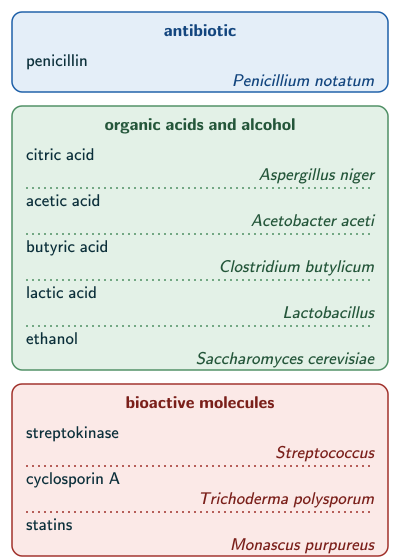
Antibiotics are chemical substances, which are produced by some microbes and can kill or retard the growth of other (disease-causing) microbes.
NCERT Biology (Class 12), Section 8.2.2, page 152
- Antibiotics produced by microbes are regarded as one of the most significant discoveries of the twentieth century (page 152).
- ‘Anti’ is a Greek word meaning ‘against’, and ‘bio’ means ‘life’: together, ‘against life’, in the context of disease-causing organisms; with reference to human beings, antibiotics are ‘pro life’ (page 152).
- They have greatly improved our capacity to treat deadly diseases such as plague, whooping cough (kali khansi), diphtheria (gal ghotu) and leprosy (kusht rog), which used to kill millions all over the globe (page 153).
- Beyond the NCERT text: antibiotics used as medicines fight bacterial infections; they do not work on viral infections such as colds (MedlinePlus, Antibiotics, US National Library of Medicine; public domain).
- NCERT asks for other antibiotics and their sources (page 153). Beyond the NCERT text (Wikipedia, facts in our words): streptomycin, first isolated in 1943 from the bacterium Streptomyces griseus; and the cephalosporins, first obtained from the fungus Acremonium, earlier called Cephalosporium.
The discovery of penicillin
- Penicillin was the first antibiotic to be discovered, and it was a chance discovery (page 152).
- Alexander Fleming, while working on Staphylococci bacteria, once saw a mould growing in one of his unwashed culture plates, around which Staphylococci could not grow. He found that this was due to a chemical produced by the mould, and named it penicillin after the mould Penicillium notatum (page 152).
- Its full potential as an effective antibiotic was established much later by Ernest Chain and Howard Florey. It was used extensively to treat American soldiers wounded in World War II (page 152).
- Fleming, Chain and Florey were awarded the Nobel Prize in 1945 for this discovery (page 152).
Chemicals, enzymes and other bioactive molecules
Organic acids and alcohol (page 153):
- citric acid from Aspergillus niger, a fungus;
- acetic acid from Acetobacter aceti, a bacterium;
- butyric acid from Clostridium butylicum, a bacterium;
- lactic acid from Lactobacillus, a bacterium;
- ethanol, produced commercially with yeast, Saccharomyces cerevisiae.
Enzymes (page 153):
- Lipases are used in detergent formulations and help remove oily stains from laundry.
- Bottled fruit juices are clearer than home-made ones because they are clarified with pectinases and proteases.
Other bioactive molecules (page 153):
- Streptokinase, produced by the bacterium Streptococcus and modified by genetic engineering, is used as a ‘clot buster’ for removing clots from the blood vessels of patients who have undergone myocardial infarction leading to heart attack.
- Cyclosporin A, used as an immunosuppressive agent in organ-transplant patients, is produced by the fungus Trichoderma polysporum.
- Statins, produced by Monascus purpureus, have been commercialised as blood-cholesterol lowering agents. They act by competitively inhibiting the enzyme responsible for the synthesis of cholesterol; see competitive inhibition in Class 11.
NCERT slip (page 153): NCERT calls Monascus purpureus a yeast. It is a mould, a fungus that forms filaments of many cells, rather than a single-celled yeast; it is fermented on rice to make ‘red yeast rice’, which can contain monacolin K, structurally identical to the statin lovastatin (beyond the NCERT text: US National Center for Complementary and Integrative Health, Red Yeast Rice; public domain). In an exam, pair statins with Monascus purpureus; if a question copies NCERT’s ‘yeast’, it means the same organism.
Reading note (page 153): beyond the NCERT text, the 1976 paper that first described cyclosporin A named its fungus Trichoderma polysporum, the name NCERT uses; the same isolate is now classed as Tolypocladium inflatum, the fungus best known today as the producer of cyclosporin (Bushley and colleagues, PLOS Genetics, 2013, which cites that 1976 paper; CC BY). For NEET, give NCERT’s Trichoderma polysporum.
Reading note (page 153): NCERT names the butyric acid producer Clostridium butylicum. Beyond the NCERT text: the NCBI Taxonomy database (US National Library of Medicine, public domain) has no entry under that name; it does list Clostridium butyricum, whose species name means ‘of butyric acid’ (our gloss). For NEET, give NCERT’s Clostridium butylicum.
Solved examples
Example 1: Cyclosporin A and statins
Find out the names of the microbes from which cyclosporin A (an immunosuppressive drug) and statins (blood-cholesterol lowering agents) are obtained. (NCERT Exercise 12, page 160.)
Answer: cyclosporin A from the fungus Trichoderma polysporum; statins from Monascus purpureus (NCERT page 153).
Example 2: Fungi that give antibiotics
Name any two species of fungus which are used in the production of antibiotics. (NCERT Exercise 6, page 159.)
Answer: Penicillium notatum, which gives penicillin (NCERT page 152). Beyond the NCERT text: Cephalosporium acremonium, also named Acremonium chrysogenum, the source of the cephalosporins (NCBI Taxonomy, US National Library of Medicine, public domain, files both names under one species; MeSH scope note for Acremonium: “Cephalosporin antibiotics are derived from this genus.”).
Example 3: Microbes against bacterial diseases
In which way have microbes played a major role in controlling diseases caused by harmful bacteria? (NCERT Exercise 5, page 159.)
Answer: some microbes produce antibiotics, chemical substances that kill or retard the growth of other, disease-causing microbes. Penicillin, from the mould Penicillium notatum, was the first; antibiotics have greatly improved the treatment of plague, whooping cough, diphtheria and leprosy, which once killed millions (NCERT pages 152–153).
Common mistakes to avoid
Common mistake
Saying wine and beer are distilled
Wine and beer are produced without distillation; whisky, brandy and rum are produced by distilling the fermented broth (NCERT page 152).
Common mistake
Crediting penicillin to Fleming alone
Fleming discovered it by chance, but Ernest Chain and Howard Florey established its full potential as an antibiotic, and all three shared the Nobel Prize in 1945 (NCERT page 152).
Common mistake
Swapping the producers of cyclosporin A and statins
Cyclosporin A comes from the fungus Trichoderma polysporum; statins come from Monascus purpureus (NCERT page 153).
Quick revision summary
- Industrial production grows microbes in very large vessels, fermentors.
- Beverages: brewer’s yeast (Saccharomyces cerevisiae) ferments malted cereals and fruit juices to ethanol; wine and beer without distillation; whisky, brandy and rum by distillation.
- Antibiotics: microbial chemicals that kill or retard disease-causing microbes. Penicillin, the first, a chance discovery by Fleming from Penicillium notatum; developed by Chain and Florey; Nobel Prize 1945. Antibiotics improved the treatment of plague, whooping cough, diphtheria and leprosy.
- Organic acids: citric (Aspergillus niger), acetic (Acetobacter aceti), butyric (Clostridium butylicum), lactic (Lactobacillus); ethanol (yeast).
- Enzymes: lipases in detergents; pectinases and proteases clarify juices. Other bioactive molecules: streptokinase (Streptococcus), a clot buster; cyclosporin A (Trichoderma polysporum), an immunosuppressant; statins (Monascus purpureus), cholesterol lowering.
Formula sheet
- antibiotic: kills or retards disease-causing microbes
- penicillin: the first antibiotic, from a mould
- wine, beer: no distillation
- whisky, brandy, rum: distilled
- lipases: detergents; pectinases, proteases: juices
- streptokinase: clot buster
- cyclosporin A: immunosuppressant
- statins: lower blood cholesterol
Questions students ask
How does penicillin kill bacteria?
Beyond the NCERT text, penicillin kills susceptible bacteria by stopping them from building their cell wall: it binds irreversibly to bacterial “penicillin-binding proteins”, which the US National Library of Medicine’s MeSH thesaurus (public domain) describes as “primarily enzymes involved in cell wall biosynthesis”. NCERT Class 11 explains why the wall matters, since it gives the bacterium “a strong structural support to prevent the bacterium from bursting or collapsing” (Chapter 8, page 90). Animal cells have no cell wall (NCERT Class 11, page 91), which, by our reading, is why penicillin can act on bacteria in the body without attacking our own cells.
How was penicillin first produced on a large scale?
Beyond the NCERT text, penicillin’s mass production was worked out at the US Department of Agriculture’s laboratory in Peoria, Illinois, which the Oxford scientists reached on 14 July 1941 (USDA Agricultural Research Service, public domain). Two advances were key: growing the mould in deep, aerated vats of corn-steep liquor instead of on the surface, and a Penicillium strain from a mouldy Peoria cantaloupe that, once improved, gave the most penicillin. After clinical trials in 1943, output grew fast enough for the Allied wounded of D-Day, by our reading the supply behind NCERT’s note that penicillin was “extensively used to treat American soldiers wounded in World War II” (page 152).
What is the difference between penicillin and amoxicillin?
Beyond the NCERT text, amoxicillin is one of the penicillins, not a different kind of antibiotic: the US National Library of Medicine’s MeSH thesaurus (public domain) groups the penicillins as antibiotics built on one 6-aminopenicillanic acid core, each with its own side chain that shapes much of how it acts, and calls amoxicillin “a broad-spectrum semisynthetic antibiotic similar to ampicillin except that its resistance to gastric acid permits higher serum levels with oral administration”. So penicillin is NCERT’s product of the mould Penicillium notatum (page 152), and amoxicillin a semisynthetic member of its family (our wording).
Practice questions
Try each question first, then open the answer to check your working.
-
Q1. Which microbe produces citric acid, and which produces acetic acid?
Show answerHide answer
Citric acid: the fungus Aspergillus niger; acetic acid: the bacterium Acetobacter aceti (NCERT page 153).
-
Q2. Why are bottled fruit juices clearer than those made at home?
Show answerHide answer
They are clarified with the enzymes pectinases and proteases (NCERT page 153).
-
Q3. What is streptokinase used for?
Show answerHide answer
As a ‘clot buster’, to remove clots from the blood vessels of patients who have undergone myocardial infarction leading to heart attack (NCERT page 153).