Enzymes
NCERT Class 11 Biology Chapter 9 Section 9.8
Quick answer
Almost all enzymes are proteins; the substrate binds at the active site to form an enzyme–substrate complex, in which it passes through a high-energy transition state, and enzymes speed reactions by lowering the activation energy needed to reach that state. Activity peaks at an optimum temperature and pH, levels off at Vmax as substrate rises, and can be blocked by competitive inhibitors such as malonate. NCERT groups enzymes into six classes, and many need co-factors: prosthetic groups, co-enzymes or metal ions.
With your textbook
NCERT Biology (Class 11), Chapter 9 “Biomolecules”, Section 9.8 “Enzymes”, pages 112–118.
Open the official NCERT chapter (PDF, 1.9 MB, ncert.nic.in) (opens in a new tab)
Checked against the 2026-27 reprint on .
Enzymes
Enzymes
Almost all enzymes are proteins.
NCERT Biology (Class 11), Section 9.8, page 112
- Some nucleic acids behave like enzymes; they are called ribozymes (page 112). In Class 12 you will meet one: in bacteria the 23S rRNA of the ribosome is the ribozyme that forms peptide bonds (NCERT Biology Class 12, Chapter 5, page 99).
- A protein enzyme has primary, secondary and tertiary structure. In the folded chain, crevices or pockets form; one such pocket is the active site, into which the substrate fits, and through it the enzyme catalyses a reaction at a high rate (pages 112–113).
- Because the substrate has to fit the active site, enzymes favour particular substrates or groups of related substrates: proteinaceous enzymes show substrate specificity (NCERT Summary, page 119).
In plain words: a typical enzyme is a protein catalyst with an active site; catalytic RNAs are exceptions to the protein description. Binding positions the reacting groups and provides a lower-barrier route to products. Stabilising the transition state and other catalytic interactions increase the reaction rate; the amount of acceleration depends on the reaction. The enzyme comes out unchanged and starts again.
Enzymes and inorganic catalysts
- NCERT contrasts industrial inorganic catalysts at high temperature/pressure with heat-sensitive enzymes, giving above 40°C as an illustration (page 113). This is not a universal enzyme damage threshold or a requirement that all inorganic catalysts need heat.
- But enzymes from organisms that live at very high temperatures, in hot vents and sulphur springs, stay stable and keep their catalytic power up to 80–90°C. Such thermal stability is an important quality of enzymes from thermophilic organisms (page 113), such as some of the archaebacteria.
Chemical reactions and their rates
- NCERT: a physical change is a change in shape without breaking of bonds; a change in state, as when ice melts or water becomes vapour, is also a physical process. When bonds are broken and new bonds are formed, the change is a chemical reaction: for example, Ba(OH) + HSO → BaSO + 2HO, an inorganic reaction, or the hydrolysis of starch into glucose, an organic one (page 113). Beyond the NCERT text: melting and boiling do break attractions between molecules, such as hydrogen bonds in water, though not the bonds inside each molecule, so the substance keeps its chemical identity (our reasoning).
- The rate of a process is the amount of product formed per unit time (page 113):
- NCERT: rate can also be called velocity if the direction is specified, and as a general rule of thumb a rate doubles or decreases by half for every 10°C change in either direction (page 113). Beyond the NCERT text: in enzyme kinetics ‘velocity’ simply means reaction rate, and the 10°C rule holds only roughly, over a limited range (our reading).
How much faster with an enzyme? Without an enzyme, CO + HO → HCO forms about 200 molecules of carbonic acid in an hour. With carbonic anhydrase, an enzyme in the cytoplasm, about 600 000 molecules form every second: the enzyme speeds the reaction about 10 million times (page 114).
Metabolic pathways. A multistep reaction in which each step is catalysed by the same enzyme complex or by different enzymes is a metabolic pathway (page 114). Glucose becomes pyruvic acid through ten enzyme-catalysed reactions; the ten steps do not directly consume oxygen (NCERT Chapter 12, pages 155–156).
With one or two extra reactions, the same pathway gives different end products: lactic acid in skeletal muscle under anaerobic conditions, pyruvic acid under normal aerobic conditions, and ethanol in yeast during fermentation (page 114).
NCERT slip (page 114): NCERT’s equation includes O, but that is not the biochemical net equation for glycolysis (reasoned from NCERT Chapter 12, pages 155–156). The ten steps themselves use no oxygen: hydrogen removed on the way is passed to NAD (NCERT Chapter 12, page 156), and NCERT calls glycolysis a partial oxidation of glucose “without the help of oxygen” (Chapter 12, page 155). That is why the same pathway also runs in muscle short of oxygen and in fermenting yeast.
How enzymes speed up reactions
- The substrate (S) must diffuse to the active site and bind it, forming an obligatory, transient enzyme–substrate complex (ES). While it is bound, a new structure of the substrate, the transition state, forms; soon the bond breaking or making is complete and the product is released (page 114).
- The difference between the average energy of S and that of the transition state is the activation energy. Whether a reaction gives out energy or needs it, S must pass through this much higher energy state; enzymes bring down this energy barrier, making the change from S to P easier (page 115).
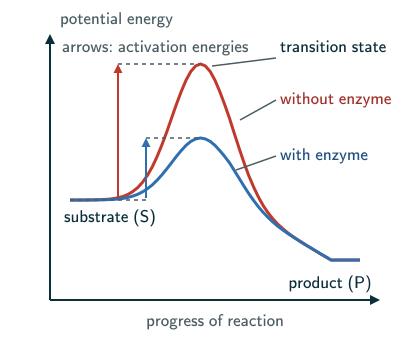
NCERT says that if P lies lower than S, the reaction is exothermic and one need not supply energy by heating to form the product (page 115), and it pairs “exothermic or spontaneous”. Beyond the NCERT Biology text: giving out heat does not by itself make a reaction spontaneous. That is decided by the Gibbs energy change, which must be negative, and some endothermic changes, such as ice melting above 0°C, are spontaneous. Nor does spontaneous mean fast: the substrate must still climb the activation-energy barrier. In NCERT Figure 9.4, S and P sit at the same levels with and without the enzyme, so an enzyme changes how fast a reaction goes, not whether it can go.
Nature of enzyme action
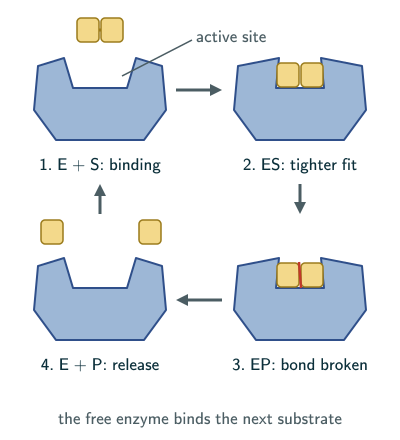
Each enzyme has a substrate-binding site, where a highly reactive, short-lived ES complex forms; it breaks down into the product and the unchanged enzyme through an enzyme–product complex (EP) (page 115): E + S ⇌ ES → EP → E + P.
The catalytic cycle (pages 115–116):
- The substrate binds to the active site of the enzyme.
- The binding induces the enzyme to alter its shape, fitting more tightly round the substrate.
- The active site, now close to the substrate, breaks its chemical bonds, and the enzyme–product complex forms.
- The enzyme releases the products, and the free enzyme is ready to bind another substrate molecule.
Step 2 is called induced fit. Beyond the NCERT text: the induced-fit model was proposed by Daniel Koshland in 1958; the older lock-and-key model of Emil Fischer (1894) pictured a rigid active site into which the substrate fits like a key.
Factors affecting enzyme activity
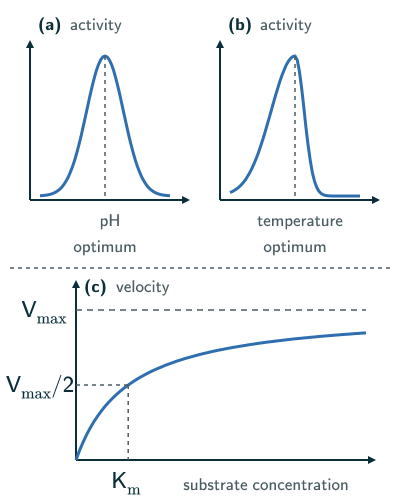
Activity depends on temperature, pH, substrate concentration and regulators (page 116). Temperature or extreme pH can change protein structure; changing substrate concentration can change active-site occupancy without denaturing the enzyme.
- Temperature and pH: enzymes work in a narrow range of each. Activity is highest at the optimum temperature and optimum pH, and declines both below and above. Low temperature generally slows catalysis; sufficiently high temperature can denature the protein and reduce activity (page 116). The observed optimum depends on the enzyme and assay conditions.
- Substrate concentration: at fixed enzyme concentration, pH and temperature, increasing substrate makes the velocity rise at first and then reaches a maximum velocity (Vmax), which further substrate cannot exceed, because the enzyme molecules are fewer than the substrate molecules and, once they are saturated, no free enzyme is left (page 116). NCERT’s Figure 9.5 (c) also marks Vmax/2 on the velocity axis and Km on the [S] axis below it. For a simple Michaelis–Menten enzyme, beyond the NCERT text, Km is the substrate concentration at which the velocity is half of Vmax; a low Km means the enzyme reaches half its top speed at a low substrate concentration.
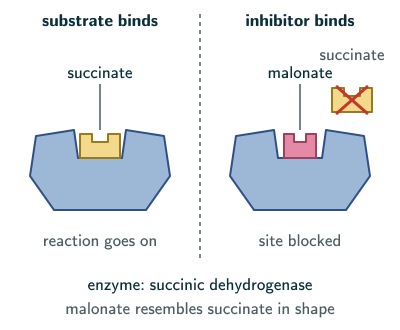
Inhibition. When a chemical binds to an enzyme and shuts off its activity, the process is inhibition and the chemical an inhibitor. A competitive inhibitor closely resembles the substrate, competes for the substrate-binding site and keeps the substrate out: malonate inhibits succinic dehydrogenase because it closely resembles the substrate, succinate. Competitive inhibitors are often used to control bacterial pathogens (pages 116–117). Beyond the NCERT text: because the substrate can outcompete the inhibitor at high concentration, competitive inhibition leaves Vmax unchanged but raises the apparent Km.
Classification of enzymes
NCERT presents 6 enzyme classes, each with 4–13 subclasses, and named by a four-digit number (page 117):
| Class | Reaction catalysed |
|---|---|
| Oxidoreductases (dehydrogenases) | oxidoreduction between two substrates |
| Transferases | transfer of a group (not hydrogen) between two substrates |
| Hydrolases | hydrolysis of ester, ether, peptide, glycosidic, C–C, C–halide or P–N bonds |
| Lyases | removal of groups, not by hydrolysis, leaving double bonds |
| Isomerases | interconversion of optical, geometric or positional isomers |
| Ligases | joining two compounds, typically coupled to ATP or a similar nucleotide’s hydrolysis |
Beyond the NCERT text: in 2018 the Nomenclature Committee of the International Union of Biochemistry and Molecular Biology (IUBMB), which maintains the Enzyme Commission list, added a seventh class, the translocases (EC 7), which move ions or molecules across membranes. For NEET, give NCERT’s six classes. NCERT’s “four-digit number” is the Enzyme Commission number, four numbers separated by points, such as EC 3.4.21.4 for trypsin.
The IUBMB’s EC 6 definition adds the energy-coupling condition for ligases; merely observing a new bond does not identify the class. NCERT also writes the first two classes as general reactions (page 117), so either reaction identifies the class:
- oxidoreductases: S reduced + S′ oxidised → S oxidised + S′ reduced
- transferases: S–G + S′ → S + S′–G
Co-factors
Some enzymes need non-protein co-factors bound to them to be catalytically active; the protein part is then the apoenzyme. There are three kinds (pages 117–118):
- Prosthetic groups: organic compounds tightly bound to the apoenzyme. In peroxidase and catalase, haem is the prosthetic group and is part of the active site (page 118).
- Co-enzymes: organic compounds whose association with the apoenzyme is only transient, usually during catalysis; a co-enzyme serves many different enzyme-catalysed reactions. Many co-enzymes are built from vitamins: NAD and NADP contain the vitamin niacin (page 118).
- Metal ions: they form coordination bonds with side chains at the active site and with the substrate; zinc is the co-factor of the proteolytic enzyme carboxypeptidase (page 118).
Catalytic activity is lost when the co-factor is removed, showing that co-factors play a crucial role (page 118). Beyond the NCERT text: the complete, active enzyme, apoenzyme plus co-factor, is called the holoenzyme.
NCERT says that peroxidase and catalase both catalyse the breakdown of hydrogen peroxide to water and oxygen (page 118). That is catalase’s reaction; beyond the NCERT text, the IUBMB entry EC 1.11.1.7 specifies that a peroxidase uses hydrogen peroxide to oxidise another substance, giving water but no oxygen.
Solved examples
Example 1: How many times faster?
Without an enzyme, about 200 molecules of carbonic acid form in an hour; with carbonic anhydrase, about 600 000 form every second. Check NCERT’s “about 10 million times”.
Answer: in one hour the enzyme makes 600 000 × 3600 = 2 160 000 000 molecules, against 200 without it: 2 160 000 000 ÷ 200 = 10 800 000, about 10 million times (numbers from NCERT page 114).
Example 2: The rule of thumb
A reaction runs at rate R at 20°C. By NCERT’s rule of thumb, about how fast does it run at 40°C, and at 10°C?
Answer: each 10°C doubles or halves the rate, so about 2 × 2 × R = 4R at 40°C and about R ÷ 2 at 10°C (rule from NCERT page 113). For an enzyme-catalysed reaction this holds only below the optimum temperature; above it the enzyme is denatured and the rate falls (NCERT page 116).
Example 3: Important properties of enzymes (NCERT Exercise 11)
Describe the important properties of enzymes.
Answer: almost all enzymes are proteins (ribozymes are nucleic acids); each has an active site that the substrate fits; they speed reactions enormously by lowering the activation energy and come out unchanged; they show substrate specificity; they work best at an optimum temperature and pH and are denatured by high temperature; their velocity reaches a maximum (Vmax) as substrate rises; they can be inhibited, for example competitively; many need co-factors (NCERT pages 112–119).
Example 4: Name the class
To which class does each belong: an enzyme joining two molecules with a new C–N bond coupled to ATP hydrolysis; an enzyme converting one optical isomer into another; trypsin, which digests proteins?
Answer: a ligase; an isomerase; a hydrolase, as it hydrolyses peptide bonds (NCERT page 117; trypsin’s action is beyond the NCERT text, which lists it only as an enzyme in Table 9.5).
Example 5: Prosthetic group or co-enzyme?
How does a prosthetic group differ from a co-enzyme?
Answer: both are organic co-factors, but a prosthetic group (haem in catalase) is tightly bound to the apoenzyme, while a co-enzyme (NAD) associates only transiently, during catalysis (NCERT page 118).
Common mistakes to avoid
Common mistake
Saying enzymes raise the activation energy
Enzymes bring down the activation energy barrier (NCERT page 115).
Common mistake
Expecting more substrate always to speed the reaction
Velocity levels off at Vmax once all enzyme molecules are saturated (NCERT page 116).
Common mistake
Calling all enzymes proteins
Almost all are; ribozymes are nucleic acids with catalytic power (NCERT page 112).
Common mistake
Confusing the inhibitor and the substrate of succinic dehydrogenase
Succinate is the substrate; malonate is the competitive inhibitor (NCERT page 117).
Quick revision summary
- Almost all enzymes are proteins; ribozymes are catalytic nucleic acids. The substrate fits the active site.
- Enzyme thermal stability varies; the 40°C example is not a universal threshold, and thermophilic enzymes can remain active at 80–90°C.
- Rate = δP/δt; it roughly doubles or halves per 10°C (for enzymes, only below the optimum). Carbonic anhydrase speeds its reaction about 10 million times.
- Metabolic pathway: glucose → pyruvic acid in ten steps; lactic acid in muscle (anaerobic), ethanol in yeast.
- E + S ⇌ ES → EP → E + P; the transition state; enzymes lower the activation energy; the catalytic cycle with a tighter fit after binding (induced fit).
- Activity: optimum temperature and pH; denaturation by heat; Vmax at saturation; competitive inhibition (malonate, succinic dehydrogenase).
- Six classes: oxidoreductases, transferases, hydrolases, lyases, isomerases, ligases.
- Co-factors: prosthetic groups (haem), co-enzymes (NAD, NADP with niacin), metal ions (zinc in carboxypeptidase); apoenzyme.
Formula sheet
- rate = δP/δt
- E + S ⇌ ES → EP → E + P
- rough temperature rule: rate doubles/halves per 10°C over a limited range
- carbonic anhydrase: about 10 million times faster
- NCERT six classes: oxidoreductases, transferases, hydrolases, lyases, isomerases, ligases
- co-factors: prosthetic groups, co-enzymes, metal ions
Questions students ask
How many classes of enzymes are there?
Enzymes are divided into six classes in NCERT, each with 4–13 subclasses and named accordingly by a four-digit number: oxidoreductases (dehydrogenases), transferases, hydrolases, lyases, isomerases and ligases (page 117). Beyond the NCERT text, the IUBMB, which keeps the international enzyme list, added a seventh class in August 2018, the translocases (EC 7), for enzymes that move ions or molecules across membranes, so current biochemistry counts seven; for NEET, give NCERT’s six. The four-digit number, also beyond the NCERT text, is the Enzyme Commission (EC) number, whose first number gives the class in NCERT’s order, from 1 for oxidoreductases to 6 for ligases.
What is competitive inhibition, and what is NCERT’s example?
Competitive inhibition is the inhibition of an enzyme by a chemical that closely resembles its substrate in molecular structure, so that it competes with the substrate for the substrate-binding site and the substrate cannot bind (NCERT pages 116–117). NCERT’s example is malonate, which inhibits succinic dehydrogenase because it closely resembles the enzyme’s substrate, succinate. NCERT adds that such competitive inhibitors are often used in the control of bacterial pathogens; beyond the NCERT text, sulpha drugs (sulphonamides) work this way, resembling para-aminobenzoic acid, which bacteria need to make folic acid, and so blocking the enzyme that uses it.
What is the difference between competitive and non-competitive inhibition?
For simple reversible Michaelis–Menten inhibition, a competitive inhibitor excludes substrate binding; more substrate can overcome its effect, so Vmax is unchanged and apparent Km rises. Beyond NCERT, the NIH Assay Guidance Manual distinguishes pure noncompetitive inhibition: the inhibitor binds free enzyme and enzyme–substrate complex equally well, lowering Vmax without changing Km. If those affinities differ, inhibition is mixed and Km changes too. Binding somewhere other than the active site alone does not establish pure noncompetitive inhibition.
What is the difference between a co-factor, a co-enzyme and a prosthetic group?
A co-factor is a non-protein constituent bound to an enzyme to make it catalytically active, and NCERT names three kinds: prosthetic groups, co-enzymes and metal ions (pages 117–118). Prosthetic groups and co-enzymes are both organic, but a prosthetic group is tightly bound to the apoenzyme, the protein part, as haem is in peroxidase and catalase, while a co-enzyme joins it only transiently, usually during catalysis, and serves many different reactions, like NAD and NADP, which contain the vitamin niacin. Metal ions, such as zinc in carboxypeptidase, form coordination bonds with active-site side chains and the substrate. Beyond the NCERT text, apoenzyme plus co-factor is the holoenzyme.
What is the difference between enzymes and inorganic catalysts?
Enzymes differ from inorganic catalysts above all in their response to heat: NCERT gives heat-sensitive enzymes and thermostable enzymes from thermophiles as contrasting examples (page 113). There is no universal 40°C cutoff, and inorganic catalysts do not all require high temperature or pressure. Enzymes are also almost all proteins, show substrate specificity because the substrate must fit their active site, and work in a narrow range of temperature and pH, each with an optimum (NCERT pages 112–119). Their speed is enormous too: carbonic anhydrase makes the reaction of carbon dioxide with water about 10 million times faster than without an enzyme (NCERT page 114).
Practice questions
Try each question first, then open the answer to check your working.
-
Q1. What is the active site of an enzyme?
Show answerHide answer
A crevice or pocket in the folded enzyme into which the substrate fits (NCERT page 113).
-
Q2. Which vitamin do NAD and NADP contain?
Show answerHide answer
Niacin (NCERT page 118).
-
Q3. What product forms from the glucose pathway in yeast during fermentation?
Show answerHide answer
Ethanol (NCERT page 114).
-
Q4. Which metal ion is the co-factor of carboxypeptidase?
Show answerHide answer
Zinc (NCERT page 118).