Polysaccharides
NCERT Class 11 Biology Chapter 9 Section 9.5
Quick answer
Polysaccharides are long chains of sugars. Cellulose, a homopolymer of glucose, makes plant cell walls; starch stores energy in plants, glycogen in animals, and inulin is a polymer of fructose. Starch forms helices that hold iodine, giving a blue colour, while cellulose cannot; chitin, a complex polysaccharide, forms the exoskeletons of arthropods.
With your textbook
NCERT Biology (Class 11), Chapter 9 “Biomolecules”, Section 9.5 “Polysaccharides”, pages 110–111.
Open the official NCERT chapter (PDF, 1.9 MB, ncert.nic.in) (opens in a new tab)
Checked against the 2026-27 reprint on .
Polysaccharides
Polysaccharides
Polysaccharides are long chains of sugars.
NCERT Biology (Class 11), Section 9.5, page 110
- They are a class of macromolecules of the acid-insoluble pellet, threads built from monosaccharides (page 110).
- Cellulose has only one type of monosaccharide, glucose, so it is a homopolymer (page 110).
In plain words: a polysaccharide is a long string of sugar units. Whether a plant stores it as food (starch), an animal stores it as food (glycogen) or a plant builds walls with it (cellulose) depends on how the glucose units are linked and folded.
Cellulose, starch and glycogen
- Cellulose: a polymer of glucose only. Plant cell walls are made of cellulose, with hemicellulose, pectins and proteins (NCERT Chapter 8, page 94); paper made from plant pulp, and cotton fibre, are cellulosic (pages 110–111).
- Starch: NCERT calls it “a variant of this”, that is, another glucose polymer like cellulose, “present as a store house of energy in plant tissues” (page 110). It is not made from cellulose. Beyond the NCERT Biology text: starch is a polymer of α-glucose with two parts, unbranched amylose (15–20 per cent) and branched amylopectin, whereas cellulose is a straight chain of β-glucose (NCERT Chemistry Class 12, Part II, Unit 10, Section 10.1.4).
- Glycogen: the variant found in animals (page 110). Beyond the NCERT Biology text: it is like amylopectin but more highly branched, and is stored in the liver, muscles and brain (NCERT Chemistry Class 12, Part II, Unit 10, Section 10.1.4); bacteria store it as glycogen granules (NCERT Chapter 8, page 91).
- Inulin: a polymer composed mainly of fructose units (NCERT page 110). Beyond NCERT, the FDA’s review of non-digestible carbohydrates notes that inulin may also have a terminal glucose residue.
Beyond the NCERT Biology text: the units of a polysaccharide are joined by glycosidic linkages, represented as joining two monosaccharides through an oxygen atom with the net loss of a water molecule (NCERT Chemistry Class 12, Part II, Unit 10, Sections 10.1.3–10.1.4).
Reducing and non-reducing ends
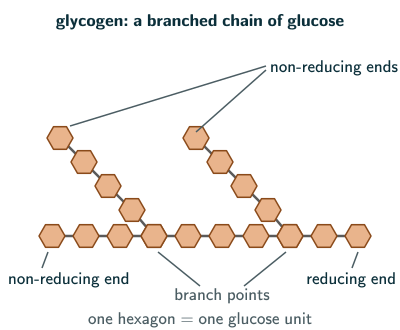
In a polysaccharide chain, say glycogen, the right end is called the reducing end and the left end the non-reducing end (page 110). Right and left are only how NCERT draws the chain. For a free reducing glucose end, carbon 1 can open to an aldehyde because it is not fixed in a glycosidic linkage (NCERT Class 12 Chemistry, Section 10.1.3). A branched glucose polymer has one reducing-end position and many non-reducing branch tips. Beyond NCERT, Essentials of Glycobiology explains that cellular glycogen is normally attached to the protein glycogenin at this core position, so it is not a freely reactive end and glycogen is not used as a simple Fehling-positive reducing sugar. Glycogen’s branches are shown as a cartoon in NCERT Figure 9.2 (page 110).
Starch, cellulose and iodine
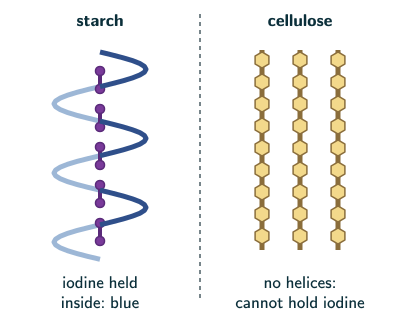
- Starch forms helical secondary structures, and it can hold I molecules in the helical portion. The starch–I complex is blue (page 110).
- Cellulose does not contain complex helices, and hence cannot hold I (page 110).
Complex polysaccharides and chitin
- More complex polysaccharides have amino-sugars and chemically modified sugars as building blocks, such as glucosamine and N-acetyl galactosamine (page 111).
- The exoskeletons of arthropods have a complex polysaccharide called chitin. NCERT says these complex polysaccharides are mostly homopolymers (page 111).
Beyond the NCERT text: chitin is a homopolymer of N-acetylglucosamine, not of N-acetyl galactosamine, the sugar NCERT names. NCERT’s “mostly homopolymers” fits chitin but not most amino-sugar polysaccharides: chondroitin, whose salts make cartilage pliable (NCERT Chapter 17, page 224), hyaluronic acid and the peptidoglycan of bacterial cell walls are each built from two different sugars in turn, so they are heteropolymers. In an NCERT-based question, chitin is the homopolymer to name. NCERT’s Chapter 2 also gives chitin, with other polysaccharides, as the material of the cell walls of fungi (Section 2.3, page 16).
Solved examples
Example 1: Which monomer?
Name the monomer of cellulose, starch, glycogen and inulin.
Answer: glucose for cellulose, starch and glycogen; fructose for inulin (NCERT page 110).
Example 2: The iodine test
A drop of iodine solution is added to cooked rice and to a cotton thread. Which turns blue, and why?
Answer: the rice, which is rich in starch: starch forms helices that hold I, and the starch–I complex is blue. The cotton is cellulose, which has no complex helices and cannot hold I (NCERT page 110).
Example 3: Storage polysaccharides
Which polysaccharide stores energy in plants, and which in animals?
Answer: starch in plant tissues and glycogen in animals (NCERT page 110).
Example 4: Gums and Fevicol (NCERT Exercise 8)
What are gums made of? Is Fevicol different?
Answer: NCERT lists gums among the polymeric secondary metabolites (Table 9.3, page 108), and NCERT’s Class 12 Chemistry book names gums, with starch, cellulose and glycogen, as polysaccharides (NCERT Chemistry Class 12, Part II, Unit 10, Section 10.1.1). Beyond the NCERT text: the common white woodworking type of Fevicol is a synthetic resin adhesive based on polyvinyl acetate (product formulations vary), a man-made polymer, so unlike a plant gum it is not a polysaccharide; plant gums such as gum arabic are branched chains of several different sugars.
Common mistakes to avoid
Common mistake
Calling inulin a polymer of glucose
Inulin is a polymer of fructose (NCERT page 110).
Common mistake
Swapping the reducing and non-reducing ends
In NCERT’s convention, the right end of the chain is the reducing end and the left end the non-reducing end (page 110).
Common mistake
Expecting cellulose to turn blue with iodine
Only starch, with its helices, holds iodine to give the blue colour; cellulose cannot (NCERT page 110).
Quick revision summary
- Polysaccharides are long chains of sugars in the acid-insoluble fraction.
- Cellulose is a homopolymer of glucose and makes plant cell walls, paper and cotton; starch stores energy in plants; glycogen in animals; inulin is a polymer of fructose.
- Glycogen is branched; in NCERT’s drawing the right end is the reducing end and the left ends are non-reducing; a molecule has one reducing-end position, normally attached to glycogenin, and many non-reducing ends.
- Starch forms helices that hold I (blue complex); cellulose cannot.
- Complex polysaccharides use amino-sugars; chitin forms arthropod exoskeletons.
Formula sheet
- cellulose, starch, glycogen: polymers of glucose
- inulin: polymer of fructose
- starch + iodine: blue
- NCERT drawing: reducing-end position right; non-reducing branch ends left
- chitin: arthropod exoskeletons
Questions students ask
What is the difference between starch, cellulose and glycogen?
Starch, cellulose and glycogen are all polymers of glucose but do different jobs: cellulose builds plant cell walls, starch is the store house of energy in plant tissues and glycogen is the energy store of animals (NCERT pages 110–111). They also differ in shape: starch forms helices that hold iodine, giving a blue colour, while cellulose, without complex helices, cannot, and glycogen is branched, as NCERT’s Figure 9.2 shows. Beyond the NCERT Biology text, starch is a polymer of α-glucose with unbranched amylose and branched amylopectin, glycogen is like amylopectin but more highly branched, and cellulose is a straight chain of β-glucose (NCERT Chemistry Class 12, Unit 10, pages 288–289).
Why is glycogen called animal starch?
Glycogen is called animal starch because its structure is similar to amylopectin, the branched component of starch, though rather more highly branched, as NCERT Class 12 Chemistry explains (Unit 10, page 289). It also does in animals what starch does in plants: NCERT Class 11 calls starch a store house of energy in plant tissues and glycogen the variant that animals have (page 110). Glycogen is present in the liver, muscles and brain, enzymes break it down to glucose when the body needs glucose, and it is also found in yeast and fungi (Unit 10, page 289).
What is the difference between inulin and insulin?
Inulin and insulin are unrelated molecules with similar names: inulin is a polysaccharide, a polymer of fructose (NCERT page 110), while insulin is a protein, a hormone listed in NCERT’s table of proteins and their functions (page 109). Insulin, a peptide hormone, is secreted by the β-cells of the islets of Langerhans in the pancreas and lowers blood glucose (NCERT Chapter 19, pages 245–246). More precisely, the NCBI Introduction to Diabetes explains that insulin stimulates GLUT4-mediated uptake in muscle and fat; liver glucose transport is not GLUT4-dependent, although insulin promotes hepatic glucose storage and suppresses glucose output. So inulin is built from sugar units and insulin from amino acids.
What is the difference between chitin and cellulose?
Chitin and cellulose are both structural polysaccharides, but cellulose, a homopolymer of glucose, makes plant cell walls, while chitin, a complex polysaccharide, forms the exoskeletons of arthropods (NCERT pages 110–111) and, with other polysaccharides, the cell walls of fungi (NCERT Chapter 2, page 16). Beyond the NCERT text, chitin is built like cellulose, but its repeating unit is N-acetylglucosamine, an amino-sugar derived from glucose, so chitin contains nitrogen and cellulose does not.
Why are polysaccharides called non-sugars?
Polysaccharides are called non-sugars because they are not sweet in taste, in the words of NCERT Class 12 Chemistry, which calls the sweet carbohydrates sugars and gives starch, cellulose, glycogen and gums as polysaccharides (Unit 10, pages 281–282). The name can look odd beside NCERT Class 11 Biology, which defines polysaccharides as long chains of sugars (page 110). Both are right: ‘non-sugar’ describes the taste of the whole polymer, while its building blocks are sugar units, monosaccharides such as glucose and fructose.
Practice questions
Try each question first, then open the answer to check your working.
-
Q1. Which polysaccharide makes up plant cell walls?
Show answerHide answer
Cellulose (NCERT page 111).
-
Q2. Name two amino-sugars or modified sugars that NCERT gives as building blocks of complex polysaccharides.
Show answerHide answer
Glucosamine and N-acetyl galactosamine (NCERT page 111).
-
Q3. Why can cellulose not hold iodine?
Show answerHide answer
It does not contain complex helices (NCERT page 110).