Proteins
NCERT Class 11 Biology Chapter 9 Section 9.4
Quick answer
Proteins consist of one or more polypeptide chains whose amino-acid residues are joined by peptide bonds; they are usually heteropolymers built from the standard set of 20 amino acids. Essential amino acids must come from the diet, while non-essential ones can be made in adequate amounts by the body. Proteins act as enzymes, hormones, antibodies, receptors, transporters and structural components.
With your textbook
NCERT Biology (Class 11), Chapter 9 “Biomolecules”, Section 9.4 “Proteins”, pages 109–110.
Open the official NCERT chapter (PDF, 1.9 MB, ncert.nic.in) (opens in a new tab)
Checked against the 2026-27 reprint on .
Proteins
Proteins
Proteins are polypeptides.
NCERT Biology (Class 11), Section 9.4, page 109
- A protein consists of one or more polypeptide chains, each a linear chain of amino acids linked by peptide bonds; each protein is a polymer of amino acids (page 109).
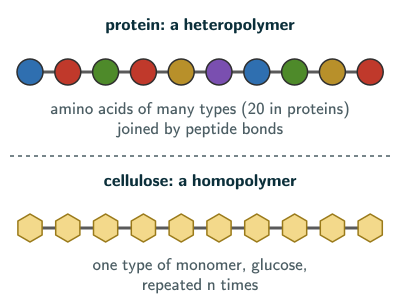
- The standard set contains 20 types of amino acids, a protein is a heteropolymer, not a homopolymer. A homopolymer has only one type of monomer repeating n times (page 109).
In plain words: think of a protein as a necklace strung from beads of up to 20 kinds. The order of the beads differs from protein to protein, and that order, the primary structure, decides what the protein becomes and does; the higher levels of protein structure build up from it.
Essential and non-essential amino acids
- Certain amino acids are essential for our health and must be supplied through our diet, so dietary proteins are the source of essential amino acids (page 109).
- Non-essential amino acids are those our body can make; essential amino acids we get through our diet or food (page 109).
Beyond the NCERT text: the US National Library of Medicine’s MedlinePlus lists nine indispensable amino acids for humans: histidine, isoleucine, leucine, lysine, methionine, phenylalanine, threonine, tryptophan and valine. NCERT’s Class 12 Chemistry book marks ten as essential, adding arginine to these nine (NCERT Chemistry Class 12, Part II, Unit 10, Table 10.2 and Summary). MedlinePlus lists arginine as conditionally essential: requirements depend on physiological circumstances. For a question explicitly quoting NCERT Chemistry’s table, identify its ten-entry convention; for adult nutritional requirements, use nine and explain arginine’s conditional status.
Functions of proteins
Proteins carry out many functions: some transport nutrients across the cell membrane, some fight infectious organisms, some are hormones and some are enzymes (pages 109–110). NCERT’s Table 9.5 (page 109) gives examples:
| Protein | Function |
|---|---|
| Collagen | intercellular ground substance |
| Trypsin | enzyme |
| Insulin | hormone |
| Antibody | fights infectious agents |
| Receptor | sensory reception (smell, taste, hormone, etc.) |
| GLUT-4 | enables glucose transport into cells |
Collagen is the most abundant protein in animal world and Ribulose bisphosphate Carboxylase-Oxygenase (RuBisCO) is the most abundant protein in the whole of the biosphere.
NCERT Biology (Class 11), Section 9.4, page 110
NCERT’s Table 9.5 entry for collagen needs a gloss: collagen is a structural protein whose fibres lie in the material between the cells of connective tissue; NCERT’s Chapter 15 describes “fibrous connective tissue with collagen fibres” in the walls of blood vessels (page 201). Beyond the NCERT text, the ground substance around those fibres is made mainly of modified polysaccharides; in a match-the-column question, give the table’s answer. RuBisCO is the enzyme that adds carbon dioxide to RuBP in photosynthesis; it also has an oxygenation activity, hence carboxylase-oxygenase (NCERT Chapter 11, pages 143 and 147).
Solved examples
Example 1: Homopolymer or heteropolymer?
Why is a protein a heteropolymer while cellulose is a homopolymer?
Answer: amino acids come in 20 types, and a protein chain is built from several of them, so its monomers differ; cellulose is built from one type of monomer, glucose (NCERT pages 109–110).
Example 2: Match the protein
Match: (a) trypsin, (b) GLUT-4, (c) insulin, (d) collagen, with (i) hormone, (ii) intercellular ground substance, (iii) enzyme, (iv) glucose transport into cells.
Answer: (a) iii, (b) iv, (c) i, (d) ii (NCERT Table 9.5, page 109).
Example 3: Most abundant
Name the most abundant protein in the animal world and in the whole biosphere.
Answer: collagen in the animal world; RuBisCO (ribulose bisphosphate carboxylase-oxygenase) in the biosphere (NCERT page 110).
Example 4: Essential or non-essential?
What makes an amino acid essential?
Answer: our body cannot make it, in sufficient amounts for its needs, so it must come from the diet; dietary proteins are the source of essential amino acids. Non-essential amino acids are made by the body (NCERT page 109).
Common mistakes to avoid
Common mistake
Swapping collagen and RuBisCO
Collagen is the most abundant protein in the animal world; RuBisCO is the most abundant in the whole biosphere (NCERT page 110).
Common mistake
Calling essential amino acids the ones the body makes
Essential amino acids must be taken in the diet; the body makes the non-essential ones (NCERT page 109).
Quick revision summary
- Proteins are polypeptides: linear chains of amino acids joined by peptide bonds; NCERT’s Summary lists enzymes, antibodies, receptors, hormones and structural proteins among them (page 119).
- With 20 standard amino-acid types, a protein is a heteropolymer; a homopolymer has one type of monomer.
- Essential amino acids come from the diet; non-essential ones are made by the body.
- Functions: transport, defence, hormones, enzymes; NCERT Table 9.5: collagen, trypsin, insulin, antibody, receptor, GLUT-4.
- Most abundant protein: collagen in the animal world, RuBisCO in the biosphere.
Formula sheet
- protein: heteropolymer built mainly from 20 standard amino acids
- homopolymer: one type of monomer repeated n times
- essential amino acids: from the diet
- collagen: most abundant protein in animals
- RuBisCO: most abundant protein in the biosphere
Questions students ask
How many essential amino acids are there: 9 or 10?
The answer depends on the stated context: Class 11 Biology gives no number, but NCERT Class 12 Chemistry marks ten as essential in its Table 10.2, namely valine, leucine, isoleucine, arginine, lysine, threonine, methionine, phenylalanine, tryptophan and histidine, and its summary says that ten amino acids are called essential (Unit 10, pages 290–291 and 301). Beyond the NCERT text, nutrition science counts nine for human adults, the same list without arginine, which is conditionally essential (Wikipedia, “Essential amino acid”). For a question explicitly quoting NCERT Chemistry’s table, identify its ten-entry convention; for adult nutritional requirements, use nine and explain arginine’s conditional status.
What is the difference between a protein and a polypeptide?
A polypeptide is a chain of amino acids linked by peptide bonds, while a protein is a functional molecule made of one or more polypeptide chains; NCERT Class 11 simply says “Proteins are polypeptides” (page 109). NCERT Class 12 Chemistry draws the line by size: a chain of more than ten amino acids is a polypeptide, and one with more than a hundred amino acid residues and a molecular mass above 10 000 u is a protein, though the distinction is not very sharp, since insulin, with 51 amino acids, is called a protein for its well-defined shape (Unit 10, page 292). Some proteins, such as haemoglobin, are made of several polypeptides.
What is the difference between a homopolymer and a heteropolymer?
A homopolymer has only one type of monomer repeating n times, while a heteropolymer is built from more than one type: NCERT calls a protein a heteropolymer because there are 20 types of amino acids (page 109). Cellulose, starch and glycogen are each made of glucose residues, so they are homopolymers; NCERT also describes inulin as a fructose polymer, and NCERT says the complex polysaccharides, such as chitin, are mostly homopolymers too (pages 110–111). By the same definition a nucleic acid, built from nucleotides with different bases, is a heteropolymer, though NCERT names only proteins as heteropolymers.
Which is the most abundant protein in the human body and in blood?
Collagen is usually named the most abundant protein in the human body, and albumin is the most abundant protein of blood plasma, about half of all plasma protein (both beyond the NCERT text). NCERT itself names collagen the most abundant protein in the animal world and RuBisCO the most abundant in the whole of the biosphere (page 110). NCERT Class 11 Chapter 15 lists fibrinogen, globulins and albumins as the major plasma proteins, with albumins helping in osmotic balance (pages 193–194).
Are all proteins enzymes?
Not all proteins are enzymes: NCERT’s summary says many proteins are enzymes, some are antibodies, some are receptors, some are hormones and some others are structural proteins (page 119). Haemoglobin, for example, is a protein that carries oxygen in the blood, not an enzyme (NCERT Chapter 14, page 189). The reverse is nearly true: almost all enzymes are proteins, the exception being ribozymes, nucleic acids that behave like enzymes (NCERT page 112).
Practice questions
Try each question first, then open the answer to check your working.
-
Q1. Which protein in NCERT Table 9.5 fights infectious agents?
Show answerHide answer
The antibody (NCERT page 109).
-
Q2. What is the function of a receptor protein?
Show answerHide answer
Sensory reception, as of smell, taste or a hormone (NCERT Table 9.5, page 109).
-
Q3. What kind of bond links the amino acids of a protein?
Show answerHide answer
The peptide bond (NCERT page 109).