Animal tissues
Beyond NCERT In the NEET syllabus; the Class 11 book has no section for it.
Quick answer
All complex animals are built from four basic tissues: epithelial, connective, muscular and neural. Epithelia line surfaces and have one free surface, connective tissues link and support (loose, dense and specialised: cartilage, bone, blood), and muscle is skeletal, smooth or cardiac. Neural tissue is made of neurons and the supporting neuroglia.
What is an animal tissue?
Animal tissues
In multicellular animals, a group of similar cells along with intercellular substances performs a specific function: such an organisation is a tissue (NCERT Chapter 7, page 79).
You may be surprised to know that all complex animals consist of only four basic types of tissues.
NCERT Biology (Class 11), Chapter 7, Introduction, page 79
- The four basic tissues are epithelial, connective, muscular and neural; the human heart contains all four (page 80).
In plain words: a tissue is a team of similar cells doing one job, held in place by material they make. Animals above the tissue level of organisation, where cells form tissues but no organs, build their organs from just these four kinds of tissue.
The 2026–27 NCERT chapter no longer has a section on these four tissues. Its Summary still defines a tissue and describes epithelia (page 84), and the NEET (UG) 2026 syllabus lists animal tissues in Unit 2, so this page gives the standard account. Apart from the NCERT lines cited, it is beyond the 2026–27 NCERT text.
Epithelial tissue and cell junctions
Epithelia are sheet like tissues lining the body’s surface and its cavities, ducts and tubes.
NCERT Biology (Class 11), Chapter 7, Summary, page 84
Epithelia have one free surface, facing a body fluid or the outside, and their cells are structurally and functionally connected at junctions (page 84). The cells are packed closely, with little matrix between them.
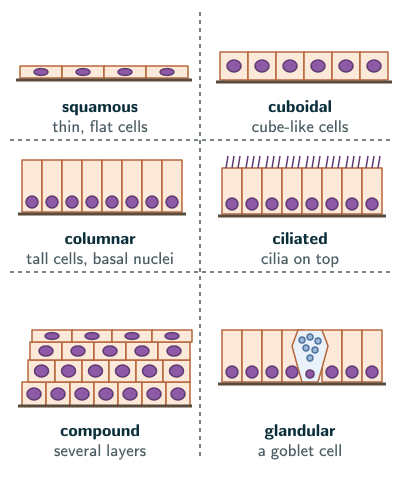
Epithelia are of two types, simple and compound.
- Simple epithelium, one layer of cells, lines body cavities, ducts and tubes. By cell shape it is of three types:
- Squamous: thin, flat cells with irregular edges; walls of blood vessels and the air sacs of the lungs, where substances diffuse across. NCERT calls the alveolar lining a thin squamous epithelium (Chapter 14, page 188).
- Cuboidal: cube-like cells; many gland ducts and nephron segments, for secretion and absorption. This is not every nephron segment: thin limbs of the loop of Henle have simple squamous epithelium, as shown in university histology collections. In the proximal convoluted tubule (PCT) the cells bear microvilli, a brush border (NCERT Chapter 16, page 209).
- Columnar: tall, slender cells with their nuclei at the base, whose free surface may have microvilli; the lining of the stomach and intestine, for secretion and absorption.
- Columnar or cuboidal cells may be modified as:
- Ciliated epithelium: with cilia, which move particles or mucus in one direction, as in the bronchioles and fallopian tubes. NCERT notes the cilia of the trachea and the ciliated passage of ova (Chapter 17, page 218).
- Glandular epithelium: cells specialised for secretion. A goblet cell (a modified columnar cell) of the alimentary canal is a unicellular gland; a salivary gland is multicellular. Exocrine glands release their products (mucus, saliva, earwax, oil, milk, digestive enzymes) through ducts; endocrine glands have no ducts and release hormones directly into the fluid bathing them; NCERT calls them ductless glands (Chapter 19, page 239).
- Compound epithelium: two or more layers of cells. It protects against chemical and mechanical stress, as in the dry surface of the skin, the moist lining of the buccal cavity and pharynx, and some larger excretory ducts of salivary glands and the pancreas. Small ducts commonly have simple cuboidal or columnar epithelium; the University of Minnesota Histology Guide illustrates this variation.
Cell junctions connect the cells of epithelia and other tissues:
- Tight junctions regulate the paracellular route between neighbouring cells and restrict leakage; their permeability varies, so they are not an absolute seal to every substance (A short guide to the tight junction, 2024).
- Adhering junctions cement neighbouring cells together.
- Gap junctions connect the cytoplasm of adjoining cells, allowing ions and small signalling/metabolic molecules to pass directly. They do not pass large proteins or cells; connexin channels generally pass molecules up to roughly 1 kDa, as described in Intercellular Electrical Communication in the Heart.
Connective tissue
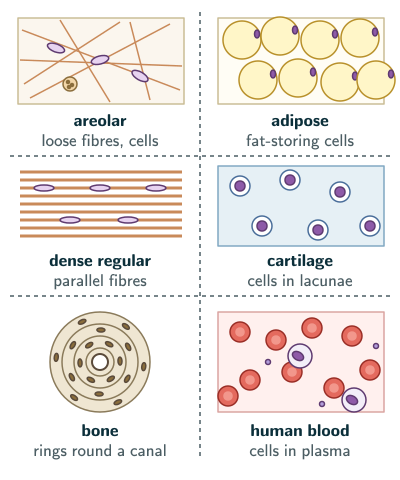
Connective tissues are the most abundant and widely distributed tissues of the body. They link and support other tissues and organs. Except in blood, their cells secrete fibres of the structural proteins collagen or elastin, which give strength, elasticity and flexibility, and a ground substance (matrix) of modified polysaccharides.
- Loose connective tissue: cells and fibres loosely arranged in a semi-fluid ground substance.
- Areolar tissue, beneath the skin, holds fibroblasts, macrophages and mast cells and supports epithelia.
- Adipose tissue, also beneath the skin, stores fat.
- Dense connective tissue: fibres and fibroblasts packed closely.
- Dense regular: collagen fibres in parallel bundles, as in tendons (muscle to bone) and ligaments (bone to bone).
- Dense irregular: fibres running in different directions, as in the skin.
- Specialised connective tissue:
- Cartilage: cells (chondrocytes) in small cavities (lacunae) in a solid but pliable matrix that resists compression; most cartilage of the embryo is replaced by bone; in adults it remains at the tip of the nose, the outer ear, between the vertebrae, and in the joints of the limbs and hands.
- Bone: cells (osteocytes) in lacunae in a hard matrix rich in calcium salts and collagen; it forms the body’s framework, and the bone marrow of some bones makes blood cells.
- Blood: a fluid connective tissue of plasma, red and white blood cells and platelets.
NCERT’s later chapters confirm the last three: bone and cartilage are specialised connective tissues, bone’s matrix very hard because of calcium salts and cartilage’s slightly pliable because of chondroitin salts (Chapter 17, Section 17.3, page 224). Blood is a special connective tissue, a fluid matrix (plasma) with formed elements (Chapter 15, Section 15.1, page 193).
Muscle tissue
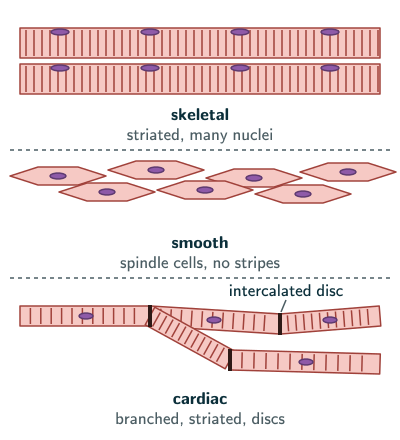
Muscle tissue is specialised for contraction and relaxation. Cell form varies: skeletal fibres are long and cylindrical, smooth muscle cells spindle-shaped, and cardiac cells branched. NCERT’s chapter on locomotion classifies muscles by location into three types (Chapter 17, Section 17.2, pages 218–219):
Based on their location, three types of muscles are identified : (i) Skeletal (ii) Visceral and (iii) Cardiac.
NCERT Biology (Class 11), Section 17.2, page 218
- Skeletal muscle: attached to the skeleton; striated and voluntary. NCERT calls each fibre a syncytium, because its sarcoplasm contains many nuclei (page 219; NCERT prints “syncitium”).
- Visceral (smooth) muscle: in the inner walls of hollow visceral organs such as the alimentary canal and reproductive tract; its fibres are not striated, and it is involuntary. Beyond the NCERT text: the fibres are spindle-shaped, each with one central nucleus.
- Cardiac muscle: the muscle of the heart; its cells are branched and striated, and it is involuntary (page 219). Beyond the NCERT text: the cells are joined end to end at intercalated discs, with mechanical junctions and gap junctions that coordinate contraction. The whole heart does not contract simultaneously: atria contract before ventricles (NCERT Chapter 15, cardiac cycle).
Neural tissue
Neural tissue controls the body’s responsiveness to changing conditions. It has two kinds of cell:
- Neurons, the excitable cells. NCERT describes a neuron as having three main parts: the cell body, the dendrites and the axon (Chapter 18, Section 18.3, page 231). When a neuron is stimulated, an electrical impulse travels along its membrane and, at its endings, stimulates or inhibits neighbouring neurons or other cells.
- Neuroglia, which support, protect and maintain the environment of neurons; their proportions and roles vary by neural region.
Solved examples
Example 1: Name the epithelium
Which epithelium lines (a) the air sacs of the lungs, (b) the proximal convoluted tubule, (c) the inner surface of the intestine, (d) the bronchioles?
Answer: (a) squamous; (b) cuboidal; (c) columnar; (d) ciliated.
Example 2: Exocrine or endocrine
Give one difference between exocrine and endocrine glands, with an example of each.
Answer: exocrine glands pour their secretions through ducts (salivary glands, for saliva); endocrine glands have no ducts and release hormones directly into the surrounding fluid (the thyroid gland; NCERT Chapter 19, pages 239 and 242).
Example 3: Tendon or ligament
What do a tendon and a ligament each join, and what tissue are they made of?
Answer: a tendon joins a muscle to a bone, a ligament a bone to a bone; both are dense regular connective tissue.
Example 4: Bone and cartilage
Why is bone hard and cartilage slightly pliable?
Answer: bone’s matrix is very hard because of calcium salts; cartilage’s matrix is slightly pliable because of chondroitin salts (NCERT Chapter 17, page 224).
Example 5: Goblet and brush border
Which epithelial cells are (a) unicellular glands of the gut, and (b) cuboidal with a brush border?
Answer: (a) goblet cells, modified columnar cells of the alimentary canal; (b) the cuboidal cells of the proximal convoluted tubule, whose microvilli form a brush border (NCERT Chapter 16, page 209).
Common mistakes to avoid
Common mistake
Mixing classification conventions for adipose tissue
The traditional NCERT scheme used here places adipose under loose connective tissue and lists cartilage, bone and blood as specialised. Other histology classifications call adipose specialised connective tissue; state the classification scheme rather than treating that terminology as inherently wrong.
Common mistake
Calling blood a non-tissue
Blood is a fluid connective tissue (NCERT Chapter 15, page 193).
Common mistake
Mixing up gap and tight junctions
Gap junctions form channels directly between cell interiors for ions and small molecules; tight junctions regulate leakage along the spaces between cells.
Quick revision summary
- Four basic tissues: epithelial, connective, muscular and neural (NCERT pages 79–80).
- Epithelia: one free surface; simple (squamous, cuboidal, columnar; ciliated and glandular cells are modified columnar or cuboidal cells; glands exocrine with ducts or endocrine without) or compound (several layers); cells joined by tight, adhering and gap junctions.
- Connective tissue: loose (areolar, adipose), dense (regular: tendons, ligaments; irregular: skin), specialised (cartilage, bone, blood).
- Muscle: skeletal (striated, voluntary), visceral or smooth (non-striated, involuntary), cardiac (striated, involuntary, intercalated discs).
- Neural tissue: neurons (cell body, dendrites, axon) and neuroglia.
Formula sheet
- four tissues: epithelial, connective, muscular, neural
- simple epithelia: squamous, cuboidal, columnar (ciliated, glandular modified)
- junctions: tight, adhering, gap
- connective: loose, dense, specialised (cartilage, bone, blood)
- muscles: skeletal, visceral (smooth), cardiac
- neural: neurons and neuroglia
Questions students ask
What is the difference between plant tissues and animal tissues?
Plant and animal tissues are of different types: plants have meristematic tissues, whose cells keep dividing, and permanent tissues, while all complex animals are built from four basic tissues, epithelial, connective, muscular and neural (NCERT Chapter 7, pages 79–80). Plant cells have a rigid cell wall that keeps a plant, fixed in one place, upright; animal cells have none (NCERT Chapter 8, page 91) and can change shape, which suits movement. Plants also keep growing throughout life from meristems at certain locations (NCERT Chapter 13, page 167), and some supporting plant tissues, such as sclerenchyma, are mostly dead cells.
What is the difference between epithelial and connective tissue?
Epithelial tissue lines the body’s surface and its cavities, ducts and tubes, with one free surface facing a body fluid or the outside (NCERT Chapter 7, Summary, page 84), while connective tissue links and supports other tissues and organs. Beyond the 2026–27 NCERT text, an epithelium’s cells are packed closely, with little matrix between them, while connective tissue cells lie in a matrix of collagen or elastin fibres and ground substance that they secrete, except in blood, whose matrix is the fluid plasma (NCERT Chapter 15, page 193).
What is the difference between skeletal, smooth and cardiac muscle?
Skeletal, smooth and cardiac muscle differ in location, appearance and control: skeletal muscle is attached to the skeleton and is striated and voluntary, smooth (visceral) muscle lies in the inner walls of hollow organs such as the alimentary canal and is non-striated and involuntary, and cardiac muscle, the muscle of the heart, is striated but involuntary, its cells branched (NCERT Chapter 17, pages 218–219). Skeletal fibres have many nuclei; beyond the NCERT text, smooth muscle cells are spindle-shaped with one nucleus, and cardiac cells are joined end to end at intercalated discs. Cardiac muscle is the one to watch: striated like skeletal muscle, yet involuntary like smooth muscle.
Why is blood called a connective tissue?
Blood is called a connective tissue because, like other connective tissues, it is made of cells lying in an intercellular matrix, here a fluid one: NCERT describes it as a special connective tissue of a fluid matrix, plasma, and formed elements, the red and white blood cells and platelets (Chapter 15, pages 193–194). It also connects all parts of the body, carrying gases, digested food, hormones and wastes to and from them. Beyond the 2026–27 NCERT text, blood cells, unlike the cells of other connective tissues, do not secrete collagen or elastin fibres.
Are animal tissues in the NEET (UG) 2026 syllabus?
Animal tissues are in the NEET (UG) 2026 syllabus: Unit 2, Structural Organisation in Animals and Plants, lists “Animal tissues” alongside the frog. The 2026–27 NCERT Class 11 book, however, has no section on them, because the full account of epithelial, connective, muscle and neural tissue was dropped when NCERT rationalised its textbooks: Chapter 7 now only names the four basic tissues (pages 79–80), and its Summary describes epithelia. Learn them from the older NCERT Class 11 edition or a standard text, with the current NCERT Class 9 chapter Tissues in Action and the Class 11 chapters on body fluids and locomotion, which describe blood, bone, cartilage and the three muscle types.
Practice questions
Try each question first, then open the answer to check your working.
-
Q1. Why does NCERT call a skeletal muscle fibre a syncytium?
Show answerHide answer
Because its sarcoplasm contains many nuclei (NCERT Chapter 17, page 219).
-
Q2. Where is compound epithelium found?
Show answerHide answer
On the dry surface of the skin, the moist lining of the buccal cavity and pharynx, and some larger excretory ducts of salivary glands and the pancreas. Small ducts commonly have simple cuboidal or columnar epithelium; the University of Minnesota Histology Guide illustrates this variation.
-
Q3. Which tissue stores fat beneath the skin?
Show answerHide answer
Adipose tissue.
-
Q4. Which broad group of cells supports and protects neurons?
Show answerHide answer
The neuroglia.