Types of movement: amoeboid, ciliary, muscular
NCERT Class 11 Biology Chapter 17 Section 17.1
Quick answer
NCERT lists amoeboid, ciliary and muscular movement in human cells; sperm also show flagellar movement. Locomotion changes the place of the cell or organism being considered, while movements such as blinking move only a body part. Human locomotion coordinates muscles, skeleton and nerves.
With your textbook
NCERT Biology (Class 11), Chapter 17 “Locomotion and Movement”, Section 17.1 “Types of Movement”, pages 217–218.
Open the official NCERT chapter (PDF, 4.5 MB, ncert.nic.in) (opens in a new tab)
Checked against the 2026-27 reprint on .
What are movement and locomotion?
Movement and locomotion
Living beings move in many ways, but only some movements carry the whole animal from place to place. NCERT links the two:
The two may be linked by stating that all locomotions are movements but all movements are not locomotions.
NCERT Biology (Class 11), Chapter 17, Introduction, page 217
In plain words: blinking and chewing move parts of the body; walking, swimming and flying move the whole animal to a new place. A white blood cell crawling through tissue also changes its own place: it shows cell locomotion, even though the person stays still. Always specify whether you mean a cell or the whole animal.
Examples of movement and locomotion
- Movement is one of the significant features of living beings. Examples: streaming of protoplasm in Amoeba; movement of cilia, flagella and tentacles; human limbs, jaws, eyelids and tongue (NCERT page 217).
- NCERT describes locomotion as voluntary movement that changes an animal’s place or location: walking, running, climbing, flying, swimming (page 217).
- The same structure can serve both: in Paramoecium, cilia move food through the cytopharynx and also give locomotion; Hydra uses its tentacles to capture prey and to move; we use our limbs for posture and for locomotion (page 217; see protozoans).
- Animals move in search of food, shelter, a mate, suitable breeding grounds and favourable climatic conditions, or to escape from enemies or predators (page 217).
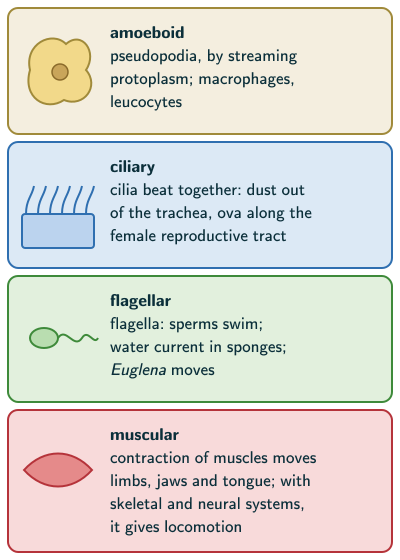
Cells of the human body show three main types of movement: amoeboid, ciliary and muscular (NCERT Section 17.1, page 217). NCERT describes flagellar movement too, at the start of Section 17.2 (page 218).
Amoeboid movement
- Some specialised cells, such as motile leucocytes and tissue macrophages, show amoeboid movement (NCERT page 218; see white blood cells).
- It is effected by pseudopodia formed by the streaming of protoplasm, as in Amoeba (page 218).
- Cytoskeletal elements such as microfilaments are also involved (page 218; see the cytoskeleton).
Ciliary movement
- Ciliary movement occurs in regions of internal tubular organs that are lined by ciliated epithelium (NCERT page 218; see ciliated epithelium).
- The coordinated movement of cilia in the trachea removes dust particles and other foreign substances breathed in with the air (page 218).
- The passage of ova through the female reproductive tract is also helped by ciliary movement (page 218).
Flagellar movement
- Cilia and flagella are outgrowths of the cell membrane (NCERT page 218, recalling Chapter 8).
- Flagellar movement helps in the swimming of spermatozoa, the maintenance of the water current in the canal system of sponges, and the locomotion of protists such as Euglena (page 218).
Muscular movement
- The movement of our limbs, jaws, tongue and so on needs muscular movement (NCERT page 218).
- Humans and many other animals use the contractile property of muscles for locomotion and other movements (page 218).
- Human locomotion needs coordinated activity of the muscular, skeletal and neural systems (page 218).
Solved examples
Example 1: Movements of human cells (NCERT Exercise 7)
What are the different types of movements exhibited by the cells of the human body?
Answer: amoeboid movement, by pseudopodia formed by streaming protoplasm, in macrophages and leucocytes; ciliary movement, by the coordinated beating of cilia in the ciliated epithelium of internal tubular organs, such as the trachea and the female reproductive tract; and muscular movement, by the contraction of muscles, as in the limbs, jaws and tongue (NCERT pages 217–218). Sperms also swim by flagellar movement (page 218).
Example 2: Movement or locomotion?
Classify each as movement only or locomotion: (a) chewing food, (b) swimming, (c) blinking an eyelid, (d) running.
Answer: (a) movement only; (b) locomotion; (c) movement only; (d) locomotion. All locomotions are movements, but not all movements are locomotions (NCERT page 217).
Example 3: One structure, two jobs
Give two examples of a structure that serves both feeding and locomotion.
Answer: the cilia of Paramoecium, which move food through the cytopharynx and also move the cell; and the tentacles of Hydra, which capture prey and are also used for locomotion (NCERT page 217).
Common mistakes to avoid
Common mistake
Calling every movement locomotion
In NCERT’s animal-level examples, locomotion changes the animal’s place; moving the jaws or eyelids alone does not (page 217). In cell biology, locomotion can also describe a migrating cell; it does not require conscious choice. Cell and whole-animal movement are different levels of comparison.
Common mistake
Treating flagellar movement as missing from human cells
NCERT’s three main types of movement in human cells are amoeboid, ciliary and muscular (page 217), and that is the answer to NCERT Exercise 7. But human sperms swim by flagella, which NCERT describes at the start of Section 17.2 (page 218), and the NEET syllabus lists flagellar movement with ciliary and muscular. If a question asks how sperms move, the answer is flagellar movement.
Common mistake
Giving amoeboid movement to all body cells
Only some specialised cells, such as macrophages and leucocytes, move by amoeboid movement (NCERT page 218).
Quick revision summary
- Movement is a feature of living beings; locomotion changes the place of the cell or organism being considered (NCERT describes voluntary animal movement). All locomotions are movements, but not all movements are locomotions.
- Animals move for food, shelter, mates, breeding grounds and better climate, and to escape enemies.
- Human cells show amoeboid (macrophages, leucocytes; pseudopodia, microfilaments), ciliary (trachea, female reproductive tract) and muscular movement.
- Flagellar movement: sperms, the water current in sponges, Euglena.
- Human locomotion needs coordinated muscular, skeletal and neural systems.
Formula sheet
- locomotion ⊂ movement
- amoeboid: pseudopodia (macrophages, leucocytes)
- ciliary: trachea, female reproductive tract
- flagellar: sperms, sponges, euglenoids
- muscular: limbs, jaws, tongue
Questions students ask
What is the difference between amoeboid and ciliary movement?
Amoeboid movement carries a whole cell along on pseudopodia, while ciliary movement in our body moves material over cells that stay in place. NCERT gives amoeboid movement to specialised cells such as macrophages and leucocytes, effected by pseudopodia formed by the streaming of protoplasm, with microfilaments involved, and places ciliary movement in the ciliated lining of internal tubular organs (page 218). So a leucocyte creeps through tissue on its own, while the cilia lining the trachea and the female reproductive tract stay put and move dust or ova along the tube (page 218).
What is the difference between ciliary and flagellar movement?
Ciliary and flagellar movement are both made by outgrowths of the cell membrane, but in our body ciliary movement moves material along the lining of a tube, while flagellar movement moves the cell itself, as when spermatozoa swim (NCERT page 218). Ciliary movement works in internal tubular organs lined by ciliated epithelium, such as the trachea and the female reproductive tract (page 218). NCERT Chapter 8 adds that cilia are small and work like oars, while flagella are comparatively longer (page 99).
How does amoeboid movement move a cell forward?
Amoeboid movement moves a cell forward by pushing out pseudopodia: NCERT says it is effected by pseudopodia formed by the streaming of protoplasm and that cytoskeletal elements such as microfilaments are also involved (page 218). Beyond the NCERT text, microfilaments are fibres made mainly of the protein actin (MeSH, “Actin Cytoskeleton”), and a pseudopodium is an actin-rich extension of the cell surface (MeSH, “Pseudopodia”). In van Haastert’s study of amoeboid cells, including neutrophils and Dictyostelium, a pseudopodium lengthens as branched actin filaments are added at its tip, while actin and myosin in the cell’s outer layer hold back the start of a second pseudopodium as the first grows (van Haastert, PLOS ONE, 2020).
Do cilia move food through the human gut?
No, food is moved through the human gut by muscular movement, not by cilia: NCERT says the visceral muscles in the inner walls of the alimentary canal assist in the transportation of food through the digestive tract (page 218). These visceral muscles are smooth and involuntary, so the movement goes on without our control (page 218). NCERT’s examples of ciliary movement in our body are the trachea and the female reproductive tract (page 218), and in the genital tract both kinds work together, since cilia help the passage of ova and visceral muscles help move gametes (page 218).
What happens when cilia and flagella cannot beat properly?
When cilia and flagella cannot beat properly, as in the genetic disorder primary ciliary dyskinesia, clearance of fluid and particles from the airways is impaired, and sperm motility may also be affected (beyond the NCERT text; MedlinePlus Genetics, “Primary ciliary dyskinesia”). The same source notes chronic respiratory tract infections, decreased fertility in many affected males and reduced fertility in some affected females, likely from abnormal cilia in the fallopian tubes. These are the jobs NCERT gives the two in our body: cilia clear the trachea and help ova along the female reproductive tract, and flagella make spermatozoa swim (page 218).
Practice questions
Try each question first, then open the answer to check your working.
-
Q1. Which cytoskeletal elements are involved in amoeboid movement?
Show answerHide answer
Microfilaments (NCERT page 218).
-
Q2. How do the cilia of the trachea help us?
Show answerHide answer
Their coordinated movement removes dust particles and other foreign substances inhaled with the air (NCERT page 218).
-
Q3. Name three things that flagellar movement does.
Show answerHide answer
It helps spermatozoa swim, keeps up the water current in the canal system of sponges, and moves protists such as Euglena (NCERT page 218).