Disorders of the muscular and skeletal system
NCERT Class 11 Biology Chapter 17 Section 17.5
Quick answer
NCERT covers myasthenia gravis, muscular dystrophy, tetany, arthritis, osteoporosis and gout. They involve impaired neuromuscular transmission, genetic muscle degeneration, spasms linked to low extracellular calcium, joint inflammation or fragile bones. Gout is inflammatory arthritis caused by urate crystals; osteoporosis increases fracture risk.
With your textbook
NCERT Biology (Class 11), Chapter 17 “Locomotion and Movement”, Section 17.5 “Disorders of Muscular and Skeletal System”, page 227.
Open the official NCERT chapter (PDF, 4.5 MB, ncert.nic.in) (opens in a new tab)
Checked against the 2026-27 reprint on .
Disorders of the muscular and skeletal system
Musculoskeletal disorders
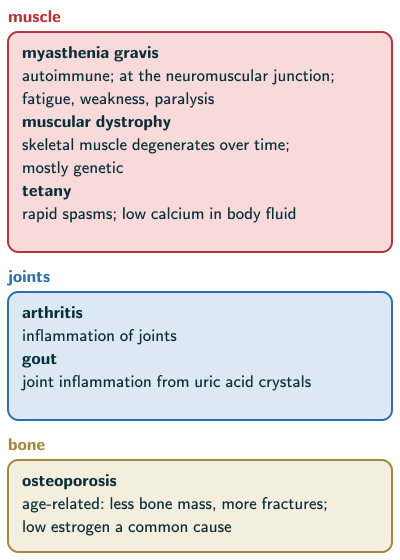
NCERT lists six disorders (Section 17.5, page 227). As a learning aid, three involve muscle function (myasthenia gravis, muscular dystrophy, tetany), two concern joints (arthritis, gout) and one concerns bone (osteoporosis). These are overlapping categories: gout is a type of arthritis, and some disorders affect additional tissues. The first:
Myasthenia gravis: Auto immune disorder affecting neuromuscular junction leading to fatigue, weakening and paralysis of skeletal muscle.
NCERT Biology (Class 11), Section 17.5, page 227
In plain words: movement can fail at several points. The signal from nerve to muscle can be blocked, the muscle itself can waste away, the muscle can cramp when calcium runs low, the joints can become inflamed, and the bones can thin until they break easily.
Myasthenia gravis
- An autoimmune disorder affecting the neuromuscular junction, leading to fatigue, weakening and paralysis of skeletal muscle (NCERT page 227).
- The neuromuscular junction is where a motor neuron meets the sarcolemma and releases acetylcholine to start contraction (NCERT Section 17.2.2, page 222).
- Beyond the NCERT text: in myasthenia gravis the body’s own immune system makes antibodies that stop acetylcholine from binding to the muscle, so the muscles become weaker. The weakness worsens with activity and eases with rest, and some people go into remission, usually for a time but sometimes for good (MedlinePlus, “Myasthenia Gravis”, a US National Library of Medicine health-topic page, public domain).
Muscular dystrophy
- NCERT describes progressive degeneration of skeletal muscle, “mostly due to genetic disorder” (page 227). Beyond the NCERT text: muscular dystrophies are genetic disorders; other causes of muscle wasting belong to other disease groups (MedlinePlus, Muscular Dystrophy; the grouping is our reading).
- Beyond the NCERT text, MedlinePlus describes muscular dystrophy as “a group of more than 30 genetic diseases” that cause muscle weakness which gets worse over time (MedlinePlus, Muscular Dystrophy).
Tetany
- Rapid spasms (wild contractions) in muscle due to low Ca in the body fluid (NCERT page 227). Parathyroid hormone (PTH) raises blood Ca (NCERT Chapter 19, page 243). Beyond the NCERT text: the relevant clinical quantity is ionised (free) extracellular calcium, not simply dietary calcium intake or total blood calcium (StatPearls, “Hypocalcemia”).
- Tetany is about Ca in the body fluid outside the cells, not the Ca that binds troponin, which the fibre releases from its own store, the sarcoplasmic reticulum (NCERT pages 219 and 222). Beyond the NCERT text, low calcium outside the cells makes sodium channels open at a more negative voltage, so nerves fire too easily (Han and colleagues, ASN Neuro, 2015), and the nerves and muscles twitch and go into spasm (MedlinePlus Genetics, Autosomal dominant hypocalcemia).
Arthritis
- Inflammation of joints (NCERT page 227; see the connective tissues of bone and cartilage).
- Beyond the NCERT text, MedlinePlus notes that osteoarthritis is the most common type, often related to ageing or injury, and that in autoimmune arthritis, such as rheumatoid arthritis, the immune system attacks healthy cells by mistake (MedlinePlus, Arthritis).
Osteoporosis
- An age-related disorder with decreased bone mass and increased chances of fractures. Decreased levels of estrogen are a common cause (NCERT page 227).
- Beyond the NCERT text: osteoporosis involves reduced bone mass and/or impaired bone structure and strength. It is common after menopause but can affect men and younger people too; age and low estrogen are risk factors, not required criteria (NIAMS, Osteoporosis).
Gout
- Inflammation of joints due to the accumulation of uric acid crystals (NCERT page 227).
- Beyond the NCERT text: NCERT’s “uric acid crystals” is a shorthand; the deposits in gout are monosodium urate crystals. Persistently high blood urate increases the risk, but many people with high urate never develop gout; a high value alone is not the diagnosis (NIAMS, Gout; NICE, Gout: diagnosis and management).
Solved examples
Example 1: Which disorder?
Name the disorder: (a) wild contractions caused by low Ca in the body fluid; (b) joint inflammation from uric acid crystals; (c) an autoimmune disorder of the neuromuscular junction; (d) decreased bone mass with more fractures, often linked to low estrogen.
Answer: (a) tetany; (b) gout; (c) myasthenia gravis; (d) osteoporosis (NCERT page 227).
Example 2: Arthritis and gout
How are arthritis and gout related?
Answer: arthritis is inflammation of the joints in general; gout is a particular joint inflammation caused by the accumulation of uric acid crystals (NCERT page 227). Beyond the NCERT text, MedlinePlus calls gout “a common type of inflammatory arthritis” (MedlinePlus, Gout).
Example 3: Calcium in contraction and in tetany
Muscle needs Ca to contract, so why does low Ca in the body fluid cause spasms rather than weakness?
Answer: in contraction, Ca is released from the sarcoplasmic reticulum, the fibre’s own store, into the sarcoplasm, where it binds troponin and unmasks the sites on actin for myosin (NCERT pages 219 and 222). Tetany is linked to low Ca in the body fluid outside the cells (page 227). Beyond the NCERT text, low calcium outside the cells makes sodium channels open at a more negative voltage, so nerves fire too easily (Han and colleagues, ASN Neuro, 2015) and the nerves and muscles twitch and go into spasm (MedlinePlus Genetics, Autosomal dominant hypocalcemia). Thus extracellular hypocalcaemia can increase excitability and cause spasms even though intracellular Ca activates contraction. This does not mean every case lacks weakness or that every cramp is tetany.
Common mistakes to avoid
Common mistake
Calling muscular dystrophy an autoimmune disease
NCERT’s autoimmune disorder is myasthenia gravis; muscular dystrophies are genetic diseases (NCERT page 227 uses “mostly”; MedlinePlus, Muscular Dystrophy).
Common mistake
Blaming tetany on high calcium
Tetany is caused by low Ca in the body fluid (NCERT page 227).
Common mistake
Confusing tetany with tetanus
Tetany is the spasm disorder that NCERT links to low Ca in the body fluid (NCERT page 227). Tetanus is a different illness: beyond the NCERT text, MedlinePlus describes it as “a serious illness caused by Clostridium bacteria” that causes painful tightening of the muscles (MedlinePlus, Tetanus).
Common mistake
Calling osteoporosis a joint inflammation
Osteoporosis is a loss of bone mass, with more fractures; joint inflammation is arthritis or gout (NCERT page 227).
Quick revision summary
- Myasthenia gravis: autoimmune; affects the neuromuscular junction; fatigue, weakness, paralysis of skeletal muscle.
- Muscular dystrophy: genetic group of disorders causing progressive muscle degeneration (NCERT wording: mostly genetic).
- Tetany: spasms associated with low ionised Ca in extracellular fluid in NCERT’s example; low magnesium and alkalosis can also be involved.
- Arthritis: inflammation of joints. Gout: inflammatory arthritis from monosodium urate crystals (NCERT: uric acid crystals).
- Osteoporosis: reduced bone strength and increased fracture risk; ageing and low estrogen are common risk factors, but not the only causes.
Formula sheet
- myasthenia gravis: autoimmune, neuromuscular junction
- muscular dystrophy: genetic, progressive
- tetany: low Ca → spasms
- gout: monosodium urate crystals (NCERT: uric acid)
- osteoporosis: reduced bone strength; increased fracture risk
Questions students ask
What is the difference between myasthenia gravis and muscular dystrophy?
Myasthenia gravis is an autoimmune disorder of the neuromuscular junction, between nerve and muscle, while muscular dystrophies are genetic disorders causing progressive degeneration of muscle (NCERT page 227 uses “mostly”; MedlinePlus, Muscular Dystrophy). Beyond the NCERT text, in myasthenia gravis antibodies impair transmission at the neuromuscular junction, so the weakness worsens with activity and eases with rest (MedlinePlus, Myasthenia Gravis). In Duchenne muscular dystrophy, a faulty gene for dystrophin, a protein that protects muscle fibres, lets them weaken and die; the condition is X-linked recessive, so it affects almost only males (MedlinePlus Genetics, Duchenne and Becker muscular dystrophy).
What is the difference between osteoporosis and osteoarthritis?
Osteoporosis is a disorder of bone, while osteoarthritis, a term from beyond the NCERT text, is a disorder of joints: NCERT describes osteoporosis as an age-related disorder with decreased bone mass and increased chances of fractures, and lists arthritis, the inflammation of joints, separately (page 227). Beyond the NCERT text, osteoarthritis is the most common type of arthritis, in which the cartilage covering the bone ends in a joint breaks down and roughens, sometimes until the bones rub together (MedlinePlus, Osteoarthritis), whereas osteoporosis thins the bone itself, with breaks most often in the hip, spine and wrist (NIAMS, Osteoporosis). Both become more common with age.
Why does uric acid build up and cause gout?
Beyond the NCERT text, urate can build up when production exceeds removal, and monosodium urate crystals in joints can cause gout, often affecting the big toe (MedlinePlus, Gout); NCERT defines gout as inflammation of joints due to accumulation of uric acid crystals (page 227). Uric acid is the end product of purine breakdown (MeSH, “Purines”), and purines come from the body’s tissues and from foods such as red meat, organ meats and some seafood (MedlinePlus, Gout). Humans are ureotelic, excreting nitrogen mainly as urea (NCERT Chapter 16, page 205), yet still make this uric acid. Hyperuricaemia is a risk factor, not proof of gout (NIAMS, Gout).
What deficiency causes tetany?
NCERT associates tetany with low Ca in body fluid (page 227), but this does not necessarily mean inadequate dietary calcium. Clinically, a fall in ionised calcium increases neuromuscular excitability; alkalosis can lower this free fraction even when total calcium is normal (StatPearls, “Hypocalcemia”). Beyond the NCERT text, one cause of low blood calcium is too little parathyroid hormone, hypoparathyroidism, which brings muscle cramps and spasms called tetany and most often follows injury to the parathyroid glands during head and neck surgery, such as thyroid surgery (NICHD, Hypoparathyroidism); tetany can also follow low blood magnesium (MeSH, “Tetany”). This fits NCERT Chapter 19, where parathyroid hormone raises blood Ca (page 243).
Why is osteoporosis more common in women after menopause?
Osteoporosis is more common in women after menopause because decreased levels of estrogen are, as NCERT notes, a common cause of this age-related loss of bone mass (page 227), and beyond the NCERT text, estrogen levels are low in women after menopause (NIAMS, Osteoporosis). NIAMS adds that women have lower peak bone mass and smaller bones than men to begin with, and that new bone growth slows with age (NIAMS, Osteoporosis). Men can get osteoporosis too, especially after the age of 70 (same source).
Practice questions
Try each question first, then open the answer to check your working.
-
Q1. Which disorder is caused by low Ca in the body fluid?
Show answerHide answer
Tetany (NCERT page 227).
-
Q2. What is a common cause of osteoporosis, according to NCERT?
Show answerHide answer
Decreased levels of estrogen (NCERT page 227).
-
Q3. Which part of the muscle’s signalling does myasthenia gravis affect?
Show answerHide answer
The neuromuscular junction (NCERT page 227).