Modes of excretion: ammonotelism to uricotelism
Beyond NCERT In the NEET syllabus; the Class 11 book has no section for it.
Quick answer
Ammonotelic, ureotelic and uricotelic animals excrete nitrogen mainly as ammonia, urea and uric acid respectively. Ammonia requires much water for elimination; urea and especially uric acid conserve water. The labels describe the predominant waste, with examples including many bony fishes, mammals, and birds respectively.
Modes of excretion
Nitrogenous wastes
Animals must remove the nitrogen-containing wastes of their metabolism. NCERT names the three main forms:
Ammonia, urea and uric acid are the major forms of nitrogenous wastes excreted by the animals.
NCERT Biology (Class 11), Chapter 16, Introduction, page 205
In plain words: breaking down proteins leaves behind nitrogen, first as ammonia, which is poisonous. Many aquatic animals can eliminate ammonia into surrounding water. Many terrestrial animals conserve water by excreting nitrogen mainly in less toxic forms: urea, which still needs some water, or uric acid, which can leave the body as an almost dry paste.
The 2026–27 NCERT book has no numbered section on the modes of excretion, but the NEET (UG) 2026 syllabus lists them in Unit 5. NCERT covers them on the opening pages of Chapter 16 (pages 205–206), and each point below carries its NCERT page.
Ammonia, urea and uric acid
- Animals accumulate ammonia, urea, uric acid, carbon dioxide, water and ions such as Na, K, Cl, phosphate and sulphate, either from their metabolic activities or by other means such as excess ingestion. These have to be removed totally or partially (NCERT page 205).
- Ammonia is the most toxic form and needs a large amount of water for its elimination (page 205).
- Uric acid, being the least toxic, can be removed with a minimum loss of water (page 205).
- Urea lies between the two: NCERT calls urea and uric acid the “lesser toxic nitrogenous wastes” that land animals make to conserve water (page 205).
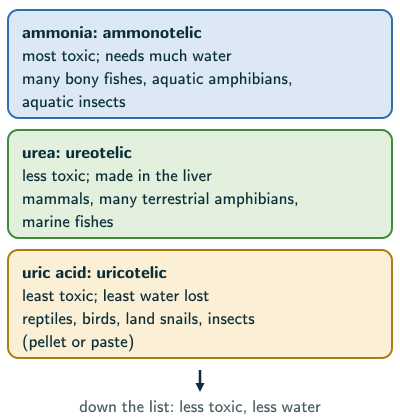
Ammonotelism, ureotelism and uricotelism
- Ammonotelism, the excretion of ammonia (NCERT page 205):
- Examples: many bony fishes, aquatic amphibians and aquatic insects are ammonotelic.
- Ammonia is readily soluble, so it is generally excreted by diffusion across body surfaces or through gill surfaces (in fish; see gills) as ammonium ions.
- The kidneys do not play any significant role in its removal.
- Ureotelism, the excretion of urea (page 205):
- Examples: mammals, many terrestrial amphibians and marine fishes mainly excrete urea and are ureotelic. The adult frog is one (Chapter 7, page 83).
- Beyond the NCERT text, the marine fishes that are clearly ureotelic are the cartilaginous fishes, the sharks and rays, which also keep urea in their body fluids for osmoregulation; only a few bony fishes are ureotelic (Ip and Chew, Frontiers in Physiology, 2010). NCERT counts the cartilaginous fishes as marine (Chapter 4, page 47), and many bony fishes as ammonotelic (page 205). NCERT uses the broad phrase “marine fishes”; do not infer that every marine fish is ureotelic. For NEET, keep NCERT’s list: marine fishes are ureotelic.
- Ammonia produced by metabolism is converted into urea in the liver, released into the blood, and filtered and excreted by the kidneys.
- Some urea may be retained in the kidney matrix of some of these animals to maintain a desired osmolarity.
- Uricotelism, the excretion of uric acid (page 205):
- Examples: reptiles, birds, land snails and insects are uricotelic.
- They excrete uric acid as a pellet or paste, with a minimum loss of water.
Why the change on land: terrestrial adaptation necessitated less toxic wastes, urea and uric acid, for the conservation of water (page 205).
Beyond the NCERT text: these modes name the predominant nitrogenous waste, not the only waste an animal makes; marine sharks and rays, for example, excrete more than half of their waste nitrogen as urea (Ip and Chew, Frontiers in Physiology, 2010, facts in our words). NCERT’s line that the kidneys play no significant role concerns the ammonotelic animals: in humans, the kidneys make ammonia and excrete it in the urine, a key part of how they keep the blood’s acid–base balance (Weiner and Verlander, Comprehensive Physiology, 2013, facts in our words).
Excretory structures in animals
Most invertebrates have simple tubular excretory structures, whereas vertebrates have complex tubular organs, the kidneys (NCERT page 206):
- Protonephridia or flame cells: in Platyhelminthes (flatworms, for example Planaria), rotifers, some annelids and the cephalochordate Amphioxus. They are primarily concerned with ionic and fluid volume regulation, that is, osmoregulation (see flatworms).
- Nephridia: the tubular excretory structures of earthworms and other annelids. They remove nitrogenous wastes and maintain fluid and ionic balance.
- Malpighian tubules: in most insects, including cockroaches. They remove nitrogenous wastes and help in osmoregulation.
- Antennal glands or green glands: perform excretion in crustaceans like prawns.
- Kidneys: the complex tubular excretory organs of vertebrates.
Solved examples
Example 1: Why not ammonia on land? (NCERT Exercise 9)
Terrestrial animals are generally either ureotelic or uricotelic, not ammonotelic. Why?
Answer: ammonia is the most toxic nitrogenous waste and needs a large amount of water for its elimination. On land, water must be conserved, so terrestrial adaptation necessitated the production of less toxic wastes, urea and uric acid; uric acid can be removed with a minimum loss of water (NCERT page 205).
Example 2: Match the columns (NCERT Exercise 7)
Match: (a) ammonotelism, (b) Bowman’s capsule, (c) micturition, (d) uricotelism, (e) ADH with (i) birds, (ii) water reabsorption, (iii) bony fish, (iv) urinary bladder, (v) renal tubule.
Answer: (a)–(iii), (b)–(v), (c)–(iv), (d)–(i), (e)–(ii). Ammonotelism and uricotelism are on page 205; the Bowman’s capsule begins the renal tubule (page 207); micturition releases urine stored in the urinary bladder (pages 212–213); ADH helps water reabsorption (page 212). NCERT labels both of the last two items “(d)”; the second is read here as (e).
Example 3: A chordate with flame cells (NCERT Exercise 11a)
Name a chordate animal having flame cells as excretory structures.
Answer: Amphioxus, a cephalochordate (NCERT page 206). Beyond the NCERT text: a protonephridium ends in a terminal cell, either a ciliated flame cell or a flagellated solenocyte, and the lancelets, the group Amphioxus belongs to, have protonephridia (Wikipedia, “Nephridium”, facts in our words).
Example 4: Osmoregulation (NCERT Exercise 8)
What is meant by the term osmoregulation?
Answer: the regulation of the ionic and fluid volume of the body: NCERT explains it with the protonephridia, which are “primarily concerned with ionic and fluid volume regulation, i.e., osmoregulation” (page 206). Nephridia and Malpighian tubules also help with it (page 206).
Example 5: Which waste, which structure?
Name the excretory structure of (a) cockroach, (b) earthworm and (c) prawn. Also name the cockroach’s predominant nitrogenous waste.
Answer: (a) uric acid (insects are uricotelic, page 205), Malpighian tubules (page 206); (b) nephridia, the excretory structures of earthworms and other annelids (page 206); NCERT does not name the earthworm’s main waste; (c) antennal or green glands (page 206); NCERT does not name the waste of prawns.
Common mistakes to avoid
Common mistake
Sending ammonia through the kidneys
In ammonotelic animals, ammonia is generally excreted by diffusion across body surfaces or through the gills as ammonium ions; the kidneys do not play any significant role in its removal (NCERT page 205). Beyond the NCERT text: do not extend this to humans, whose kidneys make and excrete ammonia as part of acid–base balance (Weiner and Verlander, 2013, facts in our words); and in most ammonotelic fishes most of the ammonia crosses the gills as uncharged NH, partly through transport proteins (Rh glycoproteins), not only as ammonium ions (Ip and Chew, Frontiers in Physiology, 2010, facts in our words). In an NCERT-based answer, write “as ammonium ions”.
Common mistake
Making urea in the kidneys
Urea is made from ammonia in the liver; the kidneys filter it out of the blood (NCERT page 205).
Common mistake
Mixing up Malpighian tubules and the Malpighian body
Malpighian tubules are the excretory structures of most insects (NCERT page 206). The Malpighian body, or renal corpuscle, is the glomerulus with its Bowman’s capsule in the human nephron (page 207).
Common mistake
Giving insects nephridia
Insects, including cockroaches, have Malpighian tubules; nephridia belong to earthworms and other annelids (NCERT page 206).
Quick revision summary
- The major nitrogenous wastes are ammonia, urea and uric acid. Ammonia is the most toxic and needs the most water; uric acid is the least toxic and needs the least.
- Ammonotelic: many bony fishes, aquatic amphibians, aquatic insects; ammonia leaves by diffusion as ammonium ions.
- Ureotelic: mammals, many terrestrial amphibians and marine fishes (NCERT; beyond the NCERT text, chiefly the sharks and rays, Ip and Chew 2010); urea is made in the liver and excreted by the kidneys.
- Uricotelic: reptiles, birds, land snails, insects; uric acid leaves as a pellet or paste.
- Excretory structures: protonephridia (flame cells), nephridia, Malpighian tubules, antennal (green) glands, kidneys.
Formula sheet
- toxicity: ammonia > urea > uric acid
- water needed: ammonia > urea > uric acid
- ammonotelic: many bony fishes, aquatic amphibians, aquatic insects
- ureotelic: mammals, many terrestrial amphibians, marine fishes
- uricotelic: reptiles, birds, land snails, insects
Questions students ask
What is the difference between ureotelic and uricotelic animals?
Ureotelic animals excrete their nitrogenous wastes mainly as urea, while uricotelic animals excrete them as uric acid, the least toxic form, which can be removed with a minimum loss of water (NCERT page 205). In ureotelic animals, such as mammals, many terrestrial amphibians and marine fishes (NCERT page 205; beyond the NCERT text, chiefly the cartilaginous sharks and rays, Ip and Chew 2010), the liver converts ammonia into urea, which the blood carries to the kidneys to be filtered and excreted; uricotelic animals, such as reptiles, birds, land snails and insects, pass uric acid as a pellet or paste (page 205). Of the three modes, uricotelism saves the most water.
Are humans ureotelic or uricotelic?
Humans are ureotelic: like other mammals, we excrete our nitrogenous wastes mainly as urea (NCERT page 205), and an adult passes on average 25–30 g of urea a day in the urine (NCERT page 213). We do make some uric acid: beyond the NCERT text, it is the end product of the breakdown of purines in humans, who still excrete mainly urea (Mori and colleagues, Molecular Biology and Evolution, 2023). Uric acid crystals that accumulate in the joints cause gout (NCERT Chapter 17, page 227).
Why are birds uricotelic?
Birds are uricotelic because uric acid, the least toxic nitrogenous waste, can be removed with a minimum loss of water, and NCERT links the change to less toxic wastes on land to the conservation of water (page 205). Beyond the NCERT text, uric acid is highly insoluble in water, so a bird can pass it as a paste instead of dissolving it in much urine (Mori and colleagues, Molecular Biology and Evolution, 2023). Birds share the trait with reptiles: the same paper describes uricotelism as a monophyletic trait of the sauropsids, the group made up of birds and reptiles, so it arose once in their common ancestry rather than separately in each.
What is the urea cycle in ureotelic animals?
The urea cycle, beyond the NCERT text, is the chain of reactions in liver cells that turns the extra nitrogen left over from the body’s use of protein into urea for the kidneys to remove (MedlinePlus Genetics, “Ornithine transcarbamylase deficiency”). NCERT gives only its outcome: the ammonia produced by metabolism is converted into urea in the liver of ureotelic animals, released into the blood, and filtered and excreted out by the kidneys (page 205). When one of the cycle’s enzymes, such as ornithine transcarbamylase, is lacking, the nitrogen builds up in the blood as ammonia, which is especially damaging to the nervous system (same source).
What is the difference between excretion and egestion?
Excretion is the removal of substances that accumulate in the body, such as ammonia, urea, uric acid, carbon dioxide, water and ions, either by metabolic activities or by other means like excess ingestion (NCERT page 205); egestion, a term from beyond the NCERT text, is the removal of undigested food from the gut as faeces. So kidneys passing urea are excreting, and the gut passing undigested fibre is egesting. The two can share an exit: bile pigments such as bilirubin and biliverdin are excretory wastes of the liver, yet most of them pass out along with the digestive wastes (NCERT page 213).
Practice questions
Try each question first, then open the answer to check your working.
-
Q1. Which nitrogenous waste is the least toxic?
Show answerHide answer
Uric acid (NCERT page 205).
-
Q2. Where is urea made in ureotelic animals?
Show answerHide answer
In the liver, from ammonia produced by metabolism (NCERT page 205).
-
Q3. Name the excretory structures of prawns.
Show answerHide answer
Antennal glands, also called green glands (NCERT page 206).