Functions of the renal tubules
NCERT Class 11 Biology Chapter 16 Section 16.3
Quick answer
The PCT reclaims most filtered water, salts and nutrients. Henle’s loop separates water reabsorption in its descending limb from salt reabsorption in its water-impermeable ascending limb. Distal segments fine-tune ions and pH, while ADH controls water recovery in the collecting system.
With your textbook
NCERT Biology (Class 11), Chapter 16 “Excretory Products and their Elimination”, Section 16.3 “Function of the Tubules”, pages 209–210.
Open the official NCERT chapter (PDF, 1.8 MB, ncert.nic.in) (opens in a new tab)
Checked against the 2026-27 reprint on .
Functions of the tubules
Function of the tubules
Each part of the renal tubule, and the collecting duct it drains into, has its own job in turning filtrate into urine. NCERT begins with the first segment:
PCT is lined by simple cuboidal brush border epithelium which increases the surface area for reabsorption.
NCERT Biology (Class 11), Section 16.3, page 209
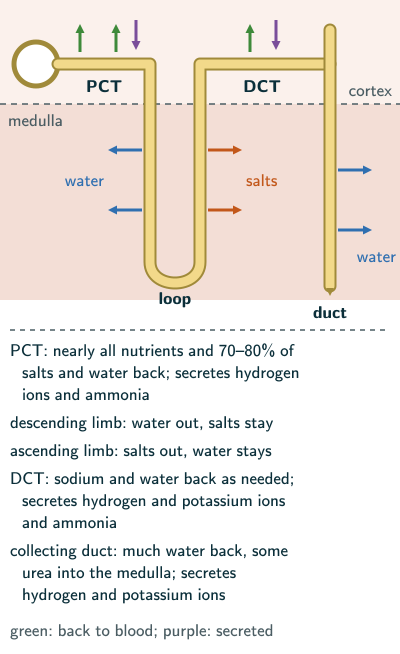
In plain words: the tubule is an assembly line. The first stretch (PCT) takes back almost everything useful; the hairpin loop sorts water from salt to build up saltiness deep in the kidney; the last stretches (DCT and collecting duct) make the fine adjustments, keeping or releasing water, sodium, potassium and acid as the body needs.
Proximal convoluted tubule
- Lined by simple cuboidal brush border epithelium, which increases the surface area for reabsorption (NCERT page 209; see cuboidal epithelium).
- Nearly all the essential nutrients, and 70–80 per cent of the electrolytes and water, are reabsorbed here (page 209).
- It helps keep the pH and ionic balance of the body fluids by the selective secretion of hydrogen ions and ammonia into the filtrate and the absorption of HCO from it (page 209).
Henle’s loop
- NCERT says “Reabsorption is minimum in its ascending limb” (page 209); for NCERT-based questions, keep NCERT’s line. This region plays a significant role in maintaining the high osmolarity of the medullary interstitial fluid (NCERT page 209).
- Descending limb: permeable to water but almost impermeable to electrolytes, so the filtrate becomes more concentrated as it moves down (page 209).
- Ascending limb: impermeable to water but allows the transport of electrolytes, actively or passively, so the concentrated filtrate becomes diluted as it moves up, as electrolytes pass into the medullary fluid (page 209).
- The ascending limb takes back essentially no water, but it moves electrolytes into the medullary fluid (page 209). Beyond the NCERT text: the ascending limb reabsorbs substantial electrolytes. Thin ascending segments transport NaCl passively; thick ascending segments use secondary active transport, including the Na–K–2Cl cotransporter (StatPearls, “Physiology, Renal”). Physiological estimates commonly put thick-ascending-limb NaCl reabsorption near 20–25 per cent of the filtered load (“Renal metabolism and hypertension”, Nature Communications, 2021). Do not add percentages from different sources or solutes to NCERT’s 70–80 per cent PCT figure.
Distal convoluted tubule
- Conditional reabsorption of Na and water takes place here (NCERT page 209).
- The DCT also reabsorbs HCO and selectively secretes hydrogen and potassium ions and NH, to maintain the pH and sodium–potassium balance of the blood (page 209).
Modern anatomy divides the distal tubule more finely than this NCERT summary. The early DCT remains poorly permeable to water; regulated water recovery is mainly in later connecting/collecting segments, where ADH changes water-channel availability. Aldosterone primarily adjusts Na reabsorption and K secretion; it is not itself a water channel (StatPearls, “Hyponatremia”; “Circadian regulation of renal function”, 2018).
Collecting duct
- A long duct that runs from the cortex to the inner parts of the medulla (NCERT page 210).
- Large amounts of water can be reabsorbed here when ADH increases water permeability and a medullary gradient is present, producing a concentrated urine (page 210).
- It lets small amounts of urea pass into the medullary interstitium, to keep up the osmolarity (page 210).
- It helps maintain the pH and ionic balance of the blood by the selective secretion of H and K (page 210).
Solved examples
Example 1: Henle’s loop (NCERT Exercises 3d and 12a)
(3d) True or false: Henle’s loop plays an important role in concentrating the urine. (12a) Fill in: the ascending limb of Henle’s loop is ___ to water, whereas the descending limb is ___ to it.
Answer: (3d) true: Henle’s loop and the vasa recta play a significant role in producing a concentrated urine (NCERT Section 16.4, page 210); the loop keeps the medullary interstitial fluid highly osmolar, which draws water from the collecting tubule (pages 209 and 212). (12a) Impermeable; permeable (page 209).
Example 2: Where does it happen?
Name the segment where each occurs: (a) 70–80 per cent of water and electrolytes are reabsorbed; (b) conditional reabsorption of Na and water; (c) small amounts of urea pass into the medullary interstitium; (d) the filtrate is diluted on its way up.
Answer: (a) PCT; (b) DCT; (c) collecting duct; (d) the ascending limb of Henle’s loop (NCERT pages 209–210).
Example 3: Following the concentration
How does the concentration of the filtrate change along Henle’s loop, and why?
Answer: it rises down the descending limb, because water leaves while electrolyte permeability is low; it falls up the ascending limb, because electrolytes leave while water cannot (NCERT page 209).
Example 4: Keeping the pH steady
Which segments help keep the pH of the body fluids steady, and how?
Answer: the PCT secretes hydrogen ions and ammonia and absorbs HCO; the DCT reabsorbs HCO and secretes hydrogen and potassium ions and NH; the collecting duct secretes H and K (NCERT pages 209–210).
Common mistakes to avoid
Common mistake
Swapping the two limbs
The descending limb is permeable to water and almost impermeable to electrolytes; the ascending limb is impermeable to water but passes electrolytes (NCERT page 209).
Common mistake
Saying the filtrate leaves Henle’s loop most concentrated
It is most concentrated at the bend; it is diluted on the way up the ascending limb (NCERT page 209).
Common mistake
Putting the main reabsorption in the DCT
Nearly all the essential nutrients and 70–80 per cent of the electrolytes and water are reabsorbed in the PCT; the DCT’s reabsorption of Na and water is conditional (NCERT page 209).
Quick revision summary
- PCT: brush border epithelium; reabsorbs nearly all nutrients and 70–80 per cent of electrolytes and water; secretes H and ammonia, absorbs HCO.
- Henle’s loop: keeps the medullary interstitium highly osmolar; the descending limb lets water out (filtrate concentrates), the ascending limb lets electrolytes out (filtrate dilutes).
- DCT: conditional reabsorption of Na and water; reabsorbs HCO; secretes H, K and NH.
- Collecting duct: ADH-dependent water reabsorption permits concentrated urine; passes some urea into the medulla; secretes H and K.
Formula sheet
- PCT: nutrients + 70–80 per cent of electrolytes and water reabsorbed
- descending limb: water out → filtrate concentrates
- ascending limb: electrolytes out → filtrate dilutes
- DCT: conditional Na and water; secretes H, K, NH
- collecting duct: ADH permits water reabsorption; urea recycling; H and K secretion
Questions students ask
Why is the descending limb of Henle’s loop permeable to water but the ascending limb is not?
The descending limb of Henle’s loop is permeable to water and the ascending limb is not because their walls differ: beyond the NCERT text, the upper descending thin limb is rich in the water channel aquaporin 1, while the ascending thin limb has no aquaporins at all (Kriz, Kaissling and Le Hir, Pflügers Archiv, 2026). The difference lets the limbs do opposite jobs: the descending limb lets water out, concentrating the filtrate, while the ascending limb moves electrolytes out, diluting it (NCERT page 209). If water followed the salt out, the salt left in the medulla would be diluted (NCERT page 211).
What is the difference between the PCT and the DCT?
The PCT is the main site of reabsorption, while the DCT fine-tunes what is left: NCERT’s Summary calls the PCT “the major site of reabsorption and selective secretion” (page 215), and in the DCT the reabsorption of Na and water is only conditional (page 209). The DCT, unlike the PCT as NCERT describes it, also secretes potassium ions, to keep the sodium–potassium balance of the blood (page 209). They also sit differently: the PCT follows Bowman’s capsule and is lined by brush border epithelium, while the DCT follows the ascending limb and, with the afferent arteriole it touches, forms the JGA (pages 208–209).
What does conditional reabsorption in the DCT mean?
Conditional reabsorption means that how much Na and water the DCT takes back depends on the body’s needs, as set by hormones: NCERT says conditional reabsorption of Na and water takes place in the DCT (page 209). Aldosterone, released when a fall in GFR starts the renin–angiotensin mechanism, causes reabsorption of Na and water from the distal parts of the tubule, and ADH increases water permeability chiefly in connecting/collecting segments, facilitating water reabsorption (NCERT page 212). When body fluid volume rises again, ADH release is suppressed (page 212).
Is the collecting tubule the same as the collecting duct?
Yes, in NCERT the collecting tubule and the collecting duct are the same straight tube, into which the DCTs of many nephrons open: Sections 16.1 and 16.3 call it the collecting duct, and Section 16.4 the collecting tubule, when describing water leaving it and urea returning from it to the medullary interstitium (NCERT pages 208–212). Beyond the NCERT text, anatomists call collecting tubules the straight tubes that receive the ends of the distal convoluted tubules in the cortex; in the medulla, those of each pyramid join a central duct of Bellini that opens on the tip of the papilla (MeSH, “Kidney Tubules, Collecting”).
Practice questions
Try each question first, then open the answer to check your working.
-
Q1. What increases the surface area for reabsorption in the PCT?
Show answerHide answer
Its lining of simple cuboidal brush border epithelium (NCERT page 209).
-
Q2. Which limb of Henle’s loop is impermeable to water?
Show answerHide answer
The ascending limb (NCERT page 209).
-
Q3. Where does the collecting duct pass small amounts of urea, and why?
Show answerHide answer
Into the medullary interstitium, to keep up its osmolarity (NCERT page 210).