Role of lungs, liver and skin in excretion
NCERT Class 11 Biology Chapter 16 Section 16.7
Quick answer
Lungs excrete carbon dioxide and water, the liver sends selected wastes into bile, and skin secretions remove small amounts of salts and organic substances. Sweat mainly cools the body; sebum protects the skin. These organs complement the kidneys’ major role in waste and fluid balance.
With your textbook
NCERT Biology (Class 11), Chapter 16 “Excretory Products and their Elimination”, Section 16.7 “Role of other Organs in Excretion”, page 213.
Open the official NCERT chapter (PDF, 1.8 MB, ncert.nic.in) (opens in a new tab)
Checked against the 2026-27 reprint on .
Role of other organs in excretion
Other excretory organs
The kidneys are not the only organs that remove wastes:
Other than the kidneys, lungs, liver and skin also help in the elimination of excretory wastes.
NCERT Biology (Class 11), Section 16.7, page 213
In plain words: the lungs breathe out carbon dioxide and water vapour, the liver dumps some wastes into bile so they leave with the faeces, and the skin loses some salt and urea in sweat and some fats and waxes in the oily sebum.
Lungs
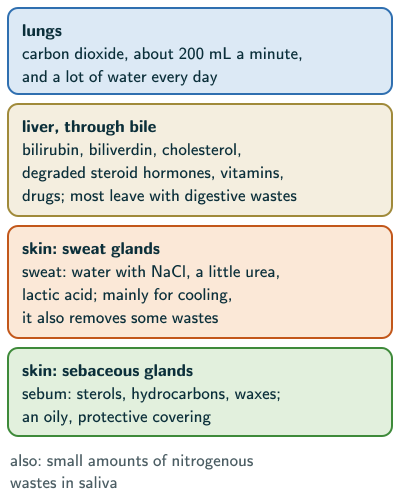
- Our lungs remove large amounts of CO, about 200 mL a minute, and also significant quantities of water every day (NCERT page 213).
- If that resting rate were maintained for 24 hours, the CO removed is about 200 mL × 60 × 24 = 288 000 mL, about 288 litres (reasoned from NCERT’s figure).
Liver
- The liver, the largest gland in our body, secretes bile containing substances such as bilirubin, biliverdin, cholesterol, degraded steroid hormones, vitamins and drugs (NCERT page 213).
- Most of these substances ultimately pass out with the digestive wastes (page 213).
- The liver also makes urea from ammonia; the blood carries the urea to the kidneys, which excrete it (NCERT page 205).
Sweat and sebaceous glands
- The sweat and sebaceous glands in the skin can eliminate certain substances through their secretions (NCERT page 213).
- Sweat, from the sweat glands, is a watery fluid containing NaCl, small amounts of urea, lactic acid and so on. Its primary function is to cool the body surface, but it also helps remove some wastes (page 213).
- Sebaceous glands eliminate substances such as sterols, hydrocarbons and waxes through sebum, which provides a protective oily covering for the skin (page 213).
- NCERT adds that small amounts of nitrogenous wastes can be eliminated through saliva too (page 213).
Solved examples
Example 1: Liver, lungs and skin (NCERT Exercise 5)
Describe the role of the liver, lungs and skin in excretion.
Answer: the lungs remove large amounts of CO, about 200 mL a minute, and significant quantities of water every day. The liver secretes bile containing bilirubin, biliverdin, cholesterol, degraded steroid hormones, vitamins and drugs, most of which pass out with the digestive wastes. The skin eliminates substances through its sweat glands (sweat: water with NaCl, small amounts of urea and lactic acid) and sebaceous glands (sebum: sterols, hydrocarbons and waxes) (NCERT page 213).
Example 2: CO in a day
Assume the lungs remove CO at a constant 200 mL/min for 24 hours. How much is removed?
Answer: 200 mL × 60 × 24 = 288 000 mL, about 288 litres a day (from NCERT page 213).
Example 3: Which organ?
Name the organ or gland that removes each: (a) biliverdin, (b) waxes, (c) lactic acid, (d) degraded steroid hormones.
Answer: (a) the liver, in bile; (b) the sebaceous glands, in sebum; (c) the sweat glands, in sweat; (d) the liver, in bile (NCERT page 213).
Common mistakes to avoid
Common mistake
Saying the main job of sweat is excretion
The primary function of sweat is to cool the body surface; removing some wastes is a secondary role (NCERT page 213).
Common mistake
Sending bile wastes out in urine
Most of the substances in bile pass out along with the digestive wastes (NCERT page 213).
Common mistake
Mixing up sweat and sebum
Sweat is watery, with NaCl, a little urea and lactic acid; sebum carries sterols, hydrocarbons and waxes and oils the skin (NCERT page 213).
Quick revision summary
- Besides the kidneys, the lungs, liver and skin help remove wastes.
- Lungs: about 200 mL of CO a minute, and water.
- Liver: bile with bilirubin, biliverdin, cholesterol, degraded steroid hormones, vitamins and drugs, which leave with the digestive wastes.
- Skin: sweat (water, NaCl, a little urea, lactic acid; mainly for cooling) and sebum (sterols, hydrocarbons, waxes; a protective oily layer). Saliva carries small amounts of nitrogenous wastes.
Formula sheet
- lungs: CO about 200 mL a minute + water
- liver: bile → bilirubin, biliverdin, cholesterol, degraded steroid hormones, vitamins, drugs
- sweat: water + NaCl + a little urea + lactic acid
- sebum: sterols + hydrocarbons + waxes
Questions students ask
Are the lungs, liver and skin part of the excretory system?
The lungs, liver and skin are not part of the human excretory system as NCERT defines it, a pair of kidneys, a pair of ureters, a urinary bladder and a urethra (Section 16.1, page 206), but they do help: NCERT says that other than the kidneys, lungs, liver and skin also help in the elimination of excretory wastes (Section 16.7, page 213). Each removes particular wastes: the lungs breathe out CO and water, the liver puts wastes such as bilirubin into bile, and sweat carries NaCl and a little urea (page 213). NCERT’s anatomical list here describes the urinary system. Lungs, liver and skin are also excretory organs in the broader functional sense; “other organs” does not mean they perform no excretion.
Where do bilirubin and biliverdin come from?
Bilirubin and biliverdin come, beyond the NCERT text, from the breakdown of haemoglobin: bilirubin is a bile pigment formed by the degradation of haem, the colour-giving part of haemoglobin, and biliverdin is made from haemoglobin as the precursor of bilirubin (MeSH, US National Library of Medicine, “Bilirubin”, “Biliverdine”, “Heme”). NCERT describes haemoglobin as the red, iron-containing protein of red blood cells, which live for an average of 120 days and are then destroyed in the spleen (blood, NCERT page 194). The liver secretes these pigments into bile, and most of them pass out with the digestive wastes (NCERT page 213).
How is the liver’s role in excretion different from the kidneys’?
The kidneys excrete wastes in urine, while the liver excretes through bile and also prepares a waste for the kidneys: it converts ammonia into urea, which the blood carries to the kidneys to be filtered and excreted (NCERT page 205), and its bile carries substances such as bile pigments, cholesterol, degraded steroid hormones and drugs, most of which pass out with the digestive wastes (page 213). Beyond the NCERT text, the two routes are called renal elimination, through the urinary tract, and hepatobiliary elimination, through the liver and biliary tract (MeSH, “Renal Elimination”, “Hepatobiliary Elimination”). Thus urea made in the liver mainly leaves in urine, while much of the bilirubin-derived pigment ultimately leaves through the gut. Some bile constituents are reabsorbed before final elimination, so secretion into bile is not always immediate loss from the body (StatPearls, “Physiology, Bile Secretion”).
Practice questions
Try each question first, then open the answer to check your working.
-
Q1. Which is the largest gland in our body?
Show answerHide answer
The liver (NCERT page 213).
-
Q2. What is the primary function of sweat?
Show answerHide answer
To produce a cooling effect on the body surface (NCERT page 213).
-
Q3. Through which secretion do the sebaceous glands eliminate sterols, hydrocarbons and waxes?
Show answerHide answer
Sebum (NCERT page 213).