Regulation of kidney function
NCERT Class 11 Biology Chapter 16 Section 16.5
Quick answer
Kidney function is regulated by hormonal feedback involving the hypothalamus, the JGA and, to a certain extent, the heart. Fluid loss makes osmoreceptors stimulate the hypothalamus to release ADH from the neurohypophysis, so more water is reabsorbed; a fall in GFR makes the JG cells release renin, which starts the chain to angiotensin II; angiotensin II constricts vessels and brings aldosterone, so Na and water are kept. More blood flow to the atria releases ANF, which dilates vessels and checks this.
With your textbook
NCERT Biology (Class 11), Chapter 16 “Excretory Products and their Elimination”, Section 16.5 “Regulation of Kidney Function”, page 212.
Open the official NCERT chapter (PDF, 1.8 MB, ncert.nic.in) (opens in a new tab)
Checked against the 2026-27 reprint on .
Regulation of kidney function
Regulation of kidney function
The kidneys do not run on their own settings. NCERT names three regulators:
The functioning of the kidneys is efficiently monitored and regulated by hormonal feedback mechanisms involving the hypothalamus, JGA and to a certain extent, the heart.
NCERT Biology (Class 11), Section 16.5, page 212
In plain words: three alarm systems adjust the kidneys. When you lose water, the brain sends a hormone telling the kidneys to keep water. When the kidneys’ own blood pressure drops, they release an enzyme that sets off a chain ending in higher blood pressure and more salt and water kept. And when the heart is over-full, it sends a hormone that lowers blood pressure, acting as the brake.
Osmoregulation: osmoreceptors and ADH
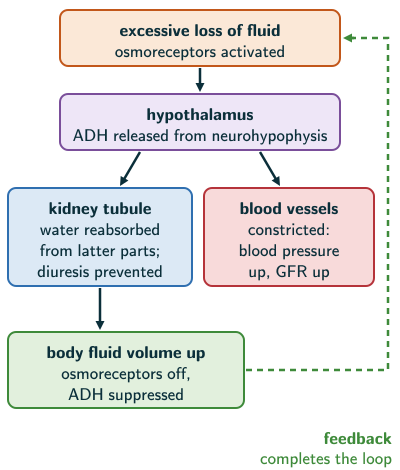
- Osmoreceptors in the body are activated by changes in blood volume, body fluid volume and ionic concentration (NCERT page 212). Keep NCERT’s line for NCERT-based questions; beyond the NCERT text, physiologists separate the two signals: vasopressin release is “stimulated by activation of central osmoreceptors”, which respond to the concentration of the plasma, while “plasma volume reductions are sensed both directly and indirectly by baroreceptors” (Hughes, Mythen and Montgomery, Perioperative Medicine, 2018, CC BY 4.0).
- An excessive loss of fluid activates them, and they stimulate the hypothalamus to release antidiuretic hormone (ADH), or vasopressin, from the neurohypophysis (page 212).
- ADH facilitates water reabsorption from the latter parts of the tubule, so it prevents diuresis (page 212).
- An increase in body fluid volume switches the osmoreceptors off and suppresses ADH release, which completes the feedback (page 212). Beyond the NCERT text: in the terms of point 1, ADH release tracks the plasma concentration sensed by the osmoreceptors, and a low blood volume sensed by baroreceptors makes it more sensitive; restoring both removes the drive (Hughes, Mythen and Montgomery, 2018, CC BY 4.0, facts in our words).
- ADH can also constrict blood vessels, which raises blood pressure; an increase in blood pressure can increase the glomerular blood flow and thereby the GFR (page 212). Keep NCERT’s chain for NCERT-based questions. Beyond the NCERT text: the kidney’s own autoregulation keeps renal blood flow and GFR nearly constant over a wide range of renal perfusion pressure (about 80–180 mm Hg), so a rise in blood pressure does not automatically raise them (Carlström, Wilcox and Arendshorst, Physiological Reviews, 2015, facts in our words).
NCERT’s Chapter 19 adds that vasopressin is synthesised by the hypothalamus and carried along axons to the neurohypophysis, which stores and releases it (page 241); that it acts mainly at the kidney, stimulating the resorption of water and electrolytes by the distal tubules; and that an impairment of ADH synthesis or release leaves the kidney less able to conserve water, causing water loss and dehydration: diabetes insipidus (Section 19.2.2, pages 241–242). Do not confuse it with diabetes mellitus: NCERT notes that glucose (glycosuria) and ketone bodies (ketonuria) in urine “are indicative of diabetes mellitus” (page 213). Beyond the NCERT text, NIDDK puts it plainly: “Diabetes insipidus is not the same as diabetes mellitus”; in diabetes insipidus, “your blood glucose levels are normal, but your kidneys can’t properly concentrate urine” (NIDDK, Diabetes Insipidus).
Renin–angiotensin mechanism
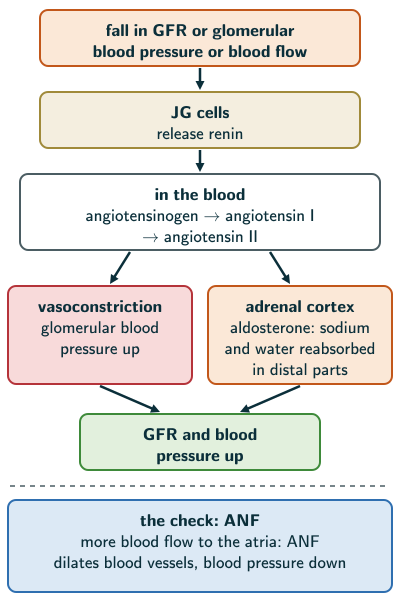
- The JGA plays a complex regulatory role. A fall in glomerular blood flow, glomerular blood pressure or GFR activates the JG cells to release renin (NCERT page 212).
- Renin converts angiotensinogen in the blood to angiotensin I, which is then converted to angiotensin II (NCERT page 212). NCERT’s sentence reads as if renin does both steps; beyond the NCERT text, the second step belongs to another enzyme: “angiotensin-converting enzyme (produced from the ACE gene) converts angiotensin I to angiotensin II” (MedlinePlus Genetics, US National Library of Medicine, Renal tubular dysgenesis).
- Angiotensin II is a powerful vasoconstrictor: it increases the glomerular blood pressure and so the GFR (page 212). Beyond the NCERT text: angiotensin II narrows both the arteriole that enters the glomerulus and the one that leaves it; when renal perfusion pressure falls, the angiotensin II made in the kidney acts mainly on the outgoing (efferent) arteriole, which holds glomerular pressure and GFR up better than renal blood flow (Carlström, Wilcox and Arendshorst, 2015, facts in our words).
- This whole mechanism is generally known as the renin–angiotensin mechanism (page 212).
Aldosterone
- Angiotensin II also activates the adrenal cortex to release aldosterone (NCERT page 212).
- Aldosterone causes the reabsorption of Na and water from the distal parts of the tubule, which also raises blood pressure and GFR (page 212). Beyond the NCERT text: water can follow the reabsorbed Na only where the tubule wall lets water through (NCERT’s ascending limb, impermeable to water but passing electrolytes, shows this, page 209); in the collecting duct ADH sets that permeability: vasopressin “inserts aquaporins in the collecting duct to promote free-water reabsorption” (Hughes, Mythen and Montgomery, 2018, CC BY 4.0).
- NCERT’s Chapter 19 adds that aldosterone, the main mineralocorticoid, also stimulates the excretion of K and phosphate ions, helping maintain electrolytes, body fluid volume, osmotic pressure and blood pressure (Section 19.2.7, page 245).
Atrial natriuretic factor
- An increase in blood flow to the atria of the heart can cause the release of atrial natriuretic factor (ANF) (NCERT page 212).
- ANF causes vasodilation (dilation of the blood vessels) and so decreases blood pressure (page 212).
- The ANF mechanism therefore acts as a check on the renin–angiotensin mechanism (page 212).
Solved examples
Example 1: ADH and urine (NCERT Exercise 3b)
True or false: ADH helps in water elimination, making the urine hypotonic.
Answer: false. ADH facilitates water reabsorption from the latter parts of the tubule and so prevents diuresis (NCERT page 212); with water kept back, the urine becomes more concentrated, not dilute.
Example 2: Fill in the gap (NCERT Exercise 12b)
Reabsorption of water from distal parts of the tubules is facilitated by the hormone ___.
Answer: ADH (antidiuretic hormone, or vasopressin) (NCERT page 212). Aldosterone also causes reabsorption of Na and water from the distal parts of the tubule (page 212), but the hormone NCERT expects here is ADH.
Example 3: The JGA (NCERT Exercise 10)
What is the significance of the juxtaglomerular apparatus (JGA) in kidney function?
Answer: the JGA is a sensitive region formed where the distal convoluted tubule and the afferent arteriole touch (NCERT page 209). When glomerular blood flow, glomerular blood pressure or GFR falls, its JG cells release renin. Renin turns angiotensinogen into angiotensin I, which is then converted to angiotensin II (beyond the NCERT text, by angiotensin-converting enzyme). Angiotensin II constricts blood vessels, raising glomerular blood pressure and GFR, and makes the adrenal cortex release aldosterone, so Na and water are reabsorbed from the distal parts of the tubule. Blood pressure and GFR rise, bringing the glomerular blood flow and GFR back to normal (NCERT pages 209 and 212). Beyond the NCERT text: when renal perfusion pressure is low, the angiotensin II made in the kidney acts mainly on the efferent arteriole, so it holds GFR up better than renal blood flow (Carlström, Wilcox and Arendshorst, 2015, facts in our words).
Example 4: After a long, hot run
A runner has sweated heavily and drunk nothing. Trace how the kidneys respond.
Answer: the excessive loss of fluid activates the osmoreceptors, which stimulate the hypothalamus to release ADH from the neurohypophysis. ADH increases water reabsorption from the latter parts of the tubule, so less urine is passed. ADH only cuts further loss; after the runner drinks, once the body fluid volume rises again, the osmoreceptors switch off and ADH release is suppressed (NCERT page 212). Beyond the NCERT text: such dehydration usually both raises the plasma concentration, which central osmoreceptors sense, and lowers the blood volume, which baroreceptors sense; the volume fall makes ADH release start at a lower concentration and rise more steeply (Hughes, Mythen and Montgomery, 2018, CC BY 4.0, facts in our words).
Example 5: Two opposite hormones
Compare the effects of angiotensin II and ANF on blood vessels and blood pressure.
Answer: angiotensin II is a powerful vasoconstrictor and raises glomerular blood pressure and GFR; ANF causes vasodilation and lowers blood pressure, so it checks the renin–angiotensin mechanism (NCERT page 212).
Common mistakes to avoid
Common mistake
Saying ADH increases urine output
ADH prevents diuresis: it increases water reabsorption, so less urine is passed (NCERT page 212).
Common mistake
Making renin a hormone that acts on the tubule
Renin, released by the JG cells, converts angiotensinogen to angiotensin I; angiotensin II then acts on blood vessels and the adrenal cortex (NCERT page 212).
Common mistake
Mixing up diabetes insipidus and diabetes mellitus
Diabetes insipidus comes from an impairment affecting the synthesis or release of ADH, which leaves the kidney less able to conserve water (NCERT Chapter 19, page 242). Glucose and ketone bodies in the urine indicate diabetes mellitus instead (NCERT page 213). Beyond the NCERT text: in a second form, nephrogenic diabetes insipidus, the body makes enough vasopressin but the kidneys do not respond to it (NIDDK, Diabetes Insipidus, public domain), and glucose or ketones in urine can also have other causes, such as an inherited kidney condition or starvation (MedlinePlus, Glucose in Urine and Ketones in Urine tests, public domain).
Common mistake
Releasing renin when GFR rises
Renin is released when glomerular blood flow, glomerular blood pressure or GFR falls; the chain it starts then brings them back to normal (NCERT pages 209 and 212).
Common mistake
Calling ANF part of the renin–angiotensin mechanism
ANF works the other way: it dilates blood vessels and lowers blood pressure, acting as a check on the renin–angiotensin mechanism (NCERT page 212).
Quick revision summary
- Kidney function is regulated by hormonal feedback involving the hypothalamus, the JGA and, to an extent, the heart.
- Fluid loss → osmoreceptors → hypothalamus → ADH from the neurohypophysis → water reabsorbed, diuresis prevented; more fluid switches the receptors off. ADH also constricts vessels, raising blood pressure and GFR. Too little ADH causes diabetes insipidus (NCERT pages 212 and 242).
- Fall in glomerular blood flow, pressure or GFR → JG cells release renin → angiotensinogen → angiotensin I → angiotensin II: vasoconstriction, and aldosterone from the adrenal cortex, so Na and water are reabsorbed; blood pressure and GFR rise (NCERT page 212). Aldosterone also stimulates the excretion of K (NCERT page 245).
- More blood to the atria releases ANF, which causes vasodilation and lowers blood pressure: a check on the renin–angiotensin mechanism (NCERT page 212).
- Beyond the NCERT text: osmoreceptors sense plasma concentration and baroreceptors sense volume (Hughes, Mythen and Montgomery, 2018); the kidney’s autoregulation keeps renal blood flow and GFR nearly constant over a wide pressure range (Carlström, Wilcox and Arendshorst, 2015).
Formula sheet
- fluid loss → osmoreceptors → hypothalamus → ADH → water reabsorbed
- renin: angiotensinogen → angiotensin I; ACE (beyond NCERT): angiotensin I → angiotensin II
- angiotensin II → vasoconstriction + aldosterone → GFR and blood pressure up
- ANF → vasodilation → blood pressure down
Questions students ask
How is ADH linked to diabetes insipidus, and what are its types?
Diabetes insipidus is linked to ADH because an impairment affecting the synthesis or release of ADH “results in a diminished ability of the kidney to conserve water leading to water loss and dehydration” (NCERT Chapter 19, Section 19.2.2, page 242). Beyond the NCERT text, the disease brings frequent urination of large amounts of dilute urine and excessive thirst (MeSH, “Diabetes Insipidus”), and NIDDK names its types: central, where too little vasopressin is made; nephrogenic, where the kidneys do not respond to it; and dipsogenic and gestational forms (NIDDK, Diabetes Insipidus).
What is the difference between ADH and aldosterone?
ADH and aldosterone both make the kidney keep water, but they come from different glands and answer different signals: ADH, or vasopressin, is synthesised by the hypothalamus and released from the neurohypophysis when fluid loss activates the osmoreceptors, and it facilitates water reabsorption from the latter parts of the tubule (NCERT pages 212 and 241). Aldosterone is released by the adrenal cortex when angiotensin II activates it, at the end of the renin–angiotensin mechanism, and it causes the reabsorption of Na and water from the distal parts of the tubule (page 212). So ADH mainly adjusts how much water is kept, while aldosterone adjusts how much sodium is kept, with water.
Why do ADH and ANF have opposite effects?
ADH and ANF have opposite effects because they answer opposite problems: ADH is released when an excessive loss of fluid activates the osmoreceptors (NCERT page 212), while ANF is secreted when blood pressure is increased, as NCERT’s Chapter 19 puts it (page 247). ADH increases water retention and can constrict vessels; ANF causes vasodilation (page 212) and, beyond the NCERT text, favours sodium excretion.
Why is ANF called natriuretic?
ANF is called natriuretic because, beyond the NCERT text, it causes natriuresis, the excretion of sodium in urine, as well as vasodilation (MeSH, “Atrial Natriuretic Factor”, “Natriuresis”), the reverse of aldosterone, which makes the tubule reabsorb Na and water (NCERT page 212). NCERT itself stresses only its vasodilation, which decreases blood pressure (page 212). As a hormone, ANF, also called atrial natriuretic peptide (ANP), is a peptide secreted by the atrial wall of the heart (NCERT page 247).
What is the role of the kidney in osmoregulation?
The kidney osmoregulates by changing how much water and how many electrolytes it reabsorbs, keeping the volume and ionic concentration of the body fluids steady: NCERT’s Summary says the DCT and collecting duct “allow extensive reabsorption of water and certain electrolytes, which help in osmoregulation” (page 215). ADH and aldosterone set the amounts (page 212), and the counter current mechanism lets urine become nearly four times as concentrated as the filtrate when water must be saved (page 212).
Practice questions
Try each question first, then open the answer to check your working.
-
Q1. From which part of the pituitary is ADH released?
Show answerHide answer
The neurohypophysis (posterior pituitary), which stores and releases it; ADH itself is synthesised by the hypothalamus (NCERT pages 212 and 241).
-
Q2. What does angiotensin II do to the adrenal cortex?
Show answerHide answer
It activates the adrenal cortex to release aldosterone (NCERT page 212).
-
Q3. What releases ANF, and what does ANF do?
Show answerHide answer
An increase in blood flow to the atria of the heart releases ANF; ANF causes vasodilation and so lowers blood pressure, a check on the renin–angiotensin mechanism (NCERT page 212).