Disorders of the circulatory system
NCERT Class 11 Biology Chapter 15 Section 15.6
Quick answer
Hypertension is blood pressure higher than the normal 120/80; NCERT says repeated checks of 140/90 or higher show hypertension. Coronary artery disease narrows the arteries supplying the heart muscle and can cause angina. In heart failure the heart is not pumping blood effectively enough to meet the body’s needs; it is not cardiac arrest (the heart stops beating) or a heart attack.
With your textbook
NCERT Biology (Class 11), Chapter 15 “Body Fluids and Circulation”, Section 15.6 “Disorders of Circulatory System”, pages 202–203.
Open the official NCERT chapter (PDF, 3.1 MB, ncert.nic.in) (opens in a new tab)
Checked against the 2026-27 reprint on .
Disorders of the circulatory system
Hypertension
NCERT describes four disorders of the circulatory system: high blood pressure, coronary artery disease, angina and heart failure (Section 15.6, pages 202–203). The first is defined against a normal reading:
Hypertension is the term for blood pressure that is higher than normal (120/80).
NCERT Biology (Class 11), Section 15.6, page 202
In plain words: the heart and its vessels can fail in a few typical ways. The pressure in the arteries can stay too high; the heart’s own supply arteries can clog; a heart short of oxygen causes chest pain; and a heart with impaired pumping or filling can fail to meet the body’s needs normally.
Hypertension
- A blood pressure reading has two numbers. In the normal reading 120/80, 120 mm Hg (millimetres of mercury) is the systolic, or pumping, pressure, and 80 mm Hg is the diastolic, or resting, pressure (NCERT page 202). “Resting” refers to the heart, not the person: the diastolic number is the pressure in the arteries in the pause between beats, while the heart relaxes and refills (beyond the NCERT text; WHO fact sheet, Hypertension).
- If repeated checks of a person’s blood pressure are 140/90 (140 over 90) or higher, it shows hypertension (pages 202–203). The WHO uses the same 140/90 line (beyond the NCERT text; see below).
- The two NCERT numbers do different jobs. NCERT calls any pressure above 120/80 higher than normal, but its test for hypertension is repeated readings of 140/90 or higher. A reading such as 130/85 is above normal, yet it does not meet that test (nor the WHO’s, below).
- High blood pressure increases the risk of heart disease and also affects vital organs like the brain and kidney (page 203).
Beyond the NCERT text, the World Health Organization draws the line at the same 140/90 and likewise does not rely on a single reading. By its definition a person has hypertension when measurements taken on two separate days show a systolic pressure of 140 mm Hg or above, a diastolic pressure of 90 mm Hg or above, or both (WHO fact sheet, Hypertension).
Coronary artery disease
- Coronary artery disease (CAD) affects the vessels that supply blood to the heart muscle (NCERT page 203), that is, the coronary system that serves the cardiac musculature (Section 15.4, page 202).
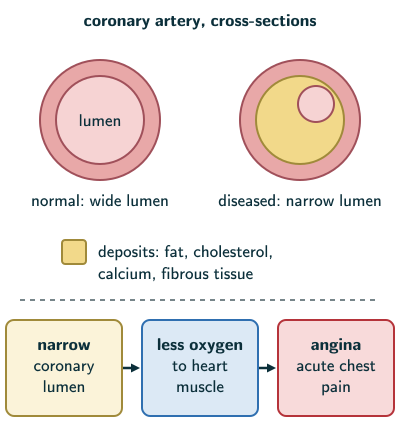
- It is caused by deposits of calcium, fat, cholesterol and fibrous tissues, which make the lumen of the arteries narrower (page 203).
- NCERT says CAD is “often referred to as atherosclerosis” (page 203); in an NCERT-based question, accept atherosclerosis as another name for CAD, as NCERT does. Beyond the NCERT text, keep the concepts distinct: atherosclerosis is plaque build-up in arterial walls throughout the body; coronary artery disease concerns the arteries supplying the heart. Coronary atherosclerosis is its common cause, so the terms overlap but are not exact synonyms (MedlinePlus, “Atherosclerosis”; NHLBI, “Coronary Heart Disease”).
Angina pectoris
- Angina, also called angina pectoris, is chest pain or discomfort caused by inadequate oxygen supply to the heart muscle. NCERT describes “acute chest pain” (page 203); clinically it may feel like pressure or squeezing rather than sharp pain (NHLBI, “Angina”). Not every chest pain is angina. NCERT’s sentence says the pain appears when “no enough oxygen” reaches the heart muscle, a slip for “not enough oxygen” (page 203).
- It can occur in men and women of any age, but it is more common among the middle-aged and elderly (page 203).
- It occurs due to conditions that affect the blood flow (page 203). CAD is one such condition: a narrower lumen carries less blood, and so less oxygen, to the heart muscle (reasoned from page 203).
Heart failure
- Heart failure is the state of the heart when it is not pumping blood effectively enough to meet the needs of the body (NCERT page 203).
- It is sometimes called congestive heart failure, because congestion of the lungs is one of its main symptoms (page 203).
- Beyond the NCERT text, a modern clarification: heart failure can involve impaired ejection or impaired filling, with raised filling pressures and congestion. A stiff ventricle can fail even when the percentage ejected per beat is preserved; heart failure does not always mean a weakly contracting heart or low resting output (AHA/ACC/HFSA heart-failure guideline, 2022).
- Keep three terms separate. NCERT: “Heart failure is not the same as cardiac arrest (when the heart stops beating) or a heart attack (when the heart muscle is suddenly damaged by an inadequate blood supply)” (page 203). Give these definitions in an NCERT-based answer. Beyond the NCERT text, in modern wording:
- heart failure: a syndrome of impaired cardiac function, including pumping or filling, often with congestion;
- cardiac arrest: sudden loss of effective pumping, not necessarily complete electrical silence or a motionless heart; an abnormal rhythm may prevent circulation (NHLBI, “Cardiac Arrest”);
- heart attack (myocardial infarction): heart-muscle injury with cell death caused by prolonged inadequate blood supply, commonly following coronary blockage (NHLBI, “Heart Attack”).
Solved examples
Example 1: Reading a blood pressure
A reading is written 120/80 mm Hg. Which number is the systolic pressure, and what does each number mean?
Answer: 120 mm Hg is the systolic, or pumping, pressure and 80 mm Hg the diastolic, or resting, pressure; 120/80 is NCERT’s normal reading (page 202).
Example 2: Repeated readings
A man’s blood pressure is checked on several days and reads 150/95, 148/94 and 152/96. Does this show hypertension?
Answer: yes. Every one of the repeated readings is at or above 140/90: each systolic value (148 to 152) is above 140, and each diastolic value (94 to 96) is above 90 (NCERT pages 202–203).
Example 3: A single high reading
A woman’s blood pressure reads 145/92 once, at a single check. Is this enough to say she has hypertension?
Answer: no, not by NCERT’s test. NCERT asks for repeated checks of 140/90 or higher (pages 202–203), and the WHO likewise wants readings taken on two separate days. The single reading is a reason to check again.
Example 4: Which disorder?
Name the condition: (a) the heart stops beating; (b) the heart muscle is suddenly damaged by an inadequate blood supply; (c) the heart is not pumping blood effectively enough to meet the needs of the body, and the lungs are congested.
Answer: (a) cardiac arrest; (b) a heart attack; (c) heart failure, also called congestive heart failure (NCERT page 203). Beyond the NCERT text: in modern terms, (a) is a sudden loss of effective pumping (NHLBI, “Cardiac Arrest”), and (b) is heart-muscle cell death from prolonged inadequate blood supply (NHLBI, “Heart Attack”).
Example 5: From deposits to chest pain
Explain how coronary artery disease can lead to angina.
Answer: in CAD, deposits of calcium, fat, cholesterol and fibrous tissues narrow the lumen of the coronary arteries that supply the heart muscle. Less blood flows through them, so not enough oxygen reaches the heart muscle, and that shortage causes the acute chest pain of angina (NCERT page 203). Beyond the NCERT text, MedlinePlus makes the same link: “Angina is a symptom of coronary artery disease (CAD), the most common heart disease.” (US National Library of Medicine, MedlinePlus, Angina).
Example 6: Only one number is high
Repeated readings on different days are 150/80 and 148/82 mm Hg. Is the WHO hypertension threshold met even though the diastolic values are below 90?
Answer: yes. The systolic pressure is ≥140 on both days; the threshold uses systolic OR diastolic, not a requirement for both to be high (WHO, “Hypertension”).
Common mistakes to avoid
Common mistake
Saying heart failure means the heart has stopped
Heart failure is not the same as cardiac arrest, when the heart stops beating (NCERT page 203). In heart failure the heart continues to beat, but it does not pump blood effectively enough to meet the needs of the body. Beyond the NCERT text: cardiac arrest is a sudden loss of effective pumping (NHLBI, “Cardiac Arrest”), and abnormal pumping or filling can cause heart failure even when the ejection fraction is preserved (AHA/ACC/HFSA guideline, 2022).
Common mistake
Swapping systolic and diastolic pressure
In 120/80, the first number, 120 mm Hg, is the systolic (pumping) pressure; 80 mm Hg is the diastolic (resting) pressure (NCERT page 202).
Common mistake
Calling angina a heart attack
Angina is a symptom: acute chest pain when not enough oxygen reaches the heart muscle. A heart attack is different: the heart muscle is suddenly damaged by an inadequate blood supply (NCERT page 203).
Quick revision summary
- Normal blood pressure is 120/80 mm Hg: 120 systolic (pumping), 80 diastolic (resting). NCERT: repeated checks of 140/90 (140 over 90) or higher show hypertension (pages 202–203); the WHO reads this as systolic ≥140 or diastolic ≥90 mm Hg on two separate days. High blood pressure leads to heart diseases and affects the brain and kidney.
- Coronary artery disease: deposits of calcium, fat, cholesterol and fibrous tissues narrow the lumen of the arteries that supply the heart muscle.
- Angina (angina pectoris): acute chest pain when not enough oxygen reaches the heart muscle; more common in the middle-aged and elderly.
- Heart failure: the heart is not pumping blood effectively enough to meet the needs of the body, often with congestion of the lungs. It is not cardiac arrest (the heart stops beating) or a heart attack (the heart muscle is suddenly damaged by an inadequate blood supply) (NCERT page 203). Beyond the NCERT text: cardiac arrest is a sudden loss of effective pumping, and a heart attack is ischaemic heart-muscle cell death (NHLBI).
Formula sheet
- normal blood pressure = 120/80 mm Hg (systolic/diastolic)
- WHO hypertension threshold: repeated systolic ≥140 OR diastolic ≥90 mm Hg
- CAD: deposits narrow the coronary lumen → less oxygen to the heart muscle → angina
- heart failure ≠ cardiac arrest ≠ heart attack
Questions students ask
What is the difference between angina and a heart attack?
Angina is chest pain from a shortage of oxygen in the heart muscle, while a heart attack is sudden damage to the heart muscle when its blood supply falls short (NCERT page 203). Beyond the NCERT text, angina comes on when the heart muscle’s need for oxygen briefly exceeds what the coronary circulation supplies, as when the heart works hard (MeSH, US National Library of Medicine, “Angina Pectoris”). In a heart attack, medically a myocardial infarction, prolonged ischaemia causes heart-muscle cell death, commonly after blockage of a coronary artery (NHLBI, “Heart Attack”). Angina can also warn of a higher risk of a heart attack (NHLBI, “Angina”).
How does hypertension lead to heart disease?
Hypertension increases heart-disease risk by making the heart work harder and by damaging the blood vessels, a mechanism beyond the NCERT text. High blood pressure is a main cause of one kind of heart failure, because heart muscle that has to work harder thickens over time and becomes stiffer (NHLBI, “Heart Failure: Causes”), and blood pressure that stays high narrows the blood vessels and, over time, damages and weakens them throughout the body (NIDDK, “High Blood Pressure & Kidney Disease”). NCERT states the link without the mechanism: high blood pressure leads to heart diseases (page 203).
How does heart failure cause oedema?
Heart failure causes oedema because blood that a failing side of the heart cannot pump on backs up behind it, and fluid then builds up in the tissues, a mechanism beyond the NCERT text. When the left side fails, pressure rises in the left atrium, which receives blood from the lungs through the pulmonary veins (NCERT page 201), and is passed back to the lung capillaries, so fluid gathers in or around the lungs, causing breathlessness and cough, sometimes worse when lying flat (Karagianni and colleagues, Journal of Cardiovascular Development and Disease, 2026; NHLBI, “Heart Failure: Symptoms”). When the right side fails, the ankles, feet, legs and abdomen can swell (NHLBI, as above).
Are the disorders of the circulatory system in the NEET (UG) 2026 syllabus?
Yes, all four disorders on this page are in the NEET (UG) 2026 syllabus: Unit 5, Human Physiology, lists “Disorders of circulatory system-Hypertension, Coronary artery disease, Angina pectoris, Heart failure” under body fluids and circulation (National Medical Commission, updated NEET (UG) 2026 syllabus). They are the same four that NCERT describes in Section 15.6 (pages 202–203), so NCERT’s definitions and its 120/80 and 140/90 readings are the ones to learn.
Practice questions
Try each question first, then open the answer to check your working.
-
Q1. What is the diastolic pressure in a normal blood pressure reading, and what does it represent?
Show answerHide answer
80 mm Hg, the resting pressure (NCERT page 202).
-
Q2. Which vessels does coronary artery disease affect?
Show answerHide answer
The vessels that supply blood to the heart muscle (NCERT page 203).
-
Q3. Why is heart failure sometimes called congestive heart failure?
Show answerHide answer
Because congestion of the lungs is one of the main symptoms of the disease (NCERT page 203).