Transport of oxygen and carbon dioxide
NCERT Class 11 Biology Chapter 14 Section 14.4
Quick answer
NCERT gives about 97% of O bound to haemoglobin and 3% dissolved; these transport shares are distinct from haemoglobin saturation. Low tissue pO favours oxygen unloading, assisted by higher CO, H and temperature. Most CO travels as bicarbonate, with smaller fractions as carbamino-haemoglobin and dissolved gas.
With your textbook
NCERT Biology (Class 11), Chapter 14 “Breathing and Exchange of Gases”, Section 14.4 “Transport of Gases”, pages 189–190.
Open the official NCERT chapter (PDF, 2.1 MB, ncert.nic.in) (opens in a new tab)
Checked against the 2026-27 reprint on .
Transport of gases
Transport of gases
Blood is the medium of transport for O and CO (NCERT Section 14.4, page 189).
About 97 per cent of O is transported by RBCs in the blood. The remaining 3 per cent of O is carried in a dissolved state through the plasma.
NCERT Biology (Class 11), Section 14.4, page 189
In plain words: haemoglobin in red blood cells is a fleet of taxis that pick up oxygen where it is plentiful (the lungs) and drop it where it is scarce (the tissues). Carbon dioxide mostly travels a different way: an enzyme in the red cells turns it into bicarbonate, which rides in the blood and is turned back into CO in the lungs.
| Gas | How it is carried | Share (NCERT page 189) |
|---|---|---|
| O | bound to haemoglobin in RBCs | about 97 per cent |
| O | dissolved in plasma | 3 per cent |
| CO | as bicarbonate | 70 per cent |
| CO | by RBCs (carbamino-haemoglobin) | 20–25 per cent |
| CO | dissolved in plasma | about 7 per cent |
The CO shares are approximate: as printed, they add to 97–102 per cent. For NCERT and NEET questions, use NCERT’s values. Beyond the NCERT text: the actual shares depend on conditions, and they are fractions of the gas carried, not haemoglobin saturation (our reading).
Transport of oxygen
- Haemoglobin is a red, iron-containing pigment in the RBCs. O binds to it reversibly, forming oxyhaemoglobin (NCERT Section 14.4.1, page 189).
- Each haemoglobin molecule can carry a maximum of four molecules of O (page 189); it has four subunits (see structure of proteins).
- Binding depends mainly on the partial pressure of O. The partial pressure of CO, the hydrogen ion concentration and temperature can interfere with it (page 189).
- Every 100 mL of oxygenated blood can deliver around 5 mL of O to the tissues under normal physiological conditions (page 189). Beyond the NCERT text: this is the amount the tissues take up, not the blood’s whole oxygen content (our reading).
| Condition | Alveoli | Tissues |
|---|---|---|
| pO | high | low |
| pCO | low | high |
| H concentration | lesser | high |
| Temperature | lower | higher |
| Result | oxyhaemoglobin forms | O dissociates |
(NCERT page 189.) So O is bound to haemoglobin at the lung surface and released in the tissues.
Oxygen dissociation curve
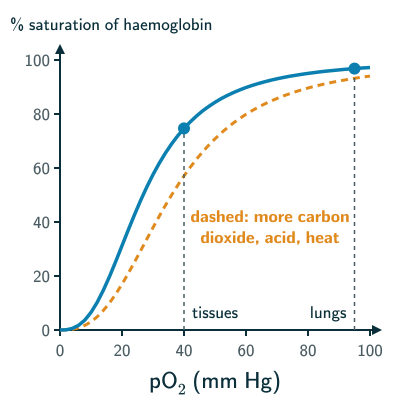
- When the percentage saturation of haemoglobin with O is plotted against pO, a sigmoid curve is obtained: the oxygen dissociation curve (NCERT page 189, Figure 14.5).
- It is highly useful for studying how factors like pCO and H concentration affect the binding of O to haemoglobin (page 189).
- Beyond the NCERT text, the S shape comes from the cooperative binding of O to haemoglobin. The position of the curve changes with pH, pCO and temperature; more CO shifts it to the right, lowering haemoglobin’s affinity for O (Valsecchi and colleagues, Frontiers in Medicine, 2026).
- This effect of CO and H is called the Bohr effect: more CO and more H reduce haemoglobin’s affinity for O and promote its release in active tissues (beyond the NCERT text; Valsecchi and colleagues, Frontiers in Medicine, 2026). In the tissues, low pO, high pCO, high H concentration and higher temperature are favourable for the dissociation of oxygen from oxyhaemoglobin (NCERT page 189).
Transport of carbon dioxide
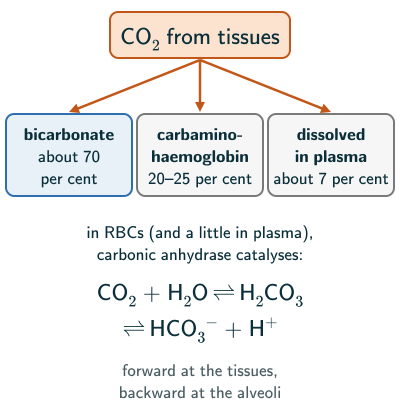
- About 20–25 per cent of CO is carried by haemoglobin as carbamino-haemoglobin (NCERT Section 14.4.2, page 189).
- This binding is related to the partial pressure of CO, and pO is a major factor that affects it (page 189):
- in the tissues, where pCO is high and pO low, more CO binds;
- in the alveoli, where pCO is low and pO high, CO dissociates from carbamino-haemoglobin.
- So CO bound to haemoglobin at the tissues is delivered at the alveoli (pages 189–190).
- Beyond the NCERT text, this effect of pO on CO binding is called the Haldane effect: deoxygenated haemoglobin binds CO more effectively, which helps carry CO from the tissues to the lungs (Valsecchi and colleagues, Frontiers in Medicine, 2026); in the alveoli, where pO is high, the CO is released (NCERT pages 189–190).
Beyond the NCERT text: in carbamino-haemoglobin, CO binds to amino groups of the globin chains, at their ends and on some side chains (Wikipedia, “Carbaminohemoglobin”, facts in our words), not to the haem sites that carry O (our reading).
Bicarbonate and carbonic anhydrase
- RBCs contain a very high concentration of the enzyme carbonic anhydrase, and minute quantities are present in the plasma too (NCERT page 190). Beyond the NCERT text: the enzyme catalyses the reversible hydration of CO, and the dissociation of carbonic acid that follows is a separate equilibrium (our reading). The overall sequence can proceed in both directions (see how fast carbonic anhydrase works):
CO + HO ⇌ HCO
HCO ⇌ HCO + H
- At the tissues, where pCO is high because of catabolism, CO diffuses into the blood (RBCs and plasma) and forms HCO and H (page 190).
- At the alveoli, where pCO is low, the reaction runs the other way, forming CO and HO. So CO trapped as bicarbonate at the tissues is carried to the alveoli and released as CO (page 190). (NCERT’s text here points to Figure 14.4, the section of an alveolus; the carriage of CO from tissues to alveoli is drawn in NCERT Figure 14.3, page 188.)
- Every 100 mL of deoxygenated blood delivers approximately 4 mL of CO to the alveoli (page 190).
Beyond the NCERT text: as bicarbonate builds up inside the red blood cells through the action of carbonic anhydrase, bicarbonate exits to plasma in exchange for chloride entering the cells; this is the chloride shift (Valsecchi and colleagues, Frontiers in Medicine, 2026). In the lungs, where NCERT’s reaction runs the other way (page 190), the exchange reverses, returning bicarbonate to the RBCs for CO release (our reasoning).
Solved examples
Example 1: Gas delivered in a minute
Every 100 mL of blood delivers about 5 mL of O to the tissues and about 4 mL of CO to the alveoli (NCERT pages 189–190). If 5000 mL of blood is pumped in a minute (the cardiac output, NCERT Chapter 15, page 200), how much O is delivered and CO removed each minute?
Answer: 5000 ÷ 100 = 50 portions of 100 mL. O: 50 × 5 = 250 mL a minute; CO: 50 × 4 = 200 mL a minute. Their ratio, 200 ÷ 250 = 0.8, is the gas-exchange ratio; at steady state it represents the body’s overall respiratory quotient on these figures (our reasoning; see the respiratory quotient).
Example 2: Transport of CO (NCERT Exercise 4)
What are the major transport mechanisms for CO? Explain.
Answer: (i) about 70 per cent as bicarbonate: carbonic anhydrase in the RBCs turns CO and water into HCO, which gives HCO and H at the tissues, and the reaction reverses at the alveoli to release CO; (ii) 20–25 per cent as carbamino-haemoglobin, binding where pCO is high and pO low and dissociating in the alveoli; (iii) about 7 per cent dissolved in plasma (NCERT pages 189–190).
Example 3: Effect of pCO on oxygen transport (NCERT Exercise 8)
What is the effect of pCO on oxygen transport?
Answer: pCO interferes with the binding of O to haemoglobin. In the alveoli, low pCO (with high pO, less H and lower temperature) favours the formation of oxyhaemoglobin; in the tissues, high pCO (with low pO, more H and higher temperature) favours the dissociation of O (NCERT page 189). So high pCO helps unload O where it is needed. This effect of CO and H is the Bohr effect, a shift of the oxygen dissociation curve to the right (beyond the NCERT text; Valsecchi and colleagues, 2026).
Example 4: The sigmoid curve (NCERT Exercise 11)
Define the oxygen dissociation curve. Can you suggest any reason for its sigmoidal pattern?
Answer: it is the curve obtained when the percentage saturation of haemoglobin with O is plotted against pO (NCERT page 189). Beyond the NCERT text: the S shape arises because the binding of O to haemoglobin is cooperative (Valsecchi and colleagues, 2026): binding gets easier as more O binds, so saturation rises steeply over a middle range of pO before levelling off.
Example 5: Loading or unloading?
For each condition, say whether it favours the formation of oxyhaemoglobin or the dissociation of O from it: (a) high pO, (b) high H concentration, (c) lower temperature, (d) high pCO.
Answer: (a) formation; (b) dissociation; (c) formation; (d) dissociation. The alveoli have high pO, low pCO, lesser H and lower temperature; the tissues the opposite (NCERT page 189).
Common mistakes to avoid
Common mistake
Saying most CO travels on haemoglobin
About 70 per cent of CO travels as bicarbonate; only 20–25 per cent is carried as carbamino-haemoglobin (NCERT page 189).
Common mistake
Putting carbonic anhydrase mainly in the plasma
RBCs have a very high concentration of carbonic anhydrase; the plasma has only minute quantities (NCERT page 190).
Common mistake
Treating carbon monoxide like carbon dioxide
Haemoglobin carries CO from the tissues and releases it at the alveoli (NCERT pages 189–190). Carbon monoxide is different. Beyond the NCERT text: haemoglobin binds carbon monoxide more than 200 times as strongly as O (Lee and colleagues, Scientific Reports, 2026, facts in our words).
Common mistake
Reversing the conditions for loading oxygen
Oxyhaemoglobin forms where pO is high and pCO, H and temperature are low (the alveoli); it gives up O in the opposite conditions (the tissues) (NCERT page 189).
Quick revision summary
- O: about 97 per cent bound to haemoglobin in RBCs, 3 per cent dissolved in plasma. CO: 70 per cent as bicarbonate, 20–25 per cent as carbamino-haemoglobin, about 7 per cent dissolved.
- Haemoglobin binds O reversibly, up to four per molecule; binding depends mainly on pO, and pCO, H and temperature interfere.
- The oxygen dissociation curve (% saturation against pO) is sigmoid. O loads in the alveoli and unloads in the tissues; 100 mL of blood delivers about 5 mL of O.
- Carbonic anhydrase, mostly in RBCs, converts CO to HCO and H at the tissues and back at the alveoli; 100 mL of deoxygenated blood delivers about 4 mL of CO.
Formula sheet
- NCERT O shares: 97 per cent as oxyhaemoglobin, 3 per cent dissolved
- CO: 70 per cent bicarbonate, 20–25 per cent carbamino-haemoglobin, 7 per cent dissolved
- CO + HO ⇌ HCO ⇌ HCO + H (carbonic anhydrase)
- 100 mL blood: delivers about 5 mL O; about 4 mL CO
- up to 4 O per haemoglobin molecule
Questions students ask
What is the Bohr effect, and does NCERT name it?
The Bohr effect is the fall in haemoglobin’s affinity for oxygen when the pCO rises or the blood becomes more acidic (more H), which shifts the oxygen dissociation curve to the right so that more O can be released at a given pO (beyond the NCERT text; Valsecchi and colleagues, Frontiers in Medicine, 2026). NCERT does not use the name, but it describes the effect: it lists pCO and H concentration among the factors that can interfere with the binding of O to haemoglobin, and uses the oxygen dissociation curve to study them (NCERT page 189). The NEET (UG) 2026 syllabus names “transport of gases” but not the Bohr effect, so learn NCERT’s wording first and the name as an extra.
What is the difference between a right shift and a left shift of the oxygen dissociation curve?
A right shift means haemoglobin holds O less tightly, so at the same pO it is less saturated and gives up more O, while a left shift means it holds O more tightly and loads it more easily. The right shift goes with the conditions NCERT gives for the tissues, high pCO, high H concentration and higher temperature, and the left shift with those of the alveoli, low pCO, less H and lower temperature (NCERT page 189). The curve shifts when those modifying conditions change; a fall in pO alone moves the operating point along the same curve (beyond the NCERT text, which gives the conditions but not the shifts; Valsecchi and colleagues, Frontiers in Medicine, 2026).
What is the difference between the Bohr effect and the Haldane effect?
The Bohr effect is the effect of CO and H on oxygen transport, while the Haldane effect is the effect of oxygen on CO transport: more CO and H make haemoglobin release O, and more O makes the blood give up CO (beyond the NCERT text; Valsecchi and colleagues, Frontiers in Medicine, 2026). The two work as a pair: in the tissues CO helps unload O and the low pO helps the blood take up CO, and in the alveoli the reverse happens (same source). NCERT describes both without the names: pCO and H concentration interfere with the binding of O, and pO is a major factor that affects the binding of CO as carbamino-haemoglobin (NCERT page 189).
Why is carbonic anhydrase important in the transport of CO?
Carbonic anhydrase is important because CO can travel as bicarbonate only if it is first turned into carbonic acid fast enough: the reaction CO + HO ⇌ HCO is very slow on its own, and the enzyme speeds it about 10 million times (NCERT Chapter 9). It also runs the reaction the other way at the alveoli, so the CO trapped as bicarbonate is released there (NCERT pages 189–190). The H formed helps unload O, because a high H concentration favours the dissociation of oxygen from oxyhaemoglobin (reasoned from NCERT pages 189–190); beyond the NCERT text, haemoglobin can bind this H as it shifts to its low-oxygen-affinity form (Valsecchi and colleagues, Frontiers in Medicine, 2026).
Practice questions
Try each question first, then open the answer to check your working.
-
Q1. Name the iron-containing pigment that carries O in the blood.
Show answerHide answer
Haemoglobin, present in the RBCs (NCERT page 189).
-
Q2. In what form is most CO transported?
Show answerHide answer
As bicarbonate, about 70 per cent (NCERT page 189).
-
Q3. How much CO does every 100 mL of deoxygenated blood deliver to the alveoli?
Show answerHide answer
Approximately 4 mL (NCERT page 190).