Respiratory quotient (RQ)
NCERT Class 11 Biology Chapter 12 Section 12.7
Quick answer
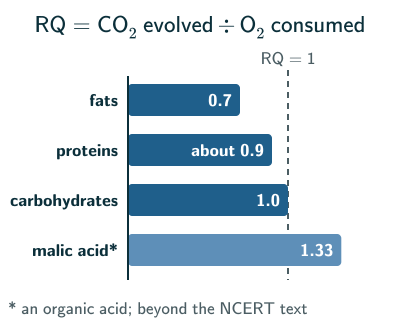
RQ is respiratory CO evolved divided by O consumed over the same interval under comparable conditions. Complete glucose oxidation gives 1, tripalmitin about 0.7, and NCERT uses about 0.9 for protein. Mixtures and other gas-exchange processes affect measurements, so RQ suggests substrates without uniquely identifying them.
With your textbook
NCERT Biology (Class 11), Chapter 12 “Respiration in Plants”, Section 12.7 “Respiratory Quotient”, pages 163–164.
Open the official NCERT chapter (PDF, 1.7 MB, ncert.nic.in) (opens in a new tab)
Checked against the 2026-27 reprint on .
Respiratory quotient
Respiratory quotient (RQ)
During aerobic respiration, O is consumed and CO is released. NCERT defines the ratio between the two:
The ratio of the volume of CO evolved to the volume of O consumed in respiration is called the respiratory quotient (RQ) or respiratory ratio.
NCERT Biology (Class 11), Section 12.7, page 163
RQ = volume of CO evolved ÷ volume of O consumed
In plain words: RQ compares what a respiring tissue breathes out with what it breathes in. Measure the CO given out and the O taken in, divide, and the number hints at what is being burnt. Carbohydrates give exactly 1, fats well under 1, proteins in between.
“The respiratory quotient depends upon the type of respiratory substrate used during respiration” (NCERT page 163).
RQ of carbohydrates
When carbohydrates are the substrate and are completely oxidised, the RQ is 1, because equal amounts of CO and O are evolved and consumed (NCERT pages 163–164):
CHO + 6O → 6CO + 6HO + energy
RQ = 6CO ÷ 6O = 1.0
RQ of fats
When fats are used in respiration, the RQ is less than 1. NCERT works it out for tripalmitin (page 164):
2(CHO) + 145O → 102CO + 98HO + energy
RQ = 102CO ÷ 145O = 0.7
NCERT introduces this as the calculation “for a fatty acid, tripalmitin” (page 164). That is a slip: tripalmitin is a fat, a triglyceride of glycerol with three palmitic acid chains, not a fatty acid (see lipids, NCERT Chapter 9, page 106). Its formula fits: glycerol’s 3 carbons plus 3 × 16 from palmitic acid make 51. The slip does not change the answer: a true fatty acid, palmitic acid, gives CHO + 23O → 16CO + 16HO, RQ = 16 ÷ 23 ≈ 0.7 (beyond the NCERT text, worked from the balanced equation).
Why below 1? Fats are more reduced than carbohydrates, so complete oxidation requires more O relative to the CO formed. The balanced equations quantify this: glucose uses 6 O for 6 CO, while two tripalmitin molecules use 145 O for 102 CO. This is net stoichiometry, not a map of individual oxygen atoms. In respiratory electron transport O is reduced to water; do not conclude that the inhaled oxygen molecules directly become the CO molecules (NCERT pages 159–160).
RQ of proteins
- When proteins are the respiratory substrates, the ratio is about 0.9 (NCERT page 164).
- In living organisms, respiratory substrates are often more than one; “pure proteins or fats are never used as respiratory substrates” (page 164). Many measurements therefore reflect a mixture. The quotation describes usual whole-organism metabolism; a controlled substrate experiment can still determine an individual substrate’s RQ.
Solved examples
Example 1: RQ of glucose
Find the RQ when glucose is completely oxidised.
Answer: CHO + 6O → 6CO + 6HO, so RQ = 6 ÷ 6 = 1.0 (NCERT page 164).
Example 2: Checking NCERT’s tripalmitin equation
Show that 2(CHO) + 145O → 102CO + 98HO balances, and find the RQ.
Answer: carbon: 2 × 51 = 102 = 102. Hydrogen: 2 × 98 = 196 = 98 × 2. Oxygen: 2 × 6 + 145 × 2 = 12 + 290 = 302 on the left; 102 × 2 + 98 = 204 + 98 = 302 on the right. It balances. RQ = 102 ÷ 145 = 0.703…, about 0.7 (NCERT page 164).
Example 3: Identifying the substrate
Germinating seeds take in 100 mL of O and give out 70 mL of CO in the same time. Which kind of substrate are they mainly respiring?
Answer: RQ = 70 ÷ 100 = 0.7, NCERT’s value for fats (page 164), so mainly fat. Under the question’s simplifying assumption of complete respiratory oxidation, this suggests predominantly fat. RQ alone does not uniquely identify a substrate mixture or exclude other processes.
Example 4: An organic acid
Some plants can respire organic acids (NCERT page 154). Find the RQ of malic acid from CHO + 3O → 4CO + 3HO.
Answer: first check the balance: carbon 4 = 4; hydrogen 6 = 3 × 2; oxygen 5 + 3 × 2 = 11 = 4 × 2 + 3. Then RQ = 4 ÷ 3 = 1.33, more than 1, because the acid already holds a lot of oxygen (beyond the NCERT text, worked from the balanced equation).
Example 5: RQ in anaerobic respiration
What happens to the RQ when yeast ferments glucose: CHO → 2CHOH + 2CO?
Answer: 2 CO are evolved but no O is consumed, so the ratio has 0 below the line: the RQ cannot be calculated, and it is often described as infinite (beyond the NCERT text, from NCERT’s definition on page 163 and the fermentation of page 157). In lactic acid fermentation (CHO → 2CHO) no CO is evolved either (NCERT Figure 12.2, page 157), so the ratio is 0 ÷ 0 and has no value; “infinite” fits only fermentation that gives off CO.
Example 6: RQ of fats (NCERT Exercise 10)
Define RQ. What is its value for fats?
Answer: RQ is the ratio of the volume of CO evolved to the volume of O consumed in respiration. For fats it is less than 1: for tripalmitin, 102 ÷ 145 = about 0.7 (NCERT pages 163–164).
Common mistakes to avoid
Common mistake
Turning the ratio upside down
RQ is CO evolved ÷ O consumed, not O ÷ CO; with the ratio inverted, fats would wrongly come out above 1 (NCERT page 163).
Common mistake
Calling tripalmitin a fatty acid
NCERT’s wording calls it one, but tripalmitin is a fat: glycerol with three palmitic acid chains (NCERT Chapter 9, page 106).
Common mistake
Giving proteins an RQ of 1
For proteins NCERT gives about 0.9; of NCERT’s three substrates, only carbohydrates, completely oxidised, give exactly 1 (page 164).
Quick revision summary
- RQ (respiratory ratio) = volume of CO evolved ÷ volume of O consumed; it depends on the respiratory substrate.
- Carbohydrates, completely oxidised: RQ = 6 ÷ 6 = 1.
- Fats: RQ less than 1; tripalmitin, 102 ÷ 145 = 0.7 (NCERT calls tripalmitin a fatty acid; it is a fat).
- Proteins: about 0.9 in NCERT’s comparison. Living tissues commonly use mixtures; RQ alone does not uniquely identify the mixture.
Formula sheet
- RQ = volume of CO evolved ÷ volume of O consumed
- carbohydrates: RQ = 6CO ÷ 6O = 1.0
- fats (tripalmitin): RQ = 102CO ÷ 145O = 0.7
- proteins: RQ about 0.9
Questions students ask
What is the significance of the respiratory quotient?
The respiratory quotient can suggest the predominant substrate under controlled respiratory conditions: NCERT says RQ depends upon the type of respiratory substrate (page 163), with values of 1.0 for carbohydrates, about 0.7 for fats and about 0.9 for proteins (page 164). Since living organisms often respire more than one substrate at a time (page 164), an in-between value points to a mixture. An RQ of 0.8, for instance, could come from one-third of the O consumed oxidising carbohydrate and two-thirds oxidising fat, since ⅓ × 1.0 + ⅔ × 0.7 = 0.8, though protein and fat each accounting for half of O consumption give 0.8 too (beyond the NCERT text, worked from NCERT’s values).
Why is RQ 1 for carbohydrates, below 1 for fats and above 1 for organic acids?
RQ differs between substrates because they differ in how much oxygen they already hold for their own hydrogen, an explanation that, beyond the NCERT text, follows from the balanced equations. Glucose, CHO, has a net requirement of 6 O for production of 6 CO, so RQ is 1. A more reduced fat requires proportionally more O per CO formed, giving about 0.7 for tripalmitin (NCERT’s values, pages 163–164). This balance does not trace individual oxygen atoms; terminal O reduction in the ETS makes water. Many organic acids, such as the malic and oxalic acids of plants, hold more, so they give out more CO than the O they take in: for oxalic acid, 2(COOH) + O → 4CO + 2HO, and RQ = 4 ÷ 1 = 4.
Does the respiratory quotient have a unit?
No, the respiratory quotient has no unit: it is the ratio of the volume of CO evolved to the volume of O consumed (NCERT page 163), two volumes in the same unit, such as mL, so the units cancel. The volumes must refer to the same tissue and time interval, at the same temperature and pressure, with photosynthetic gas exchange excluded or corrected; then, by Avogadro’s law, they are in the same ratio as the numbers of molecules, which is why RQ can be read straight from the CO and O in a balanced equation, as NCERT does for glucose and tripalmitin (page 164).
Practice questions
Try each question first, then open the answer to check your working.
-
Q1. What is another name for the respiratory quotient?
Show answerHide answer
Respiratory ratio (NCERT page 163).
-
Q2. What is the RQ when proteins are the respiratory substrate?
Show answerHide answer
About 0.9 (NCERT page 164).
-
Q3. A tissue gives out 20 mL of CO while taking in 20 mL of O. What is its RQ, and which substrate does this suggest?
Show answerHide answer
RQ = 20 ÷ 20 = 1, which suggests carbohydrate (NCERT pages 163–164).