Laws of chemical combination
NCERT Class 11 Chemistry Chapter 1 Section 1.5
Quick answer
Five laws govern how elements combine: conservation of mass (Lavoisier), definite proportions (Proust), multiple proportions (Dalton), Gay-Lussac’s law of gaseous volumes and Avogadro’s law. Mass is never lost in a reaction, a compound always has the same composition by mass, and gases react in simple whole-number ratios by volume (at the same temperature and pressure). Avogadro explained the volume ratios by proposing that equal volumes of gases at the same temperature and pressure contain equal numbers of molecules.
With your textbook
NCERT Chemistry Part I (Class 11), Chapter 1 “Some Basic Concepts of Chemistry”, Section 1.5 “Laws of Chemical Combinations”, pages 14–16.
Open the official NCERT chapter (PDF, 4.0 MB, ncert.nic.in) (opens in a new tab)
Checked against the 2026-27 reprint on .
What are the laws of chemical combination?
The five laws of chemical combination
How elements combine to form compounds is governed by five basic laws (NCERT Section 1.5, pages 14–16):
- Conservation of mass (Lavoisier, 1789): there is no net change of mass in a physical or chemical change.
- Definite proportions (Proust): a given compound always contains the same elements in the same proportion by mass.
- Multiple proportions (Dalton, 1803): when two elements form more than one compound, the masses of one that combine with a fixed mass of the other are in a ratio of small whole numbers.
- Gaseous volumes (Gay-Lussac, 1808): gases combine, or are produced, in a simple ratio by volume, at the same temperature and pressure.
- Avogadro’s law (1811): equal volumes of all gases at the same temperature and pressure contain equal numbers of molecules.
In plain words: the first law says matter is not lost or made in a reaction. The second and third say that elements combine in fixed, simple amounts. The last two deal with gases: Gay-Lussac found that gases combine in simple ratios by volume, and Avogadro explained this with molecules. Dalton’s atomic theory explained the mass laws but could not explain the gaseous volumes (NCERT Section 1.6, page 16).
Law of conservation of mass
Antoine Lavoisier (1743–1794) studied combustion reactions with careful measurements of the masses of the reactants and the products. He found that in all physical and chemical changes there is no net change in mass (NCERT Section 1.5.1, page 14).
Hence, he reached to the conclusion that matter can neither be created nor destroyed.
NCERT Chemistry Part I (Class 11), Section 1.5.1, page 14
In practice: the total mass of the reactants equals the total mass of the products. When 10.00 g of calcium carbonate is heated, it leaves 5.60 g of calcium oxide, and the other 4.40 g escapes as carbon dioxide gas (Example 1). Nothing has been destroyed; part of the mass has left as a gas. This law is also why a chemical equation must be balanced: each element must have the same number of atoms on both sides.
Strictly, the energy given out in a reaction carries away a tiny mass, by E = mc, but in chemical reactions it is far too small to weigh (Example 2; beyond the NCERT text).
Law of definite proportions
He stated that a given compound always contains exactly the same proportion of elements by weight.
NCERT Chemistry Part I (Class 11), Section 1.5.2, page 15
Joseph Proust (1754–1826) analysed two samples of cupric carbonate, one natural and one made in the laboratory (page 15). Both had the same composition:
| Sample | % Cu | % C | % O |
|---|---|---|---|
| Natural | 51.35 | 9.74 | 38.91 |
| Synthetic | 51.35 | 9.74 | 38.91 |
So, whatever its source, a compound always contains the same elements in the same proportion by mass. The law is also called the law of definite composition (page 15). Pure water from a river, from rain or from a laboratory is always 11.2% hydrogen and 88.8% oxygen by mass.
Law of multiple proportions
According to this law, if two elements can combine to form more than one compound, the masses of one element that combine with a fixed mass of the other element, are in the ratio of small whole numbers.
NCERT Chemistry Part I (Class 11), Section 1.5.3, page 15
NCERT’s example: hydrogen and oxygen form two compounds, water and hydrogen peroxide (page 15).
| Compound | H | O | Total |
|---|---|---|---|
| H2O | 2 g | 16 g | 18 g |
| H2O2 | 2 g | 32 g | 34 g |
For the same 2 g of hydrogen, the masses of oxygen are 16 g and 32 g, in the ratio 16 : 32 = 1 : 2, a ratio of small whole numbers. The key step is to fix the mass of one element first; only then compare the masses of the other.
Gay-Lussac’s law of gaseous volumes
Joseph Louis Gay-Lussac observed in 1808 that when gases combine, or are produced in a reaction, their volumes are in a simple ratio, provided all the gases are at the same temperature and pressure (NCERT Section 1.5.4, page 15). For example, 100 mL of hydrogen combines with 50 mL of oxygen to give 100 mL of water vapour (page 15). The volumes of hydrogen and oxygen that combine are in the ratio 2 : 1. Gay-Lussac’s law is really the law of definite proportions by volume; the earlier law was by mass.
Volumes do not have to add up: 100 mL + 50 mL of gases gave 100 mL of vapour, not 150 mL. Mass is conserved; volume is not.
Avogadro’s law
In 1811, Avogadro proposed that equal volumes of all gases at the same temperature and pressure should contain equal number of molecules.
NCERT Chemistry Part I (Class 11), Section 1.5.5, page 15
Avogadro made the distinction between atoms and molecules. If hydrogen and oxygen exist as two-atom molecules, H2 and O2, then Gay-Lussac’s result follows at once: two volumes of hydrogen and one volume of oxygen give two volumes of water vapour, with no oxygen left over (NCERT Fig. 1.9, page 16).
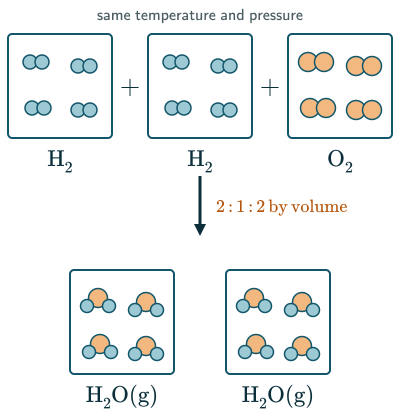
Dalton and others at the time believed that atoms of the same kind could not combine, so they did not accept molecules such as H2 and O2 (pages 15–16). Avogadro’s proposal, published in the French Journal de Physique, gained little support. About 50 years later, at the first international conference on chemistry, at Karlsruhe in Germany in 1860, Stanislao Cannizzaro presented a sketch of a course of chemical philosophy that stressed the importance of Avogadro’s work (page 16). NCERT spells his name “Cannizaro”. The same law appears in physics in Avogadro’s law.
Solved examples
Example 1: Mass is conserved when limestone is heated
Heating 10.00 g of calcium carbonate gives 5.60 g of calcium oxide and carbon dioxide gas:
CaCO3(s) → CaO(s) + CO2(g)
Find the mass of carbon dioxide formed, and check the result with the molar masses CaCO3 = 100.09, CaO = 56.08 and CO2 = 44.01 g mol.
By conservation of mass: mass of CO2 = 10.00 − 5.60 = 4.40 g.
Check: the equation gives 56.08 g of CaO and 44.01 g of CO2 from 100.09 g of CaCO3. So 10.00 g gives 5.60 g of CaO and 4.40 g of CO2, and 56.08 + 44.01 = 100.09.
Answer: 4.40 g of carbon dioxide; the masses before and after are both 10.00 g.
Example 2: How much mass does a reaction really lose?
Burning 2.016 g of hydrogen in oxygen to make 18.02 g of liquid water gives out 286 kJ of heat. Using E = mc with c = 3.00 × 10 m s, find the mass that this energy carries away (beyond the NCERT text).
m = E/c = (2.86 × 10 J)/
= (2.86 × 10)/(9.00 × 10) kg
≈ 3.2 × 10 kg = 3.2 × 10 g.
That is about 2 parts in 10 of the 18 g of water, negligible at the precision of ordinary school chemical weighings.
Answer: about 3.2 × 10 g. For chemical reactions the law of conservation of mass holds to well within any measurement.
Example 3: Which law do these data obey? (NCERT Exercise 1.21(a), page 27)
Dinitrogen and dioxygen combine to give different compounds: (i) 14 g N with 16 g O; (ii) 14 g N with 32 g O; (iii) 28 g N with 32 g O; (iv) 28 g N with 80 g O. Which law is obeyed?
Fix the mass of nitrogen at 14 g. Then the oxygen is (i) 16 g; (ii) 32 g; (iii) 32/2 = 16 g; (iv) 80/2 = 40 g.
The masses of oxygen per 14 g of nitrogen, 16, 32, 16 and 40 g, are in the ratio 2 : 4 : 2 : 5, a ratio of small whole numbers.
Answer: the law of multiple proportions. (Data (i) and (iii) give the same elemental mass ratio; composition alone does not establish that they are the same compound.) Statement: if two elements can combine to form more than one compound, the masses of one element that combine with a fixed mass of the other are in a ratio of small whole numbers.
Example 4: Volumes of gases (NCERT Exercise 1.26, page 27)
If 10 volumes of dihydrogen react with 5 volumes of dioxygen, how many volumes of water vapour form?
2H2(g) + O2(g) → 2H2O(g): 2 volumes of hydrogen and 1 of oxygen give 2 volumes of water vapour. 10 and 5 volumes are in the same 2 : 1 ratio, so they react completely and give 10 volumes of water vapour.
Answer: 10 volumes of water vapour (at the same temperature and pressure).
Common mistakes to avoid
Common mistake
Comparing masses without fixing one element first
For multiple proportions, compare the masses of one element that combine with the same mass of the other. Comparing 16 g of O in 18 g of water with 32 g of O in 34 g of hydrogen peroxide works only because both contain 2 g of hydrogen.
Common mistake
Equal volumes, equal atoms
Avogadro’s law counts independently moving gas particles, not the total atoms bound inside them. At the same temperature and pressure, equal volumes of ideal He and O2 contain equal numbers of gas particles: He atoms and O2 molecules respectively. The oxygen sample therefore contains twice as many atoms. Real gases approach this relation in the dilute-gas limit.
Common mistake
Confusing the two laws named after Gay-Lussac
Gay-Lussac’s law of gaseous volumes is about combining ratios in reactions. It is not the gas law, also named after him, that pressure is proportional to temperature at constant volume.
Common mistake
Expecting volumes of gases to add up
Mass is conserved, volume is not: 2 volumes of H2 and 1 volume of O2 give 2 volumes of water vapour, not 3.
Common mistake
Using Gay-Lussac’s law for solids and liquids
The law of gaseous volumes applies only to gases, all measured at the same temperature and pressure. Liquid water formed at room temperature takes far less room than its vapour.
Common mistake
Thinking a compound made in the laboratory may differ from a natural one
By the law of definite proportions, pure samples of a compound have the same composition whatever their source, as Proust showed for cupric carbonate.
Quick revision summary
- Conservation of mass (Lavoisier): total mass of reactants = total mass of products.
- Definite proportions (Proust): a compound always has the same elements in the same proportion by mass.
- Multiple proportions (Dalton): for a fixed mass of one element, the masses of the other in different compounds are in a small whole-number ratio (H2O and H2O2: 1 : 2).
- Gay-Lussac: gases react and form in simple whole-number ratios by volume at the same temperature and pressure.
- Avogadro: equal volumes of gases at the same temperature and pressure contain equal numbers of molecules; with diatomic H2 and O2 this explains Gay-Lussac’s 2 : 1 : 2 volumes.
Formula sheet
- Conservation: mass of reactants = mass of products
- Water: H : O by mass = 2 : 16 = 1 : 8
- Multiple proportions: O per 2 g H in HO and HO = 16 g : 32 g = 1 : 2
- Gay-Lussac: 2 vol H + 1 vol O → 2 vol HO(g)
- Avogadro: V ∝ number of molecules (same T and p)
Questions students ask
What is the difference between the law of definite proportions and the law of multiple proportions?
The law of definite proportions is about a single compound, while the law of multiple proportions compares two or more compounds formed by the same two elements. The first says that a compound always has its elements in the same proportion by mass (pure water is always 1 part hydrogen to about 8 parts oxygen); the second says that, for a fixed mass of one element, the masses of the other in the different compounds are in a small whole-number ratio. Phosphorus, for example, forms PCl3 and PCl5, in which 30.97 g of phosphorus combines with 106.35 g and 177.25 g of chlorine, a ratio of 3 : 5.
What is the law of reciprocal proportions?
The law of reciprocal proportions, stated by Jeremias Richter in 1792, says that when two elements each combine with a fixed mass of a third, the ratio of their masses is the same as, or a simple multiple of, the ratio in which they combine with each other. For example, 12 g of carbon combines with 4 g of hydrogen in methane, CH4, and with 32 g of oxygen in carbon dioxide, and 4 : 32 = 1 : 8 is exactly the ratio of hydrogen to oxygen by mass in water. Many books call it a sixth law of chemical combination, but NCERT Class 11 gives only the five on this page.
Does the law of conservation of mass hold in nuclear reactions?
No, the law of conservation of mass does not hold exactly in nuclear reactions, because the energy released carries away a measurable mass, m = E/c. In the fission of uranium-235 each nucleus releases about 200 MeV, about 0.09% of its mass, so roughly 0.9 g of every kilogram of uranium-235 that undergoes fission disappears as energy. Chemical reactions lose mass in the same way, but far too little to weigh, so for them the law holds within any measurement. What is conserved exactly is mass and energy together, the law of conservation of mass–energy.
Are there exceptions to the law of definite proportions?
Yes, the law of definite proportions fails for non-stoichiometric compounds and for compounds made from different isotopes of an element. Some solids, such as iron(II) oxide, vary in composition from sample to sample and always contain slightly less iron than the formula FeO suggests, as in Fe0.95O. Heavy water, D2O, made with the hydrogen isotope deuterium, is about 20.1% hydrogen by mass against 11.2% for ordinary water, although both have two hydrogen atoms for each oxygen atom.
Practice questions
Try each question first, then open the answer to check your working.
-
Q1. 2.00 g of copper forms 2.50 g of copper oxide. Another sample of the same oxide, 1.60 g, contains 1.28 g of copper. Show that the data obey the law of definite proportions.
Show answerHide answer
First sample: 2.00/2.50 × 100 = 80.0% copper. Second sample: 1.28/1.60 × 100 = 80.0% copper. The same percentage, so the composition is fixed.
-
Q2. Carbon forms two oxides. In one, 12 g of carbon combines with 16 g of oxygen; in the other, 12 g of carbon combines with 32 g of oxygen. Which law do these data show, and what is the ratio?
Show answerHide answer
The law of multiple proportions: for the same 12 g of carbon, the masses of oxygen are 16 g and 32 g, in the ratio 1 : 2 (the oxides are CO and CO2).
-
Q3. 4.03 g of hydrogen and 32.0 g of oxygen react completely, with neither gas left over. What mass of water forms?
Show answerHide answer
By conservation of mass, 4.03 + 32.0 = 36.0 g of water.