Importance of chemistry
NCERT Class 11 Chemistry Chapter 1 Section 1.1
Quick answer
The importance of chemistry is that it gives us medicines, fertilisers, new materials and safer substitutes for harmful chemicals; as the study of the preparation, properties, structure and reactions of substances, it is also central to the other sciences. NCERT’s examples include cisplatin and taxol for cancer therapy, AZT for AIDS patients, fertilisers and pesticides made on a large scale, conducting polymers and optical fibres, and substitutes for ozone-depleting CFCs. Managing greenhouse gases is one of its big challenges today.
With your textbook
NCERT Chemistry Part I (Class 11), Chapter 1 “Some Basic Concepts of Chemistry”, Section 1.1 “Importance of Chemistry”, page 4.
Open the official NCERT chapter (PDF, 4.0 MB, ncert.nic.in) (opens in a new tab)
Checked against the 2026-27 reprint on .
What is chemistry, and why does it matter?
Chemistry and its importance
Chemistry is the study of how substances are made, what they are like, how they are built and how they react. The substances around us are matter, so chemistry reaches into medicine, food, industry, new materials and the environment, and it is intertwined with the other sciences (NCERT Chapter 1, page 1, and Section 1.1, page 4).
The branch of science that studies the preparation, properties, structure and reactions of material substances is called chemistry.
NCERT Chemistry Part I (Class 11), Chapter 1, Introduction, page 1
Chemistry plays a central role in science and is often intertwined with other branches of science.
NCERT Chemistry Part I (Class 11), Section 1.1, page 4
In plain words: whenever something is made, changed, cleaned, cured or protected, chemistry is at work. Curd setting from milk, iron rusting and a medicine being made in a factory are all chemical changes. Every one of them can be explained in terms of atoms and molecules, which is why NCERT also calls chemistry the science of atoms and molecules (page 3).
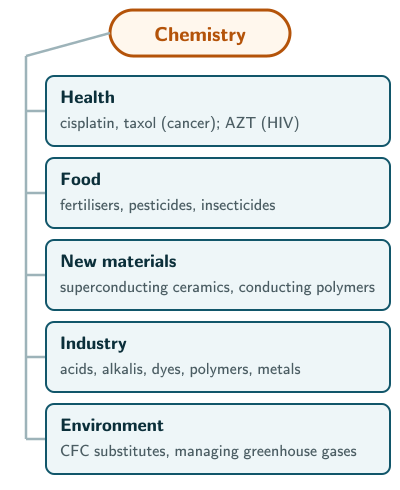
NCERT’s list of places where the principles of chemistry apply is wide (page 4). It includes weather patterns, the working of the brain and the operation of a computer. It also includes the making of fertilisers, alkalis, acids, salts, dyes, polymers, drugs, soaps, detergents, metals and alloys.
Health and medicine
Chemistry gives methods to isolate life-saving drugs from natural sources and to synthesise them in the laboratory (NCERT page 4). NCERT names three drugs:
- Cisplatin, cis-[Pt(NH3)2Cl2], a compound of platinum (only the cis isomer works as a drug), and taxol, first obtained from the bark of the Pacific yew tree, are used in cancer therapy.
- AZT (azidothymidine, also called zidovudine), C10H13N5O4, acts against HIV, the virus that causes AIDS. NCERT says it is used for helping AIDS patients.
(The formulas, the name zidovudine and taxol’s source are beyond the NCERT text.)
Medicines like these must be made pure and in the right amounts. That is why measuring masses, counting moles and working out formulas, the subject of the rest of this unit, matter so much.
Food and agriculture
Chemistry helps meet the need for food through the large-scale production of fertilisers and improved pesticides and insecticides (NCERT page 4). Nitrogen fertilisers, for example, start from ammonia, which industry makes from the nitrogen of the air and hydrogen (beyond the NCERT text here):
Making ammonia, the starting point of nitrogen fertilisers
Ammonia is then turned into fertilisers such as urea, CO(NH2)2 (also beyond the NCERT text).
New materials and industry
With a better understanding of chemical principles, chemists can now design and make materials with chosen magnetic, electric and optical properties (NCERT page 4). NCERT’s examples are:
- superconducting ceramics, which carry current with no resistance when cooled below a critical temperature;
- conducting polymers, plastics that conduct electricity;
- optical fibres, which carry light signals for telephone and internet links.
Industries that make acids, alkalis, dyes, polymers and metals add to the economy of a nation and give employment (page 4).
Protecting the environment
NCERT points to two environmental problems (page 4):
- Ozone depletion. CFCs (chlorofluorocarbons), once used as refrigerants, damage the ozone layer in the stratosphere. Chemists have made safer substitutes for them.
- Greenhouse gases. Gases such as methane (CH4) and carbon dioxide (CO2) trap heat. Managing them is still a serious concern for chemists.
How CFCs harm ozone (beyond the NCERT text): high in the stratosphere, ultraviolet light breaks chlorine atoms off CFC molecules. Each chlorine atom then destroys ozone in a cycle (free O atoms form there when ultraviolet light splits O2 and O3) and comes out unchanged at the end, so one atom can destroy thousands of ozone molecules (Example 2).
NCERT ends the section with the challenges ahead (page 4): understanding biochemical processes, using enzymes to make chemicals on a large scale, and making new exotic materials. It notes that a developing country like India needs talented and creative chemists to meet them.
How chemistry grew
NCERT opens the unit with a short history (pages 1–3). The main points:
- Origins. Chemistry was not at first studied for its own sake. It grew out of the search for the philosopher’s stone (Paras), which was meant to turn base metals into gold, and an elixir of life. NCERT says chemistry developed mainly as alchemy and iatrochemistry during 1300–1600 CE, and that modern chemistry took shape in Europe in the 18th century (page 1).
- Ancient India. Chemistry was called Rasayan Shastra, Rastantra, Ras Kriya or Rasvidya, and it covered metallurgy, medicine, cosmetics, glass and dyes (page 2).
- Harappan sites show baked bricks, glazed pottery and faience (a glazed quartz ceramic that NCERT calls “a sort of glass”). The Harappans also hardened copper with tin and arsenic.
- NCERT says the Charaka Samhita mentions the preparation of sulphuric and nitric acids, metal oxides, sulphates and carbonates.
- Nagarjuna’s Rasratnakar deals with mercury compounds and the extraction of metals (page 2).
- The atom. NCERT credits Acharya Kanada (it spells the name Kanda and dates him to 600 BCE) with the idea of Paramanu: tiny, indivisible, eternal particles that make up all matter, which can combine in pairs or triplets. NCERT places this about 2500 years before John Dalton (page 3).
- Modern chemistry in India. NCERT says modern science reached India in the later part of the nineteenth century, and that modern chemistry started growing from the mid-nineteenth century, when European scientists began coming to India (page 3).
NCERT also says that paper was known in India “in the 17th century”, on the account of the Chinese traveller I-tsing (page 3). This is evidently an error for the 7th century: I-tsing (635–713 CE) studied in India from about 673 to 685 CE (beyond the NCERT text).
Solved examples
Example 1: Which area does it belong to?
Match each item to the area of chemistry in NCERT’s list: (a) a new medicine isolated from a plant; (b) a plastic that conducts electricity; (c) a refrigerant that does not harm the ozone layer; (d) urea for wheat fields; (e) cutting methane from waste dumps.
(a) Health: isolating drugs from natural sources, as for taxol. (b) New materials: a conducting polymer. (c) Environment: a safer substitute for CFCs. (d) Food: a nitrogen fertiliser made from ammonia. (e) Environment: managing a greenhouse gas.
Answer: health, new materials, environment, food, environment.
Example 2: How one chlorine atom destroys many ozone molecules
In the stratosphere, a chlorine atom from a CFC reacts in two steps (beyond the NCERT text):
Add the two steps and find the net change. Why can one chlorine atom destroy so much ozone?
Adding the two steps, Cl and ClO appear on both sides and cancel:
The chlorine atom is used in the first step and given back in the second, so it is not used up. It acts as a catalyst and can go round the cycle again and again, destroying an ozone molecule each time.
Answer: net O3 + O → 2O2; the chlorine atom is regenerated, so a single atom can destroy thousands of ozone molecules.
Example 3: Platinum in a sample of cisplatin
Find the molar mass of cisplatin, Pt(NH3)2Cl2, and the mass of platinum in a 50.0 mg sample. Use the atomic masses Pt = 195.08, N = 14.01, H = 1.008 and Cl = 35.45 u.
Molar mass = 195.08 + 2 × (14.01 + 3 × 1.008) + 2 × 35.45 = 195.08 + 34.068 + 70.90 ≈ 300.05 g mol.
Fraction of the mass that is platinum = 195.08/300.05 ≈ 0.6502, or about 65.0%.
Platinum in 50.0 mg = 0.6502 × 50.0 mg ≈ 32.5 mg.
Answer: about 300.05 g mol; about 32.5 mg of the 50.0 mg sample is platinum. Calculations like this are the subject of percentage composition (NCERT Section 1.9).
Common mistakes to avoid
Common mistake
Thinking “chemical” means harmful
Water, air and the food we eat are made of chemical substances. Whether a substance is useful or harmful depends on what it is and how much of it there is, not on whether it was made in a factory.
Common mistake
Mixing up ozone depletion and the greenhouse effect
They are different problems. CFCs thin the ozone layer, which shields us from ultraviolet light. Greenhouse gases such as CO2 and CH4 trap heat and warm the Earth. (CFCs happen to be greenhouse gases as well, but that is a separate effect.)
Common mistake
Saying AZT cures AIDS
NCERT says AZT is used for helping AIDS patients. It slows down HIV, but it does not remove the virus from the body.
Quick revision summary
- Chemistry studies the preparation, properties, structure and reactions of substances. It is central to science and overlaps the other sciences.
- Health: drugs are isolated from natural sources or synthesised. Cisplatin and taxol are used in cancer therapy and AZT against HIV.
- Food: fertilisers, pesticides and insecticides are made on a large scale. Nitrogen fertilisers start from ammonia.
- Materials and industry: superconducting ceramics, conducting polymers and optical fibres. Acids, alkalis, dyes, polymers and metals support the economy and give jobs.
- Environment: safer substitutes for ozone-depleting CFCs. Managing greenhouse gases such as CH4 and CO2 is still a concern.
- History: alchemy and iatrochemistry, a long tradition in India (Rasayan Shastra), and Kanada’s idea of Paramanu, long before Dalton.
Formula sheet
- Cisplatin: cis-Pt(NH)Cl (cancer therapy)
- AZT: CHNO (against HIV)
- N + 3H ⇌ 2NH (ammonia for fertilisers)
- Urea: CO(NH)
- Ozone loss: Cl + O → ClO + O, then ClO + O → Cl + O
- Greenhouse gases: CO, CH
Questions students ask
What are some examples of chemistry in everyday life?
Chemistry is at work in everyday life whenever food is cooked, digested or preserved, things are cleaned and fuels are burnt: LPG burns in a stove to give heat, baking soda (sodium hydrogencarbonate) releases carbon dioxide to make a cake rise, soaps and detergents lift grease off cloth, and an antacid neutralises excess acid in the stomach. Controlled chlorination disinfects drinking water, and toothpaste, medicines, plastics, cement and the battery in a phone are all products of the chemical industry.
What are the five main branches of chemistry?
Chemistry is usually divided into five main branches: physical chemistry (the laws and energy changes behind reactions, such as their rates and equilibria), organic chemistry (most carbon compounds), inorganic chemistry (metals, minerals, salts and other substances, including carbon oxides and carbonates), analytical chemistry (finding what a sample contains and how much) and biochemistry (the chemistry of living things). Newer fields such as polymer, environmental, medicinal, nuclear and materials chemistry grew out of these, which is why the scope of chemistry, the range of subjects it covers, is so wide.
Who is called the father of chemistry?
Antoine Lavoisier (1743–1794) is usually called the father of modern chemistry: he showed by careful weighing that mass is conserved in chemical reactions, explained burning as combination with oxygen, and named oxygen and hydrogen. In India, Acharya Prafulla Chandra Ray (1861–1944), who founded Bengal Chemicals and wrote A History of Hindu Chemistry, is called the father of Indian chemistry. The title is sometimes given to earlier figures as well, such as Jabir ibn Hayyan for alchemy and Robert Boyle, author of The Sceptical Chymist (1661).
Is the importance of chemistry in the JEE Main 2027 and NEET (UG) 2026 syllabuses?
No, the importance of chemistry is not in the JEE Main 2027 or NEET (UG) 2026 syllabus: Unit 1, Some Basic Concepts in Chemistry, of both begins with ‘matter and its nature’. It is in the CBSE Class 11 Chemistry curriculum for 2026–27, whose Unit 1, Some Basic Concepts of Chemistry, opens with Importance of Chemistry, so it is studied for school examinations.
Practice questions
Try each question first, then open the answer to check your working.
-
Q1. Name the two drugs that NCERT mentions for cancer therapy, and the drug it mentions for AIDS patients.
Show answerHide answer
Cisplatin and taxol for cancer therapy; AZT (azidothymidine) for AIDS patients.
-
Q2. Which refrigerants did chemists replace to protect the ozone layer, and in which part of the atmosphere is that layer?
Show answerHide answer
CFCs (chlorofluorocarbons). The ozone layer is in the stratosphere.
-
Q3. Find the molar mass of AZT, C10H13N5O4, using C = 12.01, H = 1.008, N = 14.01 and O = 16.00 u.
Show answerHide answer
10 × 12.01 + 13 × 1.008 + 5 × 14.01 + 4 × 16.00 = 120.1 + 13.104 + 70.05 + 64.00 ≈ 267.25 g mol.