Properties of matter and their measurement
NCERT Class 11 Chemistry Chapter 1 Section 1.3
Quick answer
Physical properties, such as boiling point and density, can be measured without changing a substance, while chemical properties, such as combustibility, show up only in a chemical change. Measurements are reported as a number with a unit, using the seven SI base units and their prefixes. Density is mass per unit volume, and temperatures convert as K = °C + 273.15 and °F = (9/5)(°C) + 32.
With your textbook
NCERT Chemistry Part I (Class 11), Chapter 1 “Some Basic Concepts of Chemistry”, Section 1.3 “Properties of Matter and their Measurement”, pages 6–10.
Open the official NCERT chapter (PDF, 4.0 MB, ncert.nic.in) (opens in a new tab)
Checked against the 2026-27 reprint on .
What are the properties of matter?
Physical and chemical properties
Every substance has its own characteristic properties, of two kinds (NCERT Section 1.3.1, page 6):
- physical properties, such as colour, odour, melting point, boiling point and density, can be measured or observed without changing what the substance is;
- chemical properties, such as composition, combustibility and reactivity with acids and bases, can be observed only through a chemical change.
Measuring a property means giving a number and a unit, in SI units wherever possible (NCERT Sections 1.3.2–1.3.3, pages 7–8).
Physical properties can be measured or observed without changing the identity or the composition of the substance.
NCERT Chemistry Part I (Class 11), Section 1.3.1, page 6
The measurement or observation of chemical properties requires a chemical change to occur.
NCERT Chemistry Part I (Class 11), Section 1.3.1, page 6
In plain words: you can find the boiling point of water and still have water at the end, so boiling point is a physical property. You can only find out that magnesium burns by burning it, and then the magnesium is gone, so combustibility is a chemical property. Acidity, basicity and combustibility are chemical properties (page 6).
Measurement and the SI system
A measured quantity is a number followed by a unit: the length of a room is 6 m, where 6 is the number and m (metre) the unit (NCERT Section 1.3.2, page 7). The English and metric systems were both once in use. The metric system, which began in France in the late eighteenth century, was easier because it is decimal (page 7).
The International System of Units (SI) was set up in 1960 by the 11th General Conference on Weights and Measures (CGPM). The CGPM is an intergovernmental body created by the Metre Convention, signed in Paris in 1875 (NCERT Section 1.3.3, page 7). SI has seven base units. Since 20 May 2019 the SI as a whole has been defined by fixing seven defining constants. The table associates each base unit with a key constant; a unit definition can also depend on other constants or units (NCERT Table 1.2, page 8):
| Quantity | Unit | Key defining constant |
|---|---|---|
| Length | metre, m | speed of light c |
| Mass | kilogram, kg | Planck constant h |
| Time | second, s | caesium frequency ΔνCs |
| Electric current | ampere, A | elementary charge e |
| Temperature | kelvin, K | Boltzmann constant k |
| Amount of substance | mole, mol | Avogadro constant NA |
| Luminous intensity | candela, cd | luminous efficacy Kcd |
Other quantities, such as speed, volume and density, are derived from these (page 7). The mole, the base unit that matters most in chemistry, is defined by a count: one mole contains exactly 6.022 140 76 × 10 entities (NCERT Table 1.2). The physics side of the system is in SI base units.
In India, the National Physical Laboratory (NPL), New Delhi, maintains the national standards of measurement and compares them with those of other countries (NCERT box, page 7).
Prefixes name multiples and submultiples of a unit (NCERT Table 1.3, page 9). The ones used most in chemistry:
| Prefix | Symbol | Multiple |
|---|---|---|
| femto | f | 10 |
| pico | p | 10 |
| nano | n | 10 |
| micro | µ | 10 |
| milli | m | 10 |
| centi | c | 10 |
| deci | d | 10 |
| kilo | k | 10 |
| mega | M | 10 |
| giga | G | 10 |
NCERT’s Table 1.3 runs from yocto (10) to yotta (10) and includes deca (da, 10) and hecto (h, 10).
Where NCERT’s SI pages need correcting:
- NCERT Table 1.2 (page 8) gives the kelvin’s symbol as a small “k” and, although it writes J K correctly, gives its base-unit form as kg m s k. The kelvin is a capital K; the small k is the Boltzmann constant itself. The same table prints the caesium frequency ΔνCs as “ΔVCs”; the symbol is the Greek letter nu.
- NCERT Table 1.3 (page 9) spells zetta (10) as “zeta”. Since the 27th CGPM in 2022, four more prefixes exist (beyond the NCERT text): ronna (R, 10), quetta (Q, 10), ronto (r, 10) and quecto (q, 10).
- The box on page 11 says the kilogram is still the mass of a platinum-iridium cylinder kept near Paris, and that a new standard is expected. That is out of date. Since 20 May 2019 the kilogram has been defined by fixing the Planck constant, exactly as NCERT’s own Table 1.2 says. The same box says the metre was defined in 1960 from light emitted by a “krypton laser”. In fact it was defined from an orange-red line of krypton-86 emitted by a discharge lamp, not a laser.
- NCERT (page 10) calls the kg m “quite large”. It is in fact the smaller unit: 1 kg m is a thousandth of 1 g cm. What is large is the number, about 1000 for water.
- The box on page 7 places the international standards at an “International Bureau of Standards in Paris”. This is the International Bureau of Weights and Measures (BIPM), at Sèvres near Paris, as page 11 says.
Mass, weight and volume
Mass of a substance is the amount of matter present in it, while weight is the force exerted by gravity on an object.
NCERT Chemistry Part I (Class 11), Section 1.3.4, page 9
Mass stays the same everywhere, but weight changes from place to place as gravity changes (page 9). Weight is mass times the acceleration due to gravity, so it is measured in newtons. Mass is found accurately with an analytical balance. The SI unit is the kilogram, but laboratories mostly use the gram (1 kg = 1000 g), because reactions use small amounts (page 9).
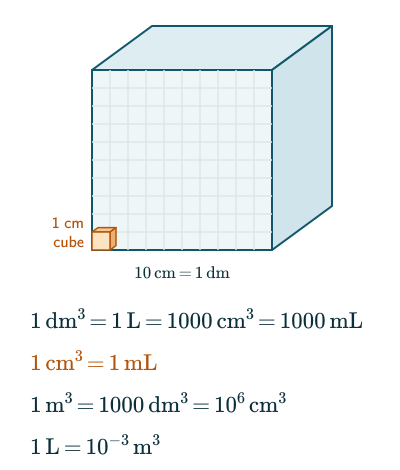
Volume is the space a substance occupies, with units of (length). The SI unit is the cubic metre, m, but chemists use the smaller cm and dm (NCERT Section 1.3.5, page 9).
A common unit, litre (L) which is not an SI unit, is used for measurement of volume of liquids.
NCERT Chemistry Part I (Class 11), Section 1.3.5, page 9
In the laboratory, volumes of liquids are measured with a graduated cylinder, burette or pipette. A volumetric flask is used to make up a known volume of a solution (NCERT Fig. 1.7, page 10).
Density
Density of a substance is its amount of mass per unit volume.
NCERT Chemistry Part I (Class 11), Section 1.3.6, page 10
Density
The SI unit is kg m. In kg m everyday densities are large numbers (water is about 1000 kg m), so chemists usually give density in g cm (page 10); 1 g cm = 1000 kg m.
NCERT adds that a higher density means the particles are more closely packed (page 10). That holds for one substance in different states, such as liquid water and steam. Between different substances, density also depends on how heavy each particle is. For example, mercury’s high density (about 13.6 g cm) reflects both atomic mass and atomic spacing; atomic mass alone does not determine density.
Temperature
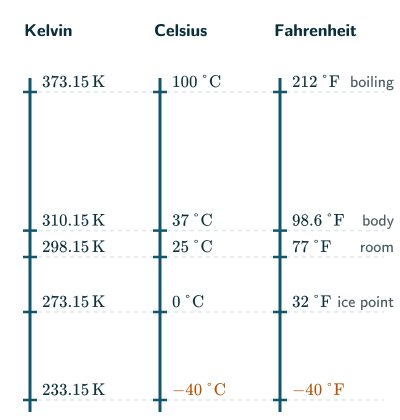
Three scales are in common use: degree Celsius (°C), degree Fahrenheit (°F) and kelvin (K). The kelvin is the SI unit (NCERT Section 1.3.7, page 10). On the Celsius scale water freezes at 0° and boils at 100° (at 1 atm); on the Fahrenheit scale the same two points are 32° and 212°.
Converting temperatures
For the ordinary thermal states studied here, temperatures can be negative in Celsius but cannot fall below 0 K, absolute zero (page 10). The kelvin has no degree sign: write 298.15 K, not 298.15 °K. More on the scales is in measuring temperature.
Solved examples
Example 1: Physical or chemical?
Is each a physical or a chemical property? (a) the boiling point of ethanol; (b) iron rusts in moist air; (c) copper sulphate crystals are blue; (d) methane burns in air; (e) the density of mercury; (f) sodium reacts with water.
Ask: can it be observed without turning the substance into something else? (a) Yes: physical. (b) Rusting makes a new substance: chemical. (c) Physical. (d) Burning makes CO2 and water: chemical (combustibility). (e) Physical. (f) Chemical (reactivity).
Answer: physical (a), (c), (e); chemical (b), (d), (f).
Example 2: Converting temperatures
Convert (a) the human body temperature, 37 °C, to °F and K; (b) a room temperature of 77 °F to °C and K. (c) At what temperature do the Celsius and Fahrenheit scales give the same reading?
(a) °F = (9/5) × 37 + 32 = 66.6 + 32 = 98.6 °F; K = 37 + 273.15 = 310.15 K.
(b) Rearranging, °C = (5/9)(°F − 32) = (5/9) × 45 = 25 °C; K = 25 + 273.15 = 298.15 K.
(c) Put °F = °C = x: x = (9/5)x + 32, so −(4/5)x = 32 and x = −40.
Answer: (a) 98.6 °F, 310.15 K; (b) 25 °C, 298.15 K; (c) −40 °C = −40 °F.
Example 3: Density in two units
A 25.0 cm sample of a liquid has a mass of 19.7 g. Find its density in g cm and in kg m, and the volume of 1.00 kg of it.
Density = 19.7 g/25.0 cm = 0.788 g cm. Since 1 g cm = (10 kg)/(10 m) = 1000 kg m, this is 788 kg m.
Volume of 1.00 kg = 1000 g/0.788 g cm ≈ 1269 cm ≈ 1.27 L.
Answer: 0.788 g cm = 788 kg m; 1.00 kg fills about 1.27 L.
Example 4: Pressure of the air in pascals (NCERT Exercise 1.13, page 26)
The mass of air above each square centimetre at sea level is 1034 g. Taking g = 9.8 m s, find the pressure in pascals (1 Pa = 1 N m).
Force on 1 cm = weight of 1.034 kg = 1.034 × 9.8 ≈ 10.13 N. Area = 1 cm = 10 m.
Pressure = 10.13 N/10 m ≈ 1.01 × 10 Pa.
Answer: the unrounded result is 1.01332 × 10 Pa, or 1.0 × 10 Pa to two significant figures, limited by g = 9.8 m s. This is approximately normal atmospheric pressure.
Common mistakes to avoid
Common mistake
Calling a change of state a chemical property
Melting and boiling do not change what the substance is: ice, water and steam are all H2O. Melting point and boiling point are physical properties.
Common mistake
Writing degrees on the Kelvin scale
It is 300 K (“300 kelvin”), not 300 °K. And the symbol is a capital K; a small k is the Boltzmann constant.
Common mistake
Adding 273.15 or 32 to a temperature change
A rise of 10 °C is a rise of 10 K but of 18 °F. A temperature change in K equals the change in °C, and a change in °F is (9/5) times the change in °C. The 273.15 and the 32 apply only to temperatures, not to differences.
Common mistake
Using mass and weight as the same thing
A beam balance (NCERT Fig. 1.5) compares masses, which do not change from place to place; a spring balance measures weight. Weight is a force, mass × g, measured in newtons, and it is smaller on the Moon.
Common mistake
Taking the litre for an SI unit
The litre is accepted alongside SI but is not an SI unit. The SI unit of volume is m; 1 L = 1 dm = 10 m.
Quick revision summary
- Physical properties are observed without changing the substance; chemical properties need a chemical change.
- A measurement is a number with a unit. SI has seven base units, each now fixed by an exact defining constant: m, kg, s, A, K, mol, cd.
- Mass is the amount of matter and does not change; weight is the pull of gravity and does.
- Volume: SI unit m; 1 L = 1 dm = 1000 cm = 1000 mL.
- Density = mass/volume; SI unit kg m, often g cm.
- Temperature: °F = (9/5)(°C) + 32 and K = °C + 273.15. Kelvin readings are never negative.
Formula sheet
- density = mass/volume (kg m; 1 g cm = 1000 kg m)
- °F = (9/5)(°C) + 32
- K = °C + 273.15
- 1 L = 1 dm = 1000 cm = 1000 mL = 10 m
- 1 kg = 1000 g
- weight = mass × g (in newtons)
Questions students ask
What is the difference between a physical change and a chemical change?
A physical change alters the form or state of a substance without making a new substance, while a chemical change produces one or more new substances with different properties. Melting wax, dissolving sugar in water and drawing copper into wire are physical changes; burning paper, cooking an egg and the souring of milk are chemical changes. Most physical changes are easily reversed, but reversibility is not the test: the test is whether a new substance forms.
What are intensive and extensive properties?
An extensive property depends on the amount of substance, while an intensive property does not: mass, volume and heat capacity are extensive, and density, temperature, boiling point and colour are intensive. Cut a 10 g piece of copper in half and each half has half the mass and half the volume, but the same density, 8.96 g cm. The ratio of two extensive properties, such as mass/volume, is intensive, which is why density helps characterise a substance, although density alone does not uniquely identify it; the same halving test appears in physics as extensive and intensive variables.
What is the difference between density and relative density (specific gravity)?
Density is mass per unit volume and has a unit (kg m or g cm), while relative density, also called specific gravity, is the density of a substance divided by the density of water at 4 °C, a ratio with no unit. Because water at 4 °C has a density of 1.000 g cm (1000 kg m), the relative density has the same number as the density in g cm: iron, at 7.87 g cm, has a relative density of 7.87. A solid that does not dissolve in water, or a liquid that does not mix with it, floats on water if its relative density is below 1, as most oils do.
Is the density of water exactly 1 g cm?
The density of water rounds to 1.000 g cm (1000 kg m) near 4 °C, where it is greatest; at 25 °C it is 0.997 g cm, and ice, at 0.917 g cm, floats on it. Below 4 °C water expands again as it cools, the anomalous expansion of water. Taking 1 g mL, so that 1 L of water has a mass of 1 kg, is an approximation good to about 0.3% at room temperature.
Practice questions
Try each question first, then open the answer to check your working.
-
Q1. Classify as physical or chemical properties: the odour of ammonia; the melting point of ice; the combustibility of petrol; the acidity of vinegar.
Show answerHide answer
Physical: odour, melting point. Chemical: combustibility, acidity.
-
Q2. Convert 25 °C to kelvin and to degrees Fahrenheit.
Show answerHide answer
K = 25 + 273.15 = 298.15 K. °F = (9/5) × 25 + 32 = 45 + 32 = 77 °F.
-
Q3. A block of aluminium has a mass of 54 g and a volume of 20 cm. Find its density in g cm and kg m.
Show answerHide answer
54/20 = 2.7 g cm = 2700 kg m.