Acceleration due to gravity
NCERT Class 11 Physics Chapter 7 Section 7.5
Quick answer
The acceleration due to gravity at the Earth’s surface is g = GME/RE2, where ME and RE are the Earth’s mass and radius and G is the gravitational constant; it is about 9.8 m s−2 and the same for every falling body. It follows from treating the Earth as concentric shells, which pull an outside point as if all the mass were at the centre. Measuring g gives the Earth’s mass, ME = gRE2/G, about 6 × 1024 kg.
With your textbook
NCERT Physics Part I (Class 11), Chapter 7 “Gravitation”, Section 7.5 “Acceleration due to gravity of the earth”, pages 132–133.
Open the official NCERT chapter (PDF, 1.8 MB, ncert.nic.in) (opens in a new tab)
Checked against the 2026-27 reprint on .
What is the acceleration due to gravity?
Acceleration due to gravity in NCERT’s words
The acceleration experienced by the mass m, which is usually denoted by the symbol g is related to F by Newton’s 2nd law by relation F = mg.
NCERT Physics Part I (Class 11), Section 7.5, page 133
In plain words: the acceleration due to gravity, g, is the acceleration of a body falling freely near the Earth, with only the Earth’s pull acting on it. Picturing the Earth as a stack of concentric shells lets us use the two shell results from the universal law of gravitation (NCERT Section 7.3) to find g from the Earth’s mass and radius:
Acceleration due to gravity at the surface
Here ME is the Earth’s mass, RE its radius and G the gravitational constant. g is about 9.8 m s, and it does not depend on the mass of the falling body.
The Earth as a sphere of concentric shells
The earth can be imagined to be a sphere made of a large number of concentric spherical shells with the smallest one at the centre and the largest one at its surface.
NCERT Physics Part I (Class 11), Section 7.5, page 132
By the two shell results of the universal law of gravitation, a uniform spherical shell pulls a point outside it as if all its mass were at its centre, and pulls a point inside it not at all. Apply this to the Earth, shell by shell, treating the Earth as spherically symmetric.
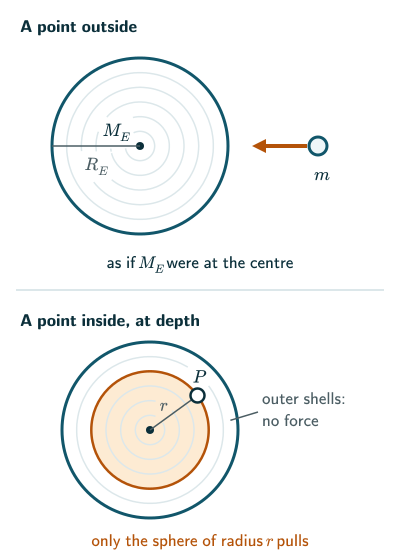
A point outside or on the surface. It is outside (or, at the surface, on) every shell, so every shell pulls as if its mass were at the common centre. The shells together make up the whole Earth:
Hence, at a point outside the earth, the gravitational force is just as if its entire mass of the earth is concentrated at its centre.
NCERT Physics Part I (Class 11), Section 7.5, page 132
A point inside. At a point P a distance r from the centre, the shells of radius greater than r have P inside them, so they pull nothing. The shells of radius r or less form a sphere with P on its surface, which pulls as if its mass Mr were at the centre. So the force on a mass m at P is GmMr/r. If the Earth had uniform density, Mr would be MEr/RE3, and
Force at distance r inside a uniform Earth
The force falls steadily to zero at the centre. How g changes with height and depth is the subject of the next topic.
g in terms of the mass and radius of the Earth
On the surface, r = RE, and the force on a mass m is
By Newton’s second law, F = mg, so g = F/m = GME/RE2. Three things follow:
- The mass m cancels: every body falls with the same acceleration (ignoring air), as Galileo found.
- The weight of a body is mg = GMEm/RE2, the Earth’s pull on it.
- The same formula gives the surface gravity of any spherical planet or moon: g = GM/R, with its own M and R.
Writing ME = (4/3)πRE3ρ, with ρ the mean density, gives another useful form (a step beyond NCERT):
g in terms of density
So two planets of the same density have surface gravity in proportion to their radii.
The value of g actually measured varies a little over the Earth: the Earth is slightly flattened and it spins, so g is about 9.78 m s at the equator and about 9.83 m s at the poles (beyond NCERT). NCERT treats the Earth as a uniform, non-rotating sphere, which is what this page does too.
Mass of the Earth from g
Acceleration g is readily measurable.
NCERT Physics Part I (Class 11), Section 7.5, page 133
The Earth’s radius is known, and Cavendish’s experiment gave G. Rearranging g = GME/RE2:
Mass of the Earth
With g = 9.8 m s, RE = 6.37 × 10 m and G = 6.67 × 10 N m kg, this gives about 5.96 × 10 kg (Example 1). That is why, as NCERT notes, Cavendish is popularly said to have weighed the Earth.
Solved examples
Example 1: Weighing the Earth
Find the mass and the mean density of the Earth, with g = 9.8 m s, RE = 6.37 × 10 m and G = 6.67 × 10 N m kg.
RE2 is about 4.06 × 10 m, so gRE2 is about 3.98 × 10 m s, and
The Earth’s volume is (4/3)πRE3, about 1.08 × 10 m, so the mean density is about (5.96 × 10)/(1.08 × 10), that is 5.5 × 10 kg m.
Answer: about 5.96 × 10 kg and 5.5 × 10 kg m. Surface rocks are only about half as dense, so the Earth’s interior must be much denser than its crust.
Example 2: Gravity on the Moon
The Moon has mass 7.35 × 10 kg and radius 1.74 × 10 m. Find the acceleration due to gravity on its surface, and the weight there of an astronaut of mass 60 kg. Take G = 6.67 × 10 N m kg.
GM is about 4.90 × 10 m s and R about 3.03 × 10 m, so
The astronaut’s weight is 60 × 1.62, about 97 N, against 60 × 9.8 = 588 N on the Earth.
Answer: about 1.62 m s, roughly one-sixth of g; the weight is about 97 N, though the mass is still 60 kg.
Example 3: A planet twice the size
A planet has the same mean density as the Earth but twice its radius. Compare its surface gravity with the Earth’s. What if instead it had twice the Earth’s mass and twice its radius?
With equal density, g = (4/3)πGρ R is proportional to R, so the first planet has 2g. For the second, g = GM/R gives 2/2 = ½ times the Earth’s g.
Answer: 2g (about 19.6 m s) for the first; g/2 (about 4.9 m s) for the second.
Common mistakes to avoid
Common mistake
Thinking heavier bodies fall faster
g = GME/RE2 contains no mass of the falling body. In a vacuum a feather and a stone fall together.
Common mistake
Confusing g with G
g (about 9.8 m s here) depends on the planet and on the place; G (6.67 × 10 N m kg) is the same everywhere.
Common mistake
Confusing mass and weight
Mass, in kg, is the same on the Moon as on the Earth; weight, mg, in newtons, changes with g.
Common mistake
Taking a 1% change in R as a 1% change in g
With M fixed, g = GM/R changes by about −2 times the fractional change in R: if R shrinks by 1%, g rises by about 2%. In general Δg/g ≈ ΔM/M − 2ΔR/R for small changes.
Common mistake
Using GM/r inside the Earth
Below the surface only the mass inside radius r pulls. Using the whole ME with a smaller r would make gravity grow towards the centre, when in fact, for a uniform Earth, it falls in proportion to r.
Quick revision summary
- The Earth can be treated as concentric shells: outside it, it pulls as if all its mass were at its centre.
- At a point inside, only the sphere of radius r below the point pulls; for a uniform Earth the force is proportional to r.
- At the surface, g = GME/RE2 ≈ 9.8 m s, the same for all falling bodies.
- In terms of density, g = (4/3)πGρR.
- Measuring g, with RE and G known, gives the Earth’s mass, about 6 × 10 kg.
Formula sheet
- g = GME/RE2 (surface)
- g = (4/3)πGρRE
- ME = gRE2/G
- F(r) = GmME r/RE3 (inside a uniform Earth)
- W = mg
Questions students ask
What is the SI unit and dimensional formula of acceleration due to gravity?
The SI unit of the acceleration due to gravity is m s, and its dimensional formula is [M L T], as for any acceleration. It can also be written N kg, the pull of gravity per kilogram, since 1 N kg = 1 m s. At the Earth’s surface g ≈ 9.8 m s, which is 980 cm s in CGS units and about 32 ft s in FPS units.
Is acceleration due to gravity a vector, and is it negative when a body moves up?
The acceleration due to gravity is a vector: near the Earth it points vertically down, towards the Earth’s centre, with size g ≈ 9.8 m s, whether the body is moving up, moving down or momentarily at rest at the top. The symbol g stands for this size, a positive number; a minus sign in an equation comes only from the choice of axes. With upwards taken as positive, a ball thrown up has a = −g on the way up and on the way down, air resistance ignored.
What is the difference between acceleration due to gravity and gravitational field strength?
The gravitational field strength at a point is the gravitational force per unit mass on a body placed there, in N kg, while the acceleration due to gravity is the acceleration that body has when gravity alone acts on it, in m s. By Newton’s second law the two are equal in size and direction, GME/r at a point outside the Earth a distance r from its centre, when the small effect of the Earth’s rotation is ignored. So they are one quantity defined in two ways, as a force per unit mass and as an acceleration.
What does the value of g depend on?
The value of g depends on the mass and radius of the planet and on where the body is: at the surface g = GM/R, so of two planets with the same radius the more massive has the larger g, and of two with the same mass the larger has the smaller g. On the Earth, g falls with height above the surface and, for a uniform Earth as NCERT assumes, with depth below it; it is also slightly smaller at the equator than at the poles, because the Earth spins and bulges at the equator. It does not depend on the mass, size or material of the falling body.
Practice questions
Try each question first, then open the answer to check your working.
-
Q1. Mars has mass 6.42 × 10 kg and radius 3.39 × 10 m. Find the acceleration due to gravity at its surface. Take G = 6.67 × 10 N m kg.
Show answerHide answer
g = GM/R = 6.67 × 10 × 6.42 × 10/(3.39 × 10). The top is about 4.282 × 10 m s and the bottom about 1.149 × 10 m, so g is about 3.73 m s, roughly 38% of the Earth’s.
-
Q2. If the Earth shrank to half its present radius with no change of mass, what would g at its surface become?
Show answerHide answer
g ∝ 1/R, so it would become 4 times as large, about 39 m s.
-
Q3. A body weighs 98 N on the Earth’s surface. What is its mass, and what would it weigh on the Moon, where g is about 1.62 m s?
Show answerHide answer
m = 98/9.8 = 10 kg. On the Moon it would weigh 10 × 1.62, about 16.2 N.