Universal law of gravitation
NCERT Class 11 Physics Chapter 7 Section 7.3
Quick answer
Newton’s universal law of gravitation says that any two point masses m and m attract each other with a force F = Gmm/r, along the line joining them, where r is the distance between them and G is the universal gravitational constant. The forces on the two bodies are equal and opposite. A uniform spherical shell attracts an outside mass as if all its mass were at its centre, and exerts no net force on a mass inside it.
With your textbook
NCERT Physics Part I (Class 11), Chapter 7 “Gravitation”, Section 7.3 “Universal law of gravitation”, pages 129–131.
Open the official NCERT chapter (PDF, 1.8 MB, ncert.nic.in) (opens in a new tab)
Checked against the 2026-27 reprint on .
What is the universal law of gravitation?
Newton’s law of gravitation
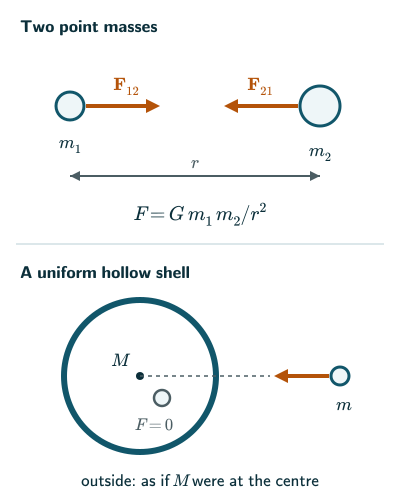
Every body in the universe attracts every other body. The force is proportional to the product of their masses and inversely proportional to the square of the distance between them (NCERT Physics Part I (Class 11), Section 7.3, page 130). For two point masses m1 and m2 a distance r apart,
These are Newtonian results for ordinary positive masses. The point-mass expression also applies exactly to two non-overlapping spherically symmetric bodies; arbitrary extended shapes require a sum over their mass elements.
In plain words: any two masses pull on each other. Double either mass and the pull doubles; double the distance and it drops to a quarter. The constant G, the universal gravitational constant, is the same everywhere. Its value, 6.67 × 10 N m kg, first found from Cavendish’s experiment, is the subject of the next topic. Because G is so small, the pull between everyday objects is far too weak to notice, while the pull of a body as massive as the Earth holds us on the ground and the Moon in its orbit.
The law is universal: the same force that makes an apple fall keeps the Moon going round the Earth and the planets round the Sun. NCERT notes that the statement is essentially from Newton’s Principia (Mathematical Principles of Natural Philosophy).
How Newton reached it: the Moon test
The Moon moves round the Earth in a near-circle of radius Rm ≈ 3.84 × 10 m, once every T ≈ 27.3 days. Its centripetal acceleration is
where V = 2πRm/T is the Moon’s speed. This works out to about 2.7 × 10 m s, far less than g at the Earth’s surface. Newton’s guess was that the Earth’s pull falls off as the inverse square of the distance from the Earth’s centre: then am ∝ 1/Rm2 and g ∝ 1/RE2 (an apple at the surface is RE from the centre), so
where RE is the Earth’s radius, and with g ≈ 9.8 m s the two sides agree (Example 2). One force, falling off as 1/r, explains both the apple and the Moon. The same law, applied to the planets, explains Kepler’s laws.
The law in vector form
On this page, as in NCERT, a vector is written in bold, F, and its magnitude in italics, F. Let r1 and r2 be the positions of two point masses, r = r2 − r1 the vector from m1 to m2, and the unit vector along it. The force on m2 due to m1 points back towards m1, along −:
Newton’s law of gravitation (vector form)
The force on m1 due to m2 is −F, equal and opposite, as Newton’s third law requires. Writing F12 for the force on m1 due to m2, and F21 for the force on m2 due to m1, as NCERT does, F12 = −F21. The Earth pulls an apple down, and the apple pulls the Earth up just as hard; the Earth’s huge mass makes its acceleration negligible.
Several masses: superposition. The law is for point masses. When several masses act on one, the total force is the vector sum of the forces from each, each found as if the others were absent. NCERT Example 7.2 is a neat case (Example 3 below).
Force due to a uniform spherical shell
Real bodies are not points. For an extended body each of its bits pulls in a slightly different direction, and the pulls must be added as vectors, which needs calculus. For a uniform spherical shell the answer is simple, and NCERT quotes the two results:
(1) The force of attraction between a hollow spherical shell of uniform density and a point mass situated outside is just as if the entire mass of the shell is concentrated at the centre of the shell.
NCERT Physics Part I (Class 11), Section 7.3, page 131
Why: the pulls of different parts of the shell have components along the line to the centre and across it. The cross components cancel in pairs, so the force points along the line to the centre. Adding the pulls with calculus gives its size, GMm/r, where M is the shell’s mass, m the point mass and r its distance from the centre.
(2) The force of attraction due to a hollow spherical shell of uniform density, on a point mass situated inside it is zero.
NCERT Physics Part I (Class 11), Section 7.3, page 131
Why: a point inside is pulled by the near part of the shell (less mass, but closer) and the far part (more mass, but farther away), and the pulls cancel exactly for an inverse-square force.
A solid sphere of uniform density, or one whose density depends only on the distance from its centre, is a set of concentric shells. So for a point outside it, its whole mass acts as if at its centre. That is why the Earth can be treated as a point mass at its centre when finding its pull on an apple or a satellite. Inside the Earth the outer shells pull nothing, which is the key to the variation of gravity with depth (three topics on).
Solved examples
Example 1: How strong is gravity between everyday bodies?
Find the gravitational force between two students of mass 50 kg each, standing 1 m apart, and compare it with the force between the Earth (5.97 × 10 kg) and the Moon (7.35 × 10 kg), 3.84 × 10 m apart. Take G = 6.67 × 10 N m kg.
Treating the students as point masses, F = Gm1m2/r = 6.67 × 10 × 50 × 50/1, about 1.7 × 10 N.
For the Earth and the Moon, the top line GMEMM is 6.67 × 10 × 5.97 × 10 × 7.35 × 10, about 2.93 × 10, and r = (3.84 × 10), about 1.47 × 10 m. So
Answer: about 1.7 × 10 N between the students, far too small to feel, and about 2.0 × 10 N between the Earth and the Moon, about 10 times larger.
Example 2: The Moon test
Check Newton’s argument with Rm = 3.84 × 10 m, T = 27.3 days, RE = 6.37 × 10 m and g = 9.8 m s.
T = 27.3 × 86 400 s, about 2.36 × 10 s, so T is about 5.56 × 10 s. The top line 4πRm is about 1.52 × 10 m, so
Then g/am ≈ 9.8/0.00272, about 3600, while (Rm/RE) = (60.28), about 3630.
Answer: the two ratios agree to about 1%, as an inverse-square force predicts.
Example 3: Masses at the corners of a triangle
This is NCERT Example 7.2 (pages 130–131). Three equal masses m are fixed at the corners of an equilateral triangle ABC, and a mass 2m is at its centroid G, with AG = BG = CG = 1 m. Find the force on 2m (a) as it is and (b) when the mass at A is doubled.
Here italic G is the gravitational constant and plain G the centroid.
(a) Each corner pulls 2m with a force of size G × m × 2m/1 = 2Gm, towards that corner. The three directions are 120° apart, so by symmetry the three equal forces add to zero.
(b) Doubling the mass at A adds one more mass m at A. Its pull on 2m is 2Gm, towards A; everything else still cancels.
Answer: (a) zero; (b) 2Gm, directed from G towards A (with m in kilograms, the force is in newtons).
Common mistakes to avoid
Common mistake
Measuring r from the surfaces
For non-overlapping spherically symmetric bodies, r is the distance between their centres. For a satellite at height h, r = RE + h, not h.
Common mistake
Thinking the heavier body pulls harder
The Earth pulls the apple exactly as hard as the apple pulls the Earth. The forces are equal; the accelerations differ, because the masses do.
Common mistake
Adding the forces from several masses as numbers
Gravitational forces are vectors. Add them with their directions, as in Example 3.
Common mistake
Thinking a third body or a medium changes the pull between two masses
Gravity cannot be screened. A third body nearby adds its own force (superposition) but does not change Gm1m2/r between the first two, and the force is the same in air, water or a vacuum.
Common mistake
Using the point-mass formula for any extended body
Gm1m2/r is exact for point masses and for non-overlapping spherically symmetric bodies. For other shapes, such as a rod or a ring, add the pulls of the parts.
Common mistake
Thinking there is no gravity inside a shell because there is no mass there
The shell’s mass is there, around the point; its pulls cancel. Inside a solid, spherically symmetric sphere the enclosed mass generally produces a nonzero force away from the centre; at the centre the net force is zero by symmetry.
Quick revision summary
- Two point masses (or non-overlapping spherically symmetric bodies) attract each other with a force F = Gm1m2/r, along the line joining them; G is universal.
- The forces on the two bodies are equal and opposite (third law).
- Newton tested the inverse square law with the Moon: its acceleration is about 1/3600 of g, and it is about 60 Earth radii away.
- For several masses, add the forces as vectors (superposition).
- A uniform spherical shell pulls an outside point as if its mass were at its centre, and an inside point not at all; so a uniform sphere acts on outside points as a point mass at its centre.
Formula sheet
- F = Gmm/r (point masses or non-overlapping spherical bodies)
- F = −G(mm/r) r̂ (vector form, force on m)
- F = −F (as vectors)
- am = 4π2Rm/T2 (the Moon)
- g/am = Rm2/RE2 ≈ 3600
Questions students ask
Why is Newton’s law of gravitation called universal?
Newton’s law of gravitation is called universal because the same law, with the same constant G, applies to every pair of bodies in the universe, whatever they are made of and wherever they are. Newton showed that the pull that makes an apple fall also keeps the Moon in its orbit, and that the Sun’s inverse-square pull explains the orbits of all the planets. Over a century later, Cavendish measured the same attraction between lead spheres in a laboratory.
What is the difference between gravitational force and electrostatic force?
Gravitational and electrostatic forces both fall off as 1/r between point bodies, but gravity acts between masses and only attracts, while the electrostatic force acts between charges and can attract or repel. Gravity is far weaker: in a hydrogen atom the electric attraction between the electron and the proton is about 2.3 × 10 times their gravitational attraction. Gravity is also the same whatever lies between the bodies, while the electrostatic force between charges is reduced when they are placed in a medium such as water.
Why is the gravitational force always attractive?
In Newtonian gravitation, the force between ordinary positive masses is always attractive. This is a property of the law, rather than something proved merely by saying that masses are positive; unlike electric charges, ordinary masses do not come in observed positive and negative varieties. This is also why gravity, the weakest of the fundamental forces, governs planets, stars and galaxies: in a large body the pulls of all its parts add up, while its positive and negative charges very nearly cancel.
What is the difference between gravitational force and weight?
Gravitational force is the attraction between any two masses, F = Gm1m2/r, while weight is one particular gravitational force: the pull of the Earth (or of another planet or moon) on a body near it, W = mg. So every weight is a gravitational force, but the pull between two books, or between the Sun and the Earth, is not called a weight. In everyday speech “gravity” usually means this pull of the Earth.
Practice questions
Try each question first, then open the answer to check your working.
-
Q1. The gravitational force between two point masses is F. What does it become if (a) the distance between them is halved, (b) each mass is doubled and the distance is doubled?
Show answerHide answer
(a) 4F, because F ∝ 1/r. (b) F: the masses multiply the force by 4, and the doubled distance divides it by 4.
-
Q2. Point masses of 5 kg and 10 kg are 2 m apart. Find the net gravitational force on a 2 kg mass placed midway between them. Take G = 6.67 × 10 N m kg.
Show answerHide answer
Each is 1 m away. The 10 kg mass pulls with 6.67 × 10 × 10 × 2 = 1.33 × 10 N and the 5 kg mass with 6.67 × 10 N, in the opposite direction. The net force is about 6.67 × 10 N, towards the 10 kg mass.
-
Q3. A small mass is placed somewhere inside a uniform hollow spherical shell, not at its centre. What gravitational force does the shell exert on it?
Show answerHide answer
None. A uniform shell exerts zero net gravitational force on a mass anywhere inside it, not only at the centre.