The gravitational constant
NCERT Class 11 Physics Chapter 7 Section 7.4
Quick answer
The gravitational constant G is the universal constant in Newton’s law of gravitation, F = Gmm/r, with the rounded value 6.67 × 10 N m kg and dimensions [M L T]. Henry Cavendish’s 1798 measurements made it possible to determine G with a torsion balance, in which the pulls of two large lead spheres on two small ones twist a fine wire through a small angle. G is the same everywhere, unlike g, the acceleration due to gravity.
With your textbook
NCERT Physics Part I (Class 11), Chapter 7 “Gravitation”, Section 7.4 “The gravitational constant”, pages 131–132.
Open the official NCERT chapter (PDF, 1.8 MB, ncert.nic.in) (opens in a new tab)
Checked against the 2026-27 reprint on .
What is the gravitational constant?
The gravitational constant in NCERT’s words
The value of the gravitational constant G entering the Universal law of gravitation can be determined experimentally and this was first done by English scientist Henry Cavendish in 1798.
NCERT Physics Part I (Class 11), Section 7.4, page 131
In plain words: G is the number in Newton’s law of gravitation, F = Gm1m2/r, that sets how strong gravity is. It is a universal constant: the same for every pair of bodies, everywhere, whatever lies between them. Newton’s law fixes how gravity depends on mass and distance, but only an experiment can give the size of G.
Value of G
Its smallness is why two people standing side by side feel no pull towards each other. The pull is there, with the two forces equal and opposite as Newton’s third law requires, but for two 60 kg people 1 m apart each force is only about 2 × 10 N.
Units and dimensions of G
From F = Gm1m2/r, G = Fr/(m1m2). So its SI unit is N m kg. Since 1 N = 1 kg m s, this is also m kg s, and its dimensions are
Dimensions of G
In CGS units, G = 6.67 × 10 dyn cm g.
Do not confuse G with g. G is a universal constant; g, the acceleration due to gravity, is about 9.8 m s at the Earth’s surface and changes from place to place and from planet to planet.
Cavendish’s experiment
The equations here use NCERT’s simplified geometry: the nearby-pair forces are perpendicular to the bar, the twist is small, and attractions from the more distant large spheres and the rest of the apparatus are neglected. Precision experiments correct for those extra torques.
The difficulty is that the gravitational force between laboratory-sized bodies is tiny. Cavendish used a torsion balance, which can detect a very small torque.
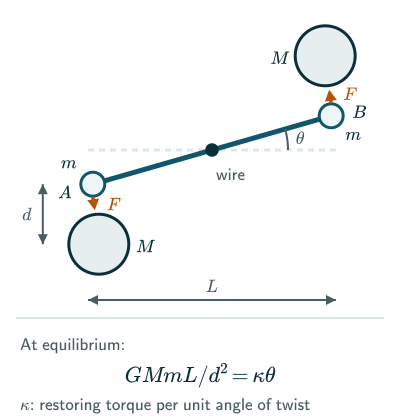
- A light bar AB carries a small lead sphere of mass m at each end. It hangs from a rigid support by a fine wire attached at its middle.
- Two large lead spheres of mass M are brought close to the small ones, on opposite sides, so that each large sphere pulls its neighbouring small sphere with a force F.
- The two forces are equal and opposite, so there is no net force on the bar, only a couple. Each force acts at distance L/2 from the wire, so the torque is F × L, where L is the length of the bar.
- The torque twists the wire until the wire’s restoring torque balances it. The restoring torque is proportional to the angle of twist θ: it equals κθ, where κ (in N m rad) is the restoring torque per unit angle of twist, measured beforehand by applying a known torque. (NCERT writes this constant as τ; on this page κ is used to keep it apart from torque itself.)
Spheres act as if their masses were at their centres, so with d the distance between the centres of a large sphere and its neighbouring small one,
At equilibrium the gravitational torque equals the restoring torque:
Torsion balance at equilibrium
Observation of θ thus enables one to calculate G from this equation.
NCERT Physics Part I (Class 11), Section 7.4, page 132
Rearranged, G = κθd/(MmL). Moving the large spheres to the other side of the small ones reverses the torque, so the bar swings the other way; measuring the whole change in angle, 2θ, doubles the effect and cancels a fixed zero-position offset if the two configurations are symmetric and the apparatus does not drift; it does not remove every experimental error.
The value of G
Since Cavendish’s experiment, the measurement of G has been refined and the currently accepted value is
NCERT Physics Part I (Class 11), Section 7.4, page 132
That is, G = 6.67 × 10 N m kg (NCERT Eq. 7.8). NIST reports the more precise estimate 6.6743 × 10 N m kg; even so, G is known less precisely than most other fundamental constants, because the forces involved are so small and every nearby mass disturbs the measurement.
Cavendish himself presented his result as the mean density of the Earth; the value of G follows from his data. Knowing G is what makes it possible to find the mass of the Earth from g and the Earth’s radius, as the next topic, acceleration due to gravity, shows; that is why Cavendish is popularly said to have “weighed the Earth”.
Solved examples
Example 1: The torque in a torsion balance
In a torsion balance, the large spheres have mass 100 kg and the small ones 1.0 kg, with their centres 0.20 m apart, and the bar is 1.0 m long. Find the force between each pair of spheres and the torque on the bar. Take G = 6.67 × 10 N m kg.
F = GMm/d = 6.67 × 10 × 100 × 1.0/0.20, about 1.67 × 10 N. The torque is FL = 1.67 × 10 × 1.0, about 1.67 × 10 N m.
Answer: about 1.67 × 10 N on each small sphere, and a torque of about 1.67 × 10 N m: a tiny effect, which is why a very fine wire is needed.
Example 2: Finding G from a reading
With the balance of Example 1, the wire’s restoring torque is 5.0 × 10 N m per radian, and the bar turns through θ = 0.0334 rad from its rest position. Find G.
Putting in the numbers, κθd = 5.0 × 10 × 0.0334 × 0.20 (= 0.040), about 6.68 × 10, and MmL = 100 × 1.0 × 1.0 = 100. So G = 6.68 × 10/100 = 6.68 × 10.
Answer: G ≈ 6.68 × 10 N m kg, close to the accepted value.
Example 3: The dimensions of G
Find the dimensions of G from Newton’s law.
G = Fr/(m1m2). Force has dimensions [M L T], r has [L] and m1m2 has [M]. So [G] = [M L T][L]/[M] = [M L T].
Answer: [M L T], so G can be given in m kg s as well as in N m kg.
Common mistakes to avoid
Common mistake
Mixing up G and g
G = 6.67 × 10 N m kg is the same everywhere. g ≈ 9.8 m s is the acceleration due to gravity at the Earth’s surface and varies from place to place.
Common mistake
Thinking G depends on the medium or the bodies
G does not change with the material of the bodies or with what lies between them. Gravity cannot be screened.
Common mistake
Using F × L/2 for the torque
Each of the two forces acts at L/2 from the wire, so together they give a couple of moment F × L, not F × L/2.
Common mistake
Measuring d from the surfaces of the spheres
In F = GMm/d, d is the distance between the centres of the two spheres.
Quick revision summary
- G is the universal constant in Newton’s law of gravitation, F = Gmm/r; its value rounded as in NCERT is 6.67 × 10 N m kg.
- Its unit can also be written m kg s, and its dimensions are [M L T].
- Henry Cavendish first measured it, in 1798, with a torsion balance: the pulls of two large spheres on two small ones form a couple that twists a fine wire.
- At equilibrium GMmL/d = κθ, where κ is the restoring torque per unit twist; measuring θ gives G.
- G is tiny, so gravity between everyday objects is far too weak to notice.
Formula sheet
- G = 6.67 × 10 N m kg
- [G] = [M L T]
- G(Mm/d) L = κθ (torsion balance)
- G = κθd/(MmL)
Questions students ask
What is the difference between G and g?
G and g are different kinds of quantity: G, the universal gravitational constant, is a scalar constant measured in N m kg, while gravitational acceleration is a vector measured in m s; the symbol g usually denotes its positive magnitude. In the spherical, non-rotating model its direction is towards the planet’s centre. At a planet’s surface they are linked by g = GM/R, so g depends on the planet’s mass M and radius R, and changes with height, depth and latitude, while G is the same everywhere. G needs a delicate torsion balance to measure; g can be found with a simple pendulum or a falling body.
What is the value of G in CGS units?
In CGS units the gravitational constant is G = 6.67 × 10 dyn cm g, which is the same as cm g s. To convert from SI, use 1 N = 10 dyn, 1 m = 10 cm and 1 kg = 10 g: the factor is 10 × 10 × 10 = 10, so 6.67 × 10 becomes 6.67 × 10. The number changes with the units because G is a dimensional constant, not a pure number like π.
What did Cavendish’s experiment actually measure?
Cavendish’s experiment of 1798 measured the tiny twist that attraction between lead spheres gave a torsion balance. He reported the result as the mean density of the Earth, as the title of his Royal Society paper, Experiments to determine the density of the earth, makes clear. The same measurements can be expressed as a value of G, so the usual textbook description is physically useful but is not how Cavendish presented his result.
Practice questions
Try each question first, then open the answer to check your working.
-
Q1. What is the gravitational force between two 1 kg masses whose centres are 1 m apart?
Show answerHide answer
F = G × 1 × 1/1 = 6.67 × 10 N. Numerically, G is the force in newtons between two 1 kg point masses 1 m apart.
-
Q2. Express the unit of G in terms of the SI base units.
Show answerHide answer
N m kg = (kg m s) m kg = m kg s.
-
Q3. Why did Cavendish place the two large spheres on opposite sides of the bar?
Show answerHide answer
So that their pulls on the two small spheres point in opposite directions and form a couple. The bar then feels a torque but no net force, and it simply twists the wire. With both on the same side, the forces would add to a net force and pull the whole bar sideways instead of turning it.