Dimensional formulae and equations
NCERT Class 11 Physics Chapter 1 Section 1.5
Quick answer
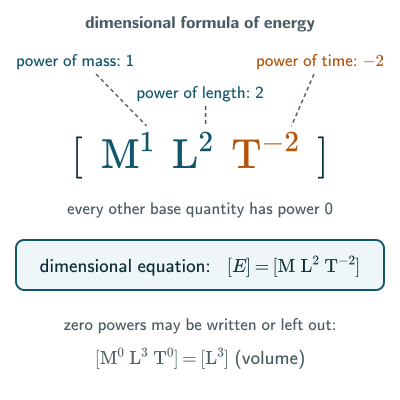
A dimensional formula shows the powers of the base quantities needed to represent a quantity’s dimensions: energy has the formula [M L T]. A dimensional equation equates the dimensions of the quantity to that expression, for example [E] = [M L T]. Derive it from a valid physical relation, dropping dimensionless factors and keeping dimensional constants such as G.
With your textbook
NCERT Physics Part I (Class 11), Chapter 1 “Units and Measurement”, Section 1.5 “Dimensional formulae and dimensional equations”, page 7.
Open the official NCERT chapter (PDF, 1.1 MB, ncert.nic.in) (opens in a new tab)
Checked against the 2026-27 reprint on .
What is a dimensional formula?
Dimensional formula and dimensional equation
- The dimensional formula of a physical quantity shows which base quantities represent it, and with what powers. For energy it is [M L T].
- The dimensional equation of a quantity equates its dimensions to its dimensional formula: [E] = [M L T].
(NCERT Section 1.5, page 7.)
The expression which shows how and which of the base quantities represent the dimensions of a physical quantity is called the dimensional formula of the given physical quantity.
NCERT Physics Part I (Class 11), Section 1.5, page 7
In plain words: a dimensional formula is like a recipe card. It lists the ingredients (mass, length, time and the other base quantities) and how much of each goes in (the powers). The dimensional equation is the statement that a particular quantity follows that recipe. How to find the powers in the first place is shown under dimensions of derived quantities.
Writing a dimensional formula
In mechanics every dimensional formula has the form [Ma Lb Tc], where the powers a, b and c can be positive, negative or zero. Outside mechanics the other base quantities, [A], [K], [cd] and [mol], can appear as well.
NCERT’s examples (page 7):
- volume: [M L T];
- speed or velocity: [M L T];
- acceleration: [M L T];
- mass density: [M L T].
A zero power, such as M, means there is no net mass dimension. It does not prove physical independence from masses: a dimensionless mass ratio can still affect a result. It may be written out, as here, or left out: [M L T] and [L] mean the same. In a few places on page 7 NCERT prints the zero power as a raised circle, as in [M° L T°]; it is a zero, not a degree sign.
Dimensional equations
An equation obtained by equating a physical quantity with its dimensional formula is called the dimensional equation of the physical quantity.
NCERT Physics Part I (Class 11), Section 1.5, page 7
NCERT’s dimensional equations for volume V, speed v, force F and mass density ρ (page 7):
A dimensional equation is obtained from an equation that relates the quantity to others (page 7). For a constant force parallel to a displacement d, take work W = Fd: replace each quantity by its dimensions and multiply,
[W] = [F][d] = [M L T][L] = [M L T].
Pure numbers, such as ½ or 4π, drop out; constants with units, such as G, do not. On page 7 NCERT points to its Appendix 9, which lists the dimensional formulae of many more quantities. These formulae are what dimensional analysis works with: checking equations, deducing relations and converting units.
Dimensional formulae of common quantities
Each row comes from the relation in the middle column. Heat Q and energy E are both [M L T]. In the rows for s, thermal conductivity, kB and R, T is a temperature, [K], not time; in the gas-constant row V is volume and μ the number of moles. The electrical rows use relations from Class 12; they are here because the JEE Main 2027 and NEET (UG) 2026 syllabuses list dimensions of physical quantities and dimensional analysis in Unit 1.
| Quantity | From | Formula |
|---|---|---|
| Angular momentum | mvr | [M L T] |
| Moment of inertia | mr | [M L] |
| Gravitational constant G | Fr/m | [M L T] |
| Surface tension | F/l | [M T] |
| Viscosity η | Fl/(Av) | [M L T] |
| Young’s modulus Y | stress ÷ strain | [M L T] |
| Planck constant h | E/ν | [M L T] |
| Specific heat capacity s | ΔQ/(mΔT) | [L T K] |
| Latent heat | Q/m | [L T] |
| Thermal conductivity | Hx/(AΔT) | [M L T K] |
| Boltzmann constant kB | E/T | [M L T K] |
| Gas constant R | PV/(μT) | [M L T K mol] |
| Charge q | It | [A T] |
| Potential difference V | W/q | [M L T A] |
| Resistance R | V/I | [M L T A] |
| Capacitance C | q/V | [M L T A] |
| Permittivity ε0 | q/(Fr) | [M L T A] |
| Magnetic field B | F/(qv) | [M T A] |
| Magnetic flux | BA | [M L T A] |
| Inductance | flux/I | [M L T A] |
| Permeability μ0 | 2πrB/I | [M L T A] |
Notes on the table:
- The coefficient of viscosity comes from F = ηA(v/l), and Young’s modulus has the dimensions of stress because strain has none.
- The specific heat capacity s = ΔQ/(mΔT) has no mass dimension: the mass in the heat cancels the mass below.
- The Boltzmann constant links energy to temperature: the average translational kinetic energy of a gas molecule is (3/2)kBT (see the kinetic interpretation of temperature), and the number 3/2 drops out.
- Thermal conductivity comes from the rate of heat flow H = KcAΔT/x through a slab of area A and thickness x. Magnetic flux is BA, inductance is flux per unit current, and μ0 comes from the field B = μ0I/(2πr) of a long straight wire.
- The charge is [A T] because current, not charge, is the base quantity. For ε0, Coulomb’s law F = q1q2/(4πε0r) gives ε0 = q1q2/(4πFr), and 4π drops out.
Constants and variables
Quantities fall into four kinds, and the kind decides what appears in a dimensional formula:
- dimensional variables, such as velocity and force: they have dimensions and their values change;
- dimensionless variables, such as angle and strain: no dimensions, but their values change;
- dimensional constants, such as G, h, c and kB: fixed values, but they do have dimensions;
- dimensionless constants, such as 2, π and ½: pure numbers with no dimensions.
Anything dimensionless drops out of a dimensional formula: pure numbers such as 2 and π, and dimensionless variables such as strain or an angle (strain drops out in Example 2). Constants such as the gravitational constant G in the universal law of gravitation carry their dimensions into any formula that contains them. Constants can even be combined into a new quantity (Example 5).
Solved examples
Example 1: The Planck constant
The energy of a photon of frequency ν is E = hν. Write the dimensional formula and the dimensional equation of h, and compare it with angular momentum (mvr).
h = E/ν. [E] = [M L T] and [ν] = [T], so [h] = [M L T]/[T] = [M L T].
[mvr] = [M][L T][L] = [M L T].
Answer: dimensional formula [M L T]; dimensional equation [h] = [M L T], the same as angular momentum.
Example 2: Young’s modulus
Young’s modulus is Y = stress/strain, where stress = force/area and strain = change in length/original length. Find [Y].
[stress] = [M L T]/[L] = [M L T]. [strain] = [L]/[L], dimensionless.
So [Y] = [M L T].
Answer: [M L T], the same as stress and pressure.
Example 3: Specific heat capacity
Heat ΔQ raises the temperature of a mass m by ΔT, with ΔQ = msΔT. Find the dimensional formula of s.
s = ΔQ/(mΔT). Heat is energy, [M L T], and a temperature difference is [K]:
[s] = [M L T]/([M][K]) = [L T K].
Answer: [M L T K], matching the unit J kg K.
Example 4: Potential difference and resistance
Using W = qV for the work done in moving a charge q through a potential difference V, q = It and V = IR, find the dimensional formulae of V and R.
[q] = [A][T] = [A T]. [V] = [W]/[q] = [M L T]/[A T] = [M L T A].
[R] = [V]/[I] = [M L T A]/[A] = [M L T A].
Answer: [V] = [M L T A] and [R] = [M L T A].
Example 5: A length made of constants
Show that √(hG/c), built from the Planck constant, the gravitational constant and the speed of light, has the dimensions of length.
[hG] = [M L T][M L T] = [L T]. [c] = [L T] = [L T].
[hG/c] = [L T]/[L T] = [L], and its square root is [L].
With h = 6.63 × 10 J s, G = 6.67 × 10 N m kg and c = 3.00 × 10 m s:
hG/c = (4.42 × 10)/(2.70 × 10)
= 1.64 × 10 m = 16.4 × 10 m,
so √(hG/c) ≈ 4.0 × 10 m.
Answer: it is a length, about 4 × 10 m. With ħ = h/2π in place of h it becomes the Planck length, about 1.6 × 10 m: the pure number 2π changes the value, not the dimensions.
Common mistakes to avoid
Common mistake
Writing units instead of dimensions
[kg m s] is a unit, not a dimensional formula. The dimensional formula of force is [M L T].
Common mistake
Forgetting that heat is energy
In s = ΔQ/(mΔT), heat has dimensions [M L T]. Treating heat as dimensionless gives [M K], which is wrong; the correct result is [L T K].
Common mistake
Treating charge as a base quantity
Current is the base quantity, so charge is [A T]. Every electrical formula is written with [A], not with a symbol for charge.
Common mistake
Mixing up quantities with the same symbol
The gas constant R is [M L T K mol] but resistance R is [M L T A]. The Boltzmann constant kB is [M L T K] but a spring constant k is [M T].
Common mistake
Dropping a dimensional constant
Only dimensionless factors (pure numbers, angles, strain) drop out. G, h, c and kB have dimensions and must be kept.
Quick revision summary
- Dimensional formula: which base quantities represent a quantity, and with what powers (NCERT page 7); for example [M L T] for energy.
- Dimensional equation: the dimensions of a quantity set equal to its dimensional formula, [E] = [M L T].
- Zero powers can be written (M) or left out; NCERT’s raised circle in [M°] means M.
- Obtain a dimensional formula from any relation for the quantity; pure numbers drop out, dimensional constants do not.
- Charge is [A T]; heat is energy; temperature is [K].
Formula sheet
- dimensional formula: [Ma Lb Tc]
- dimensional equation: [X] = [Ma Lb Tc]
- [h] = [M L T] (Planck constant; same dimensions as angular momentum)
- [η] = [M L T] (viscosity); [Y] = [M L T] (Young’s modulus)
- [s] = [L T K] (specific heat capacity); [R] = [M L T K mol] (gas constant)
- [q] = [A T] (charge); [V] = [M L T A] (potential difference); [R] = [M L T A] (resistance)
Questions students ask
How do you find a dimensional formula from a quantity’s SI unit?
To find a dimensional formula from an SI unit, write the unit in base units and replace kg by M, m by L and s by T (A, K, mol and cd stay as they are), keeping every power. For example, the electric field is measured in N C, which is kg m s ÷ (A s) = kg m s A, so its dimensional formula is [M L T A]. The same rule run backwards turns a dimensional formula into the base-unit form of the SI unit.
What do A and I stand for in a dimensional formula?
In a dimensional formula, A and I both stand for electric current, the base quantity behind every electrical formula: NCERT writes [A], after the ampere, while the SI and many other books write I. So the dimensional formula of charge, current × time, is [A T] in NCERT and [I T] elsewhere, with the same meaning. Temperature is written [K] in NCERT and Θ elsewhere in the same way.
Does every physical quantity have only one dimensional formula?
Yes, with a fixed set of base quantities each physical quantity has one dimensional formula, whichever correct relation you start from: energy from ½mv, mgh or Fd always comes out as [M L T]. The reverse does not hold, because one dimensional formula can belong to several quantities: [M L T] is also the formula of torque. So a dimensional formula alone cannot identify a quantity.
What is the dimensional formula of a dimensionless quantity?
A dimensionless quantity has the dimensional formula [M L T]: every power is zero. Refractive index, for example, is the speed of light in vacuum divided by its speed in the medium, [L T]/[L T] = [M L T], and the same holds for an angle in radians and for relative density.
What is the easiest way to remember dimensional formulae?
The easiest way to remember dimensional formulae is not to memorise a table but to rebuild each one from a short chain of definitions, starting from force, [M L T]. Work is force × distance, [M L T]; power is work/time, [M L T]; pressure and stress are force/area, [M L T]; and for electricity, charge is current × time, [A T]. Any other quantity then follows from its defining formula, with pure numbers dropped.
Practice questions
Try each question first, then open the answer to check your working.
-
Q1. Write the dimensional formula and the dimensional equation of acceleration.
Show answerHide answer
Dimensional formula [M L T]; dimensional equation [a] = [M L T] (NCERT page 7).
-
Q2. Capacitance is C = q/V. Find its dimensional formula.
Show answerHide answer
[C] = [A T]/[M L T A] = [M L T A].
-
Q3. Sort these into dimensional and dimensionless constants: G, π, c, 2, h.
Show answerHide answer
Dimensional constants: G, c and h. Dimensionless constants: π and 2.