Significant figures
NCERT Class 11 Physics Chapter 1 Section 1.3
Quick answer
Significant figures are the reliable digits of a measurement plus the first uncertain one, so they show how precise it is: 2.308 cm has four. Leading zeros never count, zeros between non-zero digits always do, and trailing zeros count only when there is a decimal point; scientific notation removes any doubt. In multiplication and division keep as many significant figures as the number with the fewest, and in addition and subtraction as many decimal places as the number with the fewest.
With your textbook
NCERT Physics Part I (Class 11), Chapter 1 “Units and Measurement”, Section 1.3 “Significant figures”, pages 3–7.
Open the official NCERT chapter (PDF, 1.1 MB, ncert.nic.in) (opens in a new tab)
Checked against the 2026-27 reprint on .
What are significant figures?
Significant figures
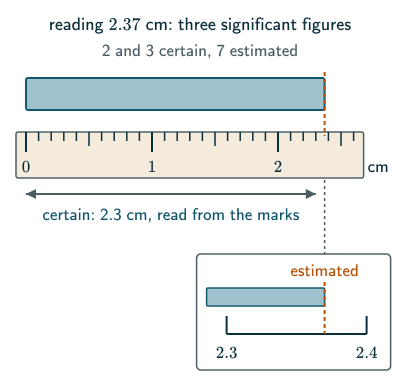
Every measurement has some uncertainty. A result is reported with all the digits that are known reliably plus the first digit that is uncertain; these are its significant figures. Their number shows the precision of the measurement, which depends on the least count of the instrument (NCERT Section 1.3, pages 3–7).
The reliable digits plus the first uncertain digit are known as significant digits or significant figures.
NCERT Physics Part I (Class 11), Section 1.3, page 3
In plain words: if the period of a simple pendulum is measured as 1.62 s, the 1 and the 6 are sure and the 2 is a best guess, so the result has three significant figures. Writing 1.6238 s would claim a precision the stopwatch never had, which is not just pointless but misleading (page 3).
Rules for counting significant figures
A choice of change of different units does not change the number of significant digits or figures in a measurement.
NCERT Physics Part I (Class 11), Section 1.3, page 3
For example, 2.308 cm = 0.02308 m = 23.08 mm = 23 080 µm: all have four significant figures (2, 3, 0, 8). So the position of the decimal point does not matter, and the rules follow (page 4):
- All non-zero digits are significant.
- Zeros between non-zero digits are significant, wherever the decimal point is.
- In a number less than 1, the zeros after the decimal point but before the first non-zero digit are not significant: 0.002308 has four.
- Trailing zeros without a decimal point are not significant: 123 m = 12 300 cm = 123 000 mm has three.
- Trailing zeros with a decimal point are significant: 3.500 and 0.06900 each have four.
- The zero written before the decimal point in a number less than 1, as in 0.1250, is never significant (page 4).
- Exact numbers, such as the 2 in d = 2r or the n in t/n, are not measurements: they have an unlimited number of significant figures (pages 4–5).
The trailing-zero trap. A length of 4.700 m has four significant figures; the zeros were written to show the precision. Converting units gives 4.700 m = 470.0 cm = 4700 mm = 0.004700 km. By the rule above, “4700 mm” seems to have only two, though a change of units cannot change the precision (page 4). (NCERT says “the last number” has trailing zeros with no decimal point; it means 4700 mm, since the last number, 0.004700 km, has a decimal point.)
Scientific notation and order of magnitude
The cure for the trailing-zero trap is to write every measurement as a × 10b, with 1 ≤ a < 10 (page 4). Then
4.700 m = 4.700 × 10 cm = 4.700 × 10 mm = 4.700 × 10 km,
and every zero in a is significant: each has four significant figures. The power of 10 plays no part in counting. (NCERT’s text here refers to “the confusion mentioned in (a) above”; it means observation (2). NCERT also describes a as “between 1 and 10” and lets it be rounded up for values up to and including 10; a is always less than 10, because 10 × 10b is written 1 × 10b+1.)
Order of magnitude. Round a to 1 if a ≤ 5, or to 10 if a > 5. The number becomes a power of 10, and its exponent is the order of magnitude (page 4). The Earth’s diameter, 1.28 × 10 m, is of order 10 m (order of magnitude 7); a hydrogen atom, 1.06 × 10 m, is of order 10 m (−10). So the Earth is about 17 orders of magnitude larger. Watch the round-up: the Earth’s radius, 6.4 × 10 m, has a > 5, so it is of order 10 m, not 10 m. (NCERT, after rounding a up to 10, still writes the number as 10b; strictly it becomes 10b+1, as here.) Some books switch at √10 ≈ 3.16 instead of 5; NCERT uses 5.
Arithmetic with significant figures
A calculated result cannot be more precise than the measurements it comes from (NCERT Section 1.3.1, page 5).
In multiplication or division, the final result should retain as many significant figures as are there in the original number with the least significant figures.
NCERT Physics Part I (Class 11), Section 1.3.1, page 5
A mass of 4.237 g and a volume of 2.51 cm give a density of 1.688047808… g cm on a calculator, but only 1.69 g cm should be reported (three significant figures, set by 2.51). Likewise, the speed of light, 3.00 × 10 m s (three significant figures), times one year, 365.25 d = 3.1558 × 10 s (five), gives the light year as 9.47 × 10 m (three). (NCERT prints the year as 3.1557 × 10 s, which cuts off 31 557 600 s instead of rounding it; the light year is unaffected.)
In addition or subtraction, the final result should retain as many decimal places as are there in the number with the least decimal places.
NCERT Physics Part I (Class 11), Section 1.3.1, page 5
436.32 g + 227.2 g + 0.301 g = 663.821 g, reported as 663.8 g, because 227.2 g is known only to one decimal place. And 0.307 m − 0.304 m = 0.003 m = 3 × 10 m. Do not apply the multiplication rule here: 664 g and 3.00 × 10 m would misstate the precision (page 5).
Rounding off
Results with more than one uncertain digit are rounded (NCERT Section 1.3.2, page 5):
- If the first digit to be dropped is more than 5, raise the preceding digit by 1: 2.746 → 2.75.
- If it is less than 5, leave the preceding digit: 1.743 → 1.74.
- If it is 5 followed by any non-zero digit, the dropped part is more than half, so raise: 2.7451 → 2.75, 12.56 → 13.
- If it is exactly 5 (only zeros after it), leave the preceding digit if it is even and raise it if it is odd: 2.745 → 2.74, but 2.735 → 2.74.
In a multi-step calculation, keep at least one extra digit in intermediate steps, as NCERT recommends (pages 5–7); when using a calculator, retain its unrounded value and round only the final answer. Extra guard digits help when nearly equal quantities are subtracted. Constants can be rounded to suit: c = 2.997 924 58 × 10 m/s is often used as 3 × 10 m/s, and π as 3.14 or 3.142 (pages 5–6).
Uncertainty in calculated results
NCERT Section 1.3.3 (pages 6–7) shows how the uncertainty carries through (the general rules are under combination of errors):
- Products: a sheet measured as l = 16.2 ± 0.1 cm (±0.6%) and b = 10.1 ± 0.1 cm (±1%) has area lb = 163.62 cm ± 1.6% = 163.62 ± 2.6 cm, reported as 164 ± 3 cm: the relative errors add.
- Subtraction can reduce the number of significant figures: 12.9 g − 7.06 g is 5.8 g, not 5.84 g. (NCERT first states that a result combined from data with n significant figures is valid to n significant figures. That is only a rough guide: a difference can lose figures, as here, and a sum can gain one, 9.9 + 0.2 = 10.1.)
- Relative error depends on the number itself: ±0.01 g is ±1% of 1.02 g but only ±0.1% of 9.89 g, though both have three significant figures.
- Keep an extra digit: rounding 1/9.58 to 0.104 and then taking the reciprocal gives 9.62, not 9.58; keeping 0.1044 brings back 9.58 (page 7).
Solved examples
Example 1: A cube (NCERT Example 1.1)
Each side of a cube is measured as 7.203 m. Find its total surface area and volume to the right number of significant figures.
The side has 4 significant figures, so the results get 4.
Area = 6 × (7.203) = 311.299254 m, reported as 311.3 m. Volume = (7.203) = 373.714754 m, reported as 373.7 m.
Answer: 311.3 m and 373.7 m (page 6).
Example 2: A density (NCERT Example 1.2)
5.74 g of a substance occupies 1.2 cm. Find its density.
The mass has 3 significant figures but the volume only 2, so the density gets 2: 5.74/1.2 = 4.783…, reported as 4.8 g cm.
Answer: 4.8 g cm (page 6).
Example 3: How many significant figures?
State the number of significant figures in (a) 0.007050, (b) 6.020 × 10, (c) 3400 (no decimal point), (d) 3400. (the same number with a decimal point written after the last zero), (e) 100.0.
(a) Leading zeros do not count; 7, 0, 5 and the trailing 0 after the decimal point do: 4. (b) 4. (c) Trailing zeros without a decimal point do not count: 2. (d) The decimal point makes the trailing zeros significant: 4. (e) All three zeros trail the 1 in a number with a decimal point, so they count: 4.
Answer: 4, 4, 2, 4, 4. Writing (c) as 3.4 × 10 or 3.400 × 10 removes the doubt.
Example 4: Adding and multiplying
Find (a) 12.11 + 18.0 + 1.012 and (b) 2.51 × 1.2, each to the right precision.
(a) The sum is 31.122; the least number of decimal places is one (18.0), so 31.1.
(b) The product is 3.012; the least number of significant figures is two (1.2), so 3.0.
Answer: 31.1 and 3.0.
Example 5: Error in an area (from NCERT Section 1.3.3)
A sheet measures 16.2 ± 0.1 cm by 10.1 ± 0.1 cm. Find its area with its uncertainty.
Relative errors: 0.1/16.2 ≈ 0.6% and 0.1/10.1 ≈ 1%. For a product they add: about 1.6%. Area = 163.62 cm, and 1.6% of it is about 2.6 cm.
The uncertainty is rounded to one significant figure, 3 cm, which sits in the units place, so the area is rounded to the units place too: 164 cm.
Answer: 164 ± 3 cm (page 6).
Common mistakes to avoid
Common mistake
Counting leading zeros
In 0.0045 the zeros only place the decimal point; there are two significant figures.
Common mistake
Trusting trailing zeros without a decimal point
By NCERT’s rule “5000 m” has one significant figure, though the length may really be known to four. Write 5 × 10 m or 5.000 × 10 m to say which.
Common mistake
Using the multiplication rule for addition
For sums and differences, count decimal places, not significant figures: 663.821 g becomes 663.8 g, not 664 g.
Common mistake
Always rounding a 5 up
NCERT’s rule for a dropped 5 looks at the preceding digit: leave it if even, raise it if odd (2.745 → 2.74, 2.735 → 2.74). This is only for an exact 5: 2.7451 → 2.75.
Common mistake
Rounding at every step
Rounding each intermediate result lets errors build up. Keep one extra digit and round once, at the end.
Common mistake
Limiting a result by an exact number
The 2 in d = 2r or the 6 in a cube’s area 6a is exact. It does not limit the significant figures of the answer.
Quick revision summary
- Significant figures = reliable digits + the first uncertain digit; they show the precision.
- Non-zero digits and zeros between them count; leading zeros never count; trailing zeros count only with a decimal point.
- Changing units does not change the number of significant figures; scientific notation, a × 10b, removes all doubt.
- Multiplication and division: as many significant figures as the factor with the fewest. Addition and subtraction: as many decimal places as the term with the fewest.
- A dropped 5: leave an even preceding digit, raise an odd one. Keep an extra digit in intermediate steps.
- For small worst-case uncertainties in a product, relative uncertainty bounds approximately add.
Formula sheet
- product or quotient: significant figures = fewest among the data
- sum or difference: decimal places = fewest among the data
- scientific notation: a × 10b with 1 ≤ a < 10
- relative error of a product = sum of relative errors
Questions students ask
What is the difference between significant figures and decimal places?
Significant figures (also called significant digits) are the digits of a measured value from the first non-zero digit to the last, uncertain one, while decimal places are simply the digits after the decimal point. So 0.0450 has three significant figures but four decimal places, and 450.2 has four significant figures but one decimal place. Changing the unit changes the number of decimal places, as in 0.0450 m = 45.0 mm, but never the number of significant figures.
Should you keep a trailing zero after rounding, as in 2.198 → 2.20?
Yes, a zero produced by rounding must be kept, because it is a significant figure: 2.198 rounded to three significant figures is 2.20, and writing 2.2 would claim only two. Likewise 0.0499 rounded to two significant figures is 0.050, and 9.996 rounded to three is 10.0.
What does it mean when two values differ by an order of magnitude?
Two values differ by one order of magnitude when one is about 10 times the other, and by n orders of magnitude when their ratio is about 10. Compare their orders of magnitude: the Sun’s mass, 2.0 × 10 kg, is of order 10 kg, and the Earth’s, 6.0 × 10 kg, is of order 10 kg (6.0 is more than 5, so it rounds up), so the Sun is about five orders of magnitude heavier. The actual ratio, about 3.3 × 10, is indeed of order 10.
How do you apply significant-figure rules when a calculation mixes multiplication and addition?
In a calculation that mixes operations, apply the significant-figure rule for each step in turn (decimal places for sums and differences, significant figures for products and quotients), carrying one extra digit in intermediate results, and round only the final answer. For (4.0 × 3.00) + 1.55, the product, carried as 12.0, is good to only two significant figures because of 4.0, so it is uncertain in the units place; adding 1.55 gives 13.55, which is then rounded to the units place: 14.
How many significant figures should a logarithm have?
For a base-10 logarithm, the usual reporting rule is to keep as many decimal places as the input has significant figures. The argument must be dimensionless, or a numerical value relative to a stated reference unit; this is not a rule for every logarithm base. For example, log(3.0 × 10) = −3.52, with two decimal places for two significant figures; in reverse, a pH of 4.25 gives [H] ≈ 5.6 × 10 mol L, with two significant figures. The rule matters most in chemistry, for pH.
Practice questions
Try each question first, then open the answer to check your working.
-
Q1. How many significant figures are there in 0.05060 and in 5060?
Show answerHide answer
0.05060 has four (5, 0, 6 and the trailing 0 after the decimal point). 5060, with no decimal point, has three; its trailing zero is not significant.
-
Q2. The radius of a circle is measured as 2.0 cm. Find its circumference to the right number of significant figures, taking π = 3.14.
Show answerHide answer
2πr = 2 × 3.14 × 2.0 = 12.56 cm. The 2 is exact, π = 3.14 has three significant figures and 2.0 has two, so keep two. The dropped 56 is more than half, so the result is 13 cm.
-
Q3. Why should a measurement be reported in scientific notation?
Show answerHide answer
Because trailing zeros in a number without a decimal point are ambiguous. In a × 10b, every digit of a is significant, so the precision is clear whatever the unit.