Dimensional analysis and its applications
NCERT Class 11 Physics Chapter 1 Section 1.6
Quick answer
Dimensional analysis uses the dimensions of quantities to check equations, to deduce how one quantity depends on others, and to convert units. By the principle of homogeneity every term in a correct equation has the same dimensions, so an equation that fails this test is wrong, though one that passes may still be wrong. Assuming a pendulum’s period is a product of powers of its length, mass and g, and matching the powers of M, L and T, gives T = k√(l/g); the number k, which is 2π for small swings, cannot be found this way.
With your textbook
NCERT Physics Part I (Class 11), Chapter 1 “Units and Measurement”, Section 1.6 “Dimensional analysis and its applications”, pages 7–9.
Open the official NCERT chapter (PDF, 1.1 MB, ncert.nic.in) (opens in a new tab)
Checked against the 2026-27 reprint on .
What is dimensional analysis?
Dimensional analysis
Dimensional analysis uses the dimensions of physical quantities to:
- check whether an equation is dimensionally consistent;
- deduce how one quantity depends on others;
- convert a quantity from one system of units to another.
It rests on the principle of homogeneity of dimensions: only quantities with the same dimensions can be added, subtracted or equated (NCERT Section 1.6, pages 7–9).
The magnitudes of physical quantities may be added together or subtracted from one another only if they have the same dimensions.
NCERT Physics Part I (Class 11), Section 1.6.1, page 8
In plain words: you cannot add 3 metres to 2 seconds. So in a correct equation every term must be the same kind of quantity, and that simple rule lets you catch wrong formulas, and even guess right ones, without solving the full problem.
Checking an equation
If the terms of an equation do not all have the same dimensions, the equation is wrong (NCERT Section 1.6.1, page 8). NCERT tests the equation of motion x = x0 + v0t + ½at, term by term:
Every term is a length, so the equation is dimensionally correct (page 8). NCERT calls x the distance travelled; strictly, x is the position at time t, and x − x0 is the signed displacement. Its magnitude equals distance travelled only if the motion does not reverse during the interval. The dimensions are the same either way.
A test of dimensions tells you no more and no less than a test of units, but you need not choose units or convert between multiples of them (page 8). It is a one-way test:
It may be borne in mind that if an equation fails this consistency test, it is proved wrong, but if it passes, it is not proved right.
NCERT Physics Part I (Class 11), Section 1.6.1, page 8
For example, K = ½mv and K = (3/16)mv both pass (Example 2); only one is right.
Special functions. The argument of a trigonometric, logarithmic or exponential function must be dimensionless (page 8). In the displacement of simple harmonic motion, x = A cos(ωt + φ), the product ωt is dimensionless because [ω] = [T]. The cosine itself is a pure number, so the amplitude A carries the dimension of x.
Dimensionless quantities
A pure number, or a ratio of two like quantities, has no dimensions (NCERT Section 1.6.1, page 8). NCERT’s examples are an angle (a ratio of two lengths, arc/radius) and the refractive index (speed of light in vacuum/speed of light in the medium); strain and relative density are others (see the longer list of dimensionless quantities). Two consequences matter for dimensional analysis:
- A dimensional check cannot see them. An equation can be right or wrong by a factor of 2, π or (1 − v/c) and still pass (page 8).
- Wherever a quantity must be a pure number, such as the argument of a sine or an exponential, or a term added to 1, dimensions tell you how to build it from the quantities available (Example 5).
Deducing a relation
If you know which quantities another one depends on, you can often find the form of the dependence (NCERT Section 1.6.2, page 9):
- List the quantities it depends on (NCERT says up to three).
- Assume it is a product of their powers, times a dimensionless constant k.
- Replace every quantity by its dimensions and equate the powers of M, L and T on the two sides.
- Solve for the powers.
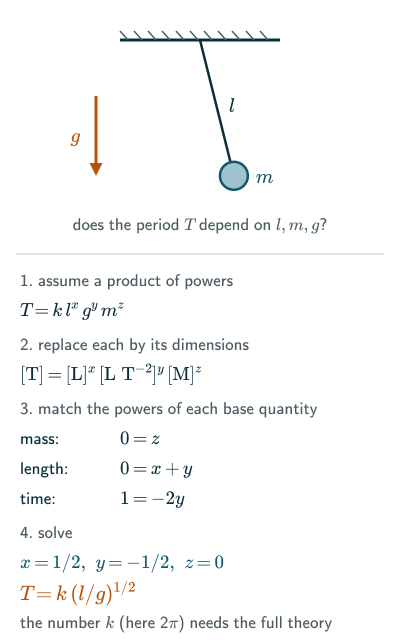
The simple pendulum (NCERT Example 1.5, page 9). Suppose the period T depends on the length l, the mass of the bob m and the acceleration due to gravity g. Assume T = k lx gy mz. Then
Matching powers: mass, z = 0; length, x + y = 0; time, −2y = 1. So x = ½, y = −½ and z = 0:
Period of a simple pendulum by dimensions
The period does not depend on the mass at all, a result found without any dynamics. The number k cannot be found this way; the full derivation gives k = 2π for small swings (NCERT page 9 states k = 2π without this condition).
Why at most three? Matching M, L and T supplies at most three independent equations. Three unknown powers are determined only when those equations are independent. For example, if an assumed relation contains speed, acceleration and a time but no mass, the mass equation merely says 0 = 0; it adds no information. Count independent equations, not just the symbols M, L and T. The same method gives the speed of a wave on a stretched string, v ∝ √(F/μ), where F is the tension and μ the mass per unit length, and the drag on a small sphere moving slowly through a fluid (Example 3).
Converting units
A quantity is a number times a unit, so if the unit gets smaller the number gets bigger: n1u1 = n2u2, so n2 = n1(u1/u2). If the quantity has dimensional formula [Ma Lb Tc], its unit in each system is (unit of mass)a(unit of length)b(unit of time)c, which gives (beyond the NCERT text, though its Exercises 1.2 and 1.3 on pages 10–11 use the idea):
Converting between systems of units
Here M1, L1 and T1 are the units of mass, length and time in the old system, and M2, L2 and T2 those in the new one.
For example, force is [M L T]. Converting 1 N into the CGS unit, the dyne: n2 = 1 × (1 kg/1 g) × (1 m/1 cm) × (1 s/1 s) = 1000 × 100 = 10. So 1 N = 10 dyn.
Limitations of dimensional analysis
However, dimensionless constants cannot be obtained by this method.
NCERT Physics Part I (Class 11), Section 1.6.2, page 9
- No numbers. It cannot find dimensionless constants such as 2π or ½ (page 9).
- No way to tell apart quantities with the same dimensions (page 9). Work and torque are both [M L T] (more such pairs under same dimensions, different quantities).
- At most three independent equations in mechanics. M, L and T may give fewer than three independent constraints; the product-of-powers method yields unique exponents only when enough independent equations remain. If the pendulum’s amplitude, a second length, is added to the list, the powers of l and of the amplitude cannot be separated.
- Blind to dimensionless variables. The real period depends slightly on the angular amplitude θ0, but an angle has no dimensions, so the method cannot show it: k is really a function of θ0, close to 2π only for small swings.
- Dimensional constants must be known in advance. If a constant such as G enters the relation, it must be in the list; a planet’s period cannot be found from its orbit radius and the Sun’s mass alone.
- No direction. Dimensions do not tell a vector from a scalar.
- Only products of powers. It cannot produce a relation with a sum, such as x = x0 + v0t + ½at, or one containing a sine, a logarithm or an exponential. It can only check them.
- One-way test. A dimensionally wrong equation must be wrong, but a dimensionally correct one may still be wrong (page 8).
Solved examples
Example 1: Is ½mv = mgh dimensionally correct? (NCERT Example 1.3)
Here m is a mass, v a speed, g the acceleration due to gravity and h a height.
Left side: [M][L T] = [M L T]. Right side: [M][L T][L] = [M L T].
Answer: both sides are [M L T], so it is dimensionally correct (NCERT pages 8–9).
Example 2: Ruling out formulas for kinetic energy (NCERT Example 1.4)
Which of these can be ruled out by dimensions? (a) K = mv, (b) K = ½mv, (c) K = ma, (d) K = (3/16)mv, (e) K = ½mv + ma. Here a is an acceleration.
Kinetic energy is [M L T]. (a) [M L T], wrong. (b) and (d) [M L T], allowed. (c) [M L T], wrong. (e) adds [M L T] to [M L T], which is not allowed at all.
Answer: (a), (c) and (e) are ruled out. Dimensions cannot choose between (b) and (d); the definition of kinetic energy gives (b) (NCERT page 9).
Example 3: Drag on a small sphere
The viscous drag F on a small sphere of radius a moving slowly at speed v through a fluid depends on a, v and the fluid’s viscosity η, [M L T]. Find the form of F.
Assume F = k ηx ay vz:
[M L T] = [M L T]x [L]y [L T]z.
Mass: 1 = x. Time: −2 = −x − z, so z = 1. Length: 1 = −x + y + z, so y = 1.
Answer: F = kηav. Experiment and theory give k = 6π, which is Stokes’ law.
Example 4: A calorie in new units (NCERT Exercise 1.3, page 11)
A calorie is about 4.2 J, and 1 J = 1 kg m s. In a system whose units of mass, length and time are α kg, β m and γ s, what is the calorie?
Energy is [M L T], so a = 1, b = 2, c = −2. With M1/M2 = 1/α, L1/L2 = 1/β and T1/T2 = 1/γ:
n2 = 4.2 × (1/α) (1/β) (1/γ) = 4.2 α β γ.
Answer: 1 calorie = 4.2 α β γ new units of energy, as the exercise asks you to show.
Example 5: Where does c go? (NCERT Exercise 1.13, page 11)
A student recalls the relation between the moving mass m and the rest mass m0 of a particle as m = m0/(1 − v)1/2, but forgets where the speed of light c goes. Put it back.
1 is a pure number, so whatever is subtracted from it must be dimensionless too. v is [L T]; dividing by c makes it dimensionless. Then m and m0 are both masses, as they must be.
Answer: m = m0/(1 − v/c)1/2.
Common mistakes to avoid
Common mistake
Taking “dimensionally correct” as “correct”
½mv and (3/16)mv have the same dimensions. Passing the test only means the equation might be right.
Common mistake
Expecting the number as well
Dimensional analysis gives T ∝ √(l/g), never the 2π. Any answer it gives has an unknown dimensionless constant.
Common mistake
Using it with too many unknowns
M, L and T give at most three independent equations, sometimes fewer. Four unknown powers cannot be fixed uniquely from them alone; even two lengths enter through the same dimensional constraint, so their individual powers may remain undetermined.
Common mistake
Applying it to a sum
x = x0 + v0t + ½at cannot be deduced by assuming a product of powers. Dimensions can only check such an equation.
Common mistake
Turning the conversion ratios upside down
In n2 = n1[M1/M2]a…, the old unit goes on top. A smaller new unit must give a bigger number: 1 N is 10 dyn, not 10 dyn.
Common mistake
Putting a dimensional quantity inside a function
sin t or et with t in seconds makes no sense; the argument must be dimensionless, as in sin ωt.
Quick revision summary
- Principle of homogeneity: only quantities with the same dimensions can be added, subtracted or equated (NCERT page 8).
- Checking: an equation whose terms differ in dimensions is wrong; one whose terms agree may still be wrong.
- Pure numbers and ratios of like quantities (angle, refractive index) are dimensionless; a dimensional check cannot see them.
- Arguments of sine, cosine, logarithm and exponential functions are dimensionless.
- Deducing: assume a product of powers and match M, L and T. A unique solution requires enough independent equations; mechanics supplies at most three.
- Pendulum: T = k√(l/g), with k = 2π for small swings from the full theory, not from dimensions.
- Converting units: the old unit goes on top in each ratio.
- Limits: no numerical constants, no sums or special functions, cannot separate quantities of the same dimensions.
Formula sheet
- every term in an equation has the same dimensions
- assume Q = k X X X; equate the powers of M, L and T
- T = k√(l/g), with k = 2π for small swings, from theory
- n2 = n1 (M1/M2)a (L1/L2)b (T1/T2)c (1 = old units, 2 = new)
- arguments of sin, cos, log and exp are dimensionless
Questions students ask
What is the principle of homogeneity of dimensions?
The principle of homogeneity of dimensions says that only quantities with the same dimensions can be added, subtracted or equated, so every term of a correct physical equation has the same dimensions. It holds because a physical law cannot depend on the units chosen: if one term were a length and another a time, changing metres to centimetres would change one and not the other, and the equation would stop being true. In Bernoulli’s equation, P + ½ρv + ρgh = constant, every term is a pressure, [M L T]. Every use of dimensional analysis, from checking equations to deducing relations, rests on it.
How do you find the dimensions of constants in an equation like v = at + b/(t + c)?
To find the dimensions of constants in an equation, use the principle of homogeneity: anything added to a quantity must have that quantity’s dimensions, and every term must have the dimensions of the left side. In v = at + b/(t + c), with v a velocity and t a time, c is added to t, so [c] = [T]; at must be [L T], so [a] = [L T]; and b/(t + c) must be [L T], so [b] = [L T][T] = [L].
Can dimensional analysis derive Kepler’s third law?
Yes, dimensional analysis gives the form of Kepler’s third law, provided the gravitational constant G is in the list. Assume the period T of a planet in a circular orbit of radius r round a star of mass M depends only on r, M and G (the planet’s own mass being negligible): T = k rx My Gz, with [G] = [M L T]. Matching powers gives mass: y − z = 0, length: x + 3z = 0, time: −2z = 1, so z = y = −½ and x = 3/2, and T = k√(r/(GM)), that is T ∝ r; Newton’s laws give k = 2π, which dimensions cannot.
Is dimensional analysis in chemistry the same as in physics?
Dimensional analysis in chemistry is a narrower use of the same idea: in NCERT Class 11 Chemistry (Unit 1, Section 1.4.3) it means converting units by multiplying by unit factors, such as (1000 m/1 km), so that the unwanted units cancel. In physics it means working with the dimensions [M], [L], [T] and the rest to check equations, deduce relations and convert units between systems. Both treat units and dimensions as algebraic symbols that multiply and cancel: 54 km h × (1000 m/1 km) × (1 h/3600 s) = 15 m s.
Practice questions
Try each question first, then open the answer to check your working.
-
Q1. Check the equations v = u + at and v = u + 2as dimensionally.
Show answerHide answer
v = u + at: [L T] = [L T] + [L T][T] = [L T], consistent. v = u + 2as: [L T] = [L T] + [L T][L] = [L T], consistent.
-
Q2. A student writes s = ut + at for the distance covered in time t. Is it dimensionally correct?
Show answerHide answer
No. [at] = [L T][T] = [L T], not [L], so the equation is wrong.
-
Q3. Why can dimensional analysis check x = x0 + v0t + ½at but not derive it?
Show answerHide answer
The method assumes a single product of powers, and this equation is a sum of three terms. It also cannot produce the number ½.