Simple harmonic motion
NCERT Class 11 Physics Chapter 13 Section 13.3
Quick answer
Simple harmonic motion has displacement from a fixed equilibrium position x(t) = A cos(ωt + φ), with constant amplitude A and angular frequency ω = 2π/T. The phase ωt + φ fixes position and velocity when A and ω are known. A constant offset in the position coordinate merely changes where equilibrium is written.
With your textbook
NCERT Physics Part II (Class 11), Chapter 13 “Oscillations”, Section 13.3 “Simple harmonic motion”, pages 262–264.
Open the official NCERT chapter (PDF, 1.6 MB, ncert.nic.in) (opens in a new tab)
Checked against the 2026-27 reprint on .
What is simple harmonic motion?
Simple harmonic motion (SHM)
A particle moving back and forth along the x-axis between −A and +A is in simple harmonic motion if its displacement from its fixed equilibrium position, chosen as the origin, varies with time as (NCERT Eq. 13.4, Section 13.3, page 262)
where A > 0, ω > 0 and φ are constants for a nontrivial oscillation:
- A is the amplitude, the largest displacement;
- ω is the angular frequency, with ω = 2π/T;
- ωt + φ is the phase, which changes with time;
- φ is the phase constant (phase angle), the phase at t = 0.
Thus, simple harmonic motion (SHM) is not any periodic motion but one in which displacement is a sinusoidal function of time.
NCERT Physics Part II (Class 11), Section 13.3, page 262
In plain words: SHM is back-and-forth motion whose displacement–time graph is a single pure sine or cosine wave, with no other wiggles. A block on a spring in an ideal frictionless Hooke-law model moves exactly like this, and a pendulum making small swings very nearly does.
Displacement as a function of time
Take φ = 0, so x = A cos ωt, and look at the particle every quarter of a period (NCERT Fig. 13.4, page 263):
| Time | Position | Motion |
|---|---|---|
| 0 | +A | at rest for an instant |
| T/4 | 0 | fastest, moving towards −A |
| T/2 | −A | at rest for an instant |
| 3T/4 | 0 | fastest, moving towards +A |
| T | +A | back to the start |
The motion repeats after T, whichever point you choose as t = 0. The speed is greatest at the mean position x = 0 and zero at the two extremes.
Plotting x against t gives a continuous cosine curve (NCERT Fig. 13.5).
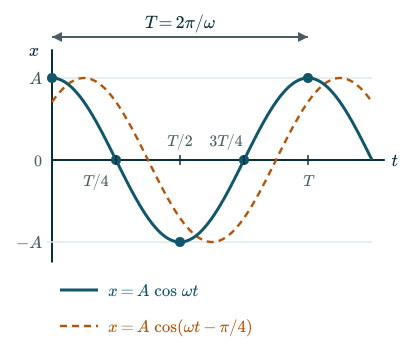
A sine curve is just as good. A sin ωt = A cos(ωt − π/2), so it is SHM with φ = −π/2: the particle starts at the mean position, moving towards +A. More generally, a sin ωt + b cos ωt is a single SHM of angular frequency ω and amplitude √(a + b), as shown under periodic functions (NCERT Eq. 13.3d, page 262); Example 2 and Practice Q1(b) use this.
Amplitude
The amplitude A is the magnitude of the largest displacement of the particle. It can always be taken as positive, because a minus sign can be absorbed into the phase constant (page 263). As the cosine runs from +1 to −1, the displacement runs between +A and −A, so the extremes are 2A apart; the distance travelled in a full cycle is 4A.
Two SHMs can have the same ω and φ but different amplitudes; their graphs then cross the axis at the same times but reach different heights (NCERT Fig. 13.7(a)). NCERT’s figure for this has two slips: its caption refers to Eq. (14.4) instead of Eq. (13.4), and the labels −A and −B on the negative side of the displacement axis are interchanged. In the figure the larger curve 2 (amplitude B) dips to the lower mark, labelled −A; that mark should read −B, and the mark nearer zero should read −A.
Phase and phase constant
For known amplitude A and angular frequency ω, the phase fixes the state of motion: both position and velocity.
This time-dependent quantity, (ωt + φ) is called the phase of the motion.
NCERT Physics Part II (Class 11), Section 13.3, page 263
The value of the phase at t = 0 is φ, the phase constant. Two SHMs can have the same A and ω but different phase constants (NCERT Fig. 13.7(b)): one curve is simply the other shifted along the time axis, as in the figure above. (In NCERT’s drawing the shift looks larger than it should; the curve for φ = −π/4 lags the other by exactly T/8.)
Finding φ. At t = 0, x(0) = A cos φ. NCERT says that once A is known, φ can be found from the displacement at t = 0 (page 263). Strictly, the displacement gives only cos φ, and one cosine value fits two angles, +φ and −φ, so you also need the direction of motion at t = 0 (a point beyond the NCERT text; see Example 3). Taking φ between −π and π:
- moving towards −x (displacement decreasing): φ between 0 and π;
- moving towards +x (displacement increasing): φ between −π and 0;
- at rest at +A or −A: φ = 0 or π, with no choice to make.
Angular frequency
Take φ = 0, so x(t) = A cos ωt (NCERT Eq. 13.5). The motion has period T, so x(t) = x(t + T) (NCERT Eq. 13.6):
The cosine first repeats when its argument grows by 2π, so ω(t + T) = ωt + 2π, that is (NCERT Eq. 13.7):
Angular frequency
ω is called the angular frequency of SHM. Its S.I. unit is radians per second.
NCERT Physics Part II (Class 11), Section 13.3, page 264
So ω is 2π times the ordinary frequency ν. It is measured in rad/s, like the angular velocity of a turning body, and the reference circle of the next section shows why the two are closely linked. Two SHMs with the same A and φ but different ω have different periods: doubling ω halves the period and doubles the frequency (NCERT Fig. 13.8).
Solved examples
Example 1: Reading an SHM equation
A particle moves as x = 0.05 cos(4πt + π/3), with x in metres and t in seconds. Find the amplitude, angular frequency, frequency, period, phase constant and the displacement at t = 0.
Compare with x = A cos(ωt + φ): A = 0.05 m, ω = 4π rad/s (about 12.6 rad/s), φ = π/3.
ν = ω/2π = 2 Hz and T = 1/ν = 0.5 s. At t = 0, x = 0.05 cos(π/3) = 0.05 × 0.5 = 0.025 m.
Answer: A = 5 cm, ω = 4π rad/s, ν = 2 Hz, T = 0.5 s, φ = π/3, x(0) = 2.5 cm.
Example 2: SHM or not? (NCERT Example 13.3)
Which of these represent SHM, and which are periodic but not SHM? Give the period of each. (1) sin ωt − cos ωt; (2) sinωt.
(1)
This is a single sinusoid: SHM with amplitude √2 and period 2π/ω. NCERT gives its phase angle as −π/4 (or 7π/4), which is the phase in this sine form. Written in the cosine form of NCERT Eq. 13.4 it is √2 cos(ωt − 3π/4), so there φ = −3π/4.
(2) sinωt = ½ − ½ cos 2ωt. This is periodic with period π/ω, not 2π/ω. Measured from x = ½, the displacement is −½ cos 2ωt: a simple harmonic motion of amplitude ½ and angular frequency 2ω about ½. The coordinate x measured from zero includes a constant offset; its acceleration is −4ω(x − ½). Translating the coordinate origin does not change the physical motion’s classification: the restoring displacement must be measured from equilibrium. NCERT describes it as a harmonic motion with its equilibrium at ½ instead of zero (page 264).
Answer: (1) is SHM with period 2π/ω. (2) is SHM about x = ½, with period π/ω. NCERT places it under (b) but explicitly identifies the shifted equilibrium; a constant coordinate offset does not make SHM non-harmonic.
Example 3: Finding the phase constant
A particle in SHM has amplitude 4 cm. At t = 0 it is at x = 2 cm, moving towards the mean position. Find φ in x = A cos(ωt + φ).
cos φ = x(0)/A = 2/4 = ½, so φ = +π/3 or −π/3.
Moving towards the mean position from x = 2 cm means x is decreasing. As t increases, the phase ωt + φ grows from φ; the cosine decreases only if the phase is between 0 and π. So φ = +π/3.
Answer: φ = π/3. Had the particle been moving away from the mean position, φ would be −π/3.
Example 4: Equal distances, unequal times
A particle in SHM has period 2 s and starts at the mean position, moving towards +A. How long does it take to reach x = A/2, and how long from there to x = A?
Starting at the mean position and moving towards +A: x = A sin ωt. A/2 is reached when sin ωt = ½, that is ωt = π/6, so t = T/12 = 2/12, about 0.167 s.
x = A is reached at T/4 = 0.5 s, so the second half takes 0.5 − 0.167, about 0.333 s, that is T/6.
Answer: about 0.167 s for the first half and 0.333 s for the second. The particle is fast near the mean position and slow near the extreme.
Example 5: A phase difference as a time delay
Two SHMs of period 0.8 s are x1 = A cos ωt and x2 = A cos(ωt − π/4). How much later does the second reach each corresponding position with the same direction of motion?
A phase difference of 2π corresponds to one period, so π/4 corresponds to (π/4)/(2π) = 1/8 of a period: 0.8/8 = 0.1 s.
Answer: 0.1 s later; the second motion lags the first by T/8.
Common mistakes to avoid
Common mistake
Calling every periodic motion SHM
Displacement from the equilibrium position must be a single sine or cosine of time. sin ωt + cos 2ωt is periodic but not simple harmonic.
Common mistake
Confusing the phase with the phase constant
The phase ωt + φ changes with time; the phase constant φ is its value at t = 0.
Common mistake
Finding φ from the starting displacement alone
x(0) = A cos φ fits two angles. Use the direction of motion at t = 0 to choose (Example 3).
Common mistake
Reading a phase angle from the sine form as φ
NCERT Eq. 13.4 uses a cosine. A sin(ωt + α) = A cos(ωt + α − π/2), so φ = α − π/2 (Example 2).
Common mistake
Taking the amplitude as the distance between the extremes
The amplitude is the largest displacement from the mean position. The distance from −A to +A is 2A, and in one full period the particle travels 4A while its displacement is zero.
Common mistake
Taking the period of sinωt as 2π/ω
sinωt = ½ − ½ cos 2ωt repeats every π/ω. It oscillates about ½ with amplitude ½, not about 0 with amplitude 1 (Example 2).
Common mistake
Assuming equal distances take equal times
The particle moves fastest at the mean position, so going from 0 to A/2 takes T/12 but going from A/2 to A takes T/6 (Example 4).
Quick revision summary
- SHM: the displacement is a sinusoidal function of time, x(t) = A cos(ωt + φ).
- A: amplitude, the largest displacement (taken positive). ωt + φ: phase. φ: phase constant, the phase at t = 0.
- ω = 2π/T = 2πν is the angular frequency, in rad/s.
- The particle is at rest for an instant at ±A and moves fastest through x = 0.
- x(0) = A cos φ; the direction of motion at t = 0 fixes the sign of φ.
- A sin ωt is also SHM, with φ = −π/2.
Formula sheet
- x(t) = A cos(ωt + φ)
- ω = 2π/T = 2πν
- phase = ωt + φ; phase constant = φ
- x(0) = A cos φ
Questions students ask
Why is it called simple harmonic motion?
Simple harmonic motion is called harmonic because its displacement is a sine or cosine function of time, the function that describes a pure musical tone, or harmonic. It is called simple because it is a single such function, with one frequency and a constant amplitude. An ideal string vibrating in several commensurate modes can have periodic motion that is not a single SHM; real strings also have damping and small departures from exact harmonic frequencies.
What are the conditions for a motion to be simple harmonic?
A body moves in simple harmonic motion when the net force on it, and so its acceleration, is proportional to its displacement from a fixed mean position and always directed towards that position: F = −kx, or a = −ωx. In practice this needs a stable equilibrium position, a restoring force that grows in proportion to the displacement (in most real systems only for small amplitudes) and no friction to damp the motion. The force law for SHM shows that F = −kx and x = A cos(ωt + φ) are two equivalent definitions, with ω = √(k/m).
What are some real-life examples of simple harmonic motion?
Real-life examples of very nearly simple harmonic motion are a block on a spring, a pendulum making small swings, the prongs of a struck tuning fork, a test tube floating upright and bobbing in water, liquid oscillating in a U-tube and the atoms of a solid vibrating about their fixed positions. Each is simple harmonic only while its amplitude is small and its friction is negligible; real oscillations slowly die away, and large swings stop being sinusoidal.
What is the SI unit of phase and phase constant in SHM?
The phase ωt + φ and the phase constant φ of SHM are angles, so their SI unit is the radian and they have no dimensions. With ω in rad s and t in seconds, ωt comes out in radians, so φ must be in radians too: a phase constant of 30° goes into x = A cos(ωt + φ) as π/6. A bare number inside the cosine is read as radians, so degrees must carry the ° sign, as explained under angles in radians.
How do you find the phase constant from a displacement–time graph?
The phase constant can be read from a displacement–time graph by finding the time t0 of the first maximum, x = +A: then x = A cos ω(t − t0), so φ = −ωt0 = −2πt0/T. For a graph with period 3 s whose first peak is at 0.5 s, φ = −2π × 0.5/3 = −π/3. As a check, at t = 0 the graph should show x = A cos(−π/3) = A/2, with x increasing towards the peak; if the first peak comes after T/2, add 2π to bring φ between −π and π.
What is the difference between linear and angular SHM?
In linear SHM a body moves to and fro along a straight line under a restoring force F = −kx, like a block on a spring; in angular SHM a body turns to and fro about an axis under a restoring torque proportional to its angle, τ = −cθ, like a torsion pendulum or the balance wheel of a watch. Both obey the same equation, with θ in place of x, so θ = θ0 cos(ωt + φ) with ω = √(c/I), I being the moment of inertia about the axis. The JEE Main 2027 and NEET (UG) 2026 syllabuses do not name angular SHM, but both list the time period of the simple pendulum, which for small swings is an angular SHM.
Practice questions
Try each question first, then open the answer to check your working.
-
Q1. Which of these represent SHM? (a) x = 3 sin 2t; (b) x = 2 cos t + 2 sin t; (c) x = cos t + cos 2t.
Show answerHide answer
(a) Yes: amplitude 3, ω = 2 rad/s, period π s. (b) Yes: it equals 2√2 sin(t + π/4), amplitude 2√2 (about 2.83), period 2π s. (c) No: it is periodic, with period 2π s, but it is not a single sinusoid.
-
Q2. An SHM has a period of 0.2 s. Find its frequency and angular frequency.
Show answerHide answer
ν = 1/0.2 = 5 Hz and ω = 2π/T = 10π, about 31.4 rad/s.
-
Q3. For x = 0.1 cos(πt − π/2) m, find the amplitude, period and phase constant, and the displacement at t = 0.5 s.
Show answerHide answer
A = 0.1 m, ω = π rad/s so T = 2π/π = 2 s, and φ = −π/2. At t = 0.5 s the phase is π/2 − π/2 = 0, so x = 0.1 m, an extreme position.