Velocity and acceleration in SHM
NCERT Class 11 Physics Chapter 13 Section 13.5
Quick answer
For x(t) = A cos(ωt + φ), velocity is v(t) = −ωA sin(ωt + φ) and acceleration is a(t) = −ωx. Speed is greatest at equilibrium and zero at the extremes; acceleration magnitude is greatest at the extremes and zero at equilibrium. At nonzero displacement, acceleration points towards equilibrium.
With your textbook
NCERT Physics Part II (Class 11), Chapter 13 “Oscillations”, Section 13.5 “Velocity and acceleration in simple harmonic motion”, pages 266–267.
Open the official NCERT chapter (PDF, 1.6 MB, ncert.nic.in) (opens in a new tab)
Checked against the 2026-27 reprint on .
Velocity and acceleration in SHM
Velocity and acceleration of a particle in SHM
For a particle in SHM with displacement x(t) = A cos(ωt + φ), the velocity and acceleration are (NCERT Eqs. 13.9 and 13.11, Section 13.5, pages 266–267)
- The speed is greatest, ωA, at the mean position and zero at the extremes.
- The acceleration magnitude is zero at the mean position and greatest, ωA, at the extremes.
- Away from the mean position, acceleration points back towards it; at the mean position acceleration is zero and has no direction.
In plain words: a particle in SHM is like a child on a swing. It whizzes through the middle and stops for an instant at each end. The restoring acceleration along the motion is strongest at the ends and zero in the middle. For a real swing this describes the tangential component; its radial centripetal acceleration need not vanish at the bottom.
Velocity from the reference circle
The reference particle P moves anticlockwise round a circle of radius A with angular speed ω, so its speed is (NCERT Eq. 13.8)
the same rule as v = ωr for a turning body. Its velocity is along the tangent at P, at right angles to OP, so it makes the angle ωt + φ with the +y-axis (NCERT Fig. 13.11, page 266), and its x-component is −ωA sin(ωt + φ). That is the velocity of the projection P′:
The minus sign means that while sin(ωt + φ) is positive, P′ moves towards −x. The same result comes straight from calculus: v(t) = dx/dt (NCERT Eq. 13.10).
Speed and position. Square v(t), use sin = 1 − cos and put A cos(ωt + φ) = x:
So (a step beyond the NCERT text)
Signed velocity at displacement x
Take the + sign when the particle moves towards +x and the − sign when it moves towards −x: it passes each interior position twice per cycle, once in each direction, at the same speed. This gives speed ωA at x = 0 and zero at x = ±A, without needing the time.
Graphs against x (beyond the NCERT text). Since a = −ωx, the a–x graph is a straight line through the origin with slope −ω. Rearranging v = ω(A − x) gives x/A + v/(ωA) = 1, so the v–x graph is an ellipse with semi-axes A and ωA.
Acceleration
The reference particle has a centripetal acceleration of size (ωA)/A = ωA, pointing along PO towards the centre. Its x-component is the acceleration of P′ (NCERT Fig. 13.12, page 266; that figure reuses the labels of NCERT Fig. 13.11, so its arrow on the x-axis is marked v(t), where it stands for the acceleration a(t) of P′):
This is NCERT Eq. 13.11; it also follows from a(t) = dv/dt (NCERT Eq. 13.12). Multiplied by the mass, it gives the force law for SHM.
So in SHM the acceleration is proportional to the displacement and opposite to it. When x > 0, a < 0; when x < 0, a > 0. For nonzero displacement, acceleration points towards the mean position; at x = 0 it vanishes (pages 266–267).
Note that the acceleration is not constant: it changes with x. The equations of motion for constant acceleration do not apply to SHM.
Displacement, velocity and acceleration together
With φ = 0 (page 267):
- x(t) = A cos ωt
- v(t) = −ωA sin ωt
- a(t) = −ωA cos ωt
All quantities vary sinusoidally with time; only their maxima differ and the different plots differ in phase.
NCERT Physics Part II (Class 11), Section 13.5, page 267
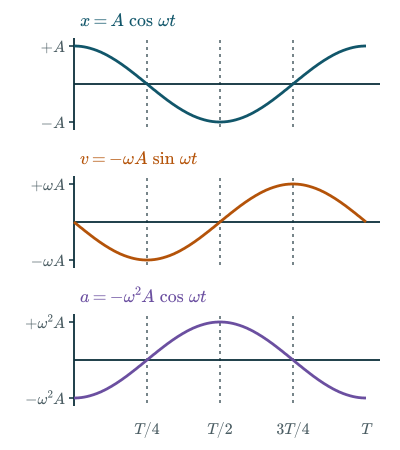
| Quantity | Range | Phase relative to x |
|---|---|---|
| displacement x | −A to +A | — |
| velocity v | −ωA to +ωA | ahead by π/2 |
| acceleration a | −ωA to +ωA | ahead by π (opposite) |
NCERT gives the phase differences as π/2 and π (page 267). “Ahead” follows from −sin θ = cos(θ + π/2) and −cos θ = cos(θ + π).
Solved examples
Example 1: Displacement, speed and acceleration (NCERT Example 13.5)
A body moves in SHM as x = 5 cos(2πt + π/4), in SI units. At t = 1.5 s, find (a) the displacement, (b) the speed and (c) the acceleration.
ω = 2π rad/s, so T = 1 s. At t = 1.5 s the phase is 3π + π/4.
(a) x = 5 cos(3π + π/4) = −5 × 0.707, about −3.54 m.
(b) v = −5 × 2π × sin(3π + π/4) = −10π × (−0.707), about +22 m/s.
(c) a = −ωx = −(2π) × (−3.54), about +140 m/s.
Answer: −3.54 m, 22 m/s and 140 m/s (page 267). The body is on the negative side, moving towards +x, with its acceleration pointing back towards the mean position. NCERT cites Eq. (13.10) for part (c), but that is v = dx/dt; the formula used, a = −ωx, is NCERT Eq. 13.11.
Example 2: Largest speed and acceleration
A particle performs SHM of amplitude 0.1 m and period 0.5 s. Find its greatest speed and greatest acceleration.
ω = 2π/0.5 = 4π, about 12.57 rad/s.
vmax = ωA = 12.57 × 0.1, about 1.26 m/s. amax = ωA = 12.57 × 0.1, about 15.8 m/s.
Answer: 1.26 m/s at the mean position and 15.8 m/s at the extremes.
Example 3: Speed halfway out
For the particle in Example 2, find the speed and acceleration at x = A/2 = 0.05 m.
v = ω√(A − x) = 12.57 × √(0.01 − 0.0025) = 12.57 × 0.0866, about 1.09 m/s.
a = −ωx = −(12.57) × 0.05 = −158 × 0.05, about −7.9 m/s.
Answer: about 1.09 m/s, which is (√3/2) ≈ 87% of the greatest speed, though the particle is already halfway out; and 7.9 m/s towards the mean position.
Example 4: From the greatest speed and acceleration
In an SHM the greatest speed is 0.6 m/s and the greatest acceleration is 1.8 m/s. Find ω, A and T.
amax/vmax = ωA/(ωA) = ω, so ω = 1.8/0.6 = 3 rad/s.
A = vmax/ω = 0.6/3 = 0.2 m, and T = 2π/3, about 2.09 s.
Answer: ω = 3 rad/s, A = 0.2 m, T ≈ 2.09 s.
Example 5: Speeds at two positions
A particle in SHM has speed 16 cm/s at x = 3 cm and 12 cm/s at x = 4 cm. Find the amplitude and angular frequency.
Use v = ω(A − x) at both points:
256 = ω(A − 9) and 144 = ω(A − 16).
Subtracting: 112 = 7ω, so ω = 16 and ω = 4 rad/s. Then A − 9 = 256/16 = 16, so A = 5 cm.
Answer: A = 5 cm and ω = 4 rad/s; the greatest speed is ωA = 20 cm/s.
Common mistakes to avoid
Common mistake
Putting the greatest speed at the extremes
The speed is zero at ±A and greatest at the mean position. It is the acceleration that is greatest at the extremes.
Common mistake
Tying the acceleration to the velocity
The acceleration in SHM is set by the displacement (a = −ωx), not by the velocity. On the way out from the mean position a is opposite to v and the particle slows down; on the way back a is along v and it speeds up. At the extremes v = 0, yet a is greatest.
Common mistake
Using v = ωx
The speed at displacement x is ω√(A − x), not ωx. It is largest where x is zero.
Common mistake
Using the constant-acceleration equations
The acceleration in SHM changes with position, so equations such as v = u + at do not apply. Use the SHM formulas instead.
Common mistake
Mixing up speed and velocity
NCERT’s Example 13.5 asks for the speed; the velocity there is +22 m/s and the speed is its size, 22 m/s. A velocity can be negative; a speed cannot.
Quick revision summary
- Displacement: x(t) = A cos(ωt + φ).
- Velocity: v(t) = −ωA sin(ωt + φ); speed ω√(A − x); greatest ωA at x = 0, zero at x = ±A.
- Acceleration: a(t) = −ωA cos(ωt + φ) = −ωx; zero at x = 0, greatest ωA at x = ±A; always towards the mean position.
- All three are sinusoidal with the same period; v is π/2 ahead of x, a is π/2 ahead of v, so a is π ahead of x (opposite to it).
- From the reference circle: the speed of P is ωA and its centripetal acceleration is ωA; their x-components give v and a of SHM.
Formula sheet
- v(t) = −ωA sin(ωt + φ)
- a(t) = −ωx = −ωA cos(ωt + φ)
- v = ±ω√(A − x)
- vmax = ωA (at x = 0); amax = ω2A (at x = ±A)
Questions students ask
What are the average velocity and average speed in SHM over one period?
Over one complete period the average velocity of a particle in SHM is zero, because it returns to its starting point and its displacement is zero. Its average speed is the total distance, 4A, divided by the period: 4A/T = 2ωA/π, about 0.64 times the greatest speed ωA. For an amplitude of 3 cm and a period of 0.6 s, the average speed is 12 cm/0.6 s = 20 cm/s, while the greatest speed is 2π × 3/0.6 ≈ 31.4 cm/s.
What is the shape of the velocity–acceleration graph in SHM?
The velocity–acceleration graph of a particle in SHM is an ellipse. Since v = −ωA sin(ωt + φ) and a = −ωA cos(ωt + φ), squaring and adding gives v/(ωA) + a/(ωA) = 1, an ellipse with semi-axes ωA along the velocity axis and ωA along the acceleration axis. Velocity and acceleration are a quarter of a period out of step, so each is zero when the other is largest; compare the velocity–displacement graph, also an ellipse, and the acceleration–displacement graph, a straight line of slope −ω.
What are the formulas for maximum velocity and maximum acceleration in SHM in terms of frequency?
In terms of the frequency ν, the greatest speed in SHM is vmax = ωA = 2πνA and the greatest acceleration is amax = ωA = 4πνA, since ω = 2πν. For a given amplitude the acceleration grows as the square of the frequency, so fast vibrations have very large accelerations even at tiny amplitudes: a prong of a 256 Hz tuning fork vibrating with an amplitude of 0.5 mm has vmax ≈ 0.80 m/s but amax ≈ 1290 m/s, about 130 times g.
Practice questions
Try each question first, then open the answer to check your working.
-
Q1. A particle performs SHM with amplitude 5 cm and angular frequency 10 rad/s. Find its greatest speed and greatest acceleration.
Show answerHide answer
vmax = ωA = 10 × 0.05 = 0.5 m/s, and amax = ωA = 100 × 0.05 = 5 m/s.
-
Q2. In an SHM with ω = 5 rad/s, find the acceleration when the particle is at x = +2 cm.
Show answerHide answer
a = −ωx = −25 × 0.02 = −0.5 m/s: 0.5 m/s towards the mean position.
-
Q3. At which positions in SHM are (a) the speed and (b) the acceleration greatest and least?
Show answerHide answer
(a) The speed is greatest at the mean position and zero at the extremes. (b) The acceleration is zero at the mean position and greatest in size at the extremes.