Force law for SHM
NCERT Class 11 Physics Chapter 13 Section 13.6
Quick answer
The force law for SHM states that a particle is in simple harmonic motion when the net force on it is a restoring force proportional to its displacement, F = −kx, always pointing back to the mean position. From F = ma and a = −ωx, the force constant is k = mω, so ω = √(k/m). For a block on a spring this gives a period T = 2π√(m/k), which does not depend on the amplitude.
With your textbook
NCERT Physics Part II (Class 11), Chapter 13 “Oscillations”, Section 13.6 “Force law for simple harmonic motion”, pages 267–268.
Open the official NCERT chapter (PDF, 1.6 MB, ncert.nic.in) (opens in a new tab)
Checked against the 2026-27 reprint on .
What is the force law for SHM?
Force law for simple harmonic motion
For one-dimensional motion with constant mass m and a fixed equilibrium position, a particle executes SHM when the net force on it is proportional to its displacement x from the mean position and opposite to it (NCERT Eqs. 13.13–13.14, Section 13.6, page 267):
The positive constant k is the force constant (for a spring, the spring constant). It is related to the angular frequency by
Like acceleration, force is always directed towards the mean position—hence it is sometimes called the restoring force in SHM.
NCERT Physics Part II (Class 11), Section 13.6, page 267
In plain words: pull the particle away from its resting place and something pulls it back, and the further you pull it, the harder it pulls back, in exact proportion. With constant mass and that net force, a displaced or moving particle executes SHM, and the stiffer the pull (larger k) or the lighter the particle (smaller m), the faster it oscillates.
From displacement to force
The previous section of the chapter showed that a particle in SHM has acceleration a(t) = −ωx(t) (NCERT Eq. 13.11). Newton’s second law then gives the force on it:
So SHM can be defined in two equivalent ways (page 267):
- by its displacement, x(t) = A cos(ωt + φ) (NCERT Eq. 13.4); or
- by its force law, F = −kx (NCERT Eq. 13.13).
Differentiating the displacement twice gives the acceleration, and multiplying by m gives the force law. Going the other way, solving the differential equation m dx/dt = −kx gives the displacement equation, with A and φ set by how the motion starts.
A quick test for SHM. If a problem gives you an acceleration of the form a = −(a positive constant) × x, the motion is SHM and that constant is ω (Example 3). A constant term only moves the mean position: a = −ω(x − x0) is SHM about x = x0 with the same ω (the vertical spring below is an example).
Restoring force and force constant
The force always points back towards the mean position, so it is called the restoring force. The force constant k has the unit N m: it is the restoring force per metre of displacement.
Because F is proportional to the first power of x, a particle moving under it is called a linear harmonic oscillator. In real systems the force may also contain small extra terms proportional to x, x and so on; such systems are non-linear oscillators (page 267). When a nonzero positive linear restoring coefficient exists, higher powers become relatively small for sufficiently small displacements, which is why so many vibrations are very nearly simple harmonic.
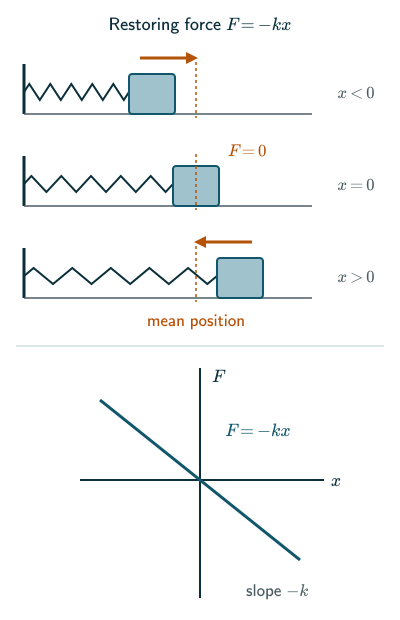
Oscillations of a spring
A block of mass m on a smooth horizontal surface, fixed to a light (massless) spring of spring constant k, is the standard example. By Hooke’s law the spring pulls or pushes the block with force −kx when it is displaced by x, so the block moves in SHM with ω = √(k/m) and period
Period of a spring–block system
This follows from T = 2π/ω and NCERT Eq. 13.14b. Notice what is not in the formula: the amplitude. A spring–block oscillator takes the same time for a small swing as for a large one (within the range where Hooke’s law holds).
Two springs. NCERT Example 13.6 (pages 267–268) fixes a block between two identical springs, each of constant k. Displace the block by x: one spring stretches by x and the other compresses by x, and both forces point back towards the mean position. The net force is −2kx, so the motion is SHM with T = 2π√(m/2k) (Example 2).
Combinations of springs (beyond the NCERT text):
- in parallel (side by side, or on either side of the block as in NCERT Example 13.6), the magnitudes of their changes in length are the same and their restoring contributions add (opposite-side springs have opposite signed changes in length): keff = k1 + k2;
- in series (end to end), both carry the same force and their extensions add: 1/keff = 1/k1 + 1/k2, so keff = k1k2/(k1 + k2);
- cutting an ideal uniform spring, neglecting end effects and changes to its geometry: k is inversely proportional to its length, so each half of a spring of constant k has constant 2k.
A vertical spring (also beyond the NCERT text). Hanging a mass m on a spring stretches it by Δl = mg/k to a new equilibrium. Take x downward from that new equilibrium: the net force is mg − k(Δl + x) = −kx, because kΔl = mg. So the period is the same, T = 2π√(m/k) = 2π√(Δl/g) (Example 4).
Solved examples
Example 1: Force constant and period
A steady applied force of 4 N holds a 0.5 kg block at a spring extension of 2 cm on a frictionless horizontal surface. Find the spring constant and the period of oscillation.
k = F/x = 4/0.02 = 200 N m. Then ω = √(k/m) = √(200/0.5) = 20 rad/s.
T = 2π/ω = 2π/20, about 0.314 s, and ν = 1/T, about 3.18 Hz.
Answer: k = 200 N m and T ≈ 0.314 s.
Example 2: A block between two springs (based on NCERT Example 13.6, pages 267–268)
A block of mass m on a smooth horizontal surface is attached to two identical springs of constant k, whose other ends are fixed to supports on either side. Show that it performs SHM and find its period. Evaluate it for m = 1 kg and k = 50 N m.
Displace the block by x to the right. The left spring is stretched by x and pulls it left with force −kx; the right spring is compressed by x and pushes it left with force −kx. The net force is
F = −kx − kx = −2kx.
It is proportional to the displacement and directed towards the mean position, so the motion is SHM with ω = √(2k/m):
T = 2π√(m/2k) = 2π√(1/100), about 0.628 s.
Answer: SHM with T = 2π√(m/2k), about 0.628 s for these values.
Example 3: Is it SHM?
For which of these accelerations (in SI units) is the motion SHM? For that one, find the period. (a) a = −16x; (b) a = 16x; (c) a = −16x.
(a) a = −ωx with ω = 16: SHM with ω = 4 rad/s and T = 2π/4, about 1.57 s.
(b) The acceleration points away from the mean position, so the particle runs away instead of oscillating: not SHM.
(c) The acceleration is towards the mean position, so the particle oscillates, but it is not proportional to x: a non-linear oscillator, not SHM.
Answer: only (a) is SHM, with T ≈ 1.57 s.
Example 4: A hanging spring
A 0.2 kg mass hung from a spring stretches it by 4 cm. Find the spring constant and the period of vertical oscillations (g = 9.8 m s).
At equilibrium kΔl = mg, so k = 0.2 × 9.8/0.04 = 49 N m.
T = 2π√(m/k) = 2π√(0.2/49), about 0.401 s. Check: 2π√(Δl/g) = 2π√(0.04/9.8) gives the same.
Answer: k = 49 N m and T ≈ 0.401 s.
Example 5: Series or parallel?
A block of mass m on one spring of constant k0 has period T0 = 2π√(m/k0). Find its period with two such springs (a) in parallel and (b) in series.
(a) Parallel: k = 2k0, so T = 2π√(m/2k0) = T0/√2.
(b) Series: k = k0/2, so T = 2π√(2m/k0) = √2 T0.
Answer: T0/√2 in parallel and √2 T0 in series; the period in series is twice the period in parallel.
Common mistakes to avoid
Common mistake
Dropping the minus sign
F = −kx: the force is opposite to the displacement. Without the minus sign the force would push the particle further away, as in Example 3(b).
Common mistake
Calling any to-and-fro force SHM
The restoring force must be proportional to x. A force such as −cx also brings the particle back, but the motion is not simple harmonic.
Common mistake
Making the period depend on the amplitude
T = 2π√(m/k) contains no amplitude. Stretching the spring further makes the block move faster, not take longer.
Common mistake
Subtracting the two spring forces in NCERT Example 13.6
One spring is stretched and the other compressed, but both forces point towards the mean position, so they add: −2kx, not zero.
Common mistake
Adding spring constants in series
For springs end to end, the reciprocals add: 1/k = 1/k1 + 1/k2. Two equal springs in series are half as stiff as one.
Common mistake
Expecting g to change a spring’s period
For a vertical spring, gravity only shifts the equilibrium position. The period is still 2π√(m/k); the form 2π√(Δl/g) contains g, but Δl = mg/k changes with g in the same proportion.
Quick revision summary
- Force law for SHM: F = −kx. The force is the restoring force, always towards the mean position.
- From a = −ωx and F = ma: k = mω, ω = √(k/m).
- SHM can be defined either by x(t) = A cos(ωt + φ) or by F = −kx.
- A linear harmonic oscillator has F ∝ −x; extra x, x terms make it non-linear.
- Spring–block: T = 2π√(m/k), independent of amplitude; a block between two identical springs, each of constant k, has effective constant 2k.
- Springs in parallel: k = k1 + k2; in series: k = k1k2/(k1 + k2).
Formula sheet
- F = −kx
- k = mω; ω = √(k/m)
- T = 2π√(m/k)
- Parallel: k = k + k; series: k = kk/(k + k)
Questions students ask
Why does a spring’s period depend on the mass when a pendulum’s does not?
The period of a block on a spring, T = 2π√(m/k), depends on the mass because the force constant k is fixed by the spring alone: a heavier block gets the same restoring force for the same stretch but accelerates less. A pendulum’s restoring force, mg sin θ ≈ (mg/L)x for small swings (x = Lθ along the arc), is itself proportional to the mass, so its force constant mg/L grows with m and the mass cancels: T = 2π√(m/(mg/L)) = 2π√(L/g), as on the simple pendulum page.
What happens to the spring constant when a spring is cut into two unequal parts?
When a uniform spring is cut, the spring constant of each piece is inversely proportional to its length, so the shorter piece is the stiffer one: k1l1 = k2l2 = kl. A spring of constant 60 N m cut in the ratio 1 : 2 gives pieces one-third and two-thirds as long, with constants 180 N m and 90 N m; joined again in series they give back 1/k = 1/180 + 1/90 = 1/60, that is 60 N m. A block on the shorter piece oscillates with 1/√3 of its period on the whole spring.
What is the difference between Hooke’s law and the force law for SHM?
Hooke’s law is a property of a spring or elastic body, while the force law for SHM is a condition on the net force on any oscillating body, though both have the form F = −kx. Hooke’s law says that, for small deformations, the force a spring exerts is proportional to its extension or compression. The force law for SHM says that a body moves in SHM when the net force on it, whatever its source, is −kx: a pendulum bob’s tangential motion for small swings, a floating body bobbing gently (weight and buoyancy) and a block between two springs all qualify, and k need not be the constant of any one spring.
What is the period of two blocks joined by a spring on a smooth floor?
Two blocks of masses m1 and m2 joined by a light spring of constant k on a smooth floor oscillate with period T = 2π√(μ/k), where μ = m1m2/(m1 + m2) is the reduced mass (a step beyond the NCERT text). Relative to their uniformly moving centre of mass, both blocks execute SHM in opposite directions. In a laboratory frame with a moving centre of mass, the motion includes uniform drift and is not generally periodic. For 2 kg and 3 kg blocks on a 300 N m spring, μ = 6/5 = 1.2 kg and T = 2π√(1.2/300) ≈ 0.40 s, shorter than for either block alone on the same spring fixed to a wall.
Practice questions
Try each question first, then open the answer to check your working.
-
Q1. What is a restoring force? Why is it called that?
Show answerHide answer
In SHM the force on the particle always points towards the mean position, F = −kx. It tends to restore the particle to its equilibrium position, hence the name.
-
Q2. A 2 kg block is attached to a spring of constant 450 N m. Find the angular frequency, period and frequency of its oscillations.
Show answerHide answer
ω = √(450/2) = 15 rad/s, T = 2π/15, about 0.419 s, and ν = 1/T, about 2.39 Hz.
-
Q3. The amplitude of a spring–block oscillator is doubled. What happens to its period?
Show answerHide answer
Nothing: T = 2π√(m/k) does not depend on the amplitude. The block simply moves faster over the longer path.