Hooke’s law
NCERT Class 11 Physics Chapter 8 Section 8.3
Quick answer
Hooke’s law says that for small deformations stress is proportional to strain: stress = k × strain, where the constant k is the modulus of elasticity of the material, measured in pascal. It is an empirical law that holds for most materials up to the proportional limit; rubber is nonlinear over much of its large elastic range. For a spring it takes the form F = −kx, where k is now the spring constant in N m.
With your textbook
NCERT Physics Part II (Class 11), Chapter 8 “Mechanical Properties of Solids”, Section 8.3 “Hooke’s law”, page 169.
Open the official NCERT chapter (PDF, 1.2 MB, ncert.nic.in) (opens in a new tab)
Checked against the 2026-27 reprint on .
What is Hooke’s law?
For small deformations the stress and strain are proportional to each other. This is known as Hooke’s law.
NCERT Physics Part II (Class 11), Section 8.3, page 169
Hooke’s law
For small deformations,
where the constant k is the modulus of elasticity of the material (NCERT Section 8.3, page 169, Eq. 8.6). Since strain has no unit, k has the unit of stress, N m or Pa, and its dimensions are [MLT], the same as pressure.
In plain words: double the load on a wire and it stretches twice as much, as long as the stretch stays small. The ratio of stress to strain is fixed for a material, and that ratio, the modulus, measures how hard the material is to deform. A material has a separate modulus for each kind of stress: Young’s, shear and bulk moduli (NCERT Section 8.5). Robert Hooke published the rule in 1678 for springs as “ut tensio, sic vis”: as the extension, so the force.
One letter, two meanings. NCERT writes the modulus as k. Do not confuse it with the spring constant k in F = −kx, which is measured in N m. The modulus belongs to the material; the spring constant belongs to a particular spring or wire, and depends on its size and shape too.
Hooke’s law for a spring and for a wire
For a spring, Hooke’s law takes the familiar form of the spring force:
Spring
where x is the change in length from the natural length (negative for compression) and the minus sign shows that the restoring force opposes it.
For a wire or rod of length L and cross-section A, put stress = F/A and strain = ΔL/L (see stress and strain) into Hooke’s law:
so the wire behaves like a spring with spring constant ks = kA/L:
Wire as a spring
Here F is the size of the applied load, so there is no minus sign; the wire’s restoring force is −ksΔL. A thicker wire (larger A) is stiffer; a longer wire (larger L) stretches more under the same load. The modulus k is a material property for a specified temperature, state and loading direction; changing a uniform wire’s dimensions alone does not change it. For stretching, this k is Young’s modulus Y (NCERT Section 8.5.1, Eq. 8.8), so you will often see ks = YA/L.
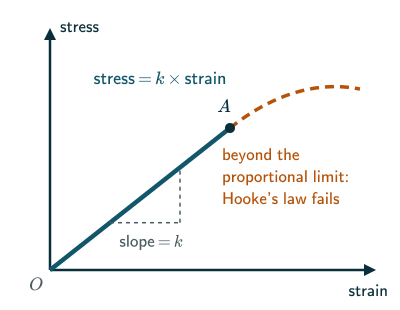
Where Hooke’s law fails
Hooke’s law is an empirical law and is found to be valid for most materials. However, there are some materials which do not exhibit this linear relationship.
NCERT Physics Part II (Class 11), Section 8.3, page 169
“Empirical” means the law was established from experiment. A linear approximation near a stable microscopic equilibrium can also explain why it often works; experiment still determines its range and modulus. It has two kinds of limit:
- Too large a deformation. Even for metals, the straight-line relation holds only up to the proportional limit (point A in the figure). Beyond it the stress-strain graph curves. Up to the elastic limit (point B, the yield point, in NCERT Fig. 8.2, Section 8.4, page 169), the body still returns to its original dimensions when unloaded. For metals A and B are close, so many books loosely say Hooke’s law holds “within the elastic limit”. Strictly, it holds up to the proportional limit; in a multiple-choice question, pick “proportional limit” if it is offered.
- Materials that are nonlinear over a broad range. Rubber can be pulled to several times its length and still recover. NCERT Fig. 8.3 (Section 8.4, page 170) shows that the elastic tissue of the aorta, though elastic over a very large range, does not obey Hooke’s law over most of it. NCERT calls such materials elastomers. Some rubber specimens can still have an approximately linear response over a sufficiently small strain interval; the warning concerns using one constant over their large recoverable stretches.
Solved examples
Example 1: Scaling the load
A wire stretches by 0.40 mm under a load of 20 N. Assuming Hooke’s law holds, by how much does it stretch under 50 N? Under 35 N?
The extension is proportional to the load: 0.40 × 50/20 = 1.00 mm, and 0.40 × 35/20 = 0.70 mm.
Answer: 1.00 mm and 0.70 mm.
Example 2: Finding the modulus
A steel wire carries a stress of 1.25 × 10 Pa and its strain is 6.0 × 10. Find its modulus of elasticity.
k = stress/strain = 1.25 × 10/(6.0 × 10), about 2.08 × 10 Pa.
Answer: about 2.1 × 10 Pa, typical of steel.
Example 3: A steel wire as a spring
A steel wire is 2.0 m long and 1.0 mm in diameter, and the modulus of steel is 2.0 × 10 Pa. Find its spring constant, and the extension under a 98 N load.
A = π(0.5 × 10), about 7.85 × 10 m. Then the spring constant is ks = kA/L = 2.0 × 10 × 7.85 × 10/2.0, about 7.85 × 10 N m.
The extension under 98 N is 98/(7.85 × 10), about 1.25 × 10 m.
Answer: about 7.85 × 10 N m; about 1.25 mm. (It takes about 78.5 N to stretch this wire by 1 mm.)
Example 4: Testing Hooke’s law from data
A wire is loaded in steps. The loads (in N) and extensions (in mm) are: 0 and 0, 10 and 0.50, 20 and 1.00, 30 and 1.50, 40 and 2.30. Up to what load does the wire obey Hooke’s law?
Up to 30 N, extension/load is 0.050 mm per newton every time, so the extension is proportional to the load. At 40 N, Hooke’s law would give 0.050 × 40 = 2.00 mm, but the wire stretched 2.30 mm, 0.30 mm more.
Answer: up to at least 30 N; somewhere between 30 N and 40 N the wire passed its proportional limit.
Common mistakes to avoid
Common mistake
Confusing the modulus with the spring constant
The modulus k in stress = k × strain is in Pa and depends only on the material (for a given kind of stress). The spring constant in F = −kx is in N m and also depends on the length and thickness of the sample.
Common mistake
Applying Hooke’s law to large deformations
It holds only up to the proportional limit. Beyond it, doubling the load does not double the stretch.
Common mistake
Using the total length instead of the extension
In F = −kx and F = ksΔL, x and ΔL are the changes in length, not the stretched length.
Common mistake
Thinking Hooke’s law holds for all materials
It is an empirical law. Rubber, for example, is elastic over large stretches but does not follow a straight line.
Quick revision summary
- Hooke’s law: for small deformations, stress is proportional to strain.
- The constant of proportionality, the modulus of elasticity, is a property of the material, with unit Pa.
- For a spring, F = −kx, with k the spring constant in N m; a wire acts as a spring of constant ks = kA/L, where k is the modulus.
- The law is empirical. It holds only up to the proportional limit, and elastomers such as rubber are nonlinear over much of their large elastic range.
- In short: stress = k × strain for the material, and F = −kx for a spring.
Formula sheet
- Stress = k × strain (k = modulus of elasticity, in Pa)
- F = −kx (spring; k = spring constant, in N m)
- F = ks ΔL, ks = kA/L (wire of length L and cross-section A)
Questions students ask
Is the modulus of elasticity the same as Young’s modulus?
The modulus of elasticity is not always the same as Young’s modulus: it is the general name for the ratio of stress to strain, and Young’s modulus is the modulus of elasticity for stretching or compression. A solid has three: Young’s modulus Y for a change of length, the shear modulus or modulus of rigidity G for a change of shape, and the bulk modulus B for a change of volume, all measured in pascals (elastic moduli). In engineering books, however, “modulus of elasticity” or “elastic modulus” E usually means Young’s modulus, so for steel E = Y ≈ 2.0 × 10 Pa.
Why does Hooke’s law for a spring have a minus sign?
The minus sign in Hooke’s law for a spring, F = −kx, shows that the restoring force always points opposite to the displacement x from the natural length: stretch the spring and it pulls back, compress it and it pushes out. The spring constant k itself is always positive. The elementary stress form here uses matched magnitudes. With a signed uniaxial convention, tensile stress and strain are both positive and compressive stress and strain both negative, so σ = Yε still has a positive modulus. Positive pressure with signed negative volume strain instead requires a minus sign in the bulk-modulus relation.
Why does Hooke’s law hold only for small deformations?
Hooke’s law holds only for small deformations because the force between neighbouring atoms is proportional to their displacement only when that displacement is small. Near the normal separation, where attraction and repulsion balance, the potential energy of a pair of atoms is very nearly a parabola, so the restoring force is very nearly −(constant) × displacement (why solids spring back). In many metals plastic slip ends the useful linear range before large bond stretches occur. The limiting strain depends on alloy and treatment: about 0.1–0.2% is an illustration for some textbook metals, not a universal boundary.
Where is Hooke’s law used in real life?
Hooke’s law is used wherever an elastic part measures or controls a force. A spring balance has an evenly spaced scale because its extension is proportional to the load, and the hairspring of a mechanical watch gives a restoring torque proportional to the angle turned by the balance wheel, which keeps its swings regular. Engineers also design buildings, bridges and machine parts so that their stresses stay well inside the range where Hooke’s law holds, so that every deformation stays small and is fully recovered.
Practice questions
Try each question first, then open the answer to check your working.
-
Q1. A spring obeys Hooke’s law. A load of 4 N stretches it by 2 cm. What load stretches it by 5 cm?
Show answerHide answer
The load is proportional to the extension: 4 × 5/2 = 10 N.
-
Q2. Wires A and B are made of the same material. A is twice as long as B and has twice its diameter. They carry equal loads. Compare their extensions.
Show answerHide answer
ΔL = FL/(kA). A has twice the length and four times the area, so its extension is 2/4 = ½ of B’s.
-
Q3. Why is the modulus of elasticity measured in Pa while a spring constant is measured in N m?
Show answerHide answer
The modulus is stress divided by strain; strain has no unit, so the modulus has the unit of stress, Pa (N m). A spring constant is force divided by extension, so it is in N m, and it depends on the size and shape of the spring as well as its material.