Elastic moduli
NCERT Class 11 Physics Chapter 8 Section 8.5
Quick answer
An elastic modulus is the ratio of stress to strain in the proportional region: Young’s modulus Y = FL/(AΔL) for stretching, the shear modulus G ≈ F/(Aθ) for small-angle shearing and the bulk modulus B = −p/(ΔV/V) for squeezing, all in pascal. Poisson’s ratio is minus signed lateral strain divided by longitudinal strain, or the positive contraction ratio in NCERT’s notation. A stretched wire stores elastic energy ½ × stress × strain per unit volume.
With your textbook
NCERT Physics Part II (Class 11), Chapter 8 “Mechanical Properties of Solids”, Section 8.5 “Elastic moduli”, pages 170–174.
Open the official NCERT chapter (PDF, 1.2 MB, ncert.nic.in) (opens in a new tab)
Checked against the 2026-27 reprint on .
What are elastic moduli?
Within the proportional region of the stress-strain curve, the ratio of stress to strain is a constant for a material, called its modulus of elasticity (NCERT Section 8.5, page 170). For the elementary homogeneous, isotropic model, three common moduli describe these loading modes; anisotropic materials need additional directional elastic constants:
The three elastic moduli
- Young’s modulus Y = tensile (or compressive) stress / longitudinal strain;
- Shear modulus (modulus of rigidity) G = shearing stress / shearing strain;
- Bulk modulus B = hydraulic stress / volume strain, with a minus sign: B = −p/(ΔV/V).
All three are measured in N m or pascal (Pa), with dimensions [MLT], because strain has no unit.
In plain words: a modulus says how hard a material is to deform in a particular way. A large Young’s modulus means a wire is hard to stretch; a large shear modulus means a block is hard to shear (its top face pushed sideways relative to the bottom); a large bulk modulus means a body is hard to squeeze into a smaller volume. Two more ideas belong here: Poisson’s ratio, which links stretching to thinning, and the elastic potential energy stored in a stretched wire.
| Modulus | Formula | Changes |
|---|---|---|
| Young’s, Y | FL/(AΔL) | length |
| Shear, G | F/(Aθ) | shape |
| Bulk, B | −p/(ΔV/V) | volume |
Young’s and shear moduli apply only to solids; the bulk modulus applies to solids, liquids and gases (after NCERT Table 8.4, page 173).
Young’s modulus
The ratio of tensile (or compressive) stress (σ) to the longitudinal strain (ε) is defined as Young’s modulus and is denoted by the symbol Y.
NCERT Physics Part II (Class 11), Section 8.5.1, page 170
With stress F/A and strain ΔL/L (see stress and strain):
Young’s modulus
In the small linear range, the model gives equal strain magnitudes for equal tensile and compressive stress magnitudes, so one Y serves for both (NCERT, page 170). The laboratory experiment to measure Young’s modulus of a wire applies this formula, with F = Mg and A = πr.
Some values from NCERT Table 8.1 (page 170), in units of 10 N m (GPa): aluminium 70, copper 110, iron 190, steel 200, glass 65, concrete 30, wood 13, bone 9.4, polystyrene 3. Metals have large Young’s moduli, so they need a large force for a small change in length; that is why steel, with the largest value here, is preferred in heavy machines and buildings, and why NCERT calls steel “more elastic” than copper, brass and aluminium (page 171). In NCERT’s comparison, “more elastic” means a larger modulus, or greater stiffness: steel is more elastic than rubber, though rubber stretches more, and a perfectly rigid body would have an infinite Y. NCERT’s Points to Ponder (page 177) also says that metals have larger Young’s moduli than alloys; its own Table 8.1 shows steel, an alloy of iron, slightly above iron, so treat that only as a loose remark.
Shear modulus
The ratio of shearing stress to the corresponding shearing strain is called the shear modulus of the material and is represented by G. It is also called the modulus of rigidity.
NCERT Physics Part II (Class 11), Section 8.5.2, page 172
Shear modulus
Here F acts along a face of area A, Δx is how far that face moves relative to the opposite face, L is the distance between them, and θ is the angle of shear in radians (for small angles, Δx/L = tan θ ≈ θ). Some values from NCERT Table 8.2 (page 172), in GPa: aluminium 25, copper 42, lead 5.6, steel 84, tungsten 150, wood 10.
The shear modulus is generally less than Young’s modulus; NCERT gives G ≈ Y/3 as a rule of thumb (page 172). It is rough: the tables give Y/G of about 2.4 for steel, 2.6 for copper and 2.8 for aluminium.
Bulk modulus and compressibility
The ratio of hydraulic stress to the corresponding hydraulic strain is called bulk modulus. It is denoted by symbol B.
NCERT Physics Part II (Class 11), Section 8.5.3, page 173
Bulk modulus
Here p is the increase in pressure, Δp. An increase of pressure makes the volume decrease, so ΔV is negative; the minus sign makes B positive. The reciprocal of B is the compressibility (NCERT writes it k), the fractional decrease in volume per unit increase in pressure:
Compressibility
Some values from NCERT Table 8.3 (page 173), in GPa: steel 160, copper 140, aluminium 72, glass 37; water 2.2, mercury 25, glycerine 4.76; air at STP 1.0 × 10. For the materials and conditions in these tables, solids have larger bulk moduli than liquids and air has the smallest: gases are about a million times more compressible than solids (NCERT, page 174). Atoms in a solid are tightly coupled to their neighbours, molecules in a liquid less so, and molecules in a gas hardly at all.
Poisson’s ratio
A stretched wire gets thinner as well as longer. The strain at right angles to the force is the lateral strain. In the small linear elastic range it is proportional to the longitudinal strain, and their ratio is Poisson’s ratio (NCERT Section 8.5.4, page 174). For a wire of diameter d that thins by Δd while its length L grows by ΔL:
Poisson’s ratio
Here Δd denotes the positive decrease in diameter, matching NCERT’s notation. If lateral strain is instead signed as (final diameter − original diameter)/original diameter, the general definition is ν = −(lateral strain)/(longitudinal strain). This sign also permits auxetic materials, which widen on stretching and have negative ν.
Poisson’s ratio is a ratio of two strains; it is a pure number and has no dimensions or units.
NCERT Physics Part II (Class 11), Section 8.5.4, page 174
Its value depends only on the material: between 0.28 and 0.30 for steels and about 0.33 for aluminium alloys (NCERT, page 174). Beyond the NCERT text: for ordinary materials it lies between 0 and 0.5 (for stable isotropic linear elastic materials with finite positive bulk and shear moduli, −1 < ν < ½); rubber is close to 0.5, which means its volume hardly changes when it is stretched.
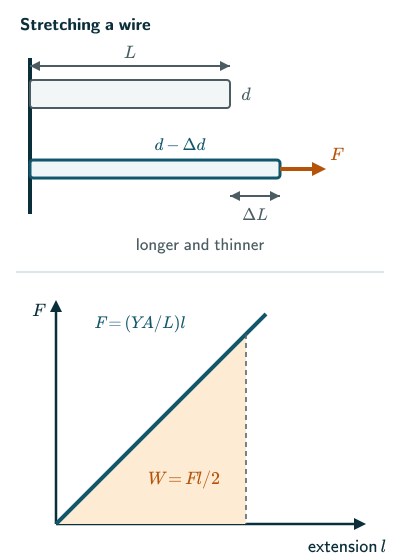
Elastic potential energy in a stretched wire
When a wire is put under a tensile stress, work is done against the inter-atomic forces. This work is stored in the wire in the form of elastic potential energy.
NCERT Physics Part II (Class 11), Section 8.5.5, page 174
Let a wire of length L and cross-section A be stretched by an amount l (NCERT uses l here for the extension, ΔL above). From the definition of Y, the force at an extension x is YAx/L, which grows in proportion to x. The work done in stretching it from 0 to l, as for any variable force, is the area under the force-extension line:
with F = YAl/L the final force: that is, ½ × stress × strain × volume. This is the same form as the ½kx of a spring, with k = YA/L. Per unit volume:
Elastic energy per unit volume
Since σ = Yε, this can also be written u = σ/(2Y) = ½Yε.
Solved examples
The first five are NCERT Examples 8.1 to 8.5 (pages 171–174). Examples 1–3 use Young’s modulus, Example 4 the shear modulus, Example 5 the bulk modulus and Example 6 the elastic energy; Poisson’s ratio is practised in Q3. Take g = 9.8 m s unless stated.
Example 1: A steel rod under a 100 kN pull
A structural steel rod of radius 10 mm and length 1.0 m is stretched along its length by 100 kN. Find the stress, the elongation and the strain. Young’s modulus of the steel is 2.0 × 10 N m.
Stress = F/(πr) = 100 × 10/(3.14 × 10), about 3.18 × 10 N m.
Elongation ΔL = (F/A)L/Y = 3.18 × 10 × 1.0/(2.0 × 10), about 1.59 × 10 m.
Strain = ΔL/L = 1.59 × 10, about 0.16%.
Answer: 3.18 × 10 N m; 1.59 mm; 0.16%. (This stress is above the 2.5 × 10 N m yield strength NCERT Table 8.1 lists for steel, though below its 4.0 × 10 N m ultimate strength. The Hooke’s-law answer holds only for a steel that is still in its linear proportional range at this stress.)
Example 2: Copper and steel wires end to end
A copper wire 2.2 m long and a steel wire 1.6 m long, both 3.0 mm in diameter, are joined end to end. A load stretches the pair by 0.70 mm in all. Find the load. Take Y = 1.1 × 10 N m for copper and 2.0 × 10 N m for steel.
Both wires carry the same tension W and have the same area A, so W/A = YcΔLc/Lc = YsΔLs/Ls. Hence
since (2.0/1.1) × (2.2/1.6) = 2.5. With ΔLc + ΔLs = 0.70 mm, ΔLs = 0.70/3.5 = 0.20 mm and ΔLc = 0.50 mm. Then W = AYcΔLc/Lc = π(1.5 × 10) × 1.1 × 10 × 5.0 × 10/2.2, about 177 N.
Answer: about 1.8 × 10 N.
Example 3: A thighbone under load
In a circus human pyramid the whole group is supported by the legs of a 60 kg performer lying on his back. The combined mass of all the performers (including him), tables and plaques is 280 kg. Each of his thighbones is 50 cm long with an effective radius of 2.0 cm. By how much is each compressed? Young’s modulus of bone is 9.4 × 10 N m (NCERT Table 8.1).
The supported mass is 280 − 60 = 220 kg, of weight 220 × 9.8 = 2156 N, so each thighbone carries 1078 N. A = π(2.0 × 10), about 1.257 × 10 m.
ΔL = FL/(YA) = 1078 × 0.5/
Answer: about 4.6 × 10 m (NCERT gives 4.6 × 10 m), a fractional decrease of only about 0.009%.
Example 4: Shearing a lead slab
A square lead slab of side 50 cm and thickness 10 cm has its lower edge riveted to the floor. A shearing force of 9.0 × 10 N acts on its narrow face. How far does the upper edge move? Take G = 5.6 × 10 N m for lead.
The force acts along a face of area 0.50 m × 0.10 m = 0.05 m, so the shearing stress is 9.0 × 10/0.05 = 1.8 × 10 N m. The slab stands on one narrow face, which is riveted to the floor; the force acts along the opposite narrow face, L = 0.50 m above it (NCERT Fig. 8.5). The displacement is Δx = stress × L/G = 1.8 × 10 × 0.5/(5.6 × 10), about 1.6 × 10 m.
Answer: about 0.16 mm.
Example 5: Water at the bottom of the ocean
The average depth of the Indian Ocean is about 3000 m. Find the fractional compression of water at the bottom. Take B = 2.2 × 10 N m for water and g = 10 m s.
The pressure of the water column is hρg = 3000 × 1000 × 10 = 3 × 10 N m. Then the fractional compression is −ΔV/V = p/B = 3 × 10/(2.2 × 10), about 1.36 × 10 (the volume decreases).
Answer: about 1.36%.
Example 6: Energy in a stretched steel wire
A steel wire 2.0 m long, of cross-section 1.0 mm, is stretched by 1.0 mm. Find the force needed and the energy stored. Take Y = 2.0 × 10 N m.
F = YAl/L = 2.0 × 10 × 1.0 × 10 × 1.0 × 10/2.0 = 100 N, and W = ½Fl = ½ × 100 × 1.0 × 10 = 0.05 J.
Check per unit volume: stress 1.0 × 10 N m, strain 5.0 × 10, so u = ½σε = 2.5 × 10 J m; times the volume 2.0 × 10 m, this is 0.05 J.
Answer: 100 N; 0.05 J.
Printing slips in NCERT Section 8.5. Several cross-references in NCERT’s text still carry numbers from an older edition: Examples 8.2 and 8.3 cite “Table 9.1” for Table 8.1, Example 8.3 cites “Eq. (9.8)” for Eq. (8.8), and Section 8.5.2 cites “Eq. (9.4)”, “Table 9.2” and “Table 9.1” for Eq. (8.4), Table 8.2 and Table 8.1. Equation number (8.12) is used twice, for σs = Gθ and for the bulk modulus. Section 8.5.3 refers to hydraulic stress as seen “in Section (8.3)”; it was Section 8.2. In Example 8.4 the working uses 9.4 × 10 N, though the question gives 9.0 × 10 N; the printed result, 1.80 × 10 N m, matches 9.0 × 10 N, as used above. The same answer refers to “Fig. 8.6” for the slab, which is printed as Fig. 8.5, and the equation numbers jump from (8.8) to (8.10).
Common mistakes to avoid
Common mistake
Using the diameter as the radius
For a wire of diameter d, A = πd/4. In Example 2 the 3.0 mm diameter gives a radius of 1.5 mm.
Common mistake
Thinking a modulus depends on the size of the sample
Y, G and B are properties of the material. A thicker or shorter wire stretches less, but its Young’s modulus is the same.
Common mistake
Dropping the minus sign in the bulk modulus
ΔV is negative when the pressure rises, so B = −p/(ΔV/V) is positive. A negative bulk modulus is a sign error.
Common mistake
Using the full Fl for the stored energy
The force grows from 0 to F as the wire stretches, so the work is the area of a triangle, ½Fl, not Fl. If a constant load Mg is suddenly released from rest on an initially unstretched wire and later settles through damping at l, gravity does work Mgl, while ½Mgl is stored and the remainder is dissipated. Without damping it oscillates instead; during slow controlled loading an external agent can remove energy, so the same heat-loss claim does not apply.
Common mistake
Using the wrong area for shear
In G = F/(Aθ), A is the area of the face along which the force acts, as in Example 4.
Quick revision summary
- A modulus of elasticity is stress/strain in the proportional region; unit Pa, dimensions [MLT].
- Young’s modulus Y = FL/(AΔL); metals have large Y, and steel has the largest value in NCERT Table 8.1.
- For small shear angles, G ≈ F/(Aθ); for common metals NCERT’s rough rule is G ≈ Y/3 (its steel, copper and aluminium values give Y/G ≈ 2.4–2.8).
- Bulk modulus B = −p/(ΔV/V); compressibility = 1/B; solids are least compressible, gases most.
- Poisson’s ratio is minus signed lateral strain divided by longitudinal strain; NCERT instead uses a positive diameter contraction. It is dimensionless, about 0.3 for many metals.
- Elastic energy stored in a stretched wire = ½ × stress × strain × volume; per unit volume u = ½σε.
Formula sheet
- Y = σ/ε = FL/(AΔL)
- G = (F/A)/(Δx/L) ≈ F/(Aθ) (small θ)
- B = −p/(ΔV/V); compressibility k = 1/B
- Poisson’s ratio = (Δd/d)/(ΔL/L) (Δd = diameter decrease)
- W = ½Fl = YAl/(2L); u = ½σε
Questions students ask
How are Young’s modulus, shear modulus, bulk modulus and Poisson’s ratio related?
For a homogeneous isotropic material in the linear elastic range, with the same properties in every direction, Young’s modulus Y, the shear modulus G, the bulk modulus B and Poisson’s ratio ν are linked by Y = 2G(1 + ν) and Y = 3B(1 − 2ν), so only two of the four are independent (a result beyond the NCERT text). With ν ≈ 0.3, typical of metals, these give G ≈ Y/2.6, within the 2.4–2.8 of NCERT’s tables, and B ≈ Y/1.2; for steel, Y = 200 GPa gives B ≈ 170 GPa, close to NCERT’s 160 GPa. Since G and B must be positive, ν lies between −1 and ½, and a material with ν close to ½, such as rubber, is very hard to compress compared with how easily it stretches.
What is the bulk modulus of a gas?
The bulk modulus of an ideal gas equals its pressure p for an isothermal compression and γp for a reversible adiabatic compression, where γ = Cp/Cv. Slow compression with good thermal contact can approximate the first process; negligible heat exchange and near-equilibrium compression approximate the second. Speed alone does not specify the thermodynamic path. So air at atmospheric pressure has an isothermal bulk modulus of about 1.0 × 10 Pa, the value in NCERT Table 8.3, and an adiabatic one of about 1.4 × 10 Pa, about a millionth of the bulk moduli of metals. The adiabatic value is the one that sets the speed of sound in a gas.
How much does a rod or wire stretch under its own weight?
A uniform rod or wire hanging from one end stretches under its own weight by ΔL = ρgL/(2Y) = MgL/(2AY), half as much as if its whole weight Mg hung from its lower end. This is because the tension at each point is the weight of the part below it, so the stress grows steadily from zero at the bottom to ρgL at the top, and the average stress is half the greatest. For example, a steel wire 50 m long, with ρ = 7.8 × 10 kg m and Y = 2.0 × 10 N m, stretches by 7.8 × 10 × 9.8 × 50/(4.0 × 10) ≈ 0.48 mm under its own weight, whatever its thickness.
What is the equivalent Young’s modulus of two wires joined end to end or side by side?
For two wires of equal length and equal cross-section, the equivalent Young’s modulus is (Y1 + Y2)/2 when they hang side by side and share the load, and 2Y1Y2/(Y1 + Y2) when they are joined end to end. Side by side they stretch equally, like springs in parallel, so their spring constants add; end to end they carry the same tension, like springs in series, so their extensions add. For copper (1.1 × 10 Pa) and steel (2.0 × 10 Pa) these give about 1.55 × 10 Pa and 1.42 × 10 Pa.
Are Poisson’s ratio and elastic energy in the JEE Main and NEET syllabus?
Poisson’s ratio and the elastic energy of a stretched wire are not named in the official JEE Main 2027 or NEET (UG) 2026 syllabus, whose Unit 7 lists elastic behaviour, the stress-strain relationship, Hooke’s law, Young’s modulus, bulk modulus and modulus of rigidity. Both are in NCERT Sections 8.5.4 and 8.5.5, and the stored energy, ½ × stress × strain per unit volume, follows directly from Young’s modulus and the work done by a variable force, so learn them with the rest of Section 8.5.
Practice questions
Try each question first, then open the answer to check your working.
-
Q1. Two wires of the same material carry equal loads. One has length L and radius r; the other has length 2L and radius 2r. Compare their extensions.
Show answerHide answer
ΔL = FL/(AY) ∝ L/r. The first gives L/r; the second 2L/(4r) = ½ × L/r. The first stretches twice as much as the second.
-
Q2. By how much does the volume of 1.0 litre of water decrease when the pressure on it rises by 1.0 × 10 Pa? Take B = 2.2 × 10 Pa.
Show answerHide answer
ΔV = −Vp/B = −1.0 × 10 × 1.0 × 10/(2.2 × 10), about −4.5 × 10 m: a decrease of about 4.5 cm.
-
Q3. A steel wire 2.0 m long and 1.0 mm in diameter is stretched by 1.0 mm. Taking Poisson’s ratio as 0.30, by how much does its diameter decrease?
Show answerHide answer
Longitudinal strain = 1.0 × 10/2.0 = 5.0 × 10, so lateral strain = 0.30 × 5.0 × 10 = 1.5 × 10. Δd = 1.5 × 10 × 1.0 mm = 1.5 × 10 mm, about 0.15 µm.