Work done by a variable force
NCERT Class 11 Physics Chapter 5 Section 5.5
Quick answer
For a force that changes with position, the work done is the area under the force–displacement graph, which is the definite integral W = ∫F(x)dx from the initial to the final position. For motion along +x, area below the x-axis, where the force opposes the motion, counts as negative work. For a spring stretched slowly from its natural length by x, the stretching force is kx and does ½kx2 of work; the spring’s own force, −kx, does −½kx2.
With your textbook
NCERT Physics Part I (Class 11), Chapter 5 “Work, Energy and Power”, Section 5.5 “Work done by a variable force”, pages 75–76.
Open the official NCERT chapter (PDF, 2.0 MB, ncert.nic.in) (opens in a new tab)
Checked against the 2026-27 reprint on .
How do you find the work done by a variable force?
Work done by a variable force in NCERT’s words
Thus, for a varying force the work done can be expressed as a definite integral of force over displacement (see also Appendix 3.1).
NCERT Physics Part I (Class 11), Section 5.5, page 75
In plain words: when the force changes as the body moves, you cannot simply multiply one force by the distance. Instead, cut the motion into many tiny steps, treat the force as constant over each step, add up the small pieces of work, and let the steps shrink to zero. The result is the area under the force–displacement graph, which in calculus is a definite integral.
For a force F(x) acting along the x-axis, as a body moves from xi to xf:
Work done by a variable force
A constant force is the special case where the graph is a horizontal line and the area is just a rectangle, F × (xf − xi).
Work as the area under the graph
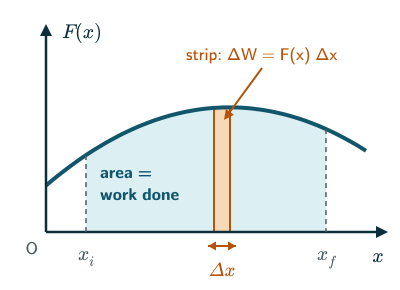
Over a very small displacement Δx, the force hardly changes, so the work done is close to that of a constant force:
If the displacement ∆x is small, we can take the force F(x) as approximately constant and the work done is then ∆W =F(x) ∆x
NCERT Physics Part I (Class 11), Section 5.5, page 75
On a graph of F against x, this small piece of work is the area of a thin rectangle of height F(x) and width Δx. Adding all such strips from xi to xf gives approximately the total work:
As the strips are made thinner (Δx → 0), their number grows without limit, but the sum approaches a definite value: the exact area under the curve. That limit is the integral above:
Two rules make the graph method reliable:
- Area below the x-axis counts as negative (for motion along +x). Where the force points against the displacement, it does negative work. Add the areas with their signs. If x decreases instead, integrate from xi to xf and the signs take care of themselves.
- Use simple shapes when you can. A graph made of straight lines splits into rectangles, triangles and trapeziums, so no calculus is needed.
Work as an integral
When the force is given as a formula, integrate it. For a force that is a power of x:
for n ≠ −1, on an interval where the power is real and the integral exists. Do not apply endpoint substitution across a singularity without checking convergence. Integrate a sum term by term, and take constant factors outside the integral. The work is the value of the result at xf minus its value at xi.
For example (see the potential energy of a spring for the full working), the force needed to stretch a spring slowly is F = kx when the stretch is x, so the work done by this stretching force in stretching it from 0 to xm is
which is the area of the triangle under the straight-line graph. The spring’s own force, −kx, does over the same stretch. Stretching from x1 to x2 needs , not .
In two dimensions, the work of a variable force along a path is the sum of its component contributions, with both integrals evaluated along that same actual path:
For example, the force N does 1 + 1 = 2 J of work as a body moves from (0, 0) to (1, 1) m. In this example each component depends only on its own coordinate, so the result is path-independent; that is not true for every two-dimensional force.
Where variable forces appear
- Springs and elastic cords. The force grows with the stretch, so the work done is the area of a triangle, not a rectangle.
- Pushing when tired. NCERT Example 5.5 (page 76) has a woman push a trunk with 100 N for 10 m, after which her push falls steadily to 50 N over the next 10 m. Her work is a rectangle, 100 × 10 or 1000 J, plus a trapezium, or 750 J, in all 1750 J. Friction of 50 N, drawn on the negative side of the force axis, does (−50) × 20, that is −1000 J, over the 20 m.
- Gravity far from the Earth. The pull of gravity weakens with distance, so the work done in launching a satellite needs an integral.
- Engines and gas in a cylinder. The push of the gas on a piston changes as it expands, and the work is the area under the pressure–volume graph.
Solved examples
Example 1: Work from a force–displacement graph
A body moves along +x from x = 0 to x = 9 m. The force on it, along x, rises linearly with position from 0 to 20 N over the first 4 m, stays at 20 N for the next 3 m, and then falls linearly with position to zero over the last 2 m. Find the total work done.
Split the area under the graph into a triangle, a rectangle and a second triangle:
Answer: the total work is 40 + 60 + 20, that is 120 J.
Example 2: Work from a force formula
A force F = 3x2 N, with x in metres, acts along the x-axis. Find the work done as the body moves from x = 1 m to x = 3 m.
Answer: 26 J.
Example 3: A force that changes sign
A force F = (6 − 2x) N acts along the x-axis. Find the work done from x = 0 to x = 4 m, and explain the answer using the graph.
By integration:
From the graph: the force is a straight line that crosses zero at x = 3 m. From 0 to 3 m it is positive: a triangle of area , that is 9 J. From 3 to 4 m it is negative, reaching −2 N: a triangle of area , which counts as −1 J.
Answer: 8 J, which is 9 J of positive work minus 1 J of negative work.
Common mistakes to avoid
Common mistake
Multiplying the final force by the distance
For a variable force, W is not Ffinal × d or Finitial × d. Find the area, or integrate. For a force that changes linearly with position (a straight-line F–x graph), the average of the first and last values times the displacement gives the right answer; for a curved graph it generally does not.
Common mistake
Ignoring area below the axis
For motion along +x, a graph below the x-axis represents a force opposing the displacement, so its work is negative. In Example 3, adding the two triangles as 9 + 1 gives 10 J instead of 8 J.
Common mistake
Using the area under a force–time graph
The area under a force–time graph is the impulse (equal to the change in momentum when F is the net force), not the work. Work is the area under a force–displacement graph.
Quick revision summary
- For a force that changes with position, split the motion into small steps over which the force is nearly constant.
- Each step contributes F(x) Δx; the total work is the limit of the sum, the definite integral of F over x.
- For motion along +x, work is the signed area under the force–displacement curve, with area below the axis negative; reverse the limits when x decreases.
- Straight-line graphs split into rectangles, triangles and trapeziums; formulas such as F = kx are integrated.
Formula sheet
- W = ∫F(x)dx from xi to xf
- ΔW ≈ F(x) Δx (one small step)
- W = area under the F–x graph
- W = ½kxm2 (stretching a spring from 0 to xm)
Questions students ask
What is the difference between the work done by a constant force and by a variable force?
A constant force does W = Fd cos θ, the area of a rectangle of height F cos θ and width d on the force–displacement graph. When the force changes with position, the work is found by adding up F Δx over many small steps:
This is the signed area under the force–position curve. A constant force is just the special case of a horizontal line on that graph.
Is the work done by a variable force always positive?
No, the work done by a variable force can be negative or zero. At each point the force does positive work if it points along the displacement and negative work if it points against it, so for motion along +x the area below the x-axis of the force–displacement graph counts as negative. For example, a spring’s own force does −½kx of work while the spring is stretched by x from its natural length.
How much work is needed to pull a hanging chain back onto a table?
Pulling a uniform chain of mass M and length L slowly back onto a smooth table, when a length L/n hangs over the edge, needs work W = MgL/(2n). The force needed is the weight of the part still hanging, (M/L)gy when a length y hangs, so it falls as the chain comes up, giving
for the total work. The same answer follows from raising the hanging part, of mass M/n, through L/(2n), the depth of its centre of mass.
Practice questions
Try each question first, then open the answer to check your working.
-
Q1. A force F = (10 + 0.5x) N acts on a body as it moves from x = 0 to x = 4 m. Find the work done.
Show answerHide answer
-
Q2. A force rises linearly with position from 10 N to 30 N while a body moves 5 m along it. Find the work done.
Show answerHide answer
The graph is a trapezium:
-
Q3. A force F = 2/x2 N acts along the x-axis. Find the work it does from x = 1 m to x = 2 m.
Show answerHide answer